
 Bitcoin
  Ethereum
  Tether
  BNB
BNB  XRP
XRP  USDC
USDC  Solana
  TRON
TRON  Lido Staked Ether
  Figure Heloc
Prior month 6.542M revised to 6.550MJOLTs Job openings for January 6.946MM vs 6.700 M estimate.Hires 5.294M vs 5.272M prior (revised)Separations 5.105M vs 5.203M prior (revised)Quits 3.137M vs 3.225M prior (revised)Layoffs and discharges 1.631M vs 1.666M (revised)For 2025 what did the numbers do?Job openings: Annual average 7.1 million in 2025, down 571K from 2024; openings rate 4.3% vs 4.6% in 2024.Hires: 63.0 million in 2025, down 1.5 million from 2024; hires rate 3.3% (down from 3.4%).Total separations: 62.8 million, down 251K from 2024; separations rate 3.3% (unchanged).Quits: 38.0 million, down 1.3 million, accounting for 60.6% of total separations; quits rate 2.0%.Layoffs and discharges: 21.2 million, up 1.2 million, accounting for 33.8% of separations; rate 1.1%.Other separations: 3.5 million, down 224K, accounting for 5.6% of separations; rate 0.2%.Economic trends from the 2025 JOLTS dataJob openings: The decline to 7.1 million (from 7.7M in 2024) suggests the labor market is cooling and demand for workers is easing. Firms appear less aggressive in posting new jobs, consistent with slower economic momentum and tighter financial conditions.Hires: The drop in hires to 63.0 million (-1.5M YoY) indicates companies are becoming more cautious about bringing on new workers. This typically reflects moderating business expansion and a more balanced labor market after the tight conditions of the post-pandemic period.Total separations: With separations slightly lower and the rate unchanged at 3.3%, the data suggests overall labor turnover is stabilizing. Workers are moving between jobs less frequently than during the peak of the labor market boom.Quits: The decline in quits to 38.0 million (-1.3M) signals reduced worker confidence in finding better opportunities. Economically, the quits rate is often seen as a proxy for labor market strength, so the drop points to less worker bargaining power and slower wage pressure.Layoffs and discharges: The increase to 21.2 million (+1.2M) indicates some normalization in layoffs after historically low levels in prior years. While not signaling a sharp deterioration, it shows firms are becoming more willing to reduce headcount as demand moderates.Other separations: The decline to 3.5 million suggests little structural shift in retirements or other exits, reinforcing the view that most of the labor market adjustment is occurring through fewer hires and fewer voluntary quits rather than mass layoffs.What is the JOLT Job Openings Report?For background, the Job Openings and Labor Turnover Survey, published monthly by the U.S. Bureau of Labor Statistics, provides comprehensive data on labor market dynamics by tracking job openings, hires, and separations across approximately 16,400 nonfarm establishments nationwide. Released typically on the first Tuesday of each month at 10:00 a.m. ET, the report measures unmet labor demand and became a closely watched indicator after former Federal Reserve Chair Janet Yellen highlighted its importance in 2014. A job opening is defined as a position that is vacant on the last business day of the month, has work available, could start within 30 days, and involves active external recruiting. The survey also breaks down separations into quits, layoffs and discharges, and other separations, offering insights into worker confidence and employer demand. This article was written by Greg Michalowski at investinglive.com. 🔗 Source 💡 DMK Insight Job openings just came in higher than expected, and here’s why that matters: it signals ongoing labor market strength, which could influence Fed policy. The January JOLTs report shows job openings at 6.946 million, surpassing the 6.700 million estimate. This uptick, along with hires at 5.294 million, suggests businesses are still looking to expand despite economic headwinds. For traders, this could mean a continued tightening cycle from the Fed if they perceive the labor market as too hot. Keep an eye on interest rate futures; if the market starts pricing in more hikes, we could see volatility in equities and bonds. However, the revisions to prior months indicate a slight cooling trend in separations and quits, which could hint at a labor market that’s stabilizing rather than overheating. This duality presents a risk: if traders assume the Fed will remain hawkish based solely on the job openings, they might overlook signs of a potential slowdown in hiring momentum. Watch for any shifts in sentiment around the next FOMC meeting, as that could dictate market direction in the short term. 📮 Takeaway Monitor the JOLTs report closely; if job openings continue to rise, expect potential Fed rate hikes that could impact equities and bonds.

USDCAD Technicals: The USDCAD continues the run higher. Target area reached.
USDCAD extends trend-like rally toward key resistanceThe USDCAD has been trending steadily higher since midday yesterday, with the pair staging a strong, trend-like move to the upside. The rally began near 1.3575 and has extended to a session high of 1.3715 in trading today. The advance has unfolded in a clear three-leg structure, with each push higher building on the prior move.The most recent leg higher has also been the steepest, highlighting strong bullish momentum in the short term. As often happens in trending markets, the acceleration in the final leg suggests that buyers have been pressing the move aggressively, forcing short-term traders to cover positions while momentum traders join the upside push.However, the rally has now run directly into a well-defined resistance area, which could determine the next directional move for the pair.Key resistance zone between 1.3715 and 1.3724The high today near 1.3715 is technically significant because it corresponds closely with the high from last Thursday and marks the lower boundary of a swing area between 1.3715 and 1.3724.This zone has proven important repeatedly over the past several weeks. Going all the way back to January 23, multiple rallies have stalled within or near this area, forming a cluster of swing highs that traders now view as a key resistance region.Because of that history, the 1.3715–1.3724 area becomes a major bias-defining level for both buyers and sellers. If the USDCAD is going to extend its rally, the pair will need to break above this resistance zone and stay above it. A sustained move through the area would likely trigger additional upside momentum and force sellers to reassess their positions.Sellers defend resistance—for nowSo far, sellers have leaned against this resistance area on the first test. The inability to immediately push through the level gives bearish traders some confidence that the rally may be losing momentum in the short term.Importantly, this is not the first time the market has struggled here. Since January 23, there have been two prior attempts to break higher, and both lasted only a few hourly bars before the price rotated lower again. That history reinforces the idea that this zone is a difficult barrier for buyers to overcome.For sellers looking for signs that the rally may be exhausting itself, there are additional technical clues worth monitoring. These include short-term momentum shifts, potential failures above resistance, and key intraday support levels that could signal a change in control.What traders should watch nextIn the video above, I take a closer look at the technical signals that sellers may watch for as evidence that the current rally could be nearing an end. At the same time, I outline the levels that buyers must break and hold if they want to keep the upside momentum intact.For now, the 1.3715–1.3724 resistance zone remains the key battleground that will likely determine the next move in USDCAD. This article was written by Greg Michalowski at investinglive.com. 🔗 Source 💡 DMK Insight The USDCAD’s surge to 1.3715 signals a critical resistance test ahead. This rally, starting from 1.3575, reflects broader strength in the Canadian dollar, likely driven by rising oil prices and a robust economic outlook. Traders should note that if USDCAD breaks above 1.3715, it could trigger further bullish momentum, potentially targeting levels not seen in recent months. However, a failure to maintain this upward trajectory could lead to a sharp pullback, especially if the U.S. dollar regains strength amid upcoming economic data releases. Keep an eye on the 1.3700 mark as a psychological level; a close below this could signal a reversal. Also, watch for correlated movements in crude oil prices, as they often influence CAD strength. If oil continues to rally, it could support the Canadian dollar further, reinforcing this trend. Conversely, any signs of weakness in the oil market could lead to a quick correction in USDCAD, making it essential to monitor these dynamics closely. 📮 Takeaway Watch the 1.3715 resistance level on USDCAD; a breakout could lead to further gains, but a close below 1.3700 might signal a reversal.

The US and Cuba are talking
Mexico’s President said she helped to broker talks between the US and Cuba that are now confirmed.Various reports said the talks have started and today Cuban President Miguel Díaz-Canel confirmed his government is holding talks with the Trump administration.”These conversations have been aimed at seeking solutions through dialogue to the bilateral differences that exist between our two nations,” Díaz-Canel said.Trump didn’t tweet directly about talks but posted an article citing talks on Truth Social.The talks are only in the initial phase and Trump previously said they may or may not include “a friendly takeover” of the island.Díaz-Canel said today that no fuel has entered the island in three months.A report last week in USA today said the Trump admin is preparing an economic deal with Cuba that could be announced “soon”, citing two sources with knowledge. It would include a relaxation on Americans ability to travel to Cuba, which is something imposed by the American side.Discussions have included an off-ramp for President Miguel Díaz-Canel, the Castro family remaining on the island and deals on ports, energy and tourism. The U.S. government has floated dropping some sanctions. That sounds a bit like the kind of diplomacy that Trump used in Venezuela, with the threat of killing leadership if talks fail. Ultimately, it will depend on how badly Cuba wants to fight. It has a small (50,000 strong) regular military but depends on guerrilla fighting should the US attack. On the US side, they would likely be hoping to spark some kind of counter-revolution that they could arm.In terms of markets, the impacts here are limited at first blush. If a conflict broke out, it could hurt tourism and cruise ships in the Caribbean and Cuba does have some resources including nickel but it’s hard to see macro impacts. In the bigger macro picture, another US shooting war would further boost the case for gold and hurt the US’ standing amongst allies, depending on the details. This article was written by Adam Button at investinglive.com. 🔗 Source 💡 DMK Insight So, Mexico’s President is stepping in to facilitate talks between the US and Cuba, and here’s why that matters for traders: geopolitical tensions can significantly impact market sentiment, especially in the crypto and forex sectors. As SOL is currently at $86.73, any positive developments from these talks could lead to increased investor confidence in Latin American markets, potentially boosting demand for cryptocurrencies like Solana. But let’s not overlook the flip side—if these talks stall or result in negative outcomes, we could see a sharp sell-off, not just in SOL but across the broader crypto market. Traders should keep an eye on the correlation between SOL and major fiat currencies, particularly the USD, as shifts in policy could lead to volatility. Watch for key resistance levels around $90 and support near $80. If SOL breaks through $90, it could signal a bullish trend, while a drop below $80 might trigger panic selling. In the coming days, monitor news from both the US and Cuba closely, as any updates could create immediate trading opportunities or risks. 📮 Takeaway Watch SOL closely; a break above $90 could signal a bullish trend, while a drop below $80 may trigger selling pressure.
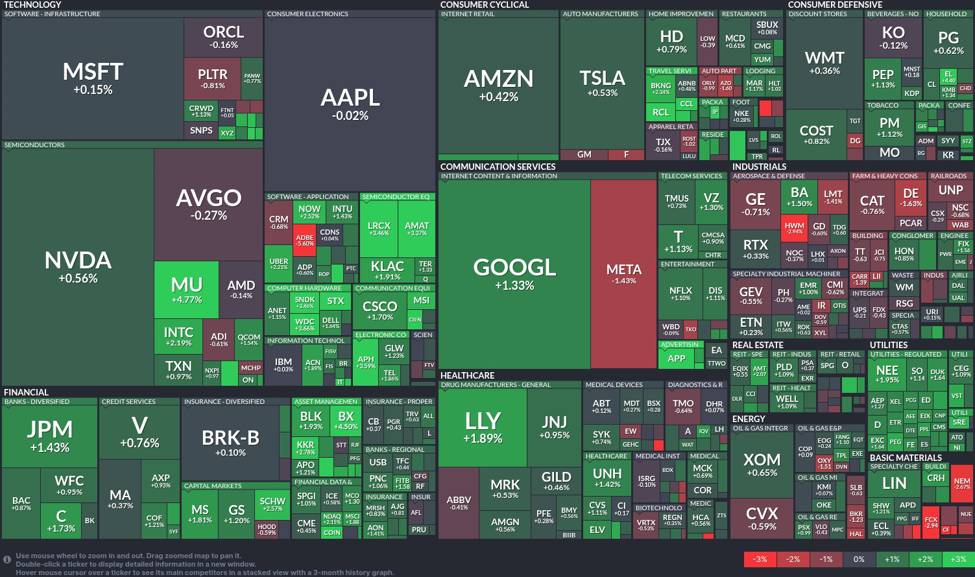
Tech sector powers ahead: Semiconductors and communication services lead the rally
📈 Technology Sector: A Forward MomentumThe tech sector is surging today with an overall positive momentum. Leading the charge, Micron Technology (MU) has seen an impressive rise of 4.77%, while Nvidia (NVDA) increased by 0.56%. This upswing in the semiconductor space reflects growing investor confidence and optimism surrounding technological advancements.🚀 Communication Services: Riding the WaveCommunication services are also on the move, with Google (GOOGL) climbing by 1.33%. The sector is seeing substantial interest, likely driven by innovations and robust user engagement metrics across its platforms.🏦 Financial Sector: A Mixed BagThe financial sector presents a mixed picture. JPMorgan Chase (JPM) has gained 1.43%, illustrating strong banking performance, while American Express (AXP) shows only a slight rise of 0.39%. Insights into financial products could be steering specific gains.📊 Market Mood and TrendsInvestor sentiment today leans towards cautious optimism. Strong performances in tech and communication offer a bullish outlook, yet the red patches in other sectors like industrials point to possible headwinds from external factors like geopolitical influences and supply chain disruptions.🔄 Strategic RecommendationsGiven today’s trends, investors might consider increasing their exposure to the thriving tech sectors, particularly in semiconductors and digital communication services. Diversification remains key; a balanced portfolio across financial services and select consumer sectors can help stabilize returns amidst potential volatility.Keep a close eye on industry reports that could affect these sectors and visit InvestingLive.com for real-time updates and comprehensive analysis. Stay informed to navigate the ever-evolving market dynamics! This article was written by Itai Levitan at investinglive.com. 🔗 Source 💡 DMK Insight Tech stocks are on fire today, and here’s why that matters: the semiconductor sector is showing strong signs of recovery. Micron’s 4.77% jump signals renewed investor confidence, likely driven by increasing demand for chips in AI and cloud computing. Nvidia’s modest gain of 0.56% also indicates that the market is still bullish on companies tied to technological innovation. This momentum could attract more retail and institutional investors, pushing prices higher in the short term. Watch for key resistance levels around Micron’s recent highs, as a breakout could lead to further gains. But don’t overlook potential risks; if broader market sentiment shifts or if inflation concerns resurface, tech stocks could face volatility. Keep an eye on the upcoming earnings reports from major players, as they could either reinforce this bullish trend or trigger a pullback. The real story is how these movements might ripple through related sectors, especially if semiconductor demand continues to rise. Traders should monitor the daily charts closely for any signs of reversal or continuation patterns. 📮 Takeaway Watch Micron’s resistance levels closely; a breakout could signal further gains in the tech sector, but be wary of potential volatility from broader market shifts.
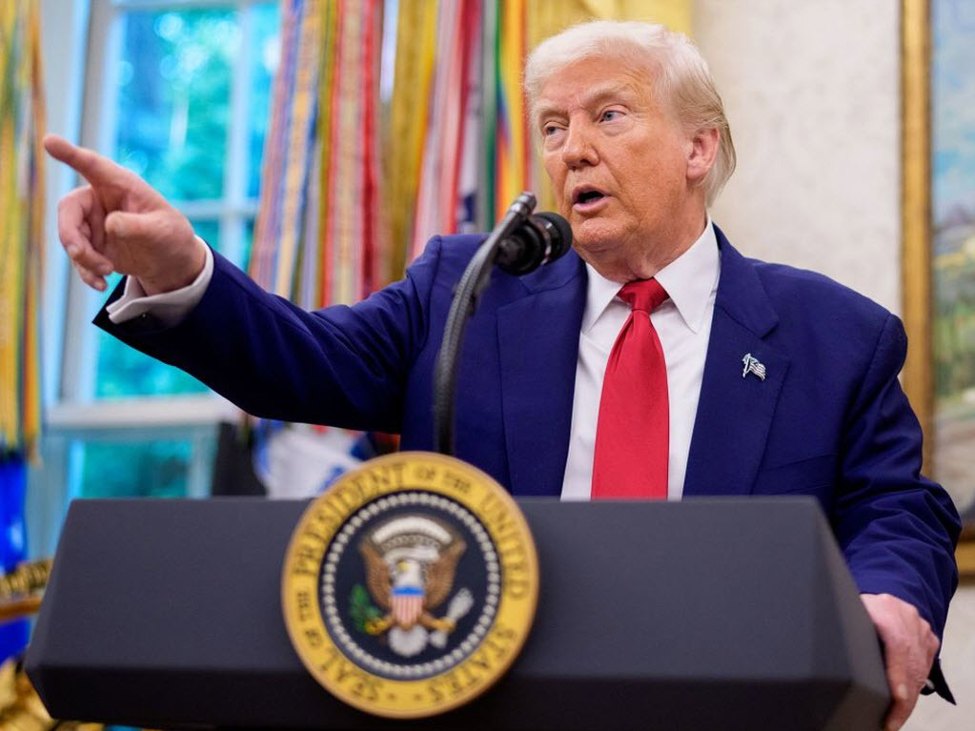
Trump says war will end when he feels it "in my bones"
We are deep into the improvisation phase of the war with Iran.Donald Trump told The Brian Kilmeade Show he will know the Iran conflict is over “when I feel it in my bones.” On a somewhat more-concrete note, he suggested it may not last much longer.The market doesn’t appear to be shifting in that direction. A WSJ report said the Pentagon sent a marine exeditionary unit to the Middle East, though it’s not clear where. The fear is that a ground war could be coming.WTI crude oil is now down just 60 cents to $95.12 after falling as low as $92.04 earlier. The S&P 500 is down 10 points after rising by 60 points earlier. This article was written by Adam Button at investinglive.com. 🔗 Source 💡 DMK Insight The ongoing tensions with Iran are creating a volatile environment for traders, especially in energy markets. With Trump hinting at a potential resolution, traders should be cautious about how geopolitical news can impact oil prices. If the conflict eases, we could see a significant drop in crude oil prices, which are already sensitive to supply disruptions. Keep an eye on the $80 per barrel level; a break below could trigger a wave of selling. On the flip side, if tensions escalate, expect oil to spike, potentially testing resistance levels around $90. This situation is a reminder that geopolitical events can shift market sentiment rapidly. Traders should monitor news closely and consider hedging strategies to mitigate risks. Look for key indicators like the EIA crude oil inventory report for further insights into market direction. 📮 Takeaway Watch for crude oil prices around $80; a break below could signal a sell-off, while escalating tensions may push prices toward $90.

Barclays pushes back expectations for Fed rate cuts
Economists at Barclays now see the Fed cutting rates in September of this year and March 2027.Previously, they saw a cut in June of this year and another in September. This shift tracks market pricing, which has shifted substantially since the Iran war and resulting oil price spike. Market pricing now sees just 22.5 bps of easing this year versus 60 bps prior to the geopolitical strife. A September cut call may prove to be premature as it’s priced at just 56% currently, with December seen as a more-likely timeline. Today’s core CPI showed a monthly rise of 0.4%, matching the December bump. That kind of pace is far from the 0.1652% that would compound to a 2% annual rate.Worsening the crunch is the latest energy spike, which was not in the January inflation data, though there will be a small amount of help from the removal of the Trump tariffs and replacement by the 10% global tariff for 150 days. For now, the sentiment around rate cuts is going to shift based on oil prices and the Iran war. Today’s price action suggests a worsening assessment of when the war might end. I would expect most economists to wait and see how it goes but we will certainly see others tilt their calls towards less easing. In terms of the Fed itself, the focus will soon shift to confirmation hearings from Kevin Warsh. He is in the tough position of having to maintain a dovish stance for Trump (or his nomination will get pulled) while trying to build credibility. That’s not going to be a pretty picture but market pricing suggests that once he gets across the finish line, he will dutifully and independently pursue the inflation target. Time will tell but right now the less-dovish shift is helping the US dollar and has the Dollar Index above 100 for the first time since November. This article was written by Adam Button at investinglive.com. 🔗 Source 💡 DMK Insight Barclays’ revised Fed rate cut timeline signals a shift in market sentiment that traders can’t ignore. The change from a June cut to September reflects how geopolitical events, like the Iran war and oil price spikes, can quickly alter economic forecasts. For traders, this means recalibrating strategies around interest rate-sensitive assets. If the Fed does cut rates in September, expect a potential rally in equities and a weaker dollar, which could impact forex pairs heavily tied to USD. Keep an eye on the S&P 500 and major currency pairs like EUR/USD for volatility around that timeframe. However, there’s a flip side: if inflation persists or geopolitical tensions escalate, the Fed might hold off on cuts, leading to market corrections. Traders should monitor inflation indicators and geopolitical news closely, as these could derail the current expectations. The key watchpoint is the Fed’s upcoming statements and economic data releases leading into September, which will provide clearer signals on their intentions. 📮 Takeaway Watch for the Fed’s September meeting; a rate cut could boost equities and weaken the dollar, impacting forex trades significantly.
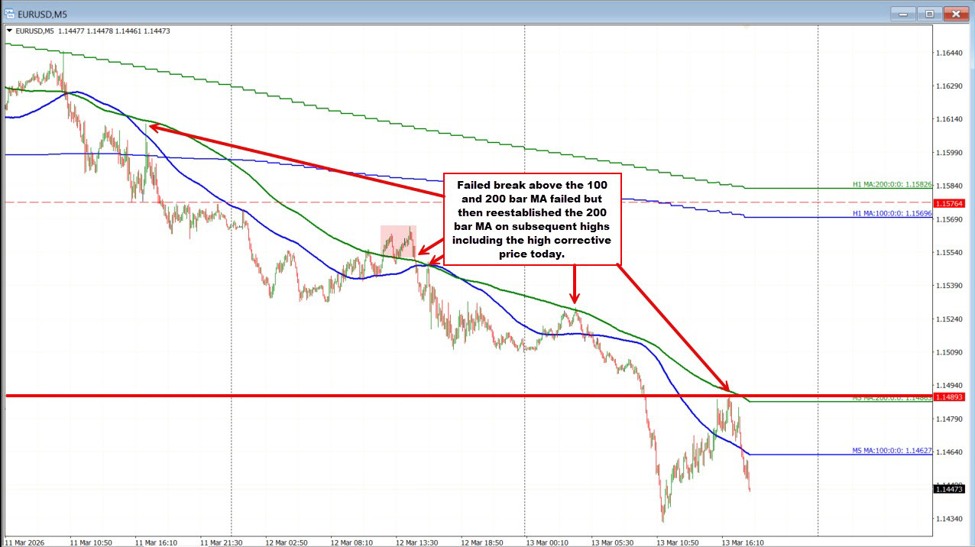
EURUSD Technicals: The EURUSD corrects higher but runs into topside resistance
EURUSD falls to new 2026 lows before corrective bounceThe EURUSD moved sharply lower earlier in the day, extending its bearish momentum and breaking to new lows for 2026. In the process, the pair also traded to its lowest level since August 2025, highlighting the continued downside pressure in the currency pair.The move lower forced the price through two key support levels from November 2025. The first level came in at 1.14912, the low from November 21, followed by the November 5 low at 1.14687. Those levels had served as an important support area for months, but once broken, they helped accelerate the move lower.The selling ultimately pushed the EURUSD down to 1.14321, marking the low for the day before buyers stepped in to produce a corrective rebound.Corrective rally stalls below key November resistanceAfter reaching the session low, the EURUSD did manage to bounce higher during the North American session. That recovery pushed the price back above the 1.14687 level, reclaiming the November 5 low in the process.However, the rebound lacked sustained momentum. The corrective move stalled just ahead of the next key resistance level at 1.14912, which corresponds to the November 21 low that had previously acted as support.The rally peaked at 1.14893, only a few pips shy of that resistance level, before sellers once again stepped in. Since then, the pair has rotated back to the downside, with the current price trading near 1.14475.Moving averages reinforce bearish short-term biasThe corrective move higher also tested an important short-term technical level — the 200-bar moving average on the 5-minute chart (shown as the green line on the chart elow). While the EURUSD briefly moved above that average during yesterday’s trading (see red shaded area), sellers quickly regained control.After breaking back below both the 100-bar and 200-bar moving averages, the pair successfully retested those levels from underneath, confirming them as resistance. In trading today, the price has made two additional attempts to move above the 200-bar moving average, but each test has been firmly rejected by sellers (follow the green line on the chart below).This repeated defense of the moving averages reinforces the view that short-term control remains with the sellers.Key levels that could shift the short-term biasFor the short-term bias to shift back toward the upside, buyers would need to push the price above both the 100-bar and 200-bar moving averages, and then extend the move through the key swing level at 1.14912.A break above that cluster of resistance would weaken the current bearish structure and open the door for a larger corrective move higher.Until that happens, however, the sellers remain firmly in control, with the broader focus still on whether the pair can extend its break to fresh lows going forward. This article was written by Greg Michalowski at investinglive.com. 🔗 Source 💡 DMK Insight The EURUSD’s drop to new 2026 lows is a wake-up call for forex traders. This bearish momentum reflects broader economic concerns, particularly around the Eurozone’s sluggish growth and the potential for further ECB rate cuts. With the pair now trading at its lowest since August 2025, traders should be on high alert for any signs of a corrective bounce, especially if it approaches key resistance levels around 1.0700. If the pair fails to reclaim this level, it could signal further downside, potentially dragging related assets like EUR-denominated commodities lower as well. Look for volatility in the coming sessions, especially with upcoming economic data releases that could sway sentiment. On the flip side, if the EURUSD manages to bounce back above 1.0700, it could trigger a short-term rally, attracting both retail and institutional buyers. Keep an eye on the daily chart for any bullish reversal patterns that might emerge, as they could provide a trading opportunity. The real story is whether this bounce can hold or if the bearish trend will continue unabated. 📮 Takeaway Watch for the EURUSD to test resistance around 1.0700; a failure to break above could lead to further declines.

The Pentagon is moving additional warships to the Middle East
The WSJ reports that the US is moving additional warships to the Middle East, citing three US officials. It says that Defense Secretary Pete Hegseth has approved a request from U.S. Central Command, responsible for American forces in the Middle East, for an element of an amphibious ready group and attached Marine expeditionary unit.Such a unit would typically include several warships and 5,000 Marines, the officials said. The Japan-based USS Tripoli and its attached Marines are now headed for the Middle East, two of the officials said.On that ship:She is a America-class amphibious assault ship — essentially a flat-deck vessel that functions similarly to a light aircraft carrier. LHA-7 was built by Huntington Ingalls Industries in Pascagoula, Mississippi, and was commissioned in 2020. She is designed to operate the F-35B Lightning II stealth fighter as well as various helicopters and tiltrotor aircraft like the MV-22 Osprey. The America-class ships are notable for prioritizing aviation capability, with a larger hangar and flight deck compared to earlier amphibious ships, though the first two ships in the class (including Tripoli) lack a well deck for launching landing craft.The trip is roughly 6000 nautical miles, which would take 12-16 days, though it’s not clear when it left. So on the one hand, we have Trump talking like the war could be wrapped up in 4-5 weeks (2-3 weeks now) and we have a unit that won’t even get there until the tail end of that timeline. So what do we go with? What they’re saying or what they’re doing?The market appears to be increasingly betting on a more-prolonged timeline. The move here is to ensure the Strait of Hormuz is open but that could be a precarious task and it could take several more weeks than an oil price of $100 supports. That could also help to explain why countries are opening strategic oil reserves. This article was written by Adam Button at investinglive.com. 🔗 Source 💡 DMK Insight The deployment of additional US warships to the Middle East could stir volatility in crypto markets, especially for ETH at $2,067.60. Geopolitical tensions often lead to risk-off sentiment among traders, pushing them toward safe-haven assets like Bitcoin and gold, while altcoins like Ethereum may experience sell-offs. If ETH breaks below key support levels—watch around $2,000—traders might see increased selling pressure. Conversely, if tensions escalate, we could see a flight to crypto as a hedge against traditional market instability. Keep an eye on how institutional players respond; they often set the tone in these scenarios. Also, consider the broader implications on oil prices, which could spike and influence inflation expectations, further impacting crypto sentiment. The real story here is how quickly traders react to news cycles; a swift response could lead to significant price swings in the coming days. Watch for any developments from the Middle East that could trigger market reactions. 📮 Takeaway Monitor ETH closely; a drop below $2,000 could signal increased selling, while geopolitical developments may drive volatility in the coming days.

GBPUSD Technicals: The GBPUSD is breaking back below the lows for the day
GBPUSD breaks lower as sellers regain momentumThe GBPUSD is once again pushing lower and trading to new session lows, extending the bearish momentum seen earlier in the day. The pair had already broken below the previous low for the year at 1.3252, but the initial move lacked follow-through and briefly corrected higher.That corrective bounce, however, proved short-lived. Sellers quickly stepped back in and reversed the modest recovery, pushing the price back to the downside with increasing momentum. The renewed selling pressure suggests traders are once again leaning toward the bearish side of the market.The pair is currently trading near 1.3235, firmly below the prior yearly low and reinforcing the bearish technical outlook in the short term.1.3252 becomes a key resistance and bias-defining levelWith the break below 1.3252, that former yearly low now becomes a key resistance and bias-defining level for traders going forward.For sellers, the ideal technical scenario would be for the price to remain below 1.3252, keeping the downside momentum intact. As long as the pair holds below that level, traders will continue to favor selling rallies rather than chasing the move higher.For those looking for more conservative risk management, additional resistance levels come in slightly higher. The first is near 1.3282, followed by the psychologically important 1.3300 level. A move back above those levels would weaken the immediate bearish momentum and force some short-term sellers to reassess their positions.Next downside targets come into focusWith the pair now trading below the previous yearly low, traders are beginning to focus on the next downside targets on the technical charts.The first level of support comes in near 1.3216, which corresponds with a swing high from November 13 that could now act as support on the way down. A break below that level would further strengthen the bearish bias and open the door for additional declines.Below that support, the next key target comes in at the December 2 corrective low near 1.3180.Larger support zone appears on the daily chartLooking at the broader daily chart, there is also an important swing area dating back to April 2025. That zone comes in between 1.31386 and 1.3179 and could attract buyers if the current bearish momentum continues.If the price breaks below that broader support zone, traders would then begin targeting the November 2025 lows, which helped stabilize the market during last year’s decline. Those levels come in between 1.3005 and 1.3036, marking a major downside target area on the longer-term chart.What traders should watch nextIn the video above, I walk through the key technical levels that traders should watch in GBPUSD and explain how the recent break below the yearly low shifts the short-term bias toward the downside.As long as the pair remains below the 1.3252 level, sellers are likely to remain in control and continue targeting lower support zones in the sessions ahead This article was written by Greg Michalowski at investinglive.com. 🔗 Source 💡 DMK Insight GBPUSD’s drop below 1.3252 signals renewed selling pressure, and here’s why that matters: The recent break below the year’s previous low indicates a shift in market sentiment, with sellers regaining control. This could lead to further downside, especially if the pair fails to reclaim that level as resistance. Traders should keep an eye on the 1.3200 psychological level, which could serve as a potential target for short positions. If the bearish momentum continues, we might see a test of lower support levels, which could trigger stop-loss orders and exacerbate selling pressure. On the flip side, if GBPUSD manages to bounce back above 1.3252, it could signal a false breakdown, prompting a short-covering rally. However, with broader economic indicators pointing towards a strong dollar, the risks seem skewed to the downside for the pound. Watch for any economic data releases that could impact the pair, as volatility is likely to increase in the coming sessions. 📮 Takeaway Monitor GBPUSD closely; a sustained move below 1.3252 could lead to targets near 1.3200, while a rebound above that level might indicate a false breakdown.

Bad news for housing. The average rate on 30 year fixed mortgage rises to 6.41%.
The average rate of 30 year mortgage has shot up to 6.41%. That is the highest rate since September of last year and comes after the rate dipped below the 6.00% level to 5.98% during the week of February 23. The spike in rates is following the rise in the 10 year note. The 10 year yield has moved up from 3.926% to the current rate of 4.283% since the start of the Iranian war. Looking at the weekly chart, the yield has moved back above its 100 week moving average at 4.248% (blue line on the chart below). Last week, the price extended back above its 200 week moving average currently at 4.024% (Green line on the chart below)..The 10 year yield is up 0.8 basis points in trading today.US stocks are down on the day but off its session lows.Dow industrial average is trading above and below unchangedS&P index is trading down -21 points or -0.31%NASDAQ index is trading down -160 points or -0.72%Crude oil is trading up $1.22 were 1.27% and $96.95. Gold is trading down $31 or -0.63% at $5045. For the week, gold prices are down -2.438% despite the global tensions. Slver is down $-3.52 or -4.20%.. For the week, silver is down -4.89%. This article was written by Greg Michalowski at investinglive.com. 🔗 Source 💡 DMK Insight Mortgage rates hitting 6.41% could shake up housing and broader markets significantly. This surge marks the highest level since last September, and it’s crucial for traders to understand the implications. Higher mortgage rates typically dampen housing demand, which can lead to lower home prices and impact related sectors like construction and home improvement. For those trading in real estate stocks or ETFs, this could be a signal to reassess positions. Also, consider how this might ripple into the broader economy—higher borrowing costs can slow consumer spending, affecting everything from retail to tech stocks. Keep an eye on the 6.00% level; if rates stabilize above this, it could signal a longer-term trend that traders need to factor into their strategies. On the flip side, if rates pull back, perhaps due to economic data or Fed signals, there could be a buying opportunity in housing-related assets. Watch for upcoming economic indicators that could influence rate movements, especially any Fed announcements or inflation data. The next few weeks will be critical for gauging market sentiment around these mortgage rates. 📮 Takeaway Monitor the 6.00% mortgage rate level closely; a sustained rise could impact housing stocks and consumer spending significantly.