
 Bitcoin
  Ethereum
  Tether
  BNB
BNB  XRP
XRP  USDC
USDC  Solana
  TRON
TRON  Lido Staked Ether
  Figure Heloc
Bitcoin’s sell-off shows signs of easing as large buyers step in, though analysts say any rebound still depends on institutional demand. 🔗 Source 💡 DMK Insight Bitcoin’s recent sell-off might be losing steam, but here’s the catch: institutional demand is the key to any real recovery. Large buyers entering the market can provide a temporary cushion, but without sustained interest from institutions, any bounce could be short-lived. Traders should keep an eye on volume metrics; if we see a significant uptick in institutional buying, that could signal a stronger reversal. Conversely, if large buyers fade and retail sentiment remains weak, we could see another leg down. Watch for key support levels that could indicate where the market is headed next. If Bitcoin can hold above recent lows, it might create a base for a more substantial rally, but the lack of institutional backing could keep it volatile. So, as we navigate this phase, monitor the daily trading volumes and institutional activity closely. If we see a consistent increase in large trades, it could be a sign to position for a potential rebound, but be ready to pivot if the momentum shifts again. 📮 Takeaway Watch for institutional buying trends in Bitcoin; a sustained increase could signal a rebound, while fading interest may lead to further declines.

US Sentences Fugitive to 20 Years Over $73 Million Crypto Scam
The sentence was handed down in absentia after prosecutors said the defendant cut off an ankle monitor and fled supervision. 🔗 Source

Vitalik Buterin Calls for Ethereum-Led Alternative to the 'Race for AGI'
The Ethereum co-founder has outlined a four-quadrant Ethereum-AI buildout spanning private AI use, agent markets, and governance. 🔗 Source 💡 DMK Insight Ethereum’s latest AI strategy could reshape its utility and market perception. The four-quadrant buildout proposed by the co-founder emphasizes private AI applications and governance, which could attract institutional interest. This is crucial as ETH is currently trading at $2,009.62, and any positive sentiment around AI integration might push it past resistance levels. Traders should keep an eye on how this development influences ETH’s volatility and trading volume in the coming weeks. If the market reacts positively, we could see ETH testing higher levels, potentially breaking through the $2,100 mark. However, there’s a flip side. If the market perceives this as just another hype cycle without substantial backing, we might see a pullback. Watch for key indicators like trading volume and sentiment analysis to gauge market reactions. The next few days will be telling, especially as traders digest this news and its implications for Ethereum’s long-term value. 📮 Takeaway Monitor ETH’s price action closely; a break above $2,100 could signal a bullish trend, while a failure to gain traction might lead to a pullback.

Oil prices are stuck in a consolidation as US-Iran negotiations keep the market on edge
FUNDAMENTAL OVERVIEWCrude oil continues to consolidate between key technical levels as traders await new developments from the US-Iran negotiations. Yesterday, Iran’s atomic energy chief said that Iran would be open to dilute its highly enriched uranium if the United States lifted all sanctions. The rangebound price action is clearly showing indecision in the market as the focus remains on the geopolitical risk. Nonetheless, the macro backdrop has also been supporting higher oil prices.In fact, OPEC+ continues to hold output steady, and demand is expected to improve as last year’s uncertainty fades. This should continue to support the oil market unless we get more output hikes or the market starts to bet on Fed’s rate hikes. CRUDE OIL TECHNICAL ANALYSIS – DAILY TIMEFRAMEOn the daily chart, we can see that crude oil is consolidating between the 66.43 and 62.35 levels as negotiations between US and Iran continue. There’s not much we can glean from this timeframe, so we need to zoom in to see some more details. CRUDE OIL TECHNICAL ANALYSIS – 4 HOUR TIMEFRAMEOn the 4 hour chart, we can see an upward trendline defining the bullish momentum. The recent price action has also formed what looks like a symmetrical triangle. This is a neutral pattern, and the price can break out on either side. The buyers will likely continue to lean on the upward trendline to keep pushing into new highs, while the sellers will keep on stepping in around the downward trendline to target a breakout to the downside.CRUDE OIL TECHNICAL ANALYSIS – 1 HOUR TIMEFRAMEOn the 1 hour chart, we can see more clearly the choppy price action with no clear levels where to lean on other than the trendlines. There’s not much we can add here as the buyers will continue to lean on the upward trendline and wait for a breakout to the upside, while the sellers will keep on stepping in around the downward trendline and increase the bearish bets on a downside breakout. The red lines define the average daily range for today.UPCOMING CATALYSTSToday we get the US December Retail Sales and the US Employment Cost Index data. Tomorrow, we have the US NFP report. On Thursday, we get the US Jobless Claims figures. On Friday, we conclude the week with the US CPI report. This article was written by Giuseppe Dellamotta at investinglive.com. 🔗 Source 💡 DMK Insight Crude oil’s consolidation around key levels is a signal for traders to stay alert. With prices hovering around significant support and resistance, the ongoing US-Iran negotiations could trigger volatility. If Iran follows through on its offer to dilute uranium in exchange for lifted sanctions, we might see a bullish breakout. Traders should monitor the $84.24 level closely; a sustained move above could lead to a test of higher resistance levels. Conversely, failure to break out could mean a dip back towards lower support. Keep an eye on the broader market sentiment, as geopolitical developments often ripple through related assets like energy stocks and even currencies tied to oil exports. The real story is how quickly these negotiations unfold—any unexpected news could shift market dynamics rapidly, so be prepared for potential whipsaws in price action. 📮 Takeaway Watch for crude oil to break above $84.24; a bullish move could lead to significant gains, while failure to hold could signal a downturn.

US January NFIB small business optimism index 99.3 vs 99.8 expected
Prior 99.5Full report hereThe NFIB Small Business Optimism Index is a monthly economic indicator that measures the “pulse” of small businesses in the United States. Published by the National Federation of Independent Business (NFIB) since 1973, it is considered a leading indicator of the health of the U.S. economy because small businesses account for roughly 50% of the nation’s private-sector workforce. Despite this, it’s not a market moving report. This article was written by Giuseppe Dellamotta at investinglive.com. 🔗 Source 💡 DMK Insight The NFIB Small Business Optimism Index is a crucial indicator, and here’s why it matters for ETH traders right now: With ETH currently at $2,011.96, any shifts in small business sentiment can ripple through the broader economy, impacting crypto investments. If optimism rises, it could signal increased consumer spending and investment, potentially boosting demand for digital assets like ETH. Conversely, a decline could lead to risk-off sentiment, pushing traders to liquidate positions. Keep an eye on the index’s upcoming release; a significant change could trigger volatility in ETH and related markets. Also, monitor the correlation with traditional markets—if small businesses are struggling, we might see a flight to safety, affecting ETH’s price action. Here’s the flip side: mainstream coverage often overlooks how these economic indicators can influence crypto markets. Traders should be wary of assuming that ETH will always follow traditional market trends. Instead, look for divergences that could present buying opportunities. Watch for key resistance levels around $2,050 and support near $1,950 in the coming weeks as the index data rolls out. 📮 Takeaway Watch the NFIB Small Business Optimism Index closely; significant changes could impact ETH’s price, especially around $2,050 resistance and $1,950 support levels.

Israel crypto industry pushes regulatory changes amid strong public support
Reform of Israel’s digital asset regulations may add 70,000 jobs and $38 billion to the country’s GDP, according to KPMG. 🔗 Source 💡 DMK Insight Israel’s potential digital asset regulation reform could reshape the crypto landscape significantly. Adding 70,000 jobs and a projected $38 billion to GDP isn’t just a number; it signals a shift towards a more robust crypto ecosystem. For traders, this could mean increased liquidity and market participation. If these regulations come to fruition, expect heightened interest from institutional players looking to capitalize on a more stable environment. Watch for any legislative updates or public sentiment shifts that could influence market dynamics. Also, consider how this could ripple into related markets, like tech stocks or blockchain firms, which might see increased valuations as the sector gains traction. However, there’s a flip side: regulatory changes can also introduce uncertainty. Traders should be cautious about overreacting to positive news without considering potential pitfalls or delays in implementation. Keep an eye on key price levels in crypto assets that could react to this news, particularly if Bitcoin or Ethereum show volatility in response to regulatory announcements. 📮 Takeaway Monitor legislative developments in Israel’s digital asset regulations, as they could significantly impact market liquidity and related asset valuations.

Polymarket sues Massachusetts, claims states can’t regulate prediction markets
Polymarket is challenging Massachusetts in federal court, arguing that states lack the authority to regulate CFTC-approved prediction markets. 🔗 Source 💡 DMK Insight Polymarket’s legal battle could reshape the prediction market landscape, and here’s why that matters: If Polymarket wins against Massachusetts, it might set a precedent that limits state-level regulation of CFTC-approved platforms. This could open the floodgates for more prediction markets to operate without stringent local oversight, potentially increasing liquidity and participation. Traders should keep an eye on how this case unfolds, as a favorable ruling could boost confidence in prediction markets, leading to increased trading volumes and volatility. But there’s a flip side: if the court sides with Massachusetts, it could impose stricter regulations on prediction markets, stifling innovation and driving some platforms out of business. This would likely lead to a contraction in market activity, affecting not just Polymarket but also other players in the space. Watch for any updates on the case, as they could impact related assets, particularly those in the broader crypto and betting markets. Key dates and court decisions will be crucial indicators to monitor. 📮 Takeaway Keep an eye on Polymarket’s court case; a win could boost prediction markets significantly, while a loss might tighten regulations across the board.

Gemini exit a ‘blow for policymakers’ with UK crypto hub ambitions
Industry groups and exchanges said the United Kingdom’s slow, overlapping crypto rules and compliance frictions are undermining its “global hub” ambition. 🔗 Source 💡 DMK Insight The UK’s crypto regulatory delays are a big deal for traders looking for stability. With industry groups highlighting compliance issues, the UK’s ambition to be a global crypto hub is in jeopardy. This uncertainty could lead to increased volatility in crypto assets tied to UK exchanges, as traders might seek more favorable environments elsewhere. If the UK doesn’t streamline its regulations, we could see a shift in trading volumes to jurisdictions with clearer frameworks, impacting liquidity and price stability. Keep an eye on how this plays out over the next few weeks, especially as traders react to any new developments or announcements from regulators. The real story is whether the UK can adapt quickly enough to retain its position in the crypto market, or if it will fall behind other regions. Watch for any updates from the Financial Conduct Authority (FCA) or major exchanges, as these could signal shifts in market sentiment and trading strategies. 📮 Takeaway Monitor the UK’s regulatory updates closely; any significant changes could shift trading volumes and volatility in crypto assets linked to UK exchanges.
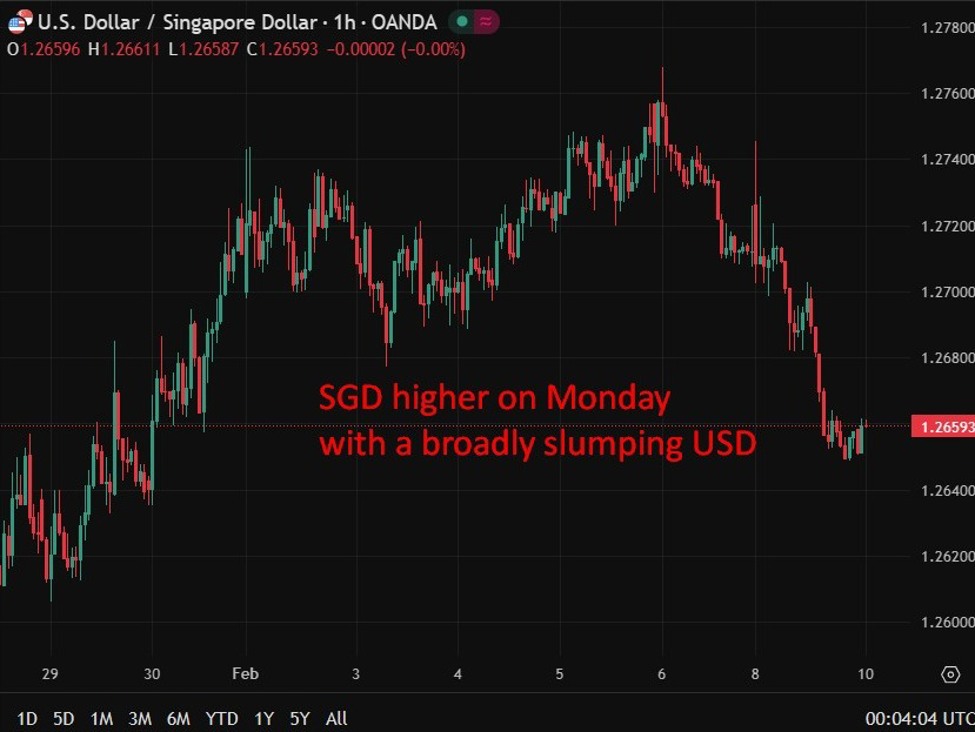
Singapore GDP explodes higher, forcing major upgrade to 2026 outlook
Singapore’s economy finished 2025 on a stronger footing than expected, prompting authorities to lift 2026 growth and export forecasts.Summary:Singapore’s economy grew faster than expected in Q4, beating official advance estimates on both annual and quarterly measures.Full-year 2025 growth was revised higher, confirming strong momentum into year-end.Authorities upgraded the 2026 GDP growth outlook, citing firmer global demand conditions.Manufacturing and trade-related services are seen as key beneficiaries of the improved outlook.Export prospects have also brightened, supported by AI-related demand and elevated gold prices, though risks remain.Singapore’s economy ended 2025 with stronger-than-expected momentum, reinforcing confidence in the near-term outlook and prompting an upgrade to official growth forecasts for the year ahead.Final data showed gross domestic product expanded 6.9% year-on-year in the fourth quarter, comfortably above the advance estimate and underscoring resilient activity across key sectors. On a seasonally adjusted quarter-on-quarter basis, output rose 2.1%, also exceeding preliminary figures and pointing to solid underlying growth heading into 2026.For the full year, economic growth was confirmed at 5.0%, slightly higher than earlier estimates and marking a firm acceleration from the prior year. Analysts say the outturn reflects stronger global demand late in the year, alongside improved performance in trade-sensitive segments of the economy.Against that backdrop, the Singapore Ministry of Trade and Industry raised its 2026 GDP growth forecast to a range of 2.0% to 4.0%, from a previous 1.0% to 3.0%. Officials pointed to stronger-than-anticipated global momentum in the fourth quarter, which is expected to carry into the early part of this year.The ministry also highlighted an improving outlook for Singapore’s manufacturing and trade-related services sectors, noting that conditions have strengthened since its last assessment. Analysts see this as a reflection of stabilising electronics demand, firmer regional trade flows and continued resilience in higher-value-added manufacturing.Export prospects have similarly improved. Enterprise Singapore upgraded its 2026 forecast for non-oil domestic exports growth to 2.0% to 4.0%, from a prior range of 0% to 2.0%. Analysts attribute the brighter outlook to robust demand linked to artificial intelligence-related investment and persistently high gold prices, which support Singapore’s key export categories.However, risks remain tilted to the downside. Authorities and analysts alike caution that a renewed escalation in global trade tensions or a sharp correction in AI-related investment demand could dampen export performance later in the year. Even so, the combination of solid recent growth, improved global conditions and targeted sectoral support suggests Singapore enters 2026 with a firmer economic foundation than previously expected. This article was written by Eamonn Sheridan at investinglive.com. 🔗 Source 💡 DMK Insight Singapore’s unexpected economic growth is a game changer for traders focused on Asia. The stronger-than-expected Q4 performance signals robust momentum, which could influence regional currencies and equities. Traders should keep an eye on the Singapore dollar (SGD) as it may strengthen against major pairs, particularly if the GDP upgrade leads to increased foreign investment. This could also ripple into sectors like real estate and tech, which are sensitive to economic health. With authorities lifting growth forecasts for 2026, it’s worth monitoring key technical levels for the SGD, especially if it approaches resistance around recent highs. However, there’s a flip side: if global economic conditions sour or if inflation pressures mount, the optimism could quickly reverse. Traders should watch for any shifts in monetary policy from the Monetary Authority of Singapore (MAS) that could impact liquidity and market sentiment. Keeping an eye on upcoming economic indicators will be crucial for gauging the sustainability of this growth trend. 📮 Takeaway Watch for potential SGD strength against major currencies as Singapore’s 2026 growth forecast improves; key resistance levels are critical to monitor.
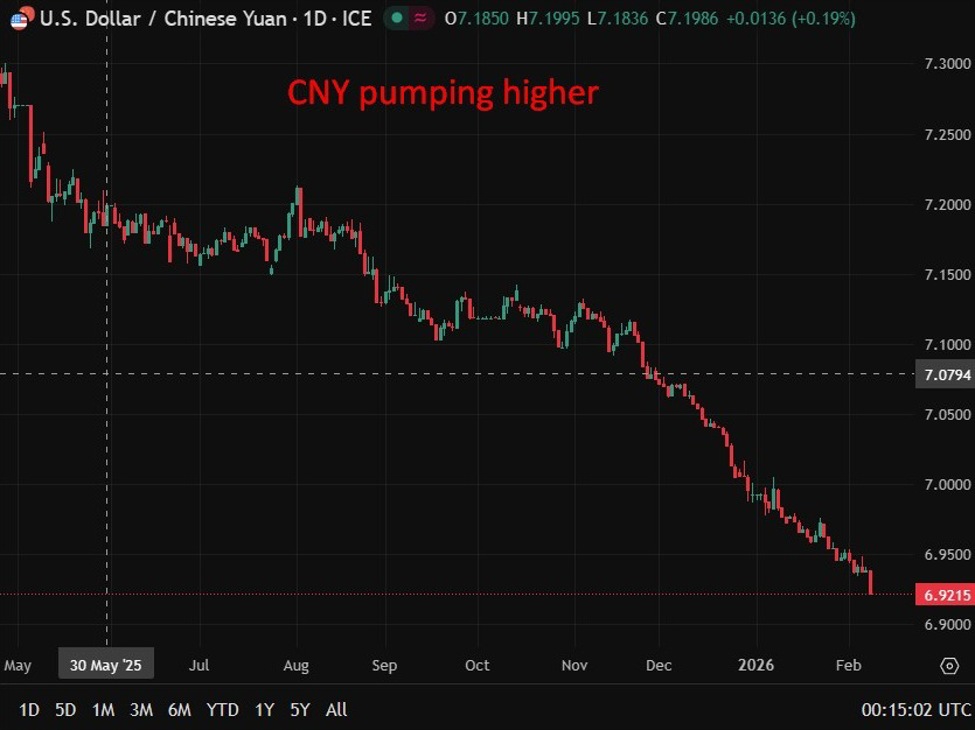
PBOC is expected to set the USD/CNY reference rate at 6.9135 – Reuters estimate
The People’s Bank of China is still letting the CNY climb higher. Along with this news I think this is all very significant:ICYMI bombshell: China tells banks to curb US Treasury exposure, “sell-America” nervesAs Trump fumbles the ball, China is picking it up and running hard with it. —The People’s Bank of China is due to set the daily USD/CNY reference rate at around 0115 GMT (2115 US Eastern time), a fixing that remains one of the most closely watched signals in Asian foreign exchange markets. China operates a managed floating exchange rate system, under which the renminbi (yuan) is allowed to trade within a prescribed band around a central reference rate, or midpoint, set each trading day by the PBOC. The current trading band permits the currency to move plus or minus 2% from the official midpoint during onshore trading hours. Each morning, the PBOC determines the midpoint based on a range of inputs. These include the previous day’s closing price, movements in major currencies, particularly the US dollar, broader international FX conditions, and domestic economic considerations such as capital flows, growth momentum and financial stability objectives. The midpoint is not a purely mechanical calculation, allowing policymakers discretion to guide market expectations. Once the midpoint is announced, onshore USD/CNY is free to trade within the allowable band. If market pressures push the yuan toward either edge of that range, the central bank may step in to smooth volatility. Intervention can take the form of direct buying or selling of yuan, adjustments to liquidity conditions, or guidance through state-owned banks. As a result, the daily fixing is often interpreted as a policy signal rather than just a technical reference point. A stronger-than-expected CNY midpoint is typically read as a sign the PBOC is leaning against depreciation pressure, while a weaker fixing for the CNY can indicate tolerance for a softer currency, often in response to dollar strength or domestic economic headwinds.In periods of heightened global volatility, such as shifts in US rate expectations, trade tensions or capital flow pressures, the fixing takes on added significance. For investors, it provides insight into Beijing’s currency priorities, balancing competitiveness, capital stability and financial market confidence. This article was written by Eamonn Sheridan at investinglive.com. 🔗 Source 💡 DMK Insight China’s move to let the CNY appreciate while advising banks to reduce US Treasury exposure is a game changer. This shift signals a potential pivot in China’s economic strategy, which could impact global markets significantly. For traders, this means keeping an eye on USD/CNY levels; a stronger CNY could lead to a weaker USD, affecting forex pairs and commodities priced in dollars. Additionally, if China continues to distance itself from US debt, we might see volatility in Treasury yields, which could ripple through equities and crypto markets. Watch for reactions from institutional investors, as they may adjust their portfolios based on these developments. But here’s the flip side: if the CNY strengthens too much, it could hurt China’s export competitiveness, leading to a potential policy reversal. Traders should monitor the 7.0 level on USD/CNY as a critical threshold; a break below could trigger further selling in USD and bolster commodities like gold and oil, which often move inversely to the dollar. 📮 Takeaway Watch the USD/CNY level closely; a break below 7.0 could signal a stronger CNY and impact USD-denominated assets.