
 Bitcoin
  Ethereum
  Tether
  BNB
BNB  XRP
XRP  USDC
USDC  Solana
  TRON
TRON  Lido Staked Ether
  Figure Heloc
 📰 DMK AI Summary Ahead of the US midterm elections, crypto PACs have amassed significant funding, with the industry spending over $245 million in campaign contributions last year. The primary super PAC backed by the crypto sector, Fairshake, received major contributions from firms like a16z, Coinbase, and Ripple, fueling concerns about the influence of big money on democratic processes. Meanwhile, the crypto lobby is focusing on pushing the CLARITY Act through Congress, although challenges remain in satisfying industry demands and addressing regulatory concerns. As the political landscape shifts towards the midterms, crypto companies are strategically supporting candidates from both sides of the aisle to advance their deregulatory agenda and protect industry interests. 💬 DMK Insight The surge in funding for crypto PACs underscores the growing influence of the industry on US politics, raising questions about the role of money in shaping policy decisions. The aggressive lobbying efforts and campaign contributions from crypto firms reflect a broader trend of special interests leveraging super PACs to sway regulations in their favor, potentially marginalizing ordinary citizens’ voices in the process. As the crypto sector continues to wield significant financial power in Washington, the outcome of the midterms and the passage of key legislation like the CLARITY Act will be crucial in determining the industry’s regulatory environment moving forward. Investors and market participants should closely monitor these developments for potential impacts on crypto market dynamics and regulatory clarity. 📊 Market Content The escalating involvement of crypto PACs in US politics comes at a time of heightened regulatory scrutiny and political uncertainty, with implications for investor sentiment and market volatility. As industry players navigate the intersection of finance and politics, the outcomes of legislative battles and electoral shifts could shape the future trajectory of the crypto market and influence investment strategies in the sector.

DKK: No intervention yet – Nordea
The report by Nordea, authored by Jan Størup Nielsen and Anders Svendsen, discusses the Danish Krone’s (DKK) recent performance against the Euro. 🔗 Source 💡 DMK Insight The Danish Krone’s recent performance against the Euro is a critical indicator for traders focused on European currencies. With the Eurozone facing economic pressures, including inflation and potential interest rate adjustments, the DKK’s strength or weakness can signal broader market trends. If the DKK continues to appreciate, it could suggest a flight to safety among investors, impacting not just Euro pairs but also related assets like Scandinavian equities and bonds. Traders should keep an eye on key technical levels for the DKK/EUR pair. A break above recent resistance could open the door for further gains, while a failure to hold current levels might trigger a sell-off. Additionally, watch for upcoming economic data releases from Denmark and the Eurozone, as these could provide further context for the DKK’s trajectory. The interplay between monetary policy decisions and inflation data will be crucial in shaping market sentiment in the near term. 📮 Takeaway Monitor the DKK/EUR pair closely; a break above resistance could signal further strength, while key economic data from Denmark and the Eurozone is crucial to watch.

Crypto PACs secure massive war chests ahead of US midterms
Crypto super PACs are getting millions of dollars in contributions to spend supporting candidates who will advance their policies in Washington. 🔗 Source 💡 DMK Insight Crypto super PACs are raking in cash, and here’s why that matters for traders: The influx of millions into political campaigns signals a growing influence of the crypto sector in shaping regulatory frameworks. This could lead to more favorable policies for digital assets, impacting market sentiment positively. Traders should keep an eye on how these contributions translate into legislative action, as any pro-crypto bills could spark bullish momentum across the market. Conversely, if these efforts falter, it could lead to increased regulatory scrutiny, creating volatility. Look for key developments in Washington over the next few months, especially around major legislative sessions. If pro-crypto candidates gain traction, expect a potential rally in major cryptocurrencies. Watch Bitcoin and Ethereum closely; they often react strongly to regulatory news. The real story is how these political moves could shift the landscape, so stay alert for announcements that could affect market dynamics. 📮 Takeaway Monitor political developments closely; pro-crypto legislation could trigger significant price movements in Bitcoin and Ethereum in the coming months.

China bans stablecoin and RWA issuance by foreign and domestic companies
The latest announcement from the People’s Bank of China follows months of flip-flopping on privately issued yuan-pegged stablecoins. 🔗 Source 💡 DMK Insight China’s latest stance on yuan-pegged stablecoins is a game changer for crypto traders. After months of indecision, the People’s Bank of China’s clarity could signal a shift in regulatory sentiment. Traders need to watch how this impacts liquidity in the crypto market, especially for stablecoins tied to the yuan. If the PBOC embraces these stablecoins, it could lead to increased adoption and trading volume, particularly in Asia. Conversely, if they impose strict regulations, it might stifle innovation and drive traders towards more established currencies like USDT or USDC. Keep an eye on the daily trading volumes of these stablecoins and any related policy announcements from the PBOC. The ripple effects could also influence forex pairs involving the yuan, so monitoring USD/CNY could provide additional insights into market sentiment and volatility. Here’s the thing: while some might see this as a positive development, the potential for regulatory overreach remains a risk. Traders should prepare for possible volatility as the market digests these changes and adjust their positions accordingly. 📮 Takeaway Watch for PBOC’s next moves on stablecoins; any regulatory clarity could significantly impact yuan liquidity and related crypto trading volumes.

Crypto-focused Erebor wins first new US bank charter of Trump’s second term: WSJ
Erebor doubled its valuation to $4 billion after a $350 million Lux Capital-led funding round late last year. 🔗 Source 💡 DMK Insight Erebor’s valuation leap to $4 billion signals a bullish trend in tech funding, and here’s why that matters: This surge, driven by a substantial $350 million investment from Lux Capital, reflects growing investor confidence in tech startups, particularly in sectors like blockchain and fintech. For traders, this could indicate a broader market shift where capital flows into innovative tech, potentially boosting related assets. If you’re tracking tech stocks or crypto projects, keep an eye on how this funding influences market sentiment and investment patterns. But don’t overlook the risks—high valuations can lead to volatility if growth expectations aren’t met. Watch for any market corrections that could ripple through tech stocks or crypto assets tied to similar funding dynamics. Key levels to monitor include the performance of major tech indices and any shifts in funding trends over the next quarter, as these could signal where the market is headed next. 📮 Takeaway Watch for potential volatility in tech stocks and crypto assets as Erebor’s funding success could influence broader market sentiment and investment flows.

Vietnam to tax crypto like stocks with 0.1% trading levy: Report
Vietnam’s Finance Ministry proposes a 0.1% tax on crypto transfers, 20% corporate tax on profits and tough licensing standards for digital asset exchanges. 🔗 Source 💡 DMK Insight Vietnam’s proposed crypto tax could reshape the trading landscape significantly. A 0.1% tax on transfers and a hefty 20% corporate tax on profits might deter speculative trading and push traders to seek more favorable jurisdictions. This could lead to reduced liquidity in the Vietnamese market, impacting local exchanges and potentially driving traders toward offshore platforms. The tough licensing standards could further complicate operations for existing exchanges, limiting competition and innovation. Traders should keep an eye on how these regulations evolve and consider adjusting their strategies accordingly. Here’s the flip side: while these measures might seem restrictive, they could also legitimize the crypto market in Vietnam, attracting institutional players who prefer a regulated environment. Watch for any pushback from the crypto community or potential amendments to these proposals, as that could create volatility in local assets. Key levels to monitor include the performance of Vietnamese exchanges and any shifts in trading volume that might indicate how traders are reacting to these changes. 📮 Takeaway Keep an eye on Vietnam’s regulatory developments; the proposed 0.1% transfer tax and 20% corporate tax could shift trading strategies and liquidity in the market.

Nasdaq futures bounce near November lows. Is the correction finally over?
FUNDAMENTAL OVERVIEWWe’ve had a rough three-day losing streak for the Nasdaq and other major stock market indices. It’s not clear what was the catalyst although it coincided with the release of Anthropic’s new AI tool called Claude Plugins. It basically demonstrated that a large portion of software could be obsolete and weighed on tech stocks.In reality, there were already cautionary signs as the market was diverging with credit spreads which have been signalling some tightening in financial conditions. In fact, the US economic surprise index recently jumped to the highest level since November 2023. That led to some hawkish repricing in interest rates expectations. Next week is going to be a big one as we get the US NFP report on Wednesday and the US CPI on Friday. Another hawkish repricing could weigh on the market. The best outcome for the bulls should be some benign jobs data coupled with a softer than expected inflation report. In fact, we should be in a “good news is good news” environment for the stock market amid the Fed’s dovish reaction function as long as inflation continues to slowly head towards target. A quick deterioration in the labour market at this point could trigger growth fears and lead to a deeper correction.NASDAQ TECHNICAL ANALYSIS – DAILY TIMEFRAMEOn the daily chart, we can see that the Nasdaq fell all the way back to November lows. The dip-buyers stepped in near those lows to position for a rally into new all-time highs. The sellers will want to see the price breaking lower to open the door for a drop into the 23,000 level next.NASDAQ TECHNICAL ANALYSIS – 4 HOUR TIMEFRAMEOn the 4 hour chart, we can see that the bullish momentum picked up after the price broke above the minor downward trendline as more buyers piled in. The target should be the resistance around the 25,188 level. If the price gets there, we can expect the sellers to step in with a defined risk above the resistance to position for a drop into new lows. The buyers, on the other hand, will look for a break higher to increase the bullish bets into new highs. NASDAQ TECHNICAL ANALYSIS – 1 HOUR TIMEFRAMEOn the 1 hour chart, we can see that we have a minor upward trendline defining the bullish momentum on this timeframe. The buyers will likely continue to lean on the trendline to keep pushing into new highs, while the sellers will look for a break lower to pile in for a drop back into the November lows. The red lines define the average daily range for today. UPCOMING CATALYSTSToday we conclude the week with the University of Michigan Consumer Sentiment survey. This article was written by Giuseppe Dellamotta at investinglive.com. 🔗 Source 💡 DMK Insight The Nasdaq’s three-day losing streak could signal broader market unease, and here’s why that matters for crypto traders. With SOL currently at $84.91, the correlation between tech stocks and cryptocurrencies remains strong. If the Nasdaq continues to falter, we might see a spillover effect into the crypto market, particularly for altcoins like Solana. Traders should keep an eye on SOL’s support levels around $80; a breach could trigger further selling pressure. Additionally, the release of Anthropic’s AI tool raises questions about tech valuations and could lead to a risk-off sentiment, pushing investors away from riskier assets like crypto. On the flip side, if SOL holds above $80, it might attract bargain hunters looking for a rebound. Watch for any news that could shift market sentiment, especially around tech earnings or further developments in AI. The next few days will be crucial for determining whether this is just a temporary dip or the start of a more significant trend. 📮 Takeaway Monitor SOL closely; if it drops below $80, it could signal further downside, while holding above that level may attract buyers.
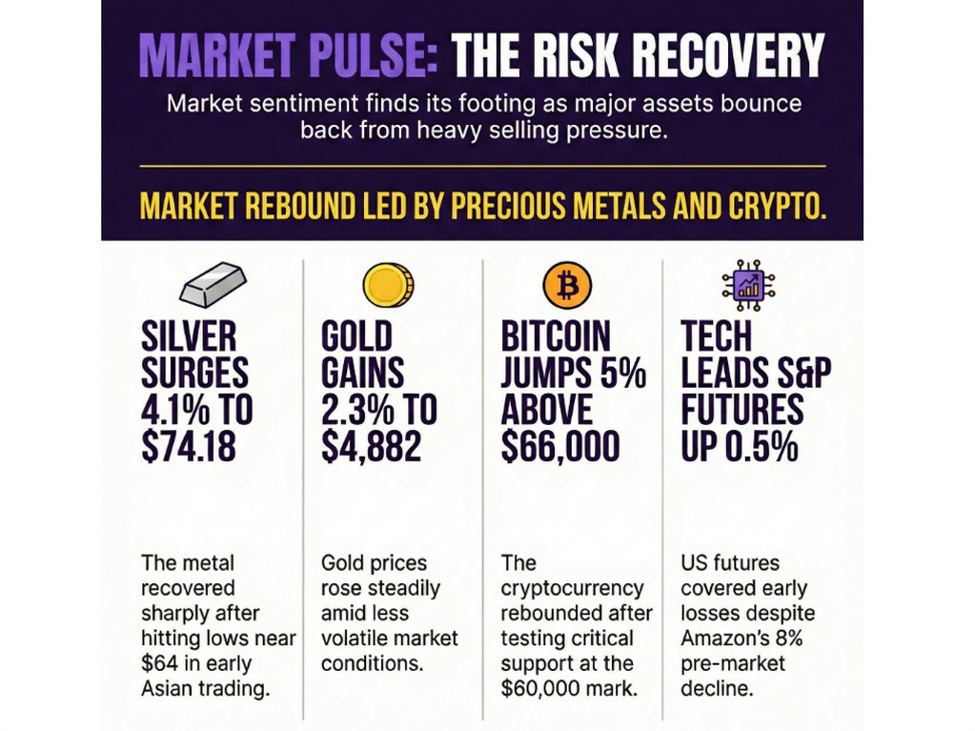
investingLive European markets wrap: Tentative recovery in precious metals, risk trades
Headlines:US equities look to recover a little after a rough few daysHow have interest rate expectations changed after this week’s events?Oil prices in the spotlight as focus remains on US-Iran negotiations in OmanECB policymakers repeat policy is in “good place”; ease tone on euro’s strengthBOJ policymaker Masu says not thinking of a particular pace in hiking interest ratesGermany December industrial production -1.9% vs -0.3% m/m expectedFrench trade deficit narrows further in 2025 as exports reboundUK January Halifax house price index +0.7% vs -0.6% m/m priorMarkets:Precious metals bounce back, US futures cover early losses, Bitcoin reboundsSilver up 4.1% to $74.18 after the low in early Asia hit near $64Gold up 2.3% to $4,882 in less volatile tradingS&P 500 futures up 0.5% as tech shares bounce back, Amazon down 8% in pre-market thoughBitcoin up over 5% to above $66,000 after coming close to test $60,000 markUS dollar steady and more mixed across the board, commodity currencies lead on risk recoveryWTI crude oil flat at $63.16 as US-Iran talks continueIt was a calmer session in Europe today as broader market sentiment shows some tentative signs of recovery. Key word there being tentative of course. That after a rough few days for risk trades especially, amid a painful combination of selling in precious metals, tech stocks, and cryptocurrencies.Today, all three are showing a modest bounce but not without some early drama in early Asia trading before this.Silver got trounced once again in falling over 13% to near $64 before recovering to be up 4% now just above the $74 level. Gold was less volatile as it fell to a low of $4,655 before bouncing back over 2% now to $4,882 on the day.The dramatic bounce highlights that the volatility spikes are still very much in play but reaffirms a continued healthy correction for precious metals. Of note, the rebound in silver comes as dip buyers stepped in with price having moved within touching distance of the 100-day moving average – a key technical level on the charts.Overall risk sentiment also caught a modest rebound with S&P 500 futures now seen up 0.5%. At the lows earlier, futures were down 1% as tech shares stayed under pressure. Amazon’s earnings backlash did not help with shares still down 8% in pre-market, but at least there’s a broader recovery elsewhere.The mood music is helped by a rebound in Bitcoin after the cryptocurrency came within a whisker of testing the $60,000 mark. That saw bids come in with Bitcoin now rising back up above $66,000 to stabilise a little after a very poor week.In other markets, things were less dramatic with the dollar holding steadier and slightly softer at the balance against the rest of the major currencies. EUR/USD keeps just below the 1.1800 level amid large option expiries and some ECB commentary on the exchange rate.Meanwhile, USD/JPY is flat holding just above the 157.00 level while commodity currencies lead gains with AUD/USD up 0.8% to 0.6980 levels on the day.Besides that, oil prices also continues to be in focus in awaiting US-Iran talks in Oman. For now, the mood is tense but oil is still set for a weekly drop with price at $63.16 currently. This article was written by Justin Low at investinglive.com. 🔗 Source 💡 DMK Insight US equities are trying to bounce back, but the underlying issues remain critical. Interest rate expectations have shifted, especially after recent economic data, which could impact market sentiment. Traders should keep an eye on how these rates affect sectors like tech and consumer discretionary, as they often react strongly to interest rate changes. Oil prices are also in focus due to US-Iran negotiations, which could lead to volatility in energy stocks. If tensions escalate, we might see a spike in oil prices, impacting inflation and, consequently, interest rates. On the flip side, the ECB’s easing tone on the euro’s strength suggests they might be more accommodating, which could weaken the euro against the dollar. This could create opportunities for forex traders looking to capitalize on currency fluctuations. Watch for key levels in the S&P 500; a break above recent resistance could signal a more sustained recovery. Keep an eye on economic indicators this week that could further influence interest rate expectations. 📮 Takeaway Monitor S&P 500 resistance levels for potential breakouts and watch oil price movements amid US-Iran negotiations for broader market impacts.

BoE's Pill: There's a risk that we draw too much comfort from dip in inflation
There’s a risk that we draw too much comfort from dip in inflation in AprilInflation falling to target earlier is good newsPolicy must address any remaining persistencePrivate sector growth is subdued but positiveThe labor market has eased quite significantlyWe should not overinterpret changes to growth outlook in February BoE forecastsThe latest pay intentions data is good evidence that the disinflation process is intact but not completeThe latest DMP data on pay and pricing plans are not at entirely comfortable levelsThe BoE yesterday surprised with a dovish hold as 4 members dissented for a rate cut versus 2 expected. Moreover, they changed the guidance in the statement from “the bank rate is likely to continue on a gradual downward path” to “the bank rate is likely to be reduced further”. Inflation forecasts were also revised much lower. Lastly, the Agents’ Pay Survey showed wage growth to average 3.4% in 2026 vs 3.5% expected. The market is now pricing 45 bps of easing by year-end with a 49% probability of a rate cut at the upcoming meeting.BoE’s Pill voted to hold rates steady yesterday. This was his reasoning for keeping interest rates steady:”I do not see a need to reduce Bank Rate further at this meeting. This follows from distinguishing between the underlying disinflation process, which remains intact but incomplete, and the risks around that process, which shift through time but have on balance been in the direction of slower disinflation than expected a year or eighteen months ago. In explaining this slowing, I would emphasise the role of structural changes in wage-bargaining and productivity – notwithstanding the conclusions in Box B, where I draw different implications from the careful and important analysis – and a monetary policy stance that has been overly accommodative since the withdrawal of restriction started in August 2024. While I draw comfort about the medium-term inflation outlook from longer-term market inflation expectations and low-frequency broad money dynamics, I remain concerned that inflationary pressures stemming from an overly rapid withdrawal of policy restriction over the past two years still need to be contained and eliminated. In that light, I continue to favour a cautious withdrawal of policy restriction, guided by longer‑term trends rather than short‑term news.” This article was written by Giuseppe Dellamotta at investinglive.com. 🔗 Source 💡 DMK Insight Inflation dipping to target is good news, but it might not be the full story for ETH traders. While ETH is currently at $2,008.69, the broader economic indicators suggest a mixed bag. The subdued private sector growth and easing labor market could signal a slowdown, which often leads to risk-off sentiment in crypto markets. Traders should be cautious about overreacting to the inflation data, as it may not translate into sustained bullish momentum for ETH. Watch for key support levels around $1,950; if breached, it could trigger further selling pressure. On the flip side, if ETH can hold above $2,000, it might attract buyers looking for a rebound. Keep an eye on upcoming economic reports that could sway market sentiment, particularly those related to employment and consumer spending, as they could impact ETH’s trajectory in the coming weeks. 📮 Takeaway Monitor ETH’s support at $1,950; a break below could lead to increased selling pressure, while holding above $2,000 may attract buyers.

Canada January employment report -24.8K vs +7.0K expected
There was no government shutdown to delay the Canadian employment data so it gets the Friday morning spotlight all to itself.Prior was +8.2KEmployment change: -24.8K vs -5.0K estimate, +8.2K priorUnemployment rate: 6.5% vs 6.6% estimate, 6.8% priorFull-time employment change: +44.9K vs +50.2 last monthPart-time employment change: -69.7K vs -42.0K last monthParticipation rate: 65.0% vs 65.4% last monthAvg hourly wages (permanent, YoY): % vs 3.7% last monthThis is a real mixed bag but it’s the second negative number in a row. The unemployment rate fell substantially though and that is surely a reflection of the plunge in the participation rate. The full time number is a good one for the second month.Overall, take this as a negative but it comes as USD/CAD is selling off and it seems to have stabilized the move. The volatility in other markets is dominating FX at the moment so the macro signals are lost.Looking at recent months, in October 2025, employment rose by 66,600 jobs, beating expectations for a decline, with gains concentrated in part-time work. The unemployment rate fell to 6.9 percent from 7.1 percent. November saw employment increase by 54,000, the third consecutive monthly gain, as the unemployment rate dropped further to 6.5 percent, the lowest in 16 months. However, December showed employment growth stalling at just 8,200 jobs, essentially flat, though full-time positions rose 50,200 while part-time employment fell 42,000. The unemployment rate increased to 6.8 percent as 81,000 people entered the labour force, pushing the participation rate to 65.4 percent. The December results followed strong cumulative gains of 181,000 jobs from September through November.For background, the Labour Force Survey, published monthly by Statistics Canada, provides comprehensive data on employment, unemployment, and labour force participation across Canada. Released on the first or second Friday of each month at 8:30 a.m. ET, the report surveys approximately 56,000 households and tracks employment changes by industry, province, full-time versus part-time status, and demographic characteristics. The survey measures not only net job creation but also unemployment rates, wage growth, and labour force participation, offering insights into the health of Canada’s economy. The data is closely monitored by the Bank of Canada when setting monetary policy and by economists assessing economic conditions. At the moment, there are no further cuts priced in for the Bank of Canada. This article was written by Adam Button at investinglive.com. 🔗 Source 💡 DMK Insight Canada’s employment data just dropped, and it’s a mixed bag that traders need to unpack. The employment change came in at -24.8K, significantly worse than the -5.0K estimate, which could signal underlying economic weakness. Despite this, the unemployment rate ticked down to 6.5%, slightly better than expected. This divergence raises questions about the labor market’s health. Full-time jobs increased, but the sharp decline in part-time positions (-69.7K) suggests that many workers are facing instability. For forex traders, this data could impact the CAD, especially against the USD. If the trend of weak job growth continues, we might see the Bank of Canada reconsider its monetary policy stance, which could lead to CAD depreciation. Watch the 6.5% unemployment rate closely; if it starts to rise again, it could trigger further volatility in CAD pairs. The immediate focus should be on how the market reacts to this data, particularly in the context of upcoming economic indicators and central bank meetings. 📮 Takeaway Keep an eye on CAD pairs; if unemployment rises above 6.5%, it could signal further weakness and volatility.