
 Bitcoin
  Ethereum
  Tether
  XRP
XRP  BNB
BNB  USDC
USDC  Solana
  TRON
TRON  Lido Staked Ether
  Figure Heloc
China’s NPC Standing Committee to hold meeting on Feb 4The NPC Standing Committee meeting on 4 February looks procedural rather than macro-moving, based on the proposed agenda flagged by state media: lawmakers are set to review a report on NPC deputy qualifications. That said, markets still pay attention because “Standing Committee” meetings can sometimes be used to set the table for bigger policy signals, especially heading into the annual National People’s Congress session in early March (the “Two Sessions” cycle). The fourth session of the 14th NPC is scheduled to open on March 5, while the fourth session of the 14th CPPCC National Committee is set to begin on March 4. The media center for the two sessions will be open from Feb. 27.If the 4 February session sticks to the published agenda (deputy qualifications), CNH and China risk assets should largely ignore it, you’re more likely to see price action driven by global risk tone, China data, property headlines, and US rates.The meeting is best viewed as preparatory plumbing ahead of March, when the big macro items typically land (growth target, fiscal stance, bond quotas, etc.). Even when the formal agenda is narrow, investors and traders will scan for:Any hint of fiscal front-loading (eg, language around local-government financing or authorisations). The Standing Committee has, in prior years, authorised mechanisms that allow earlier release of local government bond quotas to support growth. Regulatory tone changes (business/market structure, tech governance, IP). Notably, the Standing Committee is currently running a public consultation on Trademark Law revisions, which is more micro than macro but relevant for corporate/legal operating risk. FX impacts to be wary of:AUD & NZD: Any surprise pro-growth signal (bond front-loading / stimulus language) would be a marginal AUD-supportive read-through via China demand/commodities; otherwise negligible.Asia risk FX (KRW, SGD): Watch global tech/risk appetite more than February 4 politics. This article was written by Eamonn Sheridan at investinglive.com. 🔗 Source 💡 DMK Insight China’s upcoming NPC Standing Committee meeting on February 4 might seem procedural, but here’s why traders should keep an eye on it. Even if the agenda focuses on deputy qualifications, any unexpected comments or shifts in policy could influence market sentiment, especially in the yuan and broader Asian markets. Given the current volatility in forex, any hint of economic policy changes can lead to significant price movements. Moreover, with the yuan’s recent fluctuations, this meeting could serve as a catalyst for traders looking to position themselves ahead of potential shifts in monetary policy. If lawmakers hint at more stimulus or economic support, we could see a bullish reaction in the yuan and related assets. Conversely, a lack of action or negative sentiment could lead to further depreciation. Watch for any statements that could impact the yuan’s trading range, particularly if it approaches key support or resistance levels. The real story is that while the agenda seems mundane, the implications could ripple through forex markets, affecting trading strategies for both short and long positions. 📮 Takeaway Monitor the NPC meeting on February 4 for any unexpected policy hints that could impact the yuan and related forex pairs.

RBA raises its cash rate by 25bp to 3.85%, as widely expected
Reserve Bank of Australia decision. I’ll have more to come on this separately.Background:ANZ sees RBA 25bp rate hike today, but no commitment to further tighteningAustralian dollar chops, await pivotal RBA decisionRBA preview: Focus on the forward guidanceRBA tipped to hike – pollGoldman Sachs and Deutsche Bank forecast RBA holdGovernor Bullock will speak at 0430 GMT / 2330 US Eastern time This article was written by Eamonn Sheridan at investinglive.com. 🔗 Source 💡 DMK Insight The RBA’s potential 25bp rate hike is a pivotal moment for traders, especially with mixed signals from major banks. If ANZ’s prediction holds, we could see the Australian dollar react sharply, but the lack of commitment to further tightening suggests volatility ahead. Traders should keep an eye on the forward guidance from Governor Bullock, as it will shape expectations for future rate movements. The market’s response could ripple through commodities, particularly gold, which often reacts to interest rate changes. If the RBA holds rates, expect the Aussie to stabilize, but a hike could lead to a short-term spike, making it crucial to monitor the 0.65 level for potential resistance or support. Here’s the thing: while the consensus leans towards a hike, the uncertainty in forward guidance could catch many off guard. Watch for any hints of future policy direction, as this will be key for positioning in both forex and commodity markets. 📮 Takeaway Traders should watch the RBA’s forward guidance closely; a 25bp hike could push the AUD past 0.65, while a hold may stabilize it.
RBA unanimous 25bp hike, lifts inflation forecasts and signals more tightening in 2026
The RBA delivered a unanimous 25bp hike tio take the cash rate back up to 3.85% and upgraded its inflation profile, with the SMP implying further tightening in 2026 even as the Bank kept guidance explicitly data dependent.First rate hike since 2023 and after an easing cycle. Summary:RBA hiked and it was unanimous, citing a clear re-acceleration in underlying inflation in 2H25 and tighter capacity constraintsGuidance stayed open-ended: the Board stressed data dependence and uncertainty around how restrictive policy now isThe SoMP shifts hawkish: forecasts assume cash rate 3.9% by June and 4.2% by December, implying roughly two more hikes in 2026Inflation track lifted even with higher-rate assumptions; headline CPI seen peaking mid-year as electricity rebates roll offGrowth near-term upgraded, but the profile fades further out; unemployment seen edging higher into 2027–28The Reserve Bank of Australia delivered a unanimous policy tightening and paired it with a notably firmer set of forecasts, arguing that inflation momentum picked up materially in the second half of 2025 and that the economy is operating with greater capacity pressure than previously assessed.In its post-meeting messaging, (decision Statement) the Bank kept its forward guidance deliberately flexible. Policymakers emphasised that future decisions will be guided by incoming data and an evolving assessment of the outlook, noting ongoing uncertainty around domestic activity, inflation dynamics and, crucially, the extent to which monetary policy is currently restrictive. That formulation reads as an attempt to justify action now without pre-committing to a fixed hiking sequence.The tone in the accompanying Statement on Monetary Policy (SoMP) was the bigger signal. The RBA lifted inflation forecasts through the projection horizon and revised its growth view, describing the economy as further from balance and growing above potential in the near term. The Bank also flagged that some measures suggest financial conditions may have become somewhat accommodative, an important shift from prior communications that leaned more heavily on “restrictive” settings after last year’s rate cuts.Forecast assumptions imply additional tightening ahead. The SMP projections are conditioned on a cash-rate track rising to around 3.9% by June and 4.2% by December, effectively building in roughly 40bp of additional hikes this year. The Bank’s argument is that higher rates should restore balance between demand and supply, particularly after private demand growth proved much stronger than expected in late 2025.On the inflation details, the RBA acknowledged that part of the late-2025 inflation surprise reflected less persistent components such as food, travel and durable goods, but it judged that the overall pulse of inflationary pressure had strengthened, including via capacity constraints. Underlying inflation (trimmed mean) is seen lifting in the near term before trending lower only gradually, reaching the mid-2s by mid-2028,still above the target midpoint.The growth outlook was revised up near term, reflecting stronger household consumption, dwelling investment and business investment. The RBA highlighted a sharp lift in business investment expectations through 2026, with data centre spending cited as one contributor, alongside stronger government spending and housing-related demand. Further out, however, growth forecasts were marked down into 2027 as tighter financial conditions bite.Labour market language remained firm, with conditions still described as a little tight and stabilising in recent months. The RBA does not see a material near-term loosening, with unemployment projected to hover around the low-4% range before drifting higher later as rates rise.For markets, the combination of a hike, a unanimous decision, and a forecast track that embeds further tightening is a cleanly hawkish package, tempered only by the Bank’s insistence that it is not locked into any particular path and will respond to how inflation and demand evolve from here. Reserve Bank of Australia Governor Bullock will speak at 0430 GMT / 2330 US Eastern time This article was written by Eamonn Sheridan at investinglive.com. 🔗 Source

investingLive Asia-Pacific FX news wrap: AUD jumps on a hawkish RBA rate hike
RBA unanimous 25bp hike, lifts inflation forecasts and signals more tightening in 2026RBA raises its cash rate by 25bp to 3.85%, as widely expectedChina’s NPC Standing Committee to hold meeting on February 4 (ahead of full March 5 meet)Japanese stocks surge as tech rebounds, banks boost risk appetite. KOSPI rockets.ANZ sees RBA 25bp rate hike today, but no commitment to further tighteningPBOC sets USD/ CNY central rate at 6.9608 (vs. estimate at 6.9598).Gold’s surge reflects structural demand, Goldman says. Favours gold-equity barbell.Australian December 2025 building permits -14.9% m/m (expected -5.7%)Japan’s Katayama: Tokyo coordinates regularly with US on FX, declines comment interventionICYMI – Iran signals readiness for US nuclear talks as military tensions riseAltman calls Nvidia chip speculation “insanity”, backs partnershipUS cuts tariffs on India to 18% as New Delhi agrees to end Russian oil purchasesNew Zealand December 2025 building permits down m/m but up y/yTrump announces critical mineral reserve backed by Exim financing and private capitalOpenAI explores alternatives to Nvidia AI chips amid inference speed concernsinvestingLive Americas market news wrap: ISM manufacturing soarsPalantir beat, 2026 guidance beat alsoAt a glance:RBA hikes to 3.85%, flags renewed inflation pressure and capacity constraints; guidance remains data dependentAUD jumps as the RBA’s projected rate path implies close to two further hikes this yearIran signals willingness to curb nuclear activity, lifting risk sentiment and related equitiesTrump unveils US critical minerals reserve, backing supply-chain security with public and private fundingJapan plays down FX intervention talk, stressing coordination with the USAustralian dwelling approvals slump, highlighting housing sensitivity to higher ratesINR rallies after Trump slashes tariffs on IndiaThe RBA raised its cash rate to 3.85%, as widely expected, citing mounting capacity pressures, the fact that inflationary pressures picked up materially in the second half of 2025, and concern that inflation is likely to remain above target for some time. While there was no commitment to a follow-up move, the risks are clearly skewed toward further tightening. The updated cash-rate track implies close to two additional rate hikes this year. The Australian dollar jumped on both the decision and the guidance, though policymakers were careful to stress that future moves remain data dependent.Geopolitics also provided a risk tailwind. Iran has informed the United States it is willing to shut down or suspend its nuclear programme in an effort to calm Middle East tensions, according to US and Iranian officials cited by the New York Times. Tehran would prefer to revive a proposal floated last year to form a regional consortium for nuclear power production. The headlines supported risk sentiment and related equities.Separately, Ali Larijani, secretary of Iran’s National Security Council, reportedly met Russian President Vladimir Putin in Moscow, delivering a message from Supreme Leader Ayatollah Ali Khamenei indicating Iran could ship its enriched uranium stockpile to Russia, echoing arrangements under the 2015 JCPOA.In the US, Trump announced the creation of a critical minerals reserve aimed at protecting American industry from supply-chain shocks. The plan includes around $10bn in Exim-backed funding and roughly $2bn from the private sector, reinforcing the policy push around strategic materials.In FX, Japan’s finance minister Katayama declined to comment on whether intervention had occurred and avoided discussing specific levels, while emphasising regular coordination with US authorities, explicitly referencing Treasury Secretary Bessent, and pushing back on claims the government was endorsing a weak yen.On the domestic data front, Australian dwelling approvals fell 14.9% m/m in December, driven by volatility in medium-density housing. Private dwellings excluding houses dropped nearly 30%, retracing November’s gains. With interest rates rising again, approvals look increasingly vulnerable.Precious metals surged. As did Japan equities, and South Korean.Finally, the Indian rupee jumped after Trump moved to slash tariffs on India, providing a fresh boost to sentiment around Indian assets. Asia-Pac stocks: Japan (Nikkei 225) +3.26%Hong Kong (Hang Seng) +0.11% Shanghai Composite +0.38%Australia (S&P/ASX 200) +0.74% This article was written by Eamonn Sheridan at investinglive.com. 🔗 Source 💡 DMK Insight The RBA’s 25bp rate hike to 3.85% is a clear signal that inflation concerns are front and center, and here’s why that matters for traders right now. With inflation forecasts being lifted, traders should brace for potential further tightening in 2026, which could impact interest-sensitive assets like bonds and equities. The immediate market reaction has been positive for Japanese stocks, driven by a tech rebound and increased risk appetite, but this could be short-lived if inflation continues to rise. Watch how the KOSPI reacts; a sustained rally could indicate broader regional confidence, but any signs of economic slowdown could reverse gains quickly. Keep an eye on the upcoming meeting on February 4, as any hints from the NPC could further influence market sentiment. The flip side is that while the RBA’s actions are aimed at curbing inflation, they could also stifle growth, leading to volatility in the forex markets. Traders should monitor the AUD/USD pair closely, especially around key support and resistance levels, as shifts in sentiment could create trading opportunities. 📮 Takeaway Watch the AUD/USD closely; any signs of weakness could signal a broader market pullback as inflation concerns grow.
Australian dollar gets a lift as the RBA delivers on a hawkish rate hike today
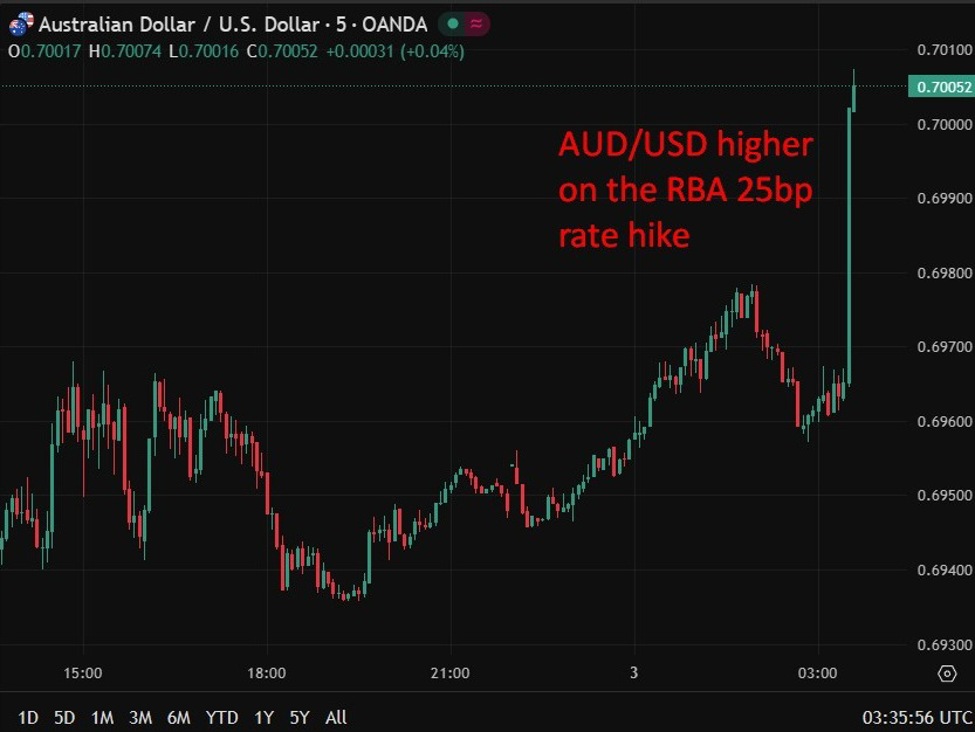
The decision to hike the cash rate was unanimous as the RBA produces a more hawkish tilt in their decision today. While the decision to hike in itself isn’t surprising, it is more so the language that is accompanying the decision that is moving markets. The RBA went from trying to sell a narrative of two-sided risks in December to completely siding with needing to deal with higher inflation pressures now and perhaps for the year ahead.This was their statement on forward guidance back in December last year:”The recent data suggest the risks to inflation have tilted to the upside, but it will take a little longer to assess the persistence of inflationary pressures. Private demand is recovering. Labour market conditions still appear a little tight but further modest easing is expected. The Board therefore judged that it was appropriate to remain cautious, updating its view of the outlook as the data evolve.”And they shifted from that to this one today:”A wide range of data over recent months have confirmed that inflationary pressures picked up materially in the second half of 2025. While part of the pick-up in inflation is assessed to reflect temporary factors, it is evident that private demand is growing more quickly than expected, capacity pressures are greater than previously assessed and labour market conditions are a little tight. The Board judged that inflation is likely to remain above target for some time and it was appropriate to increase the cash rate target.”The key point is highlighted in bold as the RBA now forecasts inflation to be higher for an extended period of time, even if they continue to view that the underlying drivers impacting price pressures may only be temporary.Besides that, their cash rate assumption also shows no signs of further easing and instead reflects more rate hikes in due time.At the balance, this does not seem like a central bank that is still weighing up monetary easing. The fact that even with projected rate hikes in their forecast above, it’s still borderline in getting inflation back into their target band.I would take that as a rather hawkish sign and an implicit tell that perhaps they could be hiking rates sooner rather than later instead.I mean, it could be a one-and-done until they get more evidence of changes to the inflation picture. However, it is clear that they are almost surely done with the easing part of the cycle already.On inflation developments, the RBA argued two key points:Capacity pressures are judged to have contributed to high underlying inflation but are unlikely to explain the majority of the recent increaseThe larger part of the resurgence in inflation is judged to reflect some sector-specific demand and price pressures, which may not persistHowever, the overall judgement is very uncertainTo put it more plainly, this rate hike is mostly to deal with capacity pressures. But for further rate hikes to come along, the threshold is likely to be much higher. That of course subject to inflation developments.So, how are markets reacting?The Australian dollar is catching a modest bid, with markets previously only pricing in ~78% odds of a rate hike coming into the decision today. A more hawkish tilt also lays out the potential for more rate hikes to come, with cash rate futures now showing ~41 bps of rate hikes to follow after this one.For some context, traders were only pricing in ~57 bps of rate hikes (including the one for today) before this.AUD/USD is trading back up to above 0.7000 now and is up over 1% on the day. The jump higher not only takes out the figure level but pushes back above the 100-hour moving average (red line) of 0.6997. The firm break back above the key near-term level now sees the bias turn more bullish again for the pair.A bit of a dollar recovery might still cap gains to start the week but all else being equal, the aussie looks well positioned for a continued move higher this year. That especially if global growth holds up and we see a rebound back in precious metals/commodities eventually.And the RBA is definitely playing a helping hand in becoming the first major central bank to complete the pivot back to rate hikes. This article was written by Justin Low at investinglive.com. 🔗 Source 💡 DMK Insight The RBA’s unanimous cash rate hike signals a shift in monetary policy, and here’s why that matters: Traders should pay close attention to the RBA’s hawkish language, as it indicates a stronger commitment to controlling inflation. This could lead to increased volatility in the forex market, particularly for AUD pairs. A stronger AUD might emerge if traders interpret this as a signal for further rate hikes, impacting commodities and equities tied to Australian economic performance. Look for key levels around recent highs in AUD/USD, as a break could trigger momentum buying. On the flip side, if the market perceives this as a one-off move rather than a sustained trend, we could see a quick reversal. Keep an eye on upcoming economic data releases that could either support or undermine the RBA’s stance. The immediate focus should be on how the market reacts in the next few days, especially if we see a divergence in economic indicators from Australia compared to its trading partners. 📮 Takeaway Watch for AUD/USD around recent highs; a break could signal further strength, but be cautious of potential reversals based on upcoming economic data.
RBA governor Bullock says that inflation pulse is too strong
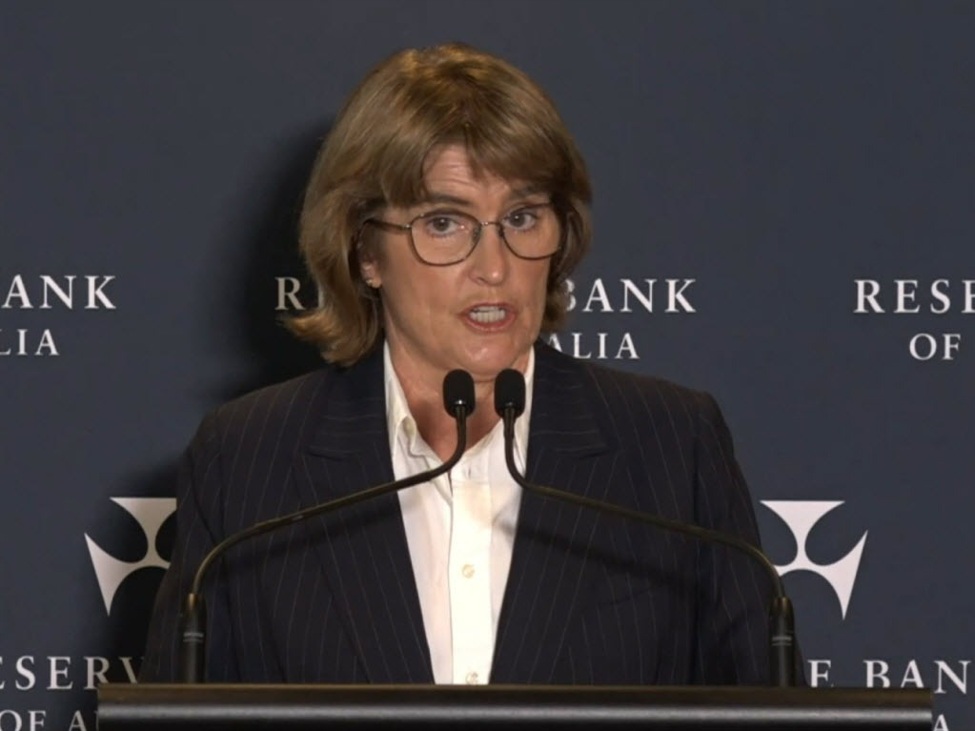
It will now take longer for inflation to return to the targetAnd this is no longer an acceptable outcomeWe cannot allow inflation to get away from us againThe pickup in inflation is not down to just one factorIt is due to a combination of factors across a broad range of components and sectorsRight from the get go, we’re seeing Bullock shift the narrative to basically say “inflation is a problem” now. And that effectively puts to bed any thoughts about two-sided risks or reversing back to the easing part of the cycle again. The outlook picture that she is painting is one that the RBA has to deal with higher price pressures more than anything else moving forward.Her remarks from the Q&A session:We felt it was necessary today to make an adjustmentWill continuously monitor and update forecasts based on data developmentsCurrent forecast/projection is based on the view that some factors driving up inflation is temporaryNot making any predictions, not giving any forward guidance; to remain focused on the dataNo discussion about a 50 bps rate hikeA reminder that forecasts the further out you go, becomes more and more uncertainNo particular path in mind on the cash rateAnd we’re going to monitor and wait, as we did when rates were on the way downWe think there’s some temporary drivers to inflation and hopefully it will come down, so that will helpI think we were doing the right thing last year but circumstances changeThe point highlighted in bold is something to be wary of. Their current view is that if the factors driving up inflation is temporary, they can adopt a slower approach to hiking the cash rate through to 2027. The indirect meaning of that is if the underlying factors appear to be stronger than anticipated, then they would have to move quicker instead. So, just be wary of that. This article was written by Justin Low at investinglive.com. 🔗 Source 💡 DMK Insight Inflation’s stubborn persistence is a wake-up call for traders—here’s why it matters now: The recent commentary suggests that inflation won’t return to target levels anytime soon, which could lead to prolonged volatility in both the forex and crypto markets. Traders should keep an eye on central bank responses, as any hawkish stance could strengthen the dollar and pressure risk assets like cryptocurrencies. A multi-faceted inflationary environment means that traders need to be agile, adjusting their strategies based on economic indicators and central bank signals. For instance, if inflation continues to rise, we might see interest rates increase, which historically leads to a stronger dollar and weaker performance in equities and crypto. But here’s the flip side: if inflation is driven by supply chain issues or other temporary factors, we could see a quick reversal, creating opportunities for short-term trades. Watch for key economic reports, especially CPI and PPI data, as these will provide insight into inflation trends. Also, keep an eye on the 1.05 level for the euro against the dollar; a break below could signal further dollar strength, impacting risk assets significantly. 📮 Takeaway Monitor inflation reports closely; a sustained rise could strengthen the dollar and pressure crypto, especially if the euro breaks below 1.05.
RBA governor Bullock says the Australian economy is in a good position
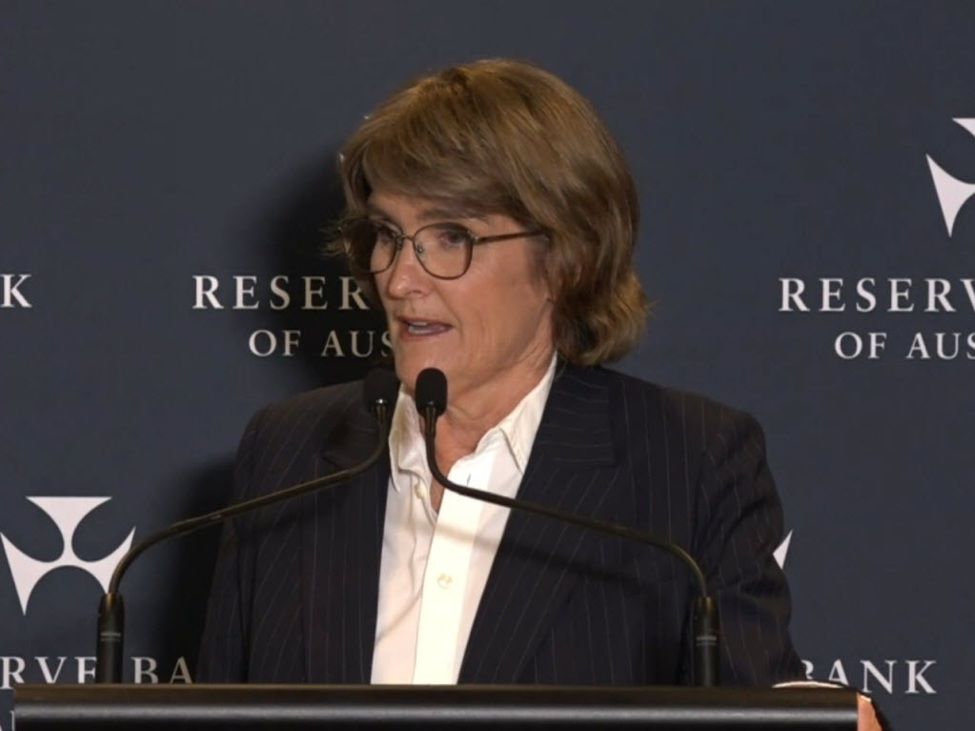
We are still looking to bring inflation down without sacrificing muchThe economy is actually in a really good positionThe labour market is really strong and domestic demand is recoveringBut it is just that we’re supply constrained, and it might be more so than what we thought a while backWe’re still adopting the same approach/strategy but it is always difficult to strike a balanceWe are uncomfortable with inflation at the level it is currentlyIf inflation continues to keep at this level, that is not acceptable; hence, the rate hike todayThere is uncertainty surrounding the persistence of inflation pressuresWe might have to raise the cash rate further if inflation remains more persistentAustralian dollar appreciating does help to provide a buffer for the economyWe already factored in a higher exchange rate into our forecastWe expect Australian dollar to shift up as interest differentials move in our favourThis is not the same tightening cycle when we came out of the Covid pandemicWe cannot rule anything in or out at this stage, it’s not clear one way or the otherNow we’re actively monitoring data to try and figure out how to bring inflation backA lot of the questions are basically just roundabout ways of trying to question if there will be more rate hikes to come and if the RBA has gotten it “wrong” with their policy moves last year. Just as an aside though, this rate hike comes six months after the last rate cut and fits with the timeline lag in how the RBA has conducted policy pivots in the past. So, I’m not sure what the fuss is all about. I guess everyone just wants to find fault with something, as controversy sells.Just to sum things up, Bullock has basically just said that they will be keeping more cautious and they will be taking a more data-dependent approach. They’re not going to pre-commit to any further rate hikes but it is clear now that inflation is the main problem they’re dealing with.Given the circumstances, they’re expecting price developments to look better over time and not rush them to hike rates more aggressively. However, the caveat here is that if inflation pressures are not as temporary as they anticipate, it could force them to raise the cash rate at a quicker pace.So, that is the main takeaway for me here. AUD/USD is trading up 0.9% to 0.7013 currently. This article was written by Justin Low at investinglive.com. 🔗 Source 💡 DMK Insight Inflation remains a hot topic, and the current economic indicators suggest a complex balancing act. With a strong labor market and recovering domestic demand, traders might feel optimistic. However, the mention of supply constraints hints at potential volatility ahead. If supply issues persist, we could see inflation remain sticky, which might force central banks to adjust their monetary policies sooner than expected. This could impact interest rates and, consequently, forex pairs sensitive to rate changes. For day traders, keeping an eye on economic releases, particularly those related to inflation and employment, is crucial. A sudden shift in these indicators could lead to rapid price movements in both forex and crypto markets. Watch for key levels in major currency pairs; for instance, if USD/JPY breaks above a certain resistance level, it could signal a bullish trend influenced by inflation data. The real story is how these supply constraints could ripple through various sectors, affecting everything from commodities to equities. As we move forward, monitor the upcoming economic reports closely, especially those related to inflation and supply chain metrics, as they could dictate market sentiment and trading strategies. 📮 Takeaway Watch for inflation reports and supply chain updates; they could trigger significant moves in forex and crypto markets.

FX option expiries for 3 February 10am New York cut
There is arguably just one to take note of on the day, as highlighted in bold below.That being for EUR/USD at the 1.1850 level. It’s not one that ties too closely to any key technical levels but could help to limit upside extensions later on in the session, if any. The pair has been trending lower this week, now falling back below both its key hourly moving averages. The 200-hour moving average now is the closest at 1.1865, so keep below that and the near-term bias stays more bearish.So, the expiries could just add another layer nearby on any price spikes depending on the overall market mood. But for now, it’s all about dollar sentiment being the bigger driver of price action more than anything else.The greenback has recovered modestly amid the selloff in precious metals but we’re seeing a bit of a breather in the latter now. So, that’s keeping traders on edge a little in figuring out the next move. It won’t be helped of course by yet another delay to the US non-farm payrolls data release amid the US government shutdown. Oh, what fun.For more information on how to use this data, you may refer to this post here.Head on over to investingLive (formerly ForexLive) to get in on the know! This article was written by Justin Low at investinglive.com. 🔗 Source 💡 DMK Insight EUR/USD hitting 1.1850 could be a pivotal moment for traders today. While this level isn’t tied to major technical indicators, it serves as a psychological barrier that might cap any bullish momentum. If the pair approaches this level and fails to break through, we could see a pullback, especially if broader market sentiment shifts. Keep an eye on the economic calendar for any news that might influence the euro or dollar, as volatility could spike around key announcements. Additionally, if 1.1850 holds, it could trigger selling from traders looking to capitalize on a reversal, impacting correlated pairs like GBP/USD or AUD/USD. Watch for price action around this level; a decisive break could lead to a new trend, while a rejection might signal a short-term bearish outlook. 📮 Takeaway Monitor the 1.1850 level on EUR/USD closely; a rejection here could lead to a significant pullback.

HFM Launches New Educational Suite for 2026
HFM begins 2026 by announcing the release of its latest Trading Courses and a new eBook. HFM aims to reinforce the company’s commitment to empowering traders through high-quality education.Products have been put together for both beginners and experienced traders. The new Trading Courses cover essential market concepts, practical trading strategies, and risk management techniques. These courses aim to help learners build confidence, sharpen decision-making skills, and better understand today’s fast-moving trading markets.Complementing the courses, HFM’s newly released eBook serves as a practical guide that traders can reference at their own pace. HFM’s latest eBook addition is ‘A Trader’s Guide to Economics and Fundamental Analysis’.With this latest educational offering, HFM continues to invest in trader development by providing accessible, professional, and relevant learning tools. The new Trading Courses and eBook are now available through HFM’s platforms, offering traders an opportunity to expand their skills and trade with greater confidence.For more information about HFM’s educational resources, visit the official HFM website. This article was written by IL Contributors at investinglive.com. 🔗 Source 💡 DMK Insight HFM’s launch of new Trading Courses and an eBook could shift trader sentiment, especially with ETH at $2,281.88. Education is key in volatile markets, and with ETH’s current price, traders might be looking for strategies to navigate potential fluctuations. The focus on both beginners and experienced traders suggests a broad appeal, which could lead to increased participation in the market. If these courses provide actionable insights, we might see a rise in trading volume, particularly around key technical levels for ETH. Watch for how this educational push influences trader behavior in the coming weeks, especially if ETH approaches significant support or resistance levels. On the flip side, while education is beneficial, it’s crucial to remain skeptical of any claims about guaranteed success. Traders should assess the credibility of the content and consider how it aligns with their own strategies. Keep an eye on ETH’s price action and any shifts in trading volume as these courses roll out. 📮 Takeaway Monitor ETH’s price action around $2,281.88 for potential trading opportunities as HFM’s educational offerings could influence market sentiment and activity.
Reminder: US jobs report this week delayed again amid government shutdown
From yesterday: Non-farm payrolls delayed: US won’t release the January jobs report as scheduled on FridayThis will just continue to paint a bad image on the incumbent US administration, with this adding to the delays from the longest federal government shutdown in US history late last year. The BLS has said that the latest jobs report for January will be delayed and rescheduled “upon the resumption of government funding”.It is expected that the partial shutdown will end at least later today. However, the fact that these kinds of disruptions are impacting markets is hardly assuring. As mentioned yesterday:”A one or two-week delay might not seem like much, but it’s testament to the shaky and uncertain nature of the US administrative policy at the moment. And that will have its own sentiment knock on the way investors view the US outlook.”With markets already punishing the dollar and the US outlook amid incoherent and uncertain policy setting from the administration, a shutdown delaying key economic data releases won’t help whatsoever. That especially since it will leave the Fed flying blind once again. And that’s never a good thing.The main worry now is that if this is going to be a repeat episode and keep happening every now and then. If so, that’ll be a massive knock to investor confidence – not least when Trump already has his hands in the cookie jar in the BLS. And especially if it comes at a time when the Fed may need to rely heavily on the data for policy conviction and decision-making. Rough.With the absence of the non-farm payrolls data, that leaves just the ADP employment report, ISM services PMI survey, and University of Michigan consumer sentiment survey as the only key releases on the data docket for the US this week. This article was written by Justin Low at investinglive.com. 🔗 Source 💡 DMK Insight The delay in the non-farm payrolls report is a big deal for traders right now. This isn’t just about missing a data point; it reflects broader economic uncertainty and could impact market sentiment significantly. With the US government shutdown still fresh in traders’ minds, this delay might exacerbate fears around economic stability. Traders should be cautious, as this could lead to increased volatility in both the forex and equity markets. If the jobs report is delayed further, we might see a shift in trading strategies, especially for those relying on economic indicators to guide their positions. Keep an eye on the USD, as any negative sentiment could weaken it against major pairs. On the flip side, this could create a buying opportunity for those looking at safe-haven assets like gold or the Swiss franc. If traders anticipate a weaker dollar, they might flock to these assets, pushing their prices higher. Watch for any comments from the Federal Reserve regarding this delay, as they could provide hints on monetary policy adjustments. The immediate focus should be on how the market reacts in the next few days, especially around key support and resistance levels for the USD. 📮 Takeaway Monitor USD performance closely; a weaker dollar could boost safe-haven assets like gold and the Swiss franc in the coming days.