
 Bitcoin
  Ethereum
  Tether
  BNB
BNB  XRP
XRP  USDC
USDC  Solana
  TRON
TRON  Lido Staked Ether
  Figure Heloc
Lawmakers begin debating amendments to a sweeping digital asset market structure proposal as Congress looks to clarify oversight of crypto markets. 🔗 Source 💡 DMK Insight Congress is finally tackling crypto oversight, and here’s why that matters right now: As lawmakers debate amendments to a comprehensive digital asset market structure proposal, traders should be aware that this could lead to significant regulatory changes. If passed, these amendments could clarify the rules for crypto trading, potentially impacting everything from compliance costs to market access for institutional players. A clearer regulatory framework might attract more institutional investment, which could bolster market liquidity and stability. However, there’s a flip side: increased regulation could also stifle innovation and push some projects offshore, leading to reduced competition. Traders should keep an eye on key developments in Congress, especially any timelines for votes or further hearings. If the proposal gains traction, it could create volatility in the crypto markets as participants react to the news. Watch for price movements in major cryptocurrencies and related assets like Bitcoin and Ethereum, as they often respond sharply to regulatory news. The next few weeks could be pivotal, so stay alert for updates and prepare for potential trading opportunities or risks. 📮 Takeaway Monitor Congress for updates on the digital asset proposal; regulatory clarity could drive institutional interest and market volatility in the coming weeks.

SEC, CFTC strike cooperative tone ahead of White House crypto meeting
SEC Chair Paul Atkins and CFTC Chair Mike Selig spoke on CNBC on Thursday as debate continued over stablecoin yield in the CLARITY Act. 🔗 Source 💡 DMK Insight The ongoing debate over stablecoin yield in the CLARITY Act is a pivotal moment for crypto traders. With SEC Chair Paul Atkins and CFTC Chair Mike Selig discussing this on CNBC, traders should be paying close attention. Regulatory clarity could significantly impact how stablecoins are perceived and utilized, especially regarding yield generation. If the CLARITY Act leans towards stricter regulations, it might dampen the attractiveness of stablecoin yields, leading to a potential sell-off in related assets. Conversely, a more favorable outcome could boost confidence and drive capital into stablecoins, affecting liquidity across the crypto market. Watch for any shifts in sentiment or policy announcements that could create volatility in both stablecoins and broader crypto assets. Key levels to monitor include the performance of major stablecoins like USDC and USDT, as well as their correlation with Bitcoin and Ethereum, which could react sharply to regulatory news. Keep an eye on the coming weeks as discussions evolve, as this could set the tone for year-end trading strategies. 📮 Takeaway Watch for developments in the CLARITY Act debate; regulatory clarity could shift stablecoin dynamics and impact market liquidity significantly.

US market regulators move to coordinate on crypto oversight
The chairs of the CFTC and SEC appeared together at a joint agency event Thursday to discuss a unified approach to crypto regulation. 🔗 Source 💡 DMK Insight The SEC and CFTC’s joint event signals a potential shift in crypto regulation, and here’s why that matters: A unified regulatory approach could bring much-needed clarity to the crypto market, which has been plagued by uncertainty. For traders, this means that regulatory compliance might become more predictable, potentially reducing the risk of sudden market shocks. If the agencies can align on key issues, we could see a more stable environment for assets like ETH, currently at $2,732.29. Watch for any hints on specific regulations that could impact trading strategies, especially for those holding positions in altcoins that might be classified differently under new rules. But there’s a flip side: if the regulations are too stringent, we could see a flight of capital from the U.S. markets to more crypto-friendly jurisdictions. This could lead to increased volatility in the short term as traders react to the news. Keep an eye on ETH’s support levels around $2,600; a break below could trigger further selling pressure. Overall, this development is worth monitoring closely as it unfolds, especially for those looking to position themselves ahead of regulatory changes. 📮 Takeaway Watch ETH closely around $2,600; regulatory clarity could stabilize prices, but strict rules might trigger volatility.
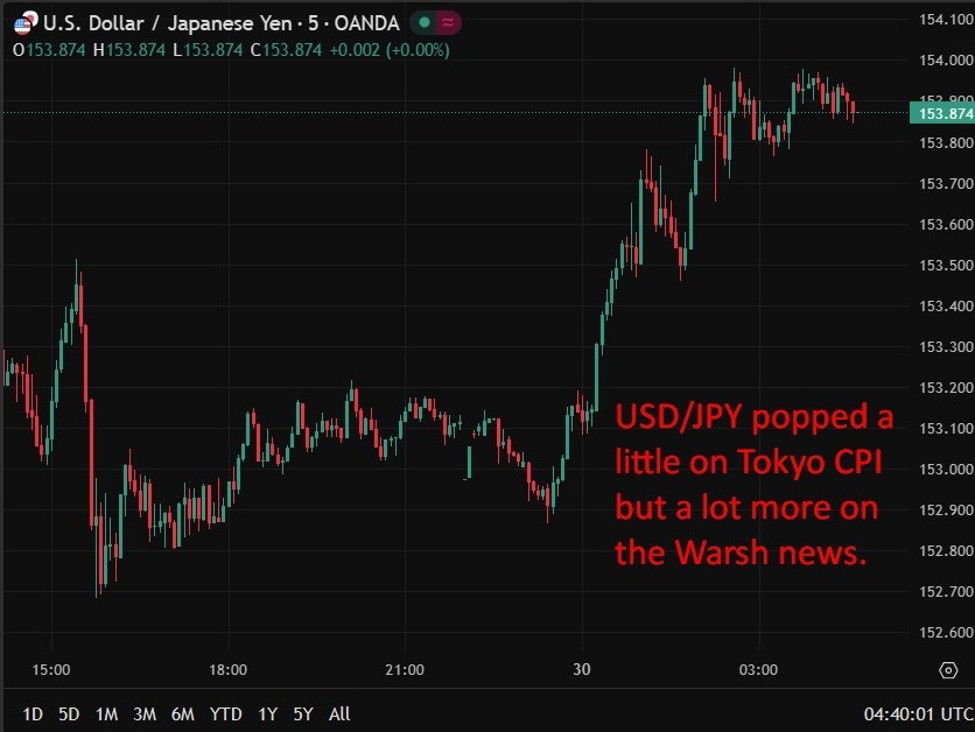
investingLive Asia-Pacific FX news wrap: USD rose on Warsh Trump Fed Chair pick talk
Morgan Stanley sticks with Nvidia, says underperformance is overblownTrump warns UK over China ties as Starmer hails diplomatic resetUSD higher everywhere. Crypto particularly hard hit. BTC/USD lows circa $81K.London Metal Exchange resumed trading at 0200 GMT after a one-hour delayRBA tipped to hike to 3.85% in February after inflation surprise – pollWSJ reported Trump and Senate Democrats struck a shutdown-avoidance dealTrump signals talks with Iran amid rising military tensionsPBOC sets USD/ CNY reference rate for today at 6.9678 (vs. estimate at 6.9459)UK business confidence slips as global economic worries intensifyUSD has jumped on rumors Kevin Warsh will be new Fed Chair, announcement due FridayJapan’s factory output edged down in December, nat as bad as expectedTokyo inflation cools in January, reducing BoJ rate hike urgency. Weight on yen.Latest Trump tantrum, threatens 50% aircraft tariff on Canada over jet certification fightJapan inflation – January Tokyo CPI Headline 1.5% y/y (prior 2%)US Treasury says yuan undervalued, urges China to allow appreciationUS shutdown risk eases as Senate splits DHS funding, adopts stopgapUBS ramps up gold targets, flags $7,200 bull case as demand surgesNZ consumer confidence hits four-year high in January as retail gauge turns positiveApple beats Q1 estimates as iPhone revenue jumps and China surprisesSandisk delivered a major beat on both earnings and revenue, stock price soarsVisa beats Q1 estimates as cross-border volumes rise 12%investingLive Americas market news wrap: Gold goes for a wild rideAt a glance:The Trump administration is preparing to nominate Kevin Warsh as the next Fed chair, lifting the USD on hawkish assumptions.Tokyo CPI cooled in January, easing near-term pressure on the BoJ to hike again; USD/JPY rose more on Warsh news than Japan data.Apple forecast a sharp rebound in March-quarter revenue, led by iPhone demand and China.New Zealand consumer confidence hit a four-year high in January.Metals were mildly softer, while a Panama court ruling raised fresh risks for Chinese port ownership.The Trump administration is reportedly preparing to nominate Kevin Warsh as the next Federal Reserve chair, with Donald Trump expected to announce his decision on Friday morning. Warsh is understood to be on a four-person shortlist and visited the White House on Thursday, though sources cautioned that the decision is not final until Trump makes a formal announcement. Other candidates under consideration include Kevin Hassett, Christopher Waller, and Rick Rieder of BlackRock.The US dollar strengthened broadly on the report, with markets treating Warsh as a hawkish appointment. That assumption is being questioned in some quarters. While Warsh was clearly hawkish prior to aligning himself with Trump, it is less obvious that a Trump-appointed Fed chair would be encouraged to maintain that stance. The question for markets is why Trump would choose a genuinely hawkish central banker.In Japan, Tokyo inflation data for January came in softer than expected. Headline CPI slowed to 1.5% y/y from 2.0%, while core inflation eased to 2.0% from 2.3%. Underlying measures also cooled, reducing the urgency for further Bank of Japan rate hikes following December’s move to a 30-year high. Labour market conditions remained firm, but USD/JPY gained far more on the Warsh news than on the CPI release.Elsewhere, Apple forecast revenue growth of up to 16% for the March quarter, comfortably ahead of expectations, driven by strong iPhone demand and a rebound in China. In New Zealand, ANZ-Roy Morgan consumer confidence rose to its highest level since August 2021.Metals were mildly pressured, with spot gold and silver lower and CME copper futures softer. Trading on the London Metal Exchange was briefly delayed by technical issues. Finally, a Panama court voided port contracts held by CK Hutchison, raising fresh concerns over Chinese infrastructure ownership. Asia-Pac stocks: Japan (Nikkei 225) +0.03%Hong Kong (Hang Seng) -1.78% Shanghai Composite -1.19%Australia (S&P/ASX 200) -0.67%Bitcoin continue to post lower lows: This article was written by Eamonn Sheridan at investinglive.com. 🔗 Source 💡 DMK Insight Bitcoin’s recent dip to around $81K signals a critical moment for traders: volatility is back. With BTC currently at $82,689, the market’s reaction to the broader economic landscape, including a stronger USD and potential interest rate hikes, is palpable. The RBA’s expected move to 3.85% in February could further pressure crypto markets, as higher rates typically strengthen the dollar and dampen risk appetite. Traders should watch for support around the $81K level; a break below could trigger further selling, while a rebound might indicate a buying opportunity. Keep an eye on correlated assets like Nvidia, which Morgan Stanley believes is undervalued despite recent underperformance. This could reflect a broader tech sector sentiment that might spill over into crypto. Here’s the thing: while the mainstream narrative focuses on the immediate downturn, there’s potential for a contrarian play if BTC holds above $81K. If it can consolidate and push back up, it could attract buyers looking for value in a volatile market. Watch for trading volumes and sentiment shifts as key indicators of where BTC might head next. 📮 Takeaway Monitor BTC closely around the $81K support level; a break could lead to further declines, while a bounce may signal a buying opportunity.

Gold volatility continues after quick bout of profit-taking yesterday
Things are certainly heating up as we clock into the final trading day of January. Precious metals were hit by a quick bout of profit-taking in US trading yesterday, which briefly sent gold down to a low of $5,097. Dip buyers didn’t take long to step in but since then, the volatility swings are very much continuing.Of note, dip buyers put up a defense at a key near-term level in defending the 100-hour moving average. That is also helped by bids layered at the $5,100 mark perhaps. Looking closer at price action, things are looking dicey now with gold dipping back under the key near-term level (red line):A firm break under the 100-hour moving average of $5,225 will help to keep buyers and those in long positions on their toes. That as profit-taking action could hit hard and fast, resulting in a more significant correction.As a reminder, profit-taking begets profit-taking and is a cascading move when it comes to market sentiment. That especially on any asset that goes parabolic, like what we’ve seen with gold and silver this month. So, just be wary of that.For now, the technical lines continue to suggest that we’re not quite there yet as dip buyers are still hanging on. I would argue a firmer break under the $5,100 mark as well as the 200-hour moving average (blue line) would be much needed to confirm a potential for a much stronger retracement in price action.The other thing to note is that the January seasonal tailwind is coming to an end for gold. February is still a decent month for gold, with the precious metal average roughly 1% gains on the second month of the new year over the past two decades. That being said, gold has traded down in 5 out of the last 8 February months. And in that stretch, a gain in January has coincided with a corresponding decline in February for gold prices with exception to 2025. So, make what you will of that. This article was written by Justin Low at investinglive.com. 🔗 Source 💡 DMK Insight Gold’s recent dip to $5,097 highlights a critical moment for traders: profit-taking can create buying opportunities. As we close January, the volatility in precious metals is a reminder of how quickly sentiment can shift. The quick rebound after the dip indicates strong support levels, suggesting that traders should keep an eye on the $5,100 mark as a potential pivot point. If gold holds above this level, it could signal a bullish trend, especially with ongoing geopolitical tensions and inflation concerns that typically drive demand for safe-haven assets. However, if it breaks below, we might see further selling pressure. Look out for related movements in silver and platinum, as they often follow gold’s lead. The interplay between these metals can provide additional insights into market sentiment. Monitoring the daily trading volume and the RSI (Relative Strength Index) could also give clues about whether this rebound is sustainable or just a temporary bounce before another sell-off. 📮 Takeaway Watch the $5,100 level in gold; a hold above could trigger bullish momentum, while a break below may invite further selling pressure.

Plenty of key economic data releases coming up in European trading today
Market players will be watching precious metals closely as we look to wrap up January trading. That will not only have an impact in the commodities space but there will be broader spillovers to the likes of the dollar and risk sentiment as well. As we see the profit-taking and volatility swings accelerate, it could cause a bit of a ruckus and mess in the day ahead.The dollar is already holding firmer across the board now with gold dropping by 3% to around $5,200 and silver down some 4% to $110 levels at the moment. It’s wild to think that even with a $500 drop in gold in a day, it isn’t exactly a “big deal” for markets like what we saw yesterday. But now, the nerves are starting to creep in and that is resulting in broader reverberations elsewhere.Looking to European trading, we will have plenty of data points to work through but none of which will be all too impactful. The ECB is to remain on the sidelines indefinitely, awaiting a shift in the fundamental narrative especially on the German economy.Today, we will be getting the latest inflation snapshot for Germany. However, it’s not likely to offer much unless the numbers surprise with a heavy deviation. But even then, it’s just one data point and not something that will get the ECB to rush off their seats.0630 GMT – France Q4 preliminary GDP figures0700 GMT – Germany December import price index0800 GMT – Spain Q4 preliminary GDP figures0800 GMT – Spain January preliminary CPI figures0855 GMT – Germany January unemployment change, rate0900 GMT – Germany Q4 preliminary GDP figures0900 GMT – Germany January state CPI readings0900 GMT – Italy Q4 preliminary GDP figures0900 GMT – UK December mortgage approvals, credit data1000 GMT – Eurozone Q4 preliminary GDP figures1300 GMT – Germany January preliminary CPI figures This article was written by Justin Low at investinglive.com. 🔗 Source 💡 DMK Insight January’s close is crucial for precious metals, and here’s why: profit-taking could shift market dynamics. As traders wrap up the month, the focus on precious metals like gold and silver is intensifying. A strong finish could signal renewed interest, impacting not just commodities but also the dollar and overall risk sentiment. If profit-taking leads to a dip, we might see a stronger dollar, which typically pressures gold prices. Watch for key resistance levels in gold around recent highs; a failure to break through could trigger further selling. Conversely, if we see a rebound in precious metals, it could indicate a shift in risk appetite, potentially benefiting equities as well. But keep an eye on the broader economic indicators, like upcoming employment data, which could influence Fed policy and, in turn, affect both the dollar and precious metals. The real story is how these dynamics play out in the next few weeks, especially as we head into February. Traders should monitor gold’s performance closely, particularly around key technical levels, to gauge potential moves in related markets. 📮 Takeaway Watch gold’s resistance levels closely; a failure to break through could signal profit-taking and a stronger dollar in February.

France Q4 preliminary GDP +0.2% vs +0.2% q/q expected
Prior +0.5%GDP +1.1% vs +1.2% y/y expectedPrior +0.9%The headline reading meets estimates as the French economy grew slightly in the final quarter of last year. Overall, French GDP expanded by 0.9% in 2025 and that’s a slight decline from the 1.1% growth seen in 2024.Looking at the breakdown for the year, household consumption posted a modest growth of 0.4% on the year with the final quarter coming in strong as well with a 0.3% jump. Total government expenditure was up 1.7% on the year with imports up 2.9% while exports were up 1.4% in terms of overall growth contributions.In terms of actual percentage contributions, internal demand excluding inventory changes accounted for 0.7% of GDP growth. Meanwhile, inventory changes itself also accounted for 0.7%. The offsetting line was net foreign trade, which subtracted 0.5% from GDP.Here’s the full breakdown: This article was written by Justin Low at investinglive.com. 🔗 Source 💡 DMK Insight French GDP growth hitting 0.9% is a mixed bag for traders: here’s why. While the headline figure meets expectations, the decline from 1.1% in 2024 raises questions about the sustainability of this growth. For forex traders, this could mean a cautious approach to EUR/USD pairs, especially if the market reacts negatively to the slower growth rate. If economic indicators continue to show weakness, we might see the euro under pressure against the dollar, particularly if the Fed maintains a hawkish stance. Keep an eye on the 1.05 support level for EUR/USD; a break below could trigger further selling. On the flip side, if the French economy shows resilience in upcoming reports, it could bolster the euro. Traders should monitor upcoming employment data and consumer sentiment reports for clues on whether this growth trend can hold. The real story is whether this slowdown is a temporary blip or a sign of deeper economic issues. Watch for volatility around these releases, as they could impact not just the euro but also related assets like European equities. 📮 Takeaway Watch the 1.05 support level for EUR/USD; a break could signal further downside as traders react to the slower French GDP growth.

FX option expiries for 30 January 10am New York cut
There is arguably just one to take note of on the day, as highlighted in bold below.That being for EUR/USD at the 1.1900 level. The expiries don’t tie to any technical significance but are resting just under the 100-hour moving average of 1.1935 currently. The pair is finding a bit of a push and pull in trying to keep above 1.1900 with bids layered there too during the week, so the expiries will add another layer in defending that.However, dollar sentiment remains the main driver at the moment. And that will largely be affected by the action in precious metals. As gold and silver are down and may be poised to correct further, that will invite dollar shorts to be covered as well. As such, the impact of the expiries will be lesser when accounting for this key factor driving trading sentiment currently.There are other large ones at 1.1800 and 1.1850 which could come into play, that is should the dollar jump much higher if we do see a much sharper decline in both gold and silver. That also as risk sentiment starts to get rocked by the profit-taking and volatility in precious metals.So, just keep that in mind as that is the bigger thing to watch out for in not only commodities but also major currencies at the moment. You have to keep your eye on what is happening with gold and silver to have a gauge of the spillover impact towards the dollar and the rest of the FX space.For more information on how to use this data, you may refer to this post here.Head on over to investingLive (formerly ForexLive) to get in on the know! This article was written by Justin Low at investinglive.com. 🔗 Source 💡 DMK Insight EUR/USD is flirting with critical levels, and here’s why that matters right now: The 1.1900 level is a psychological barrier, and with expiries just below the 100-hour moving average at 1.1935, traders should be on high alert. If the pair breaks below 1.1900, it could trigger a wave of selling, especially if we see increased volatility in the broader market. Conversely, a bounce off this level could signal a potential rally back towards the moving average, making it a key pivot point for day traders. Keep an eye on the 1.1935 level as well; if it holds, we might see a short-term bullish sentiment develop. But don’t ignore the potential for false breakouts. If the market sentiment shifts, particularly with any economic data releases or geopolitical tensions, the EUR/USD could react sharply. Watch for volume spikes around these levels to gauge market commitment. The next few hours could be pivotal, so stay nimble and ready to adjust your positions based on how the pair interacts with these key levels. 📮 Takeaway Watch the 1.1900 support level closely; a break could lead to increased selling pressure, while a bounce may signal a rally towards 1.1935.

Germany December import price index -0.1% vs -0.4% m/m expected
Prior +0.5%The year-on-year reading for December was for a decline of 2.3%, marking the sharpest year-on-year drop since March 2024. And overall in 2025, the annual average for German import prices showed a decrease of 0.3% compared to 2024.The breakdown shows the same story that it has been all year, that being the biggest drag on the overall development was the decline in energy prices. That was the same case for the monthly reading as well, with December reflecting a 4.6% drop in energy prices compared to November. If you strip that out, import prices were actually up 0.3% on the month instead.And looking over to the year-on-year estimate, it would just be a 0.3% decline if you exclude energy prices from the calculations.It’s the same as when we look at the annual average too. For some context, the 0.3% drop in 2025 isn’t as bad as the 1.2% drop in 2024 and 6.5% decline in 2023 before that. But when you strip out energy prices, the import price index was 0.7% higher on average in 2025 than in the previous year.The overall breakdown shows that prices for capital goods were also below the 2024 level in 2025 (-0.2%). In contrast, agricultural goods (+4.3%), consumer goods (+1.9%), and intermediate goods (+0.3%) were on average more expensive than in the previous year. This article was written by Justin Low at investinglive.com. 🔗 Source 💡 DMK Insight German import prices are down 2.3% year-on-year, and here’s why that matters: This decline signals potential deflationary pressures that could impact the Eurozone’s economic outlook. Traders should be aware that lower import prices might lead to reduced inflation expectations, which could influence the European Central Bank’s (ECB) monetary policy decisions. If the ECB perceives a need to adjust interest rates in response to these trends, it could affect the euro’s strength against other currencies, particularly the USD. Keep an eye on the EUR/USD pair, especially if it approaches key support levels. On the flip side, while this data might seem bearish for the euro, it could also present buying opportunities if traders anticipate a rebound in demand or if the ECB maintains a dovish stance. Watch for any comments from ECB officials regarding future rate hikes or economic forecasts, as these could provide clues on market direction. Overall, the immediate impact could be felt in the forex markets, particularly in the next few trading sessions as traders digest this data. 📮 Takeaway Monitor the EUR/USD pair closely; a break below key support could signal further weakness in the euro amid declining import prices.

Precious metals continue to see volatility spikes as correction danger builds
As we get into the session, everyone is keeping a watchful eye on precious metals at the moment. The parabolic surge higher was what captivated markets all through this month. However, is it finally running out of steam now as we are in the final stretch of January trading? It would be quite a timely one as the seasonal tailwind also draws to a close, especially for silver.Both gold and silver are being shoved lower today after a quick bout of profit-taking yesterday. The overnight drop was somewhat held by key near-term support but that is now starting to crack as we get into European trading.The near-term charts for both gold and silver are painting a similar picture. That being the latest drop now takes out the 100-hour moving average (red line), which shifts the near-term bias from being more bullish to more neutral instead.There’s still some work to fully break the momentum, which likely will result in a material pullback for both precious metals. The 200-hour moving average (blue line) will be an important line in the sand in that regard.However, do also keep a look out for round floor figures such as $5,100 and $5,000 for gold and then also $106 and $100 for silver respectively.A firmer break on those will likely run stops and trigger more profit-taking from certain quarters of the market. As a reminder, profit-taking begets profit-taking and it’s a cascading effect. So when it starts to run, it can really run. And that means any correction/pullback/retracement on this parabolic move can be potentially be a deep and sharp one.Circling back to the seasonal patterns, February is a bit of a mixed month for gold historically. It has been good sometimes in the past but in recent years, not so much. That especially in following up any gains from January with the exception of 2025.Meanwhile, February as a whole is not too bad a month for silver in the past two decades. However, that seasonal trend has sort of branched off to a different path in recent times. In the past eight years, silver has posted a drop in seven February months.So, there’s some argument there from a seasonal perspective that perhaps the parabolic surge higher may very well be running out of steam. That especially since January is usually the best month for both gold and silver. This article was written by Justin Low at investinglive.com. 🔗 Source 💡 DMK Insight Precious metals are at a critical juncture, and here’s why that matters for traders: The recent parabolic surge in precious metals has drawn significant attention, but as we approach the end of January, many are questioning whether this rally can sustain itself. Traders should be cautious, as the momentum indicators may be signaling overbought conditions. If gold and silver start to show signs of weakness, it could trigger profit-taking, leading to a sharp pullback. Watch for key support levels; if gold falls below its recent highs, it could open the door for a deeper correction. On the flip side, if these metals hold their ground, it could indicate strong underlying demand, especially with ongoing geopolitical tensions and inflation concerns. This could lead to renewed buying interest, particularly from institutional investors looking for safe-haven assets. Keep an eye on the daily charts for any reversal patterns that might signal a continuation of the uptrend. The next few days will be crucial for determining the short-term direction of these markets. 📮 Takeaway Watch for precious metals’ support levels; a break below recent highs could trigger a significant pullback.