
 Bitcoin
  Ethereum
  Tether
  XRP
XRP  BNB
BNB  USDC
USDC  Solana
  TRON
TRON  Lido Staked Ether
  Figure Heloc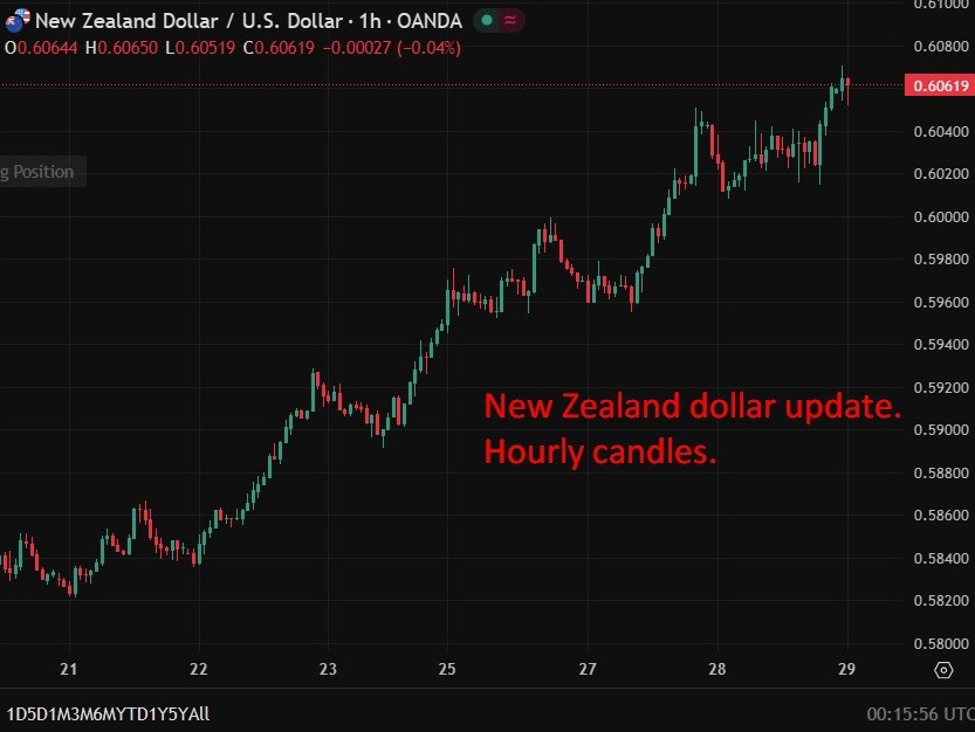
Business confidence remains exceptionally strong despite a pullback, but rising inflation and wage signals are emerging as a key risk.Summary:New Zealand business confidence eased in January but remains at extremely elevated levels, according to ANZ’s latest survey.Activity indicators point to a solid Q4 GDP outcome, with experienced activity and employment improving across most sectors.Inflation signals are re-emerging, with pricing intentions and cost expectations rising to multi-year highs.Wage pressures are picking up modestly, with more firms reporting wage increases and higher expected wage growth.ANZ says the recovery looks intact, but inflation risks may complicate the RBNZ policy outlook if pressures persist.New Zealand business confidence pulled back in January from December’s 30-year high but remains historically strong, according to the latest ANZ Business Outlook survey, as activity indicators stayed elevated while inflation pressures showed signs of re-emerging.ANZ said headline business confidence fell 10 points to 64, following December’s surge to 74, a level the bank noted was unlikely to be sustained. Expected own-activity also eased, dropping nine points to 52, though ANZ stressed this reading remains very strong by historical standards. Measures of experienced activity continued to signal momentum in the economy, with past activity at its second-highest level since August 2021 and past employment turning positive across all sectors for the first time since late 2022.The survey suggests the economic recovery that gained traction late last year has largely carried into early 2026. ANZ said reported past activity — a key lead indicator for GDP — points to the potential for a solid fourth-quarter growth outcome, with strength broadly based across sectors.However, inflation indicators were less encouraging. The net proportion of firms expecting to raise prices rose sharply to 56.5%, the highest since March 2023, while numerical pricing intentions climbed to 2.1%, a two-year high. Cost expectations also continued to edge higher, particularly in construction and retail, and one-year-ahead inflation expectations lifted to their highest level in 15 months.Wage pressures are also beginning to stir. Expected wage growth rose to 2.8%, while the share of firms reporting wage increases over the past year climbed to 72%, the strongest since April 2024.ANZ said the combination of resilient activity and rising inflation signals presents a mixed picture. While momentum remains intact despite higher interest rates, the bank warned that persistent pricing pressures could bring forward expectations for tighter monetary policy if they translate into official inflation data. This article was written by Eamonn Sheridan at investinglive.com. 🔗 Source 💡 DMK Insight New Zealand’s business confidence is still high, but inflation signals could shake things up. With SOL currently at $122.92, traders should keep an eye on how rising inflation and wage pressures might affect the broader market. If inflation continues to rise, it could lead to tighter monetary policies, which historically have a cooling effect on risk assets like cryptocurrencies. The strong business confidence suggests that the economy is resilient, but the potential for inflation to erode purchasing power can’t be ignored. This could lead to volatility in the crypto market as traders react to economic indicators. Watch for key inflation data releases and employment figures in the coming weeks. If inflation ticks higher, it might trigger a sell-off in risk assets, including SOL. Conversely, if business confidence translates into sustained economic growth without inflationary pressures, SOL could see upward momentum. Keep an eye on the $120 support level for SOL; a break below that could signal a bearish trend. 📮 Takeaway Monitor inflation data closely; a rise could pressure SOL below $120, while strong economic growth may support upward movement.

PBOC is expected to set the USD/CNY reference rate at 6.9521 – Reuters estimate
The People’s Bank of China is due to set the daily USD/CNY reference rate at around 0115 GMT (2115 US Eastern time), a fixing that remains one of the most closely watched signals in Asian foreign exchange markets. China operates a managed floating exchange rate system, under which the renminbi (yuan) is allowed to trade within a prescribed band around a central reference rate, or midpoint, set each trading day by the PBOC. The current trading band permits the currency to move plus or minus 2% from the official midpoint during onshore trading hours. Each morning, the PBOC determines the midpoint based on a range of inputs. These include the previous day’s closing price, movements in major currencies, particularly the US dollar, broader international FX conditions, and domestic economic considerations such as capital flows, growth momentum and financial stability objectives. The midpoint is not a purely mechanical calculation, allowing policymakers discretion to guide market expectations. Once the midpoint is announced, onshore USD/CNY is free to trade within the allowable band. If market pressures push the yuan toward either edge of that range, the central bank may step in to smooth volatility. Intervention can take the form of direct buying or selling of yuan, adjustments to liquidity conditions, or guidance through state-owned banks. As a result, the daily fixing is often interpreted as a policy signal rather than just a technical reference point. A stronger-than-expected CNY midpoint is typically read as a sign the PBOC is leaning against depreciation pressure, while a weaker fixing for the CNY can indicate tolerance for a softer currency, often in response to dollar strength or domestic economic headwinds.In periods of heightened global volatility, such as shifts in US rate expectations, trade tensions or capital flow pressures, the fixing takes on added significance. For investors, it provides insight into Beijing’s currency priorities, balancing competitiveness, capital stability and financial market confidence. This article was written by Eamonn Sheridan at investinglive.com. 🔗 Source 💡 DMK Insight The upcoming USD/CNY reference rate fixing is crucial for traders navigating the Asian forex markets right now. With the People’s Bank of China setting this rate, it can significantly influence market sentiment and trading strategies, especially for those holding positions in the Chinese yuan. A stronger yuan could lead to a ripple effect, impacting commodities priced in dollars and other Asian currencies. Traders should keep an eye on the market reaction post-fixing, as volatility can spike around this time. If the reference rate deviates from market expectations, it could trigger rapid moves in related assets, including AUD/USD and USD/JPY. Watch for any comments from the PBOC that might hint at future policy directions, as these could provide further context for the fixing. Here’s the thing: while many focus solely on the rate itself, the broader implications for trade balances and economic sentiment are equally important. If the yuan strengthens significantly, it could signal confidence in the Chinese economy, but it might also raise concerns about export competitiveness. Keep an eye on the 7.0 level for USD/CNY as a potential pivot point in the coming days. 📮 Takeaway Watch the USD/CNY reference rate closely; deviations from expectations could lead to significant volatility in related forex pairs, especially around the 7.0 level.
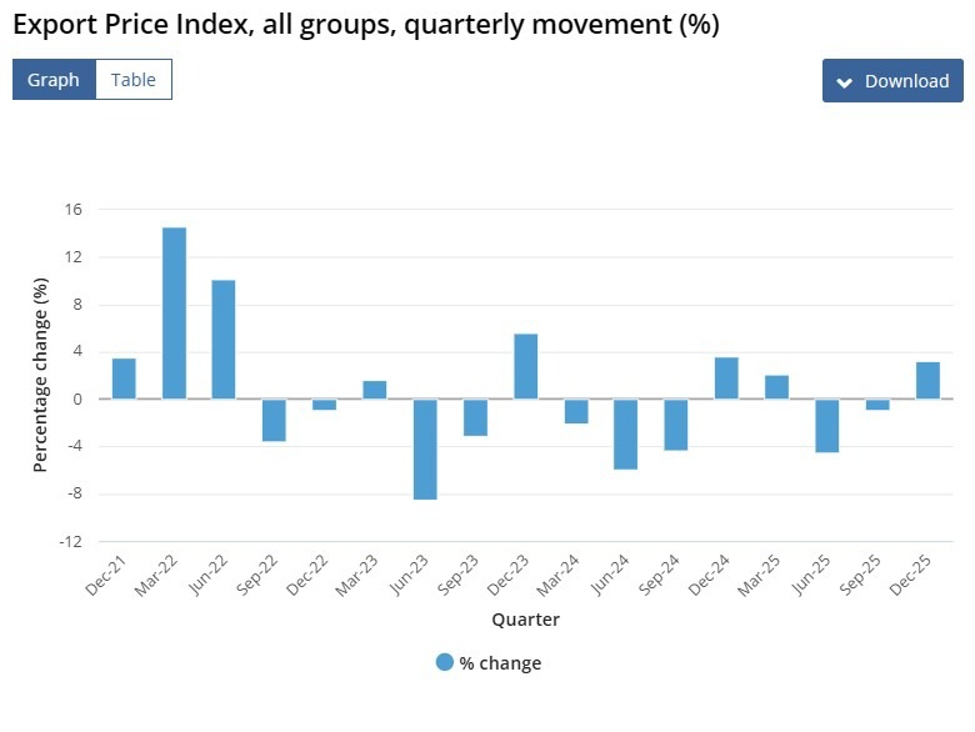
Australia’s Q4 trade prices lift terms of trade as export prices rebound
Australia’s Q4 trade prices point to improving terms of trade, offering modest support for national income and the AUD.Summary:Australian export prices rebounded strongly in Q4, rising 3.2% q/q after a sharp decline in the prior quarter.Import prices rose 0.9% q/q, defying expectations for a decline and marking a clear turnaround from Q3.The combined move implies an improvement in Australia’s terms of trade late in 2025.Stronger terms of trade tend to support national income, fiscal revenues and the Australian dollar.The data reinforces a more resilient external backdrop for Australia despite mixed domestic growth signals.Australian trade price data for the December quarter pointed to a notable improvement in the external backdrop, with export prices rebounding sharply and import prices rising unexpectedly, lifting Australia’s terms of trade.Export prices rose 3.2% quarter-on-quarter in Q4, reversing a 0.9% fall in Q3, as commodity prices stabilised and demand conditions improved late in the year. At the same time, import prices increased 0.9% q/q, well above expectations for a 0.2% decline and marking a clear turnaround from the previous quarter’s 0.4% fall.Taken together, the data imply a positive shift in Australia’s terms of trade, which measure the ratio of export prices to import prices. When export prices rise faster than import prices, the terms of trade improve, meaning the country earns more for its exports relative to what it pays for imports. This typically boosts national income, corporate profits in export-facing sectors and government revenues.For financial markets, the terms of trade are an important transmission channel to the Australian dollar. An improving terms-of-trade backdrop tends to support the currency by lifting export receipts, improving the current account position and reinforcing Australia’s attractiveness to foreign capital. Historically, sustained rises in export prices — particularly for bulk commodities — have been closely associated with periods of AUD strength.However, the relationship is not mechanical. Rising import prices can also feed into domestic inflation, particularly if higher costs are passed through to consumers. That dynamic may complicate the policy outlook if stronger trade prices coincide with already-sticky services inflation.Overall, the Q4 trade price data suggest Australia ended 2025 with a firmer external position than earlier in the year. While domestic growth and monetary policy remain the primary drivers for markets, an improving terms-of-trade profile provides a supportive backdrop for the Australian dollar and broader macro resilience into 2026. This article was written by Eamonn Sheridan at investinglive.com. 🔗 Source 💡 DMK Insight Australia’s Q4 trade price rebound is a game changer for the AUD and traders need to pay attention. The 3.2% rise in export prices signals a recovery in demand, which could bolster national income and strengthen the Australian dollar. This is particularly relevant as the AUD has been under pressure from global economic uncertainties. A stronger AUD could impact commodity prices, especially for gold and iron ore, which are key exports. Traders should watch for potential resistance levels around recent highs, as a sustained rally could trigger further bullish sentiment. On the flip side, the 0.9% rise in import prices suggests inflationary pressures might be building, which could complicate the Reserve Bank of Australia’s monetary policy. If inflation continues to rise, it might force the RBA to consider tightening sooner than expected, impacting interest rate expectations and market sentiment. Keep an eye on the AUD/USD pair, especially if it approaches key support levels in the coming weeks. 📮 Takeaway Watch the AUD/USD closely; a sustained rally above recent highs could signal further strength, while rising import prices may complicate RBA policy.

ICYMI – Tesla to end Model S and X production as Musk shifts focus to robots and autonomy
Tesla will phase out the Model S and X as it pivots toward robotaxis and humanoid robots, marking a major strategic shift.Summary:Elon Musk said Tesla will phase out Model S and Model X production, ending two of its longest-running vehicle lines.Production is expected to wind down next quarter, with full cessation planned as Tesla pivots toward robots and autonomy.Tesla will retool its Fremont, California factory to manufacture humanoid robots, including the planned Optimus line.The move marks a strategic shift away from legacy premium EVs toward robotaxis and AI-driven robotics.Tesla shares rose about 2% in after-hours trade, despite signs of broader revenue pressure.Tesla is set to end production of its Model S and Model X vehicles as the company accelerates a strategic pivot toward autonomous driving and humanoid robotics, according to comments from Chief Executive Elon Musk.Speaking on a call with investors and analysts on Wednesday (after earnings) , Musk said Tesla would begin phasing out the two models later this year, with production expected to wind down next quarter before coming to a halt. While the vehicles will no longer be built, Musk said Tesla will continue to support existing owners for as long as the cars remain on the road.The decision marks the end of an era for Tesla. The Model S, launched in 2012, played a critical role in bringing electric vehicles into the mainstream at a time when demand was widely questioned. The Model X followed in 2015, expanding Tesla’s lineup into the SUV segment, though it faced early reliability challenges. Together, the models helped establish Tesla as a dominant force in the global auto industry.Musk acknowledged the emotional weight of the decision but framed it as a necessary step in Tesla’s broader transformation. He said the phase-out is part of a wider operational overhaul designed to refocus the company on robotaxis and humanoid robots, which he views as Tesla’s long-term growth engines.As part of the shift, Tesla plans to convert its Fremont, California facility from a traditional auto manufacturing plant into a production hub for its planned Optimus humanoid robots. Those robots are not yet commercially available, and large-scale production timelines remain unclear.The announcement coincided with Tesla’s latest earnings release. While the company beat earnings expectations for the final quarter of last year, full-year revenue declined around 3% from 2024 levels, highlighting ongoing pressure on vehicle sales amid rising competition and softer demand. Tesla shares rose about 2% in after-hours trading following the update. This article was written by Eamonn Sheridan at investinglive.com. 🔗 Source 💡 DMK Insight Tesla’s decision to phase out the Model S and X is a bold pivot, and here’s why it matters now: This shift signals a significant strategic realignment towards robotaxis and humanoid robots, which could redefine Tesla’s market position. For traders, this means keeping a close eye on how this impacts Tesla’s stock price and overall market sentiment. Historically, major product line changes can lead to volatility, especially in the tech sector. As production winds down next quarter, watch for potential price fluctuations in Tesla shares, particularly around earnings reports or product announcements. If the market perceives this move as a positive step towards innovation, we could see a rally; however, if investors view it as a loss of traditional revenue streams, expect downward pressure. Also, consider the ripple effects on related sectors, like autonomous vehicle technology and battery production. If Tesla’s pivot succeeds, it could boost stocks in those areas. On the flip side, if the transition falters, it may create a bearish sentiment across the EV market. Keep an eye on key price levels for Tesla, especially around its support and resistance zones as this transition unfolds. 📮 Takeaway Watch Tesla’s stock closely as it phases out the Model S and X; key price levels to monitor are around recent support and resistance zones, especially leading into next quarter’s production changes.

PBOC sets USD/ CNY mid-point today at 6.9771 (vs. estimate at 6.9521)
The PBOC follows a managed floating exchange rate system that allows the value of the yuan to fluctuate within a +/- 2% range, around a central reference rate, or “midpoint.” The rate set under 7 today for the first time since May 2023.Previous close 6.9475.Injects 354bn yuan through 7-day reverse repos at 1.40%:net inject 143.8bn after today’s maturities This article was written by Eamonn Sheridan at investinglive.com. 🔗 Source 💡 DMK Insight The yuan’s drop below 7 is a big deal for traders: it signals potential volatility ahead. The People’s Bank of China (PBOC) is clearly trying to manage the yuan’s value, but breaking that psychological barrier could lead to increased market speculation. With the previous close at 6.9475, this shift might trigger a wave of reactions, especially from forex traders who often look for momentum plays. If the yuan continues to weaken, it could impact commodities priced in yuan, like oil and gold, making them more expensive for Chinese buyers. Keep an eye on the 7.02 resistance level; if we breach that, expect a flurry of activity. On the flip side, if the PBOC steps in with further interventions, it could stabilize the yuan, but traders need to be cautious. Watch for any statements from the PBOC that might hint at future policy changes. The immediate focus should be on the next few days as the market digests this new level, and consider how this might affect broader market sentiment, especially in emerging markets. 📮 Takeaway Watch the yuan closely; a break above 7.02 could spark significant trading opportunities in forex and commodities.

Banks lift gold forecasts as $6,000/oz targets emerge after record rally
Summary:Major banks are lifting gold price forecasts, with several now flagging $6,000/oz scenarios for 2026.Deutsche Bank sees persistent investment and central bank demand driving further upside, with an upside scenario near $6,900/oz.Societe Generale also targets $6,000/oz, warning its forecast may prove conservative.Goldman Sachs, Morgan Stanley and Citi all see material upside risks, even after gold’s record-breaking rally.Gold has surged more than 18% so far in 2026, following a 64% gain last year, as investors seek real assets.Reuters summarised gold price forecasts across major investment banks earlier this week. Some of the forecasts have been supassed, some already were. Several are projecting prices could reach or exceed $6,000 per ounce in 2026, driven by sustained investment demand and growing diversification away from the U.S. dollar.Deutsche Bank said on Tuesday that gold could climb to $6,000 per ounce next year, citing persistent demand from both central banks and private investors increasing allocations to real assets and non-dollar reserves. The bank added that, under alternative scenarios, prices closer to $6,900 per ounce would be more consistent with gold’s strong outperformance over the past two years.Societe Generale echoed that bullish view, forecasting gold will reach $6,000 per ounce, while warning that even this level may prove conservative if current trends persist. Other major banks remain constructive, though with slightly lower central forecasts. Morgan Stanley highlighted a bull-case target of $5,700, while Goldman Sachs said it sees meaningful upside risks to its $5,400 forecast for December 2026, given structural demand dynamics.The renewed wave of forecast upgrades comes after spot gold surged to a fresh record high of $5,110.50 per ounce on Monday. The precious metal is already up more than 18% so far in 2026, extending a powerful rally that delivered a 64% gain in 2025.Analysts broadly attribute gold’s strength to a combination of central bank reserve diversification, geopolitical uncertainty, and expectations that real interest rates could fall or move deeper into negative territory. Several banks also note that strong price momentum itself has attracted additional investor flows.While forecasts vary in magnitude, the common theme across institutions is that downside risks appear limited under current macro conditions. With demand broadening beyond traditional safe-haven buying, analysts increasingly see gold’s rally as structural rather than cyclical.— In table format … the rapidly rising price has sprinted past most of these already. This article was written by Eamonn Sheridan at investinglive.com. 🔗 Source
MUFG, CBA see February RBA rate hike as inflation lifts and AUD finds support
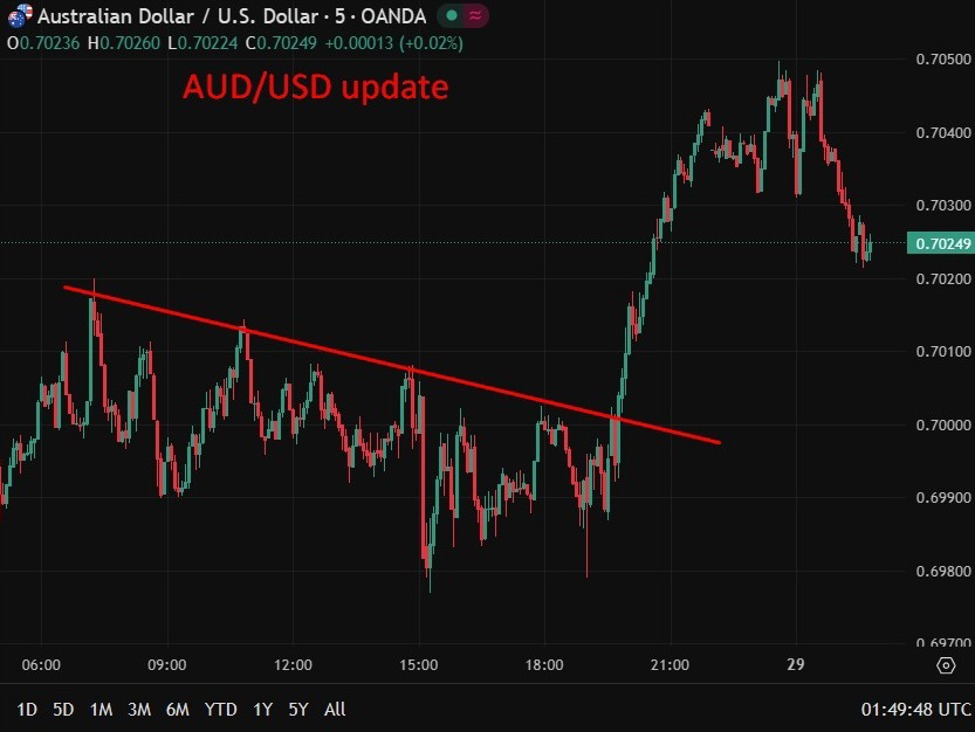
Stronger inflation has locked in February RBA hike expectations, supporting the AUD but leaving risks of further tightening alive.Summary:MUFG and CBA both say persistent inflation and tight labour conditions have strengthened the case for a February RBA rate hike.Australia’s latest CPI showed headline inflation rising to 3.8% y/y, while trimmed mean inflation lifted to 3.4%, reinforcing concerns about sticky price pressures.Rate markets have moved to fully price a 25bp hike in February, supporting recent AUD outperformance.MUFG says rising commodity prices, firmer global growth and RBA expectations are underpinning the Australian dollar.CBA expects a single 25bp hike, but warns a second increase remains a risk if labour market tightness persists.Expectations for a near-term rate hike from the Reserve Bank of Australia have firmed following stronger-than-expected inflation data, with both MUFG and Commonwealth Bank of Australia pointing to persistent price pressures and a tight labour market as key drivers.MUFG said the Australian dollar’s recent outperformance has been supported by growing optimism around global growth, rising commodity prices and increasing confidence that the RBA will lift rates early this year. Those expectations were reinforced by the latest CPI report, which showed inflation moving further away from the central bank’s target range.Headline CPI unexpectedly rose to 3.8% in December, while the trimmed mean measure of core inflation increased 0.9% quarter-on-quarter in Q4, lifting the annual rate to 3.4%. MUFG said the combination of elevated inflation and evidence of tightening labour market conditions will heighten the RBA’s concern about persistent inflation risks. As a result, Australian rate markets have moved to more fully price a 25bp hike at the February meeting.CBA shares that view, saying the inflation data reinforce its expectation that the RBA will raise the cash rate by 25 basis points in February. The bank continues to argue that the economy requires only limited policy fine-tuning, with a single rate increase likely to be sufficient to steer inflation back toward target by the end of the forecast horizon.However, CBA cautioned that risks remain skewed toward further tightening. While underlying inflation is no longer accelerating, it remains too high, and early signs of renewed labour market tightness alongside ongoing support from consumer demand could force the RBA to consider a second hike later this year.For markets, the alignment of rising rate expectations, resilient growth signals and supportive commodity dynamics has helped underpin the Australian dollar. MUFG said a clearer path toward RBA tightening has been an important factor behind AUD strength, with the currency likely to remain sensitive to incoming inflation and labour data. This article was written by Eamonn Sheridan at investinglive.com. 🔗 Source 💡 DMK Insight February RBA rate hike expectations just got a boost, and here’s why that matters: With Australia’s CPI hitting 3.8% y/y, traders need to pay attention to how this impacts the AUD and broader forex markets. MUFG and CBA’s analysis highlights that persistent inflation and tight labor conditions are likely to keep the RBA on a tightening path. This could lead to a stronger AUD against major currencies, especially if the market starts pricing in a more aggressive rate hike cycle. Watch for key resistance levels around recent highs, as a break could signal further bullish momentum. But don’t overlook the risks. If inflation pressures ease or if the RBA signals a more cautious approach, we could see a sharp reversal. Traders should monitor the upcoming economic data releases closely, particularly any shifts in employment figures or consumer sentiment, as these could influence the RBA’s decision-making. Keep an eye on the AUD/USD pair for volatility, especially as we approach February. The real story is how quickly market sentiment can shift based on new data. 📮 Takeaway Watch the AUD/USD closely; a break above recent highs could signal a bullish trend as February RBA hike expectations grow.
Reuters poll: RBI seen holding rates at 5.25% as focus shifts to liquidity and rupee
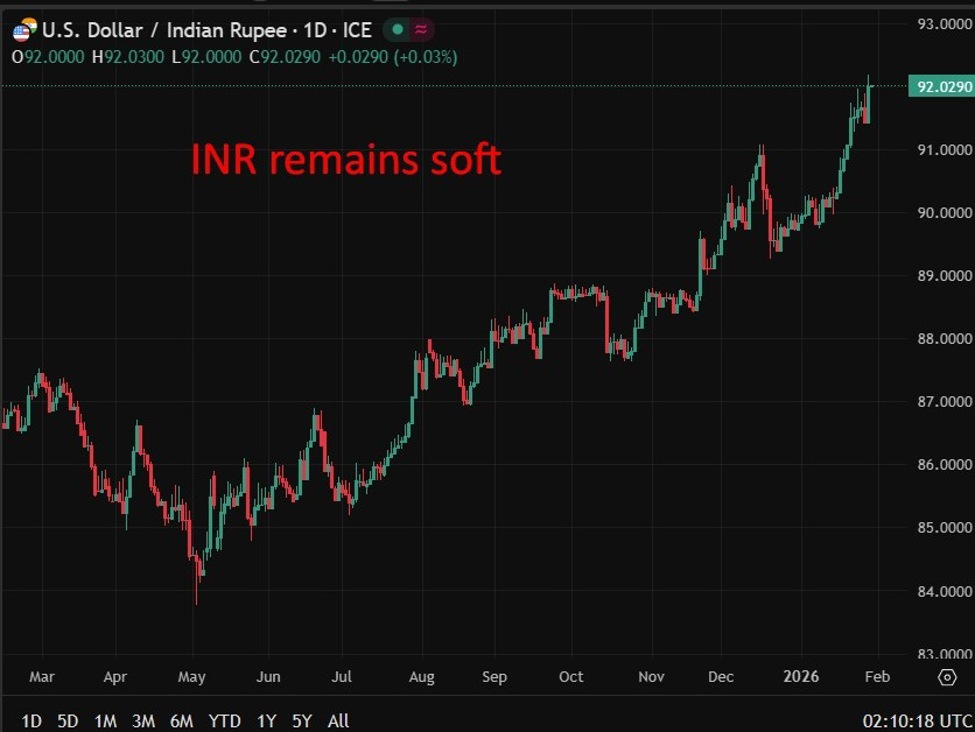
Economists expect the RBI to stay on hold in February, with policy focus shifting to transmission and currency stability.Summary:A Reuters poll shows the Reserve Bank of India is expected to hold the repo rate at 5.25% at its February 4-6 policy meeting.Most economists also see rates staying unchanged through 2026, after cumulative cuts of 125bp since early 2025.Inflation is forecast to remain benign in the near term, while growth stays robust but government-led.The RBI faces a trade-off between supporting growth and stabilising the rupee, which has hit record lows.Liquidity conditions remain a focus, with the RBI taking steps to improve policy transmission.The Reserve Bank of India is widely expected to keep interest rates unchanged at its February policy meeting, with most economists seeing little urgency for further easing after a substantial run of rate cuts, according to a Reuters poll.In the January 19–28 survey, 59 of 70 economists forecast the RBI’s Monetary Policy Committee would leave the repo rate at 5.25% at the conclusion of its February 4–6 meeting. Only 10 respondents expected a further 25bp cut, while one anticipated a larger move. The majority also expect the policy rate to remain at 5.25% through the end of 2026.The RBI has already lowered borrowing costs by 125 basis points since February 2025, and economists say the combination of subdued inflation and solid growth has reduced the need for additional stimulus. Inflation is forecast to average 2.1% this fiscal year, before rising to around 4.0% next year, while economic growth is seen at 7.4% this year, easing to 6.7% thereafter.However, the growth mix remains uneven. Analysts note that recent momentum has been driven largely by government spending, with private investment still lagging despite easier monetary conditions. Against that backdrop, economists argue the RBI’s focus has shifted from delivering further cuts to ensuring existing policy support is transmitted effectively across the economy.The central bank is also contending with pressure on the currency. The rupee has fallen to record lows amid foreign equity outflows, forcing the RBI to balance domestic policy objectives with efforts to stabilise the exchange rate. Some economists say currency intervention has tightened liquidity, blunting the impact of earlier rate cuts.To address this, the RBI has recently announced measures to inject liquidity through bond purchases, FX swaps and repo operations. Economists say these steps should help ease funding pressures and improve transmission without altering the policy rate. This article was written by Eamonn Sheridan at investinglive.com. 🔗 Source 💡 DMK Insight The RBI’s decision to hold the repo rate at 5.25% signals a cautious approach amidst global economic uncertainty. With most economists projecting no changes through 2026, traders should consider how this stability impacts the INR and related forex pairs. A steady rate could bolster confidence in the currency, but it also suggests that inflation control remains a priority, potentially limiting growth. Watch for any shifts in economic indicators leading up to the February meeting, as these could influence market sentiment. If inflation trends upward, the RBI might be forced to reconsider its stance, which could lead to volatility in the forex market. Keep an eye on the USD/INR pair, especially around key support and resistance levels, as traders react to any unexpected economic data releases. 📮 Takeaway Monitor the USD/INR pair closely as the RBI’s February meeting approaches; any inflation surprises could trigger significant market movements.
Goldman Sachs and Deutsche Bank forecast Reserve Bank of Australia on hold next week
Summary:All four major Australian banks now expect a 25bp RBA rate hike next Tuesday, following a stronger-than-expected Q4 inflation outcome.The shift contrasts with Goldman Sachs and Deutsche Bank, which continue to call for a hold.The debate centres on whether the 0.9% q/q rise in trimmed mean inflation is sufficient to justify near-term tightening.Markets see the decision as finely balanced, with the RBA having a history of surprising expectations.A hike would make the RBA the first non-Japan G10 central bank to raise rates in the current global easing cycle.Expectations for a near-term rate hike from the Reserve Bank of Australia have firmed sharply, with all four of the country’s major banks now forecasting a 25 basis point increase at next Tuesday’s policy meeting, following an upside surprise in inflation data last quarter.The shift among domestic banks highlights growing confidence that inflation pressures remain sufficiently persistent to warrant further tightening. The December-quarter CPI showed trimmed mean inflation rising 0.9% quarter-on-quarter, lifting the annual pace to levels still well above the RBA’s target band. That outcome has pushed markets and local economists to reassess the central bank’s easing bias.Not all institutions are convinced. Goldman Sachs and Deutsche Bank remain among the minority calling for policy to remain on hold. Goldman Sachs chief economist Andrew Boak said the latest inflation print was not large enough to justify a rapid shift from an easing stance to an outright rate hike within just three months.Boak described the February decision as a “very close call”, while noting the RBA has, on several occasions, shown a willingness to surprise market expectations when inflation risks are judged to be rising.The stakes are elevated. If the RBA does proceed with a hike next week, it would become the first non-Japan G10 central bank to raise interest rates during the current global easing cycle. Such a move would mark a clear divergence from peers, many of which are either cutting rates or signalling patience amid cooling inflation.For markets, the implications are significant. A hike would likely reinforce recent Australian dollar strength, push front-end bond yields higher and force a repricing of the domestic rate path. Conversely, a hold could trigger a sharp unwind in tightening expectations, particularly given how fully markets have moved toward pricing a February hike.With opinion divided and inflation data still sending mixed signals, the RBA faces one of its most finely balanced decisions in years. This article was written by Eamonn Sheridan at investinglive.com. 🔗 Source 💡 DMK Insight The anticipation of a 25bp RBA rate hike is crucial for traders, especially in the context of rising inflation. With ETH currently at $2,937.75, the potential rate hike could impact crypto markets as traders reassess risk appetite. Higher interest rates typically strengthen fiat currencies, which could lead to a short-term sell-off in crypto assets as investors seek safer havens. Keep an eye on how ETH reacts around the $2,900 support level; a drop below this could trigger further selling pressure. Conversely, if ETH holds above this level, it may indicate resilience against macroeconomic shifts. The contrasting views from major banks highlight uncertainty, suggesting that traders should be prepared for volatility. Watch for any shifts in sentiment leading up to the RBA’s decision next Tuesday, as this could set the tone for the rest of the week. Additionally, monitor related assets like BTC, as correlations often amplify during such pivotal moments. 📮 Takeaway Watch ETH closely around the $2,900 level next week; a break could signal a bearish trend amid rate hike fears.
China property shares jump on report of easing “three red lines” rules
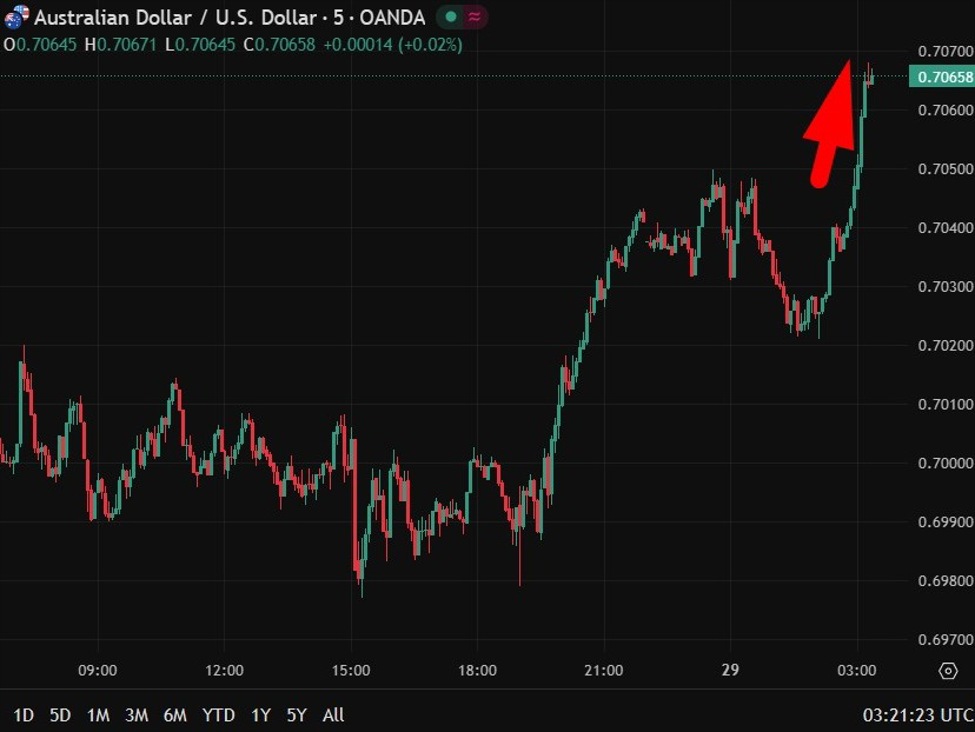
Reports of easing China’s property leverage rules sparked a sector rally and lifted China-linked risk assets, including the AUD.Summary:Chinese property shares surged after reports that regulators have eased enforcement of the “three red lines” leverage rules.Sunac China led gains, jumping as much as 25% in Hong Kong, lifting broader sector sentiment.Local media said developers are no longer required to submit monthly leverage metrics, signalling regulatory relaxation.Analysts said the move is more sentiment-positive than structurally transformative, but reinforces easing momentum.The news helped support the Australian dollar, via improved China growth and commodity demand expectations.Chinese property stocks rallied sharply after reports suggested regulators have eased oversight of developers’ leverage metrics, fuelling optimism that authorities are continuing to relax constraints on the struggling real estate sector.According to local media reports, Chinese developers are no longer required to submit monthly data tied to the so-called “three red lines” framework, leverage thresholds introduced in 2021 to curb excessive borrowing across the property industry. If confirmed, the shift would mark a meaningful softening of one of the sector’s most restrictive regulatory pillars.Property shares responded strongly. Sunac China Holdings surged as much as 25% at one point in Hong Kong trading, with gains spreading across the sector as investors interpreted the reports as another signal of policy easing. Other developers also moved higher, reflecting improved sentiment rather than any immediate change in balance-sheet fundamentals.Additional reporting suggested that while the blanket reporting requirement may have been relaxed, some financially distressed developers are still being asked to regularly disclose leverage metrics such as debt ratios to local government task forces. That nuance has led analysts to caution against viewing the move as a full dismantling of regulatory controls.Market participants said the development is best seen as part of a broader effort by Beijing to stabilise the property sector after a prolonged downturn that has weighed on growth, confidence and local government finances. While the direct impact on developers’ funding conditions may be limited in the near term, the symbolic value of easing scrutiny around the “three red lines” has been enough to lift risk appetite.The rally also spilled into broader markets. The Australian dollar edged higher, reflecting its sensitivity to Chinese growth expectations and commodity demand. Australia’s exposure to China through iron ore and other bulk exports means signs of stabilisation in China’s property sector are often viewed as supportive for the currency.Overall, while the regulatory change may not materially alter the sector’s fundamentals overnight, it reinforces the narrative of incremental policy easing aimed at restoring confidence. Info via Bloomberg reporting. This article was written by Eamonn Sheridan at investinglive.com. 🔗 Source 💡 DMK Insight China’s easing of property leverage rules is a game changer for risk assets right now. The surge in Chinese property shares, with Sunac China jumping 25%, signals a potential thaw in the sector that’s been under pressure for months. This could lead to a broader rally in China-linked assets, including the Australian dollar (AUD), which often moves in tandem with Chinese economic health. Traders should watch for continued momentum in property stocks as a leading indicator for overall market sentiment. If this rally holds, it could also influence commodities tied to China’s recovery, like iron ore and copper, which are critical for AUD strength. But here’s the flip side: while the immediate reaction is bullish, the long-term sustainability of this rally hinges on actual economic recovery in China. If the easing measures don’t translate into real demand, we could see a quick reversal. Keep an eye on the AUD/USD pair; a break above recent resistance levels could confirm a bullish trend, while failure to hold gains might signal a return to caution. Watch for key economic data releases from China in the coming weeks that could either support or undermine this rally. 📮 Takeaway Monitor the AUD/USD closely; a sustained rally in Chinese property stocks could push the pair above recent resistance, signaling further upside potential.