
 Bitcoin
  Ethereum
  Tether
  XRP
XRP  BNB
BNB  USDC
USDC  Solana
  TRON
TRON  Lido Staked Ether
  Figure Heloc
Severe storm conditions in the United States caused the Senate and other government offices to close on Monday. 🔗 Source 💡 DMK Insight So, the Senate’s closure due to severe storms isn’t just a weather issue—it’s a potential market mover. When government operations halt, it can delay key economic announcements or legislative actions that traders rely on for direction. This uncertainty can lead to increased volatility in markets, especially in sectors sensitive to government policy, like infrastructure and energy. Traders should keep an eye on how this storm impacts economic data releases or any scheduled votes that could affect fiscal policy. If the storm leads to prolonged closures, we might see a ripple effect in the stock market, particularly in sectors tied to government contracts. Watch for any updates on reopening and how that might correlate with market sentiment. A sudden shift in trading volume or price action could signal how investors are reacting to this disruption, so be prepared to adjust your positions accordingly. 📮 Takeaway Monitor government updates and market reactions closely; any prolonged closures could trigger volatility in related sectors.

Senator Marshall to shelve card fees provision in crypto bill markup: Report
US Senator Roger Marshall filed an amendment last week that would have forced companies to compete on swipe fees. 🔗 Source 💡 DMK Insight Senator Marshall’s swipe fee amendment could shake up payment processing—here’s why traders should care: Swipe fees are a hidden cost that can impact profit margins for businesses, especially in retail and e-commerce. If this amendment gains traction, it could lead to lower fees, benefiting companies that rely heavily on card transactions. This change might also ripple through related sectors, including fintech and payment processors, which could see volatility as they adjust to new competitive pressures. Traders should keep an eye on stocks in these sectors, particularly those that have been underperforming due to high operational costs. But there’s a flip side: if companies are forced to lower fees, it could squeeze profit margins, leading to potential sell-offs in the short term. Watch for any market reactions around earnings reports from major retailers and payment processors in the coming weeks. Key levels to monitor include support and resistance zones around recent price action in these stocks, as they could indicate trader sentiment towards this legislative change. 📮 Takeaway Keep an eye on payment processor stocks as Senator Marshall’s amendment could impact their profitability—watch for earnings reports and key price levels in the coming weeks.

ASIC wins $9.3M penalty against BPS Financial over misleading Qoin Wallet
Australia’s Federal Court ordered BPS Financial to pay $1.3 million for unlicensed conduct and $8 million for misleading and deceptive representations. 🔗 Source 💡 DMK Insight The hefty fines against BPS Financial highlight increasing regulatory scrutiny in the financial sector, and here’s why that matters for traders: This ruling could signal a shift in enforcement priorities, potentially impacting other firms in the financial services space. Traders should be aware that heightened regulation can lead to increased volatility, especially in stocks tied to financial services. If other companies face similar scrutiny, we might see a ripple effect, leading to sell-offs or increased caution among investors. Keep an eye on the broader market sentiment towards financial stocks, particularly those with questionable compliance histories. Also, watch for any changes in trading volumes or price action in related sectors, as this could indicate how the market is digesting these regulatory developments. The real story is that while some might see this as just another fine, it could be the beginning of a trend that reshapes the landscape for financial firms in Australia and beyond. 📮 Takeaway Monitor financial stocks for potential volatility as regulatory scrutiny increases; watch for trading volume changes in the sector.

South Korea’s central bank flags FX risks as lawmakers debate stablecoin issuance
South Korea’s stablecoin debate remains stalled as the central bank raises concerns over capital flows, issuer oversight and US dollar-linked risks. 🔗 Source 💡 DMK Insight South Korea’s stablecoin discussions are at a standstill, and here’s why that matters: the central bank’s worries about capital flows and oversight could impact crypto liquidity. With the global regulatory landscape tightening, South Korea’s hesitance to move forward on stablecoins signals potential volatility in the crypto market. Traders should keep an eye on how this affects local exchanges and liquidity pools, especially if the won starts to show weakness against the dollar. If the central bank’s concerns lead to stricter regulations, we could see a ripple effect on other Asian markets, particularly those with strong ties to US dollar transactions. Watch for any updates from the Bank of Korea, as these could set the tone for future crypto regulations in the region. In the short term, monitor the US dollar’s strength and any shifts in capital flows that could impact South Korean assets. If the dollar continues to gain, it might exacerbate the central bank’s concerns, leading to further delays in stablecoin approvals. 📮 Takeaway Keep an eye on the Bank of Korea’s next moves; any regulatory changes could impact crypto liquidity and volatility in the coming weeks.
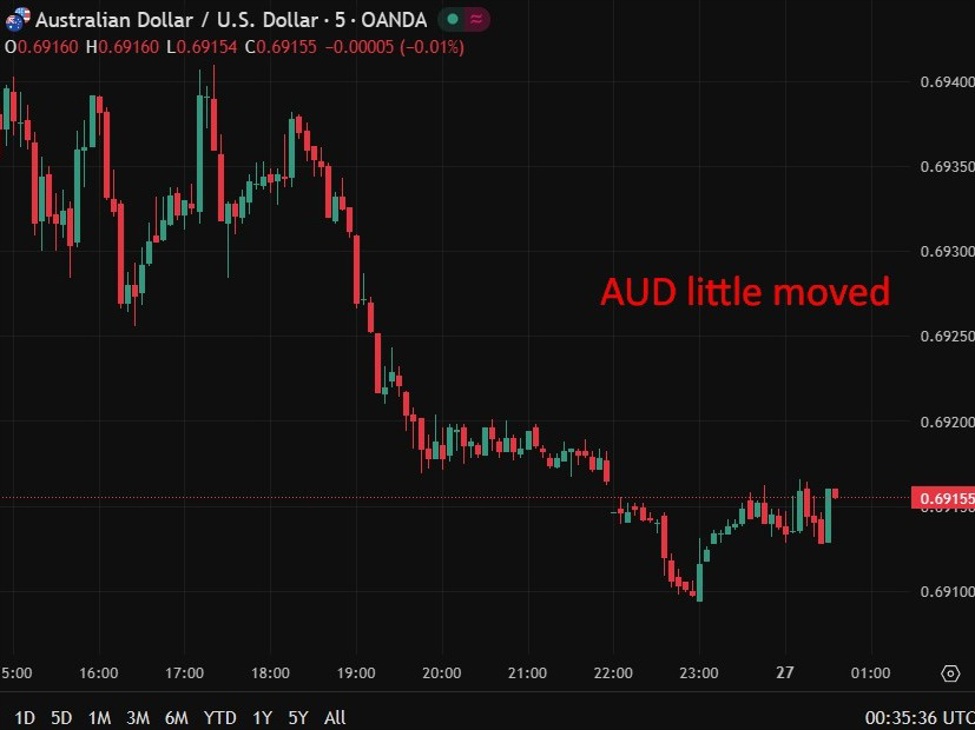
Australian December Business confidence 3 (prior 1) & Conditions 9 (prior 7)
Australian business conditions improved in December as sales and profits strengthened, while elevated capacity utilisation suggests limited spare capacity.Summary:NAB business conditions rose to +9 in DecemberBusiness confidence edged higher to +3Sales and profits strengthened, employment steadyCapacity utilisation remains elevated at 83.2%Data point to improved Q4 economic momentumAustralian business activity strengthened in December, with sales and profits improving and capacity utilisation remaining elevated, reinforcing signs that economic momentum picked up late in 2025, according to a survey from National Australia Bank.NAB’s business conditions index rose two points to +9 in December after a sharp fall the previous month. Business confidence edged up to +3 from +2, remaining positive but subdued by historical standards.Sales were a key driver of the improvement, jumping three points to a historically strong +16, adding to broader evidence of a recovery in consumer demand. Profitability also improved, with the profits index rising three points to +7, while employment held steady at +4.Price pressures firmed modestly over the three months to December, while capacity utilisation eased only slightly to 83.2%, a level NAB considers elevated and indicative of limited spare capacity across the economy.NAB chief economist Sally Auld said the survey aligns with the view that economic momentum improved in the fourth quarter, noting that high capacity utilisation remains broad-based rather than confined to a handful of sectors.Cyclically sensitive industries, including retail and manufacturing, recorded gains in both business conditions and employment. Trend activity was strongest in services, underscoring the sector’s continued role as the primary engine of domestic growth.Overall, the survey suggests the economy may be operating close to its effective speed limit, a signal likely to be watched closely by policymakers assessing inflation risks and the outlook for monetary policy. –The survey reinforces signs of improving late-2025 momentum and highlights persistent capacity constraints. For markets, the data supports the view that inflation risks remain asymmetric, even as growth stabilises.–Reserve Bank of Australia meeting next week:There are some analysts tipping a rate hike. This article was written by Eamonn Sheridan at investinglive.com. 🔗 Source 💡 DMK Insight Australian business conditions are on the rise, and here’s why that matters for traders: The NAB business conditions index hitting +9 in December signals a strengthening economic backdrop, which could influence the Australian dollar positively. With business confidence also inching up to +3, traders should keep an eye on how this momentum affects the forex market, particularly AUD/USD pairs. Elevated capacity utilization at 83.2% indicates that businesses are operating near their limits, suggesting potential inflationary pressures ahead. This could lead to shifts in monetary policy from the Reserve Bank of Australia, impacting interest rates and, consequently, currency valuations. However, while the data looks promising, it’s worth noting that external factors like global economic conditions and commodity prices can still create volatility. Traders should monitor key levels in the AUD/USD pair, especially if it approaches resistance around recent highs. Watch for any comments from RBA officials regarding future rate hikes, as these could provide further direction for the Aussie dollar in the coming weeks. 📮 Takeaway Keep an eye on AUD/USD as improved business conditions could push it towards resistance levels; monitor RBA comments for potential rate hike signals.
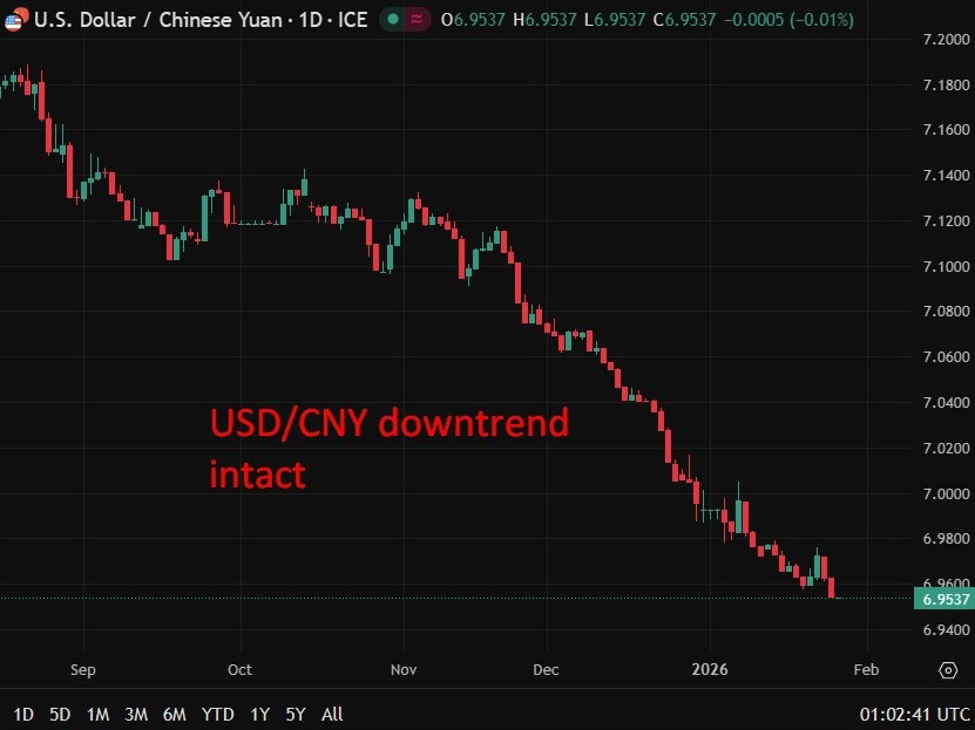
PBOC sets USD/ CNY reference rate today at 6.9858 (vs. estimate 6.9548)
The PBOC follows a managed floating exchange rate system that allows the value of the yuan to fluctuate within a +/- 2% range, around a central reference rate, or “midpoint.” The rate set under 7 today for the first time since May 2023.Previous close 6.9540PBoC injects 402bn yuan through 7-day reverse repos at 1.40%.Earlier:ExSAFE official: China RMB faces domestic reform test as cracks emerge in dollar dominance This article was written by Eamonn Sheridan at investinglive.com. 🔗 Source 💡 DMK Insight The yuan’s drop below 7 is a significant psychological level, and here’s why it matters now: The People’s Bank of China (PBOC) is clearly trying to manage volatility with its recent injection of 402 billion yuan. This move indicates a proactive stance to stabilize the currency amid global economic pressures. Traders should note that the yuan’s depreciation could impact export competitiveness, potentially leading to a ripple effect on commodities and global markets. Watch for how this impacts the USD/CNY pair, especially if it tests the 7.05 resistance level. If the yuan continues to weaken, we could see increased volatility in related assets like gold and oil, as China is a major consumer. On the flip side, a stronger dollar could put additional pressure on the yuan, leading to a cascading effect on emerging markets. Keep an eye on the upcoming economic data releases from China, as they could provide further insight into the PBOC’s next moves. The immediate focus should be on the 7.00 level; a sustained breach could signal deeper bearish sentiment. 📮 Takeaway Watch the USD/CNY pair closely; a sustained break below 7.00 could trigger increased volatility in commodities and emerging markets.

Financial Times says "EU to announce ‘mother of all’ Indian trade deals"
This via the Financial Times (gated):I’ll post more separately as it becomes available. This article was written by Eamonn Sheridan at investinglive.com. 🔗 Source
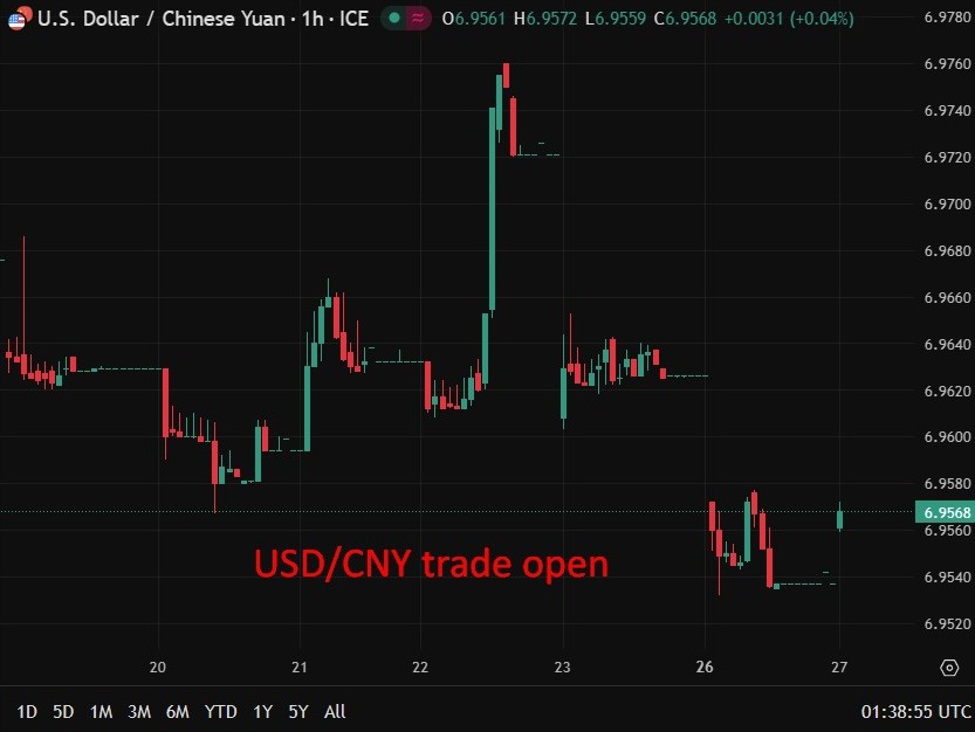
China Dec 2025 Industrial Profits +5.3% y/y (prior -13.1%)
For the full year 2025 +0.6% y/y (prior +0.1%).I’ll have more to come on this separately … ADDED: China industrial profits rebound in December as price pressures ease This article was written by Eamonn Sheridan at investinglive.com. 🔗 Source 💡 DMK Insight China’s industrial profits rebounding is a key signal for traders: it suggests easing price pressures and could impact commodity markets. With a projected +0.6% year-over-year growth for 2025, this uptick in profits indicates a potential recovery in industrial activity. Traders should keep an eye on commodities like copper and steel, which often react to changes in Chinese industrial output. If these profits continue to rise, we might see increased demand for raw materials, pushing prices higher. However, it’s worth questioning whether this rebound is sustainable or just a temporary blip, especially given global economic uncertainties. Watch for any shifts in sentiment around Chinese economic data as it could ripple through related markets, impacting forex pairs like AUD/USD, which is sensitive to Chinese demand. Key levels to monitor include the performance of industrial commodities over the next few weeks, particularly if they break resistance levels established in recent months. This could signal a broader trend worth trading into. 📮 Takeaway Keep an eye on China’s industrial profits and related commodity prices; a sustained rebound could signal trading opportunities in copper and steel.
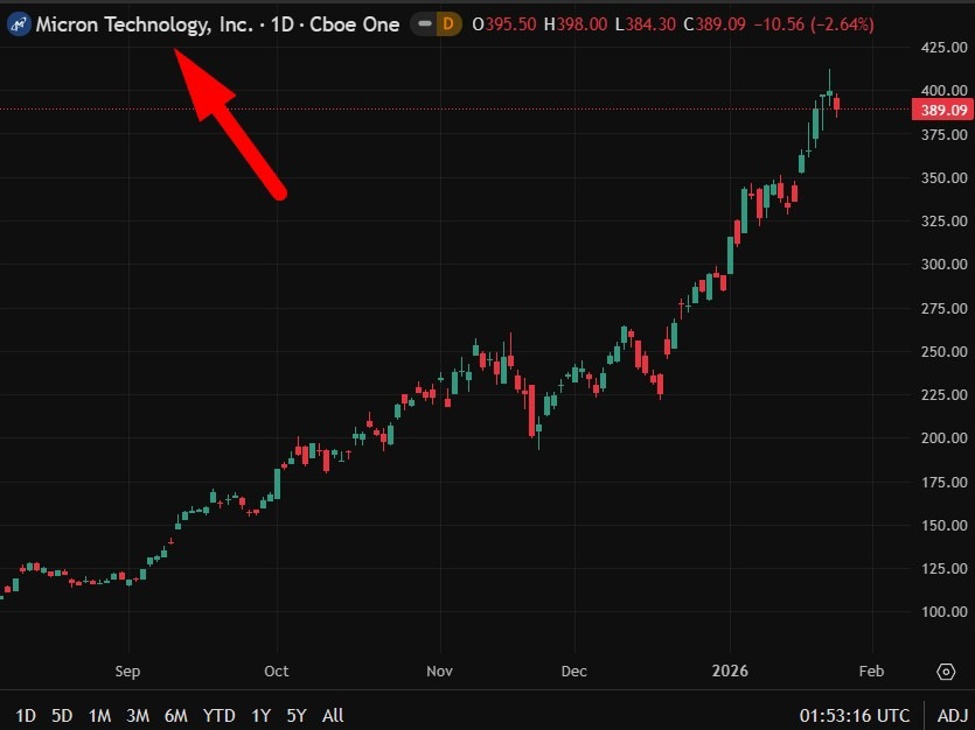
Micron to expand memory chip production in Singapore amid global shortage
Micron is poised to expand memory chip production in Singapore as global shortages intensify amid surging AI-driven demand.Summary:Micron plans new memory chip investment in SingaporeExpansion driven by global memory shortage and AI demandSingapore already produces most of Micron’s flash memoryRivals Samsung and SK Hynix also accelerating capacitySupply shortfall may persist through late 2027Micron Technology is set to announce a new memory chip manufacturing investment in Singapore, expanding capacity as global industries grapple with an acute shortage of memory chips, sources familiar with the matter told Reuters.The investment is expected to be announced as soon as Tuesday, with one source saying it will focus on NAND flash memory. The people declined to be identified as they were not authorised to speak publicly. Micron did not immediately respond to a request for comment.The expansion comes as demand from consumer electronics makers and artificial intelligence service providers accelerates amid a global race to build AI infrastructure, intensifying shortages across memory chip types.Singapore already plays a critical role in Micron’s global footprint, accounting for about 98% of its flash memory chip production. The company is also constructing a US$7 billion advanced packaging facility in the city-state to support high-bandwidth memory used in AI chips, with production slated to begin in 2027.Micron’s move follows similar capacity expansions by rivals including Samsung Electronics and SK Hynix, which have announced new production lines and accelerated plant start dates. Even so, analysts warn that the global memory supply shortfall could persist through late 2027.Last week, Micron said it was in talks to acquire a fabrication site in Taiwan from Powerchip Semiconductor Manufacturing for US$1.8 billion in cash, a move aimed at boosting its DRAM wafer output. SK Hynix has also said it plans to bring forward the opening of a new factory and start operating another new plant as early as February. This article was written by Eamonn Sheridan at investinglive.com. 🔗 Source 💡 DMK Insight Micron’s decision to ramp up memory chip production in Singapore is a game changer for traders focused on tech and semiconductor stocks. With AI demand skyrocketing, the global memory chip shortage isn’t just a temporary blip; it’s a structural issue that could last longer than expected. Micron’s move signals confidence in sustained demand, which could lead to higher prices for memory chips. This is especially relevant for traders in related sectors, like Nvidia and AMD, which rely heavily on memory for their products. Keep an eye on Micron’s stock performance as it may influence the broader semiconductor index. If Micron’s production ramp-up leads to improved supply, it could stabilize prices, but if demand continues to outstrip supply, we might see further price increases. Watch for Micron’s quarterly earnings report next month for insights on how this expansion impacts their bottom line. Also, monitor Samsung and SK Hynix’s responses; any aggressive moves from them could shake up the market dynamics significantly. 📮 Takeaway Traders should watch Micron’s upcoming earnings report and monitor semiconductor stocks for potential volatility as AI demand shapes the memory chip market.

China to roll out policy to manage AI job impact and boost employment
China is preparing targeted policies to manage AI-driven labour disruption while promoting job creation and employment stability.Chinese state media, Xinhua, with the info. Summary:China to issue policy on AI’s impact on employmentFocus on job creation and managing labour disruptionGraduate and youth employment prioritisedUrban–rural employment systems to be unifiedLong-term safeguards aimed at preventing return to povertyChina will roll out a dedicated policy framework to address the employment impact of artificial intelligence, as part of broader efforts to stabilise and expand the labour market, according to the Ministry of Human Resources and Social Security.The policy document will focus on managing AI-related disruptions while promoting job creation, with targeted support for key industries and a particular emphasis on employment for college graduates. Authorities see graduate employment as a priority area amid structural shifts driven by technology adoption and economic transition.Beyond AI, the initiative forms part of a wider labour strategy aimed at strengthening long-term employment resilience. Measures include unifying urban and rural employment systems to improve labour mobility and access to opportunities, while reducing structural disparities between regions.The government also plans to establish permanent support mechanisms to prevent households from slipping back into poverty, using sustained employment initiatives as a central pillar. These measures are intended to reinforce income stability and social security as technological change reshapes labour demand.Overall, the policy signals Beijing’s intent to balance productivity gains from AI with social stability, ensuring that technological progress supports, rather than undermines, employment growth. This article was written by Eamonn Sheridan at investinglive.com. 🔗 Source 💡 DMK Insight China’s move to manage AI-driven labor disruption is a big deal for global markets. As the country gears up to implement targeted policies, traders should keep an eye on sectors that could be impacted, particularly tech and manufacturing. If China successfully promotes job creation while mitigating disruption, it could stabilize domestic consumption, which is crucial for commodities and related markets. Look for potential ripple effects in global supply chains, especially in tech stocks that rely on Chinese manufacturing. On the flip side, if these policies fall short, we might see increased volatility in sectors tied to labor-intensive processes. Monitoring employment data and policy announcements over the next few weeks will be key. Pay attention to how these developments affect the yuan and commodities like copper and aluminum, which are sensitive to Chinese economic health. 📮 Takeaway Watch for China’s policy announcements on AI and employment; they could impact tech stocks and commodities significantly in the coming weeks.