
 Bitcoin
  Ethereum
  Tether
  BNB
BNB  XRP
XRP  USDC
USDC  Solana
  TRON
TRON  Lido Staked Ether
  Figure Heloc
The Financial Conduct Authority has begun seeking final feedback on a set of proposals aiming to apply traditional finance standards to the UK crypto sector. 🔗 Source 💡 DMK Insight The FCA’s push to impose traditional finance standards on crypto is a game changer for traders. This move signals a shift towards regulatory clarity, which could stabilize the market but also impose stricter compliance costs. Traders should be aware that these regulations might affect liquidity and trading strategies, especially for those heavily involved in derivatives or leveraged positions. If the proposals are adopted, expect increased scrutiny on exchanges and potentially higher barriers to entry for new players. This could lead to a consolidation in the market, impacting smaller firms disproportionately. On the flip side, while some traders may view this as a threat, it could also present opportunities for those who adapt quickly. Monitoring the feedback process and any subsequent announcements will be crucial. Watch for key dates related to the FCA’s timeline for implementing these standards, as they could trigger volatility in crypto prices, particularly for assets that are heavily traded in the UK market. 📮 Takeaway Keep an eye on the FCA’s feedback timeline; regulatory changes could impact liquidity and trading strategies significantly.

Japan plans framework that could permit crypto ETFs by 2028: Nikkei
Japan’s financial regulator is weighing rule changes that could allow crypto assets to qualify for ETFs, signaling a possible shift in retail access. 🔗 Source 💡 DMK Insight Japan’s potential ETF rule changes could unlock significant retail interest in crypto assets. If the Financial Services Agency (FSA) moves forward, it might not just boost local trading volumes but also influence global sentiment. Retail traders often react positively to increased accessibility, which could lead to a surge in demand for major cryptocurrencies. This aligns with broader trends where regulatory clarity tends to drive market confidence. Keep an eye on how this development might affect correlated assets like Bitcoin and Ethereum, especially if they see increased inflows from Japanese investors. However, it’s worth questioning whether this will lead to sustainable growth or just a short-term spike. If the FSA’s changes are perceived as too restrictive, it could dampen enthusiasm. Watch for any announcements in the coming weeks that could provide clearer insights into the regulatory framework and its implications for trading strategies. 📮 Takeaway Monitor Japan’s FSA announcements closely; a positive shift could significantly impact crypto demand and trading volumes in the near term.

Monday morning in Tokyo: Indications are for USD/JPY much lower
The market is warming up for the week and we already have some big moves indicated. Australia is on holiday today but the big notable change is that USD/JPY contionues to sink. The pair rose as high as 159.23 on Friday in the aftermath of the BOJ but it’s now down nearly 500 pips from that level, including 123 today.Net change:Euro: 1.1864 change since Friday’s close +0.0038Japanese Yen: 154.48 change since Friday’s close −1.23British Pound: 1.3650 change since Friday’s close +0.0009Swiss Franc: 0.7753 change since Friday’s close−0.0048Canadian Dollar: 1.3700 change since Friday’s close 0.0000Australian Dollar: 0.6913 change since Friday’s close +0.0020New Zealand Dollar: 0.5958 change since Friday’s close +0.0009Note that liquidity is still extremely thin so be careful with these numbers.On Friday, the Bank of Japan decision wasn’t any big surprise but several reports/rumors suggest that the Federal Reserve did a rate check on USD/JPY on behalf of the BOJ/Japanese Ministry of Finance. That’s a big warning about potential intervention. In addition, on the weekend Japan PM Sanae Takaichi warned officials stand ready to act against “speculative and highly abnormal” market moves as the yen weakens and bond yields rise.Officials appear to be escalating from verbal warnings to operational signalling, increasing intervention risk into thin-liquidity sessions and the market is taking heed. USD/JPY longs and yen shorts in general have been a popular and increasingly crowded trade over the past eight months and it looks like a race to the exits that’s continuing in early trade.The comments from Takaichi were made during the leaders’ debates and an election is coming in February. There’s no doubt she doesn’t want markets (including the bond market) to get disorderly during the campaign so that heights the risk of intervention. At the same time, she’s campaigned on more fiscal spending and you can’t fool the bond market forever. This article was written by Adam Button at investinglive.com. 🔗 Source 💡 DMK Insight USD/JPY’s drop from Friday’s high of 159.23 signals a potential shift in market sentiment. With Australia on holiday, liquidity might be thinner, amplifying price movements. Traders should watch for support levels around 157.50, which could act as a pivot point. If the pair breaks below this level, it could trigger further selling pressure, especially with the ongoing uncertainty surrounding the Bank of Japan’s policies. This shift could also impact correlated assets like Japanese equities and commodities priced in yen. Keep an eye on the broader economic indicators, especially U.S. inflation data, as they could influence the USD’s strength against the yen in the coming days. 📮 Takeaway Watch for USD/JPY to hold above 157.50; a break below could lead to increased selling pressure.

Chinese President Xi Jinping launched the largest military purge in years
With all the drama in the United States and Japan at the moment, some massive moves in China are flying under the radar.President Xi Jinping undertook a massive purge of the military. Gen. Zhang Youxia was accused of leaking nuclear-weapons data to the US and accepting bribes for promotions, including of a defense minister, according to the WSJ.The general was once considered one of Xi’s most-loyal allies and is the highest-ranking uniformed officer in the Chinese military. He is also a member of the 24-person Politburo, the party’s center of power.Officials also placed Liu Zhenli, chief of its Joint Staff arm, under investigation. Officially, Zhang and Liu were “suspected of serious violations of discipline and law”, the defence ministry said in a short announcement on Saturday.In October, Xi also purged He Weidong, who was the vice chairman of the Central Military Commission and seven other top generalsThere have also been rumors of an attempted coup, so it’s altogether unclear what’s happening here but this is a major move from Xi and perhaps the largest military shakeup in decades. It’s not clear how this might impact the timeline for a potential Taiwan invasion but would seemingly push it back, as Xi will need time to consolidate power and restore ranks.In 2023, defense minister Li Shangfu disappeared from public view and was removed and the WSJ report indicates that Saturday’s moves may have been related. It’s not clear if Li is currently imprisoned.Xi and Zhang are both ‘princelings’ in the CPC as their fathers fought side by side during the Chinese civil war that led to Mao’s Communist forces seizing power in 1949.In terms of markets, I don’t see any obvious implications here aside from a smaller chance of Chinese military action but it bears watching closely on what could happen next. This article was written by Adam Button at investinglive.com. 🔗 Source 💡 DMK Insight China’s military shakeup could ripple through global markets, and here’s why traders should pay attention: While the focus has been on US and Japanese economic policies, Xi Jinping’s military purge signals potential instability in China. This could lead to increased volatility in the yuan and related assets, impacting forex traders. If geopolitical tensions rise, we might see a flight to safety, benefiting gold and the US dollar. For ADA at $0.35, any significant geopolitical unrest could lead to a risk-off sentiment that might push crypto prices down as investors seek safer havens. Keep an eye on the correlation between ADA and broader market sentiment—if fear spikes, ADA could be dragged down despite its fundamentals. Watch for key levels in the crypto market; if ADA drops below $0.30, it could trigger stop-loss orders and further selling pressure. Conversely, if it holds above $0.35, it might indicate resilience against the backdrop of geopolitical uncertainty. Traders should monitor news from China closely, as any escalation could lead to immediate market reactions. 📮 Takeaway Watch ADA closely; if it drops below $0.30, it could signal further downside risk amid geopolitical tensions.

Mag 7 earnings preview: Dan Niles warns of AI winner/loser divergence
Late last year, long-time tech investor and analyst Dan Niles said his best idea for 2026 was cash. So far, that’s proven to be mostly correct as the Mag7 names have been struggling or uneven. On Friday, they got a lift but only Meta (+1.7%) and Alphabet (+7.1%) are higher on the year so far. Apple is the laggard, down 8%.Niles now runs Niles Investment Management and warns in a post on twitter that the group’s historical dominance is fraying. 2025 saw a notable divergence as five of the seven underperformed the S&P 500. Without a massive +65% gain from Alphabet, the group’s average return would have lagged the broader index. Niles points to a “distinct shift” from concentration to diversification and from large-cap to small-cap that began in late October 2025, as investors start distinguishing between true AI winners and those simply riding the hype. The Russell 2000 is up 7.5% so far this year.Despite the immediate tech headwinds, Niles remains constructive on the broader market for the first half of 2026, citing “easy money” drivers:Q1 is benefiting from the tax advantages of Big, Beautiful Bill.He also suspects a new Fed Chair will push for at least 100 bps in rate cuts.He breaks down the earnings outlook for four of the Mag7 who are reporting this week.Meta (META): While ad markets remain robust, the focus is on “Meta Compute”—a new initiative announced in mid-January 2026 aiming for tens of gigawatts of power capacity this decade. Niles fears this massive infrastructure pivot will spike 2026 capex and crush cash flow, drawing parallels to Oracle’s stock performance after its September 2025 results.Microsoft (MSFT): Azure remains strong thanks to its 27% stake in OpenAI. OpenAI’s growth is staggering, exiting 2025 at a $20 billion revenue run-rate with projections for $44 billion in 2026. However, Niles flags risks to March quarter guidance due to rising memory prices hurting PC margins, and long-term competition from Google Gemini and Anthropic.Tesla (TSLA): Demand concerns loom for 2026 following the expiration of the $7,500 EV tax credit on September 30, 2025. While Elon Musk’s future-looking narratives (Robo-taxis, FSD) often drive immediate post-earnings moves, Niles notes that valuation has mattered long-term: since 2021, TSLA is up only 10% compared to 47% for the S&P and Nasdaq.Apple (AAPL): Expect a reset in March quarter EPS guidance due to memory costs. However, Niles remains bullish for the full year, viewing the upcoming foldable iPhone and AI-integrated Siri as a multi-year upgrade catalyst similar to the iPhone 6 cycle.Beyond stock specific news, Niles is increasingly focused on credit as the “life blood of the economy.” He is hedging with shorts against public and private credit providers, noting that the 2025 failures of First Brands (auto parts) and Tricolor (subprime auto) were just the beginning of a broader credit crunch.Global macro risks are also surfacing in Japan. Following Prime Minister Sanae Takaichi’s call for a snap election on February 8, 2026, Japanese 40-year yields surged 41 bps in two days. Niles warns that Takaichi’s “tax cut and spend” agenda could trigger a “Liz Truss-style” market reaction, making a Japan-focused hedge a key part of his current strategy.Here is more on the earnings schedule this week. This article was written by Adam Button at investinglive.com. 🔗 Source 💡 DMK Insight Cash is king right now, and here’s why: the Mag7 stocks are showing weakness despite a slight uptick. With Meta and Alphabet’s modest gains, it’s clear that the broader tech sector is still grappling with volatility. This trend matters for traders focusing on tech stocks, as it suggests a cautious approach is warranted. If the Mag7 continues to struggle, it could lead to a broader market pullback, impacting correlated sectors like consumer discretionary and even crypto, which often mirrors tech sentiment. Watch for key support levels in these stocks—if they break down, it could trigger more selling pressure. On the flip side, holding cash could provide opportunities to buy on dips, especially if the market sentiment shifts. Keep an eye on upcoming earnings reports and economic indicators that could influence tech performance. The next few weeks will be crucial for determining whether this cash strategy remains viable or if a buying opportunity emerges. 📮 Takeaway Monitor the Mag7 stocks closely; if they fail to regain momentum, consider increasing cash positions or looking for dip-buying opportunities in stronger sectors.

Why the Canadian dollar isn't sweating the latest Trump tariff threat
The Canadian dollar is flat in early trading but slightly undeperforming in a broad US dollar selloff. The reason is that Trump on the weekend threatened 100% tariffs against Canada.Trump said the tariffs will come if Canada “makes a deal with China.” “China will eat Canada alive, completely devour it, including the destruction of their businesses, social fabric, and general way of life,” Trump said in a post on his Truth Social website this morning.”If Canada makes a deal with China, it will immediately be hit with a 100% Tariff against all Canadian goods and products coming into the U.S.A.” Trump didn’t clarify what kind of deal that might be. Last week Trump seemed to endorse the small deal Canada made to import 49,000 EVs in exchange for dropping agricultural tariffs.”That’s what [Carney] should be doing. It’s a good thing for him to sign a trade deal. If you can get a deal with China, you should do that,” Trump told reporters at the White House.However Mark Carney stole the show from Trump at Davos with a memorable speech that declared the end of the US-led world order. That seemed to irk Trump and led to the latest threat.In any case, Treasury Secretary Scott Bessent walked back the threat and said on the weekend that it would only apply if Canada signed a free trade agreement with China, something that’s not even on the table and is already prohibited under USMCA.”We have no intention of doing that with China or any other nonmarket economy,” Carney said. “What we have done with China is to rectify some issues that developed in the last couple of years.”So the whole thing is basically political theater.USD/CAD is down 8 pipis to 1.3692 so far in Asia. That’s near the lows of the month. This article was written by Adam Button at investinglive.com. 🔗 Source 💡 DMK Insight Trump’s tariff threat could shake up CAD and related assets, and here’s why: With ADA currently at $0.35, the broader implications of a US dollar selloff could create volatility in crypto markets, especially if traders seek refuge in digital assets. The CAD’s underperformance against the USD might lead to increased speculative trading in ADA as investors look for alternatives. If tariffs are implemented, it could exacerbate economic tensions, impacting trade flows and investor sentiment. Keep an eye on the 50-day moving average for ADA; a break below could signal further downside risk. On the flip side, if the CAD stabilizes or if Trump backtracks, we might see a rebound in CAD-denominated assets, including ADA. Watch how institutional players react to these developments, as they often set the tone for market direction. The next few days will be crucial; monitor any news from Canada regarding trade negotiations or responses to Trump’s threats. 📮 Takeaway Watch for ADA’s movement around the 50-day moving average; a break could signal increased volatility amid CAD’s response to tariff threats.

Gold blasts through $5000 to all time high. What to look for next
It’s a banner moment for the gold bugs as it hits $5000 per ounce for the first time. It’s a monster rally since August and includes a 17% rally so far this year.Despite how impressive that is, it pales in comparison to silver, which is up 48% year-to-date.It’s all great news if you’re long precious metals or miners and it’s set to continue this week with the strong start. I would expect some profit taking after hitting the big round numbers but maybe not. Silver tagged $100 on Friday and has continued to cruise higher, adding another 5% already. The hard money crowd seems to be shifting out of bitcoin and into precious metals.If you’re not long metals, then this is worrisome. The global order appears to be breaking down and the violence in Minneapolis on the weekend isn’t conductive to the US calming down any time soon. With that event, we are also seeing rising odds of a US government shutdown over funding to DHS agents.S&P 500 futures are down 0.35% and the US dollar is lower across the board.It’s not much better abroad, the military purge from Xi Jinping in China looks like the biggest shakeup since Mao, with the top uniformed general being purged along with other top officials. In Ukraine, peace talks continue but it’s hard to muster any optimism at this point until there’s some real smoke. Iranian protests seem to have calmed down after a brutal response from the regime while talk of US intervention continues, along with talk of more activity in Cuba and even Mexico. It’s an uncertain world out there and gold is screaming that louder than ever before. In terms of price action, we’re at the tail end of a seasonal pull that I’ve been writing about here for 15 years. That’s one reason for caution but if it blows through $5000 without any real profit taking, then it speaks to a one-in-a-lifetime type of momentum trade in precious metals. This article was written by Adam Button at investinglive.com. 🔗 Source 💡 DMK Insight Gold hitting $5000 per ounce is a big deal, but don’t overlook silver’s massive 48% gain this year. Traders need to consider why gold’s rally, while impressive, isn’t matching silver’s momentum. This divergence could indicate a shift in market sentiment or demand dynamics. If gold continues to rise but silver outpaces it, we might see traders reallocating funds from gold to silver, especially if silver breaks through key resistance levels. Watch for silver’s performance against gold; if it maintains its lead, it could signal a broader trend toward industrial metals, particularly if economic indicators suggest increased manufacturing activity. Keep an eye on the $5000 level for gold—if it holds, it could attract more institutional interest. But if silver continues its ascent, it might become the go-to asset for traders looking for growth in precious metals. The real story is how these two metals interact moving forward, especially as we approach year-end positioning. 📮 Takeaway Monitor gold’s $5000 level closely; if silver maintains its lead, consider reallocating to silver for potential gains.

Australia is closed today for Australia Day but AUD hits the highest in 15 months
The Australian dollar is up 21 pips to 0.6913 today, which is the highest since October 2024. The Aussie benefited from a strong jobs report on Friday and the market is beginning to sniff out rate hikes.The cash rate right now is 3.60% but the OIS curve prices that at around 4.30% by the end of the year. For the immediate future, there is a better-than-even chance—roughly 63%—that the RBA will hike rates at their meeting in early February. Even if they don’t move in February, the pricing suggests a rate rise is almost guaranteed to happen by March.Looking further out, the market has fully priced in a second rate increase by September. By the time December arrives, traders are positioning for a likely third hike. Essentially, the market expects the cost of borrowing to keep rising slowly but surely all year and that’s a strong contrast to the Fed, where two cuts are priced in.Today is Australia Day and markets are closed so AUD liquidity is thinned out. If Australian markets were open, surely gold miners would be celebrating as it’s up 1.7% to a record $5067. Silver is even hotter, up another 4.8% to a record $107/oz. The mining industry is about to boom, with copper prices also near record highs.That will mean big mining investment inflows into Australia and other mining districts. I also get the sense that the FX market is looking for safe havens outside of US dollars. Normally that means the yen but with political turmoil there and the threat of intervention and massive government debt, the market is looking elsewhere. Switzerland benefits from some of those flows but low rates and the threat of negative rates are a sharp contrast to 4% cash returns in AUD.In short, there is a lot working for AUD right now and even at a 15-month high, AUD is still historically in the bottom half of the 10-year range. This article was written by Adam Button at investinglive.com. 🔗 Source 💡 DMK Insight The Aussie dollar’s rise to 0.6913 signals a shift in market sentiment, driven by a robust jobs report. With the cash rate at 3.60%, traders are now eyeing potential rate hikes, which could further bolster the AUD. This uptick comes as the market begins to price in tighter monetary policy, a trend that could attract both retail and institutional investors looking for yield. The 0.6900 level is crucial; a sustained break above could lead to further gains, potentially targeting 0.6950. However, keep an eye on the broader economic indicators, especially U.S. data releases, as they could influence the AUD’s trajectory. If the U.S. shows signs of economic weakness, the Aussie could outperform, but any hawkish signals from the Fed might reverse this trend. Watch for the next jobs report and any comments from the Reserve Bank of Australia, as they could provide additional clarity on future rate movements. The market’s reaction to these events will be key in determining the AUD’s strength in the coming weeks. 📮 Takeaway Monitor the 0.6900 resistance level closely; a break could lead to further gains for the AUD, especially if U.S. economic data disappoints.
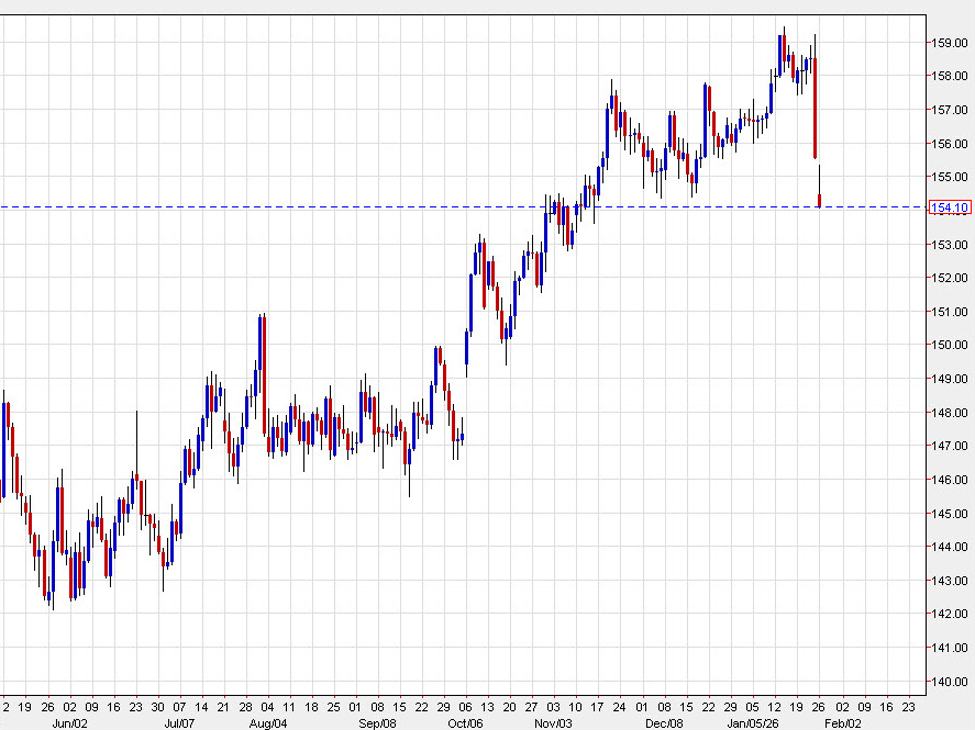
USD/JPY falls to a fresh low as official sees a "high sense of urgency"
USD/JPY is down 167 pips to the lows of the day.It’s been volatile trading so far today as the pair initially traded near these levels befoer bouncing by more than 100 pips. In the past two hours though, it began trending lower and has now taken out the lows.The drop today takes the pair through a December double bottom near 154.30 and that highlights the possibility of a trend change. If you zoom out, the reversals in this pair, particularly the ones lower lately have been big and aggressive. The July 2024 reversal is instructive as it also started near 160 and continued down to 141 less than a month later.That move was kicked off by actual intervention from Japanese officials.So far we haven’t seen that, but just now Japan’s chief cabinet secretary said they are closely watching market moves with a high sense of urgency. Kihara also said they will take appropriate action based on the Sept j int statement with US officials. That statement wasn’t overly notable at the time but in it, the United States and Japan reaffirmed their commitment to “market determined” exchange rates.He declined to comment about JGB moves are reports of a rate check.The latest move lower in USD/JPY is part of a larger selloff in the US dollar but the moves are particularly large in USD/JPY, likely reflecting the crowded nature of long bets in that pair. Over in the precious metals market, gold and silver are making historical moves as the market seemingly loses confidence in USD reserves.Amidst all this, the bond market is relatively stable. Should it come unmoored, the volatility could spill into equities and cause some larger problems. Odds of another US government shutdown are currently spiking and that won’t be welcomed by any equity market but the yen would be an FX winner if it means risk off and USD selling. This article was written by Adam Button at investinglive.com. 🔗 Source
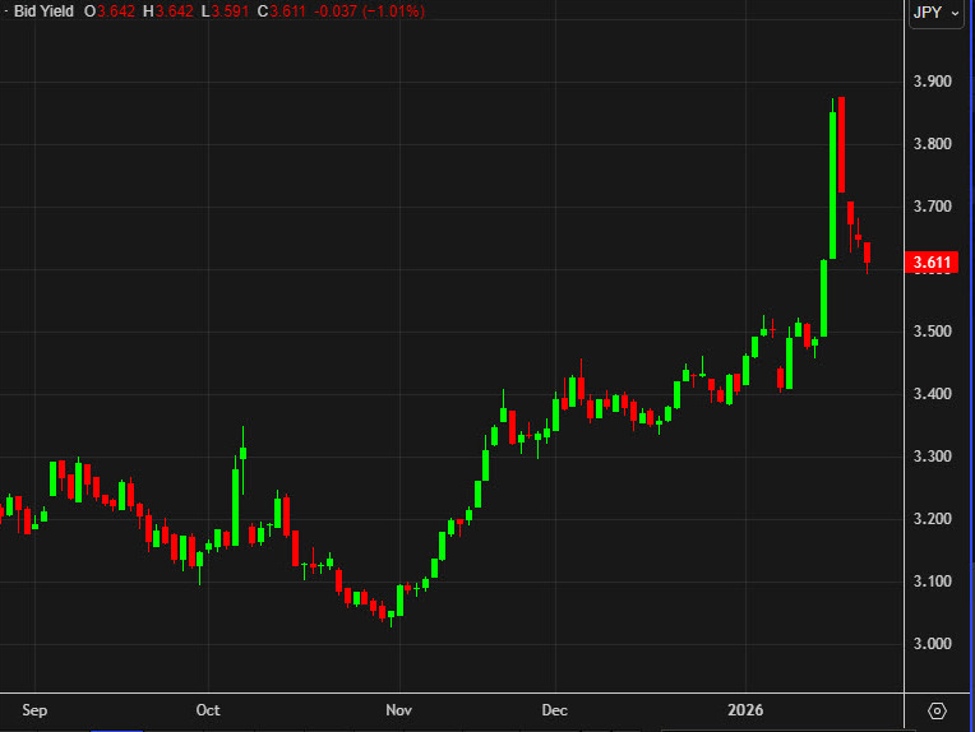
The Japanese bond market has settled down after last week's blowout
Last week’s move in long-dated Japanese bonds was a scary one.30-year yields jumped more than 25 basis points in a day, a range that was one the hallmark of an entire year in Japanese bond markets. The move came after PM Takaichi called an election and immediately began talking about higher spending.It’s a sign that these are different times in Japan and that the era of limitless lending to an aging, heavily-indebted country is over. It could also be a sign of genuine fears about inflation in Japan for the first time in decades.As the chart shows, we’ve seen yields retreat from a high of 3.87% down to 3.61%, erasing the entire move from Jan 20, though not the one from the day before. I don’t think we’ve seen the end of this story as we navigate towards the Feb 8 lower house election. The ruling LDP holds a lead in the polls but there was a slight dip on the weekend. They had her slipping around 4 points to 69% in the Yomiuri newspaper, though others have her as low as 57%. She remains personally popular and is campaigning on a temporary suspension in the food sales tax.The nightmare scenario for her and for markets is that yields continue to rise and officials are forced to intervene in both the FX and bond market. That’s a losing strategy in a market as large as both and risks undermining global markets beyond Japan’s borders. The turmoil in Japan is one of the reasons that gold today hit an all-time high of $5092, breaking $5000 for the first time and the surging further. Silver is also up an additional 5% today to $108.60/oz after breaking $100 for the first time on Friday. This article was written by Adam Button at investinglive.com. 🔗 Source 💡 DMK Insight The spike in 30-year Japanese bond yields by over 25 basis points signals a potential shift in market sentiment. For traders, this rapid increase could indicate rising inflation expectations or a shift in monetary policy, especially with PM Takaichi’s election announcement. Such volatility in bond yields often ripples through related markets, impacting forex pairs like USD/JPY. If yields continue to rise, watch for a potential strengthening of the yen as investors seek safer assets. Key levels to monitor are the recent highs in yields, as breaking through these could lead to further sell-offs in equities and risk assets. On the flip side, if yields stabilize, it might present a buying opportunity in equities, especially in sectors sensitive to interest rates. Keep an eye on the next economic data releases from Japan, as they could provide further context for these movements. 📮 Takeaway Watch the 30-year Japanese bond yields closely; a sustained rise could strengthen the yen and impact USD/JPY trading strategies.