
 Bitcoin
  Ethereum
  Tether
  BNB
BNB  XRP
XRP  USDC
USDC  Solana
  JUSD
JUSD  TRON
TRON  Lido Staked Ether
 📰 DMK AI Summary Experts are warning that proposed restrictions on stablecoin yields under the US CLARITY Act may drive capital offshore into unregulated instruments, as compliant stablecoins could be banned from offering yield. The GENIUS Act already prohibits payment stablecoins like USDC from paying interest directly to holders, treating them as digital cash rather than yield-generating products. However, this move could create a competitive dynamic where investors seek higher yields offshore or through synthetic structures outside US regulatory oversight. Banks have raised concerns that yield-bearing stablecoins could lead to deposit outflows, affecting their lending capacity and competitiveness globally, especially as other jurisdictions like China and Singapore develop frameworks for yield-bearing digital instruments. 💬 DMK Insight The potential ban on stablecoin yields could have unintended consequences, pushing investors towards offshore and unregulated financial structures for higher yields. While the aim may be to protect the financial system, experts argue that it could inadvertently incentivize capital migration beyond US oversight. This shift could impact banks’ competitiveness, particularly in the face of emerging interest-bearing digital currencies from other countries. 📊 Market Content The debate over stablecoin yield bans highlights the global competition in the digital currency space, with different jurisdictions racing to develop frameworks for yield-bearing instruments. This could have broader implications on the competitiveness of the US financial system and its ability to set global standards for compliant yield products. Traders and investors will need to closely monitor how regulatory decisions in this space unfold and the potential impact on market dynamics.

From Stellar to Canton: How Franklin Templeton Adopted Tokenization
Roger Bayston, Head of Digital Assets at Franklin Templeton, unpacks how one of the world’s largest asset managers embraced tokenization. 🔗 Source 💡 DMK Insight So Franklin Templeton’s move into tokenization is a game changer for the asset management sector. This shift signals a growing acceptance of blockchain technology among traditional finance players, which could lead to increased liquidity and efficiency in asset trading. For traders, this means potential new investment vehicles and opportunities to capitalize on tokenized assets. Keep an eye on how this affects the broader market, especially in the crypto space, as institutional interest often leads to price movements. If more asset managers follow suit, we could see a ripple effect that boosts the legitimacy of digital assets. Watch for any announcements from other major firms in the coming weeks, as they could provide insights into market trends and investor sentiment. Also, monitor key levels in major cryptocurrencies that might react to this news, particularly if we see a surge in institutional buying pressure. 📮 Takeaway Watch for institutional responses to Franklin Templeton’s tokenization move, as this could signal new trading opportunities in crypto markets.

Trump sues JPMorgan for $5B! Ledger prepares for $4B IPO! “Crypto Adoption is no longer reversible” says PWC!
Crypto majors are red while Gold nears $5,000 and Silver closes in on $100; BTC -1% at $89,100; ETH -2% at $2,925, SOL -2% at $127; XRP -2% to $1.90. ZRO (+15%), AXS (+10%) and DASH (+8%) led top movers. Ledger is preparing for a $4B IPO, enlisting Goldman Sachs, Jefferies and Barclays for support. Ripple CEO Brad Garlinghouse predicted crypto could hit new highs in 2026, pointing to regulatory momentum and institutional participation as key drivers. President Trump sued JPMorgan for $5 billion, alleging politically motivated “debanking”. BitGo briefly surged in its stock market debut before finishing its first day of trading just over its $18 IPO price. BlackRock CEO Larry Fink pushed the idea of a single blockchain for tokenization to avoid corruption and aid in scaling. Kansas introduced its own Bitcoin Strategic Reserve bill. PwC said institutional crypto adoption has crossed a point of no return, as regulatory frameworks move from draft rules toward active supervision. Treasury Secretary Scott Bessent reaffirmed the Trump administration’s push for U.S. crypto leadership and support for a strategic Bitcoin reserve. 🔗 Source 💡 DMK Insight With Bitcoin dipping to $88,378 and gold nearing $5,000, traders need to assess the shifting dynamics between crypto and traditional assets. The recent downturn in major cryptocurrencies like BTC and ETH, down 1% and 2% respectively, signals a potential risk-off sentiment among investors. As gold approaches a significant psychological level of $5,000, it could attract capital away from crypto, especially if inflation fears persist. This shift may also impact altcoins, as seen with SOL and XRP both down 2%. Traders should keep an eye on the correlation between these assets; if gold continues to rise, we might see further pressure on crypto prices. On the flip side, the strong performance of ZRO, AXS, and DASH suggests that not all is bleak in the crypto space. These tokens could be indicative of a rotation into smaller caps or niche projects, which might offer hidden opportunities. Watch for BTC to hold above the $88,000 level; a break below could trigger further selling pressure. Additionally, keep an eye on Ledger’s upcoming IPO, as institutional interest could shift market sentiment positively if executed well. 📮 Takeaway Watch for Bitcoin to maintain above $88,000; a drop below could signal increased selling pressure as gold rises.

Newsquawk Week Ahead: Highlights include FOMC, BoC, Riksbank, EZ GDP, Tokyo CPI
Mon: Australian Holiday (Australia Day), German Ifo (Jan).Tue: Chinese Industrial Profits (Dec), US Richmond Fed (Jan), US Consumer Confidence (Jan).Wed: Fed Policy Announcement, BoC Policy Announcement, BCB Policy Announcement, Australia CPI (Q4), German GfK (Feb), NZ Trade (Dec).Thu: Riksbank Policy Announcement, CBRT Minutes, EZ Money Supply (Dec).Fri: German Import Prices (Dec), German Unemployment (Jan), German GDP (Q4, flash), HICP (Jan), EZ GDP (Q4, flash).Sat: Chinese NBS PMI (Jan).Chinese Industrial Profits (Tue): The previous release (covering January-November 2025), showed a sharp loss of momentum, with YTD profits at major industrial firms up just 0.1% Y/Y, slowing sharply from 1.9% growth in the first ten months. November profits alone fell 13.1% Y/Y, after a 5.5% drop in October, marking the steepest monthly contraction in more than a year. By sector, resilience was confined to high-tech manufacturing, where profits rose 10%, and equipment manufacturing, up 7.7%, while heavy industry remained a major drag, with coal mining and washing profits down 47.3% and oil and gas extraction down 13.6%. By ownership, state-owned enterprises reported a 1.6% Y/Y decline in profits, while private firms slipped 0.1%. Analysts cited weak domestic demand and persistent factory-gate deflation, warning profits remain vulnerable unless pricing power and demand improve.Australian CPI (Wed): The ABS is due to publish December and Q4 inflation data, with the focus firmly on the quarterly print. Headline CPI stood at 3.4% Y/Y in November, remaining above the RBA’s 2-3% target band, though the central bank in December said that recent firmness in underlying inflation reflected temporary factors, while also flagging increased noise in the monthly CPI series. Attention now turns to Q4 after CPI in Q3 edged up to 3.2% Y/Y. NAB expects a notably firm outcome, forecasting trimmed mean inflation at 0.9% Q/Q and 3.3% Y/Y, above the RBA’s own projections of 0.75% Q/Q and 3.2% Y/Y, citing ongoing pressure from housing costs, services inflation – particularly seasonally strong travel prices – and new vehicles. Any upside surprise in Q4 inflation would reinforce the Bank’s tightening bias amid a still-tight labour market, even as market pricing implies about a 60% chance of a February cut (up from roughly 30% before the latest employment data).BoC Policy Announcement (Wed): Canada headline CPI rose to 2.4% Y/Y in December from 2.2%, slightly above expectations, reflecting higher food, alcohol and selected goods prices. The increases were driven in part by unfavourable base effects linked to last year’s GST holiday, which more than offset a sharp monthly decline in energy prices. Measures of core inflation were broadly stable: CPI excluding food and energy edged higher, but the BoC’s preferred core measures eased, suggesting underlying price pressures remain contained. Oxford Economics argued that the Bank will not be swayed by M/M volatility in headline inflation caused by base effects, instead focusing on the underlying trend, which both it and the BoC see in the mid-2% range. Oxford Economics also highlighted ongoing upside risks from US tariffs and elevated trade policy uncertainty, and continues to expect the BoC to keep rates on hold at 2.25% until early 2027. Meanwhile, the BoC’s Business Outlook Survey sends a similar signal. While businesses are more optimistic about sales and point to firmer GDP growth, they still anticipate layoffs and continue to face persistent cost pressures. According to NAB, this combination provides little evidence that inflation risks have fully receded, reinforcing the case for policymakers to remain on hold until there is clearer confirmation that price pressures are durably under control.Fed Policy Announcement (Wed): The FOMC is widely expected to leave the policy rate unchanged at 3.50-3.75% at next week’s meeting. As has been the case for several meetings now, the decision itself matters less than the guidance, particularly around how patient policymakers intend to be before easing eventually comes into view. A Reuters poll showed unanimous expectations for no change at this meeting, while 58% of economists also see rates staying on hold through the quarter. Recent data continue to underline resilient US growth and sticky inflation, which together argue against any urgency to cut rates. The economy expanded strongly in the H2 2025, while inflation remains above target, reinforcing the Fed’s preference for patience. Policymakers are therefore likely to repeat their data-dependent messaging and avoid signalling that easing is imminent. Markets will pay close attention to Chair Powell’s press conference for any tonal shift, particularly given growing political pressure on the central bank. Public criticism from President Trump and ongoing legal scrutiny related to the Fed’s HQ renovation have raised questions around institutional independence, though officials are expected to steer clear of political commentary. Analysts said that, overall, the balance of risks still points to rates remaining on hold through Q1, with cuts more likely later in the year if inflation shows clearer signs of moderation. Further hikes remain very unlikely, but strong growth and expansionary fiscal policy suggest that any easing cycle, when it comes, is likely to be gradual. Few surprises are expected from the meeting, leaving markets focused on Powell’s assessment of inflation persistence, labour market tightness and financial conditions.BCB Policy Announcement (Wed): Policymakers are expected to maintain a cautious tone following December’s decision to hold the Selic rate at 15.00%. At that meeting, the central bank described the current policy stance as “adequate” to deliver inflation convergence over time, while emphasising that future steps may be adjusted as needed. This wording leaves room for renewed tightening should inflation pressures re-emerge, but also preserves flexibility for eventual easing once confidence in the disinflation path improves. Pantheon Macroeconomics viewed the shift in language from “sufficient” to “adequate”, alongside a return to “as usual” vigilance, as signalling slightly higher confidence without constituting a clear dovish pivot, and continues to characterise the BCB’s stance as hawkish. Pantheon expects the current hold to extend into early 2026 as policymakers seek to re-anchor expectations. Since the December meeting, however, inflation data have surprised to the downside, strengthening the case for eventual easing. Annual inflation for 2025 slowed more than both the central bank and

What Is Cardano? The Complete 2026 Guide for Traders
You may be wondering what Cardano is and how it fits into today’s crypto trading landscape. Cardano is a blockchain project focused on long-term growth, security, and efficiency. Instead of The post What Is Cardano? The Complete 2026 Guide for Traders appeared first on NFT Evening. 🔗 Source 💡 DMK Insight Cardano’s focus on long-term growth and security is more relevant than ever as traders seek stability in a volatile crypto market. With ongoing regulatory scrutiny and market fluctuations, projects that emphasize security and efficiency are likely to attract serious investors looking for sustainable options. Cardano’s unique proof-of-stake mechanism positions it well against competitors, especially in a landscape where energy efficiency is becoming a key concern. However, the challenge lies in its adoption and real-world utility. While Cardano has made strides, it still faces skepticism from traders who prioritize immediate returns over long-term potential. The upcoming developments and partnerships could serve as catalysts for price movements, so keeping an eye on announcements and community engagement is crucial. Watch for key resistance levels around previous highs, as breaking through these could signal renewed bullish sentiment. In the current climate, where many assets are experiencing heightened volatility, Cardano’s approach could provide a safer haven for those looking to diversify their portfolios. Monitor the daily trading volume and sentiment shifts to gauge potential entry points. 📮 Takeaway Keep an eye on Cardano’s upcoming developments and resistance levels; breaking previous highs could signal a bullish trend.
MEXC vs BingX: A 2026 Comparison of Features and Fees
If you love crypto trading, you already know the critical role that a crypto exchange plays in this business. Currently, two prominent cryptocurrency exchanges are emerging as notable players: BingX The post MEXC vs BingX: A 2026 Comparison of Features and Fees appeared first on NFT Evening. 🔗 Source 💡 DMK Insight Look, the rise of exchanges like BingX and MEXC is shifting the crypto trading landscape. As these platforms ramp up their features and competitive fees, traders need to pay attention to how this affects liquidity and trading strategies. With more exchanges vying for market share, we’re likely to see tighter spreads and potentially lower fees, which could benefit day traders looking for quick entries and exits. But here’s the catch: not all exchanges are created equal. Traders should be wary of the security and reliability of these platforms, especially in a volatile market. If BingX or MEXC can establish themselves as trustworthy, they could attract significant trading volume, impacting price movements across major cryptocurrencies. Keep an eye on user reviews and trading volumes on these exchanges, as they can provide insights into their reliability and market impact. Also, monitor how these exchanges handle liquidity during peak trading hours, as this could affect your execution speed and slippage. In short, the competition between exchanges could lead to better trading conditions, but due diligence is key. 📮 Takeaway Watch for trading volume and user feedback on BingX and MEXC; their reliability could influence your trading strategies significantly.

Stablecoin yield bans could push capital offshore into ‘unregulated instruments’
Proposed restrictions under the US CLARITY Act could drive demand for offshore and synthetic dollar products as investors seek yield outside regulated markets, experts warn. 🔗 Source 💡 DMK Insight The US CLARITY Act could reshape the trading landscape, pushing investors toward offshore and synthetic dollar products. With potential restrictions looming, traders might find themselves scrambling for yield in less regulated markets. This shift could lead to increased volatility in both the forex and crypto markets as liquidity moves offshore. If you’re holding positions in traditional dollar-denominated assets, now’s the time to reassess your exposure. Watch for a spike in demand for synthetic products, which could impact pricing and availability. Moreover, this trend could ripple through related markets, particularly those tied to emerging currencies or alternative assets. Here’s the thing: while mainstream coverage may focus on the risks of regulatory changes, savvy traders should consider the opportunities in less regulated environments. Keep an eye on how institutional players react, as their movements could signal broader market trends. Monitor key indicators like trading volume in synthetic products and any shifts in forex pairs that might indicate a flight to safety or yield. 📮 Takeaway Watch for increased demand for offshore dollar products as the US CLARITY Act progresses; monitor trading volumes and forex pairs for shifts in market sentiment.

Could Europe sell US debt if a Greenland deal doesn’t come through?
Some European policymakers have floated the idea of selling off US debt as a way of combating US belligerence, but it may be much more difficult in practice. 🔗 Source 💡 DMK Insight European policymakers are considering selling US debt, but here’s why that could backfire: While the sentiment reflects growing frustration with US foreign policy, the actual mechanics of dumping US Treasuries are complex. Selling off significant amounts could destabilize the bond market, leading to rising yields and a stronger dollar, which would hurt the very economies looking to make a statement. Plus, US debt is still viewed as a safe haven, so any mass sell-off could trigger a flight to quality, ironically boosting demand for Treasuries. Traders should keep an eye on the 10-year Treasury yield as a barometer; if it spikes significantly, it could signal broader market volatility. Watch for reactions from major institutional players, as their moves could amplify or dampen the effects of any policy shifts. The flip side is that if European nations do start to divest, it could create opportunities in emerging markets or other asset classes as investors seek alternatives. But for now, the risks of destabilizing the US debt market are high, and traders should remain cautious about any knee-jerk reactions in the forex or bond markets. 📮 Takeaway Monitor the 10-year Treasury yield closely; a significant spike could indicate market volatility triggered by geopolitical tensions.

Polymarket sees January US gov't shutdown odds surge to 77%
The spike in Polymarket odds comes just days after United States President Donald Trump said “we’re probably going to end up in another Democrat shutdown.” 🔗 Source 💡 DMK Insight Polymarket odds are shifting sharply, and here’s why that matters for traders: the looming threat of a government shutdown could create volatility in markets. With Trump’s comments, traders should brace for potential market reactions, especially in sectors sensitive to government spending and policy changes. If odds on Polymarket are indicating a higher likelihood of a shutdown, it could lead to risk-off sentiment across equities and even impact crypto markets, which often react to macroeconomic news. Keep an eye on related assets like Treasury yields and the S&P 500, as they could show signs of stress or opportunity depending on how the situation unfolds. The flip side is that if a shutdown is avoided, we could see a relief rally, particularly in sectors that thrive on government contracts. Watch for key resistance levels in major indices and consider hedging strategies if the odds continue to rise. The next few days will be crucial, so monitor Polymarket closely for any shifts in sentiment. 📮 Takeaway Watch Polymarket odds closely; a significant spike could signal increased market volatility ahead of a potential government shutdown.
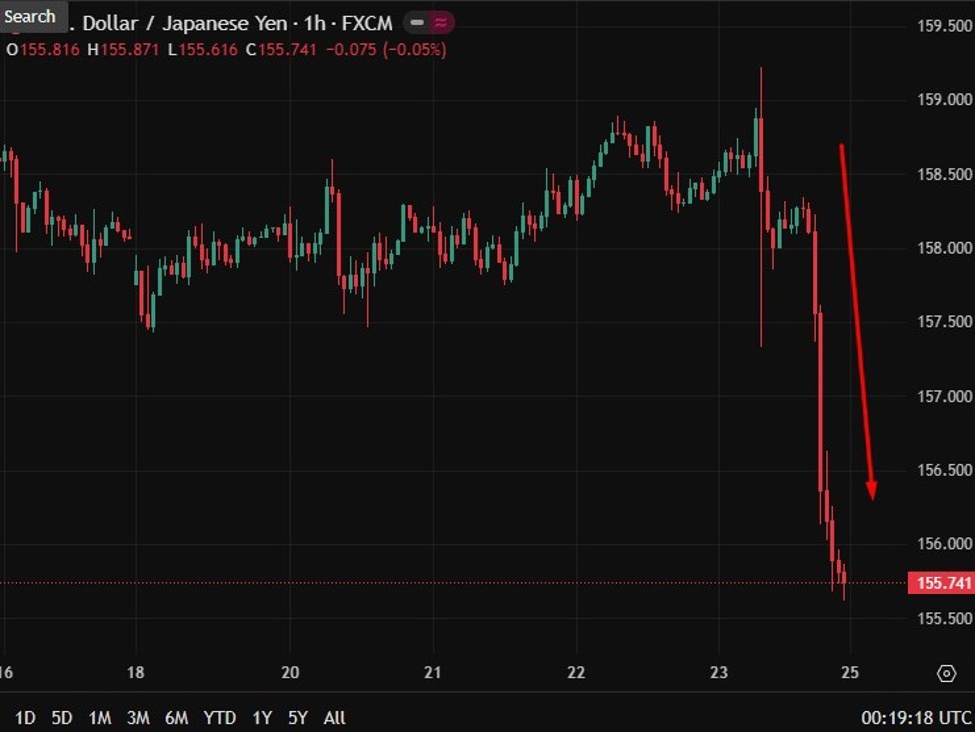
Japan PM Takaichi Sunday yen verbal intervention. Follows USD/JPY Friday rate check slam.
Japan’s intervention risk is back in sharp focus after PM Takaichi warned on Sunday against speculative moves, following a violent yen reversal and rate-check chatter late Friday.Summary:Japan PM Sanae Takaichi warned officials stand ready to act against “speculative and highly abnormal” market moves as the yen weakens and bond yields rise.The remarks follow sharp yen gains late Friday after market chatter of a Federal Reserve rate check, a precursor to actual FX intervention if needed.USD/JPY reversed violently from above 159.20 to below 156.00, a move in Friday (thinning) liquidity.Officials appear to be escalating from verbal warnings to operational signalling, increasing intervention risk into thin-liquidity sessions.Takaichi’s comments ahead of Monday Asia trade reinforce expectations Japanese authorities remain on high alert for disorderly yen moves.Japan has stepped up its warning rhetoric on the yen, with Prime Minister Sanae Takaichi signalling readiness to act against speculative market moves as pressure builds across currency and bond markets.Speaking during a televised debate among party leaders on Sunday, Takaichi said authorities would not hesitate to respond to “speculative and highly abnormal movements,” even as she acknowledged that market pricing itself is not a matter for political direction. While she did not explicitly reference either the yen or Japanese government bonds, the timing of the remarks leaves little doubt over the intended target.The comments follow a dramatic reversal in the yen late on Friday after traders reported that the Federal Reserve Bank of New York had contacted financial institutions to ask about the yen’s exchange rate. This is a ‘rate check’ action that is a precursor to actual intervention (its the next step along from the verbal jawboning we’ve had in recent months) that may follow if the yen continues to weaken. USD/JPY had earlier surged to around 159.22 following the Bank of Japan decision before reversing sharply, falling to the mid-155s into the close. The late-week timing raised eyebrows, with thin Friday liquidity amplifying the impact of official signalling. While direct intervention was not seen yet, the Fed’s outreach was widely interpreted as groundwork that can precede coordinated action when currency moves are seen as excessive or disorderly.Market participants have long flagged holiday-thinned sessions as attractive windows for Japanese action, given the greater price impact per dollar deployed. While I had focused on Monday’s U.S. holiday (January 19) as a potential flashpoint, Friday’s rate-check chatter confirms officials are willing to act opportunistically as liquidity fades.With Takaichi now reinforcing the message ahead of Asia-Pacific trade on Monday, traders are increasingly wary that Japan is transitioning from prolonged verbal jawboning to more tangible market operations if yen weakness accelerates further. Its not usual for the PM to jump in with verbal intervention, but given its now an election campaign its unusual times. This article was written by Eamonn Sheridan at investinglive.com. 🔗 Source 💡 DMK Insight Japan’s yen intervention risk just spiked—here’s why that’s crucial for traders right now: PM Takaichi’s warning against speculative moves highlights a growing concern over the yen’s volatility, especially after a sharp reversal late Friday. This isn’t just noise; it signals that the Bank of Japan might step in if the yen continues to weaken, which could lead to significant market shifts. Traders should be on high alert for any intervention announcements, as these can cause rapid price movements. If the yen breaks key support levels, expect a potential surge in volatility across forex pairs, particularly those involving the USD/JPY. But here’s the flip side: if the yen stabilizes without intervention, it could indicate a shift in market sentiment, potentially leading to a stronger yen in the medium term. Keep an eye on the 145 level for USD/JPY; a breach could trigger intervention, while a bounce could signal a recovery. Watch for any upcoming economic data releases from Japan that might influence the BOJ’s decision-making process, as these could provide clues on future intervention timing. 📮 Takeaway Monitor the USD/JPY around the 145 level—any intervention could lead to sharp price swings, so stay alert for news from Japan.