
 Bitcoin
  Ethereum
  Tether
  BNB
BNB  XRP
XRP  USDC
USDC  Solana
  TRON
TRON  Lido Staked Ether
  Figure Heloc
INTC stock has been the best performer on the S&P 500 so far this year.It’s become a market darling after the US government took a 10% stake in the company and ramped up subsidies. The China-style stake backing is suddenly a trading theme but it couldn’t survive Thursday’s earnings report. Shares fell 14% after Intel reported mixed results for the fourth quarter, in addition to issuing softer guidance than expected for Q1. The company earned 15 cents per share on an adjusted basis, topping analysts’ consensus estimate of 8 cents per share, per LSEG data. However, revenue fell short of their expectations at $13.7 billion versus the Street’s estimate of $13.4 billion. The firm also said it doesn’t have the supply it needs for seasonal demand in the first quarter, leading to a harsh round of profit taking.Shares opened at $46.70 after falling as low as $46.51 in the pre-market. That harsh drop only puts INTC stock market to where it was on January 13, in a sign of how much it’s run this year.The company has been chosen by the US government to be the national fab for chips as leaders try to reduce reliance on equipment made in Taiwan. That said, for a decade Intel has struggled to execute and CEO Lip-Bu Tan gave a lackluster forecast that warned about manufacturing problems. Analysts at JPMorgan bumped their target to $30 from $35 but that’s still significantly below spot.“Results were stronger than expected, but guidance landed well short of expectations — both primarily a function of burgeoning server CPU demand, offset to varying degrees by Intel’s inability to fully service this demand due to a lack of available internal wafer capacity,” said the analysts at JPM.Other pre-market moves:Capital One shares slipped about 2% after the bank announced a $5.15 billion deal to acquire fintech firm Brex, a move it said would strengthen its presence in business payments.Spotify shares rose roughly 2% after a Goldman Sachs analyst upgraded the stock to buy from neutral.Novo Nordisk shares gained around 2% following strong weekly prescription data for its new oral weight-loss drug. This article was written by Adam Button at investinglive.com. 🔗 Source 💡 DMK Insight INTC’s stellar performance is now under scrutiny after earnings, and here’s why that matters: The stock has been riding high, buoyed by government backing and subsidies, but Thursday’s earnings report could be a reality check. Traders need to watch how the market reacts to this news, especially given that INTC has been a standout in the S&P 500. If the earnings miss expectations, we could see a sharp pullback, potentially testing support levels that have held firm this year. Look for key price levels around recent highs and lows to gauge sentiment. Also, consider how this could ripple through tech stocks and the broader market, as investor confidence in government-backed initiatives may wane. On the flip side, if INTC manages to surprise on the upside, it could reignite bullish sentiment, pushing the stock back toward its highs. Keep an eye on institutional trading patterns, as they could signal where the stock is headed next. The next few days will be crucial for traders looking to position themselves ahead of potential volatility. 📮 Takeaway Watch INTC closely after earnings; a miss could trigger a pullback to key support levels, while a surprise could reignite bullish momentum.

US January S&P Global flash services PMI 52.5 vs 52.8 expected
Prior was 51.8Manufacturing 51.9 vs 52.20 expectedPrior manufacturing 51.8Composite 52.8 vs 52.7 priorConfidence in the year ahead outlook meanwhile remained positive but dipped slightly lowerManufacturing price pressures intensified in January, tariffs citedNew order growth improved from December’s 20-month lowExport markets were a key source of order book weakness for both manufacturing and servicesThis numbers are below-consensus but note that both manufacturing and services saw a slight uptick in the month.Chris Williamson, Chief Business Economist at S&P Global Market Intelligence: “The flash PMI brought news of sustained economic growth at the start of the year, but there are further signs that the rate of expansion has cooled over the turn of the new year compared to the hotter pace indicated back in the fall. “The survey is signalling annualised GDP growth of 1.5% for both December and January, and a worryingly subdued rate of new business growth across both manufacturing and services adds further to signs that first quarter growth could disappoint. “Jobs growth is meanwhile already disappointing, with near stagnant payroll numbers reported again in January, as businesses worry about taking on more staff in an environment of uncertainty, weak demand and high costs. “Increased costs, widely blamed on tariffs, are again cited as a key driver of higher prices for both goods and services in January, meaning inflation and affordability remains a widespread concern among businesses.”There is some real optimism about the US economy at the start of the year but it’s not showing up in the survey data, which is often a leading indicator. Businesses are struggling with tariffs and business uncertainty, there is also a drag from anyone on the wrong side of the K-shaped economy, something we’ve seen from airlines.The consumer side of the economy is also very tough to get a read on with the UMich sentiment index at compared 56.4 to 54.0 in the prelim reading and 52.9 in December. That’s a nice bump but let’s put it into perspective.The inflation index changes might be more meaningful with it at 4.0% compared to 4.2% a month earlier. Longer term inflation expectations ticked up to 3.3% from 3.2%. This article was written by Adam Button at investinglive.com. 🔗 Source 💡 DMK Insight Manufacturing data just came in mixed, and here’s why that matters: the slight dip in confidence could signal caution among traders. The manufacturing index at 51.9, while above the prior 51.8, still fell short of expectations, indicating that growth is slowing. This could lead to volatility in related markets, especially if traders start to question the strength of the economic recovery. New order growth improving from December’s low is a silver lining, but the mention of intensified price pressures and tariffs could weigh on margins, making it crucial for traders to monitor sectors sensitive to these changes. Look for potential ripple effects in commodities and export-driven stocks, as they might react to these signals. Keep an eye on the 52.0 level for the manufacturing index; a break below that could trigger further bearish sentiment. Also, watch how the market reacts to upcoming economic indicators, as they could provide more clarity on the overall trend. 📮 Takeaway Watch the manufacturing index closely; a drop below 52.0 could signal deeper economic concerns and affect related asset classes.
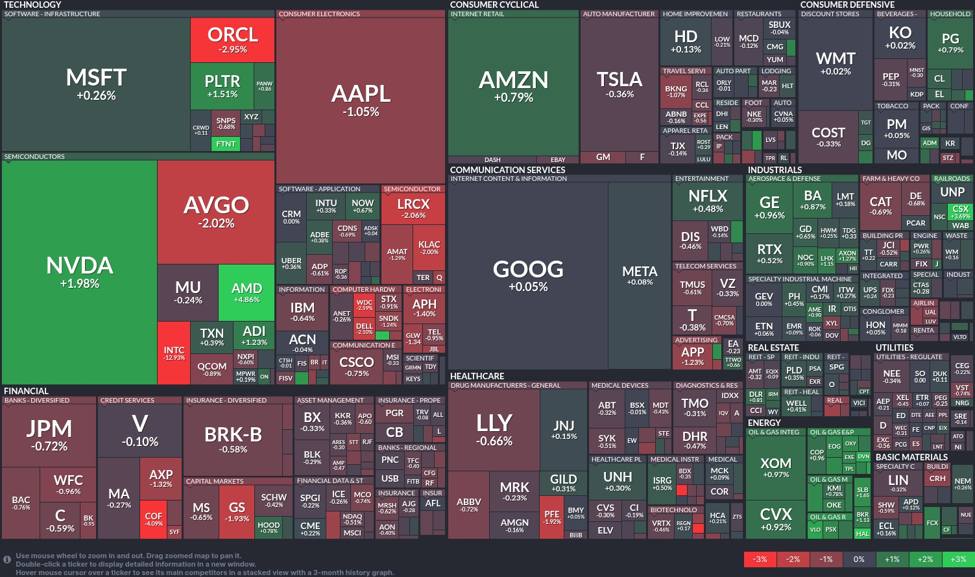
Tech sector resilience: Nvidia soars while Intel struggles
Sector OverviewThe stock market presented a mixed bag of performances today, with noteworthy activity across several key sectors. The technology sector stood out with striking contrasts: while Nvidia (NVDA) surged by 1.98% amid high investor interest, Intel (INTC) faced a steep decline of 12.93%, reflecting challenges or unfavorable news impacting the semiconductor space. Notably, AMD emerged as another strong player, advancing 4.86%.Technology: While Nvidia’s gains underline investor confidence or positive developments, Oracle (ORCL) dropped by 2.95% possibly hinting at concerns in infrastructure software.Consumer Cyclical: The sector saw modest gains with Amazon (AMZN) up by 0.79%, signaling continued consumer confidence in retail giants. Tesla (TSLA) fell slightly by 0.36%.Financials: Mixed emotions mark the financial landscape, with JPMorgan Chase (JPM) dipping by 0.72%, and Bank of America (BAC) declining 0.76%, suggesting cautious sentiment. Market Mood and TrendsThe broader market sentiment today hints at uncertainty and selective optimism. The tech sector’s polarized performance is a vivid example, with investors appearing wary yet opportunistic. Investor anxiety may stem from Intel’s drop, yet the surge in Nvidia and AMD demonstrates confidence in parts of the tech ecosystem. Consumer confidence in retail giants like Amazon could underpin future retail sector strength.Strategic RecommendationsInvestors may want to capitalize on the robust performance of key tech stocks such as Nvidia and AMD while staying cautious around sectors experiencing volatility, like semiconductors. Continuous monitoring of developments in the tech arena and diversification across sectors might optimize portfolio resilience. Consider reallocating resources towards the healthcare sector, where steadiness prevails with stocks like Johnson & Johnson (JNJ) maintaining a positive 0.15%. Navigating this volatile market requires adaptability and attentiveness to real-time data and trends. 🌐 Stay connected with InvestingLive.com for timely insights and updates! This article was written by Itai Levitan at investinglive.com. 🔗 Source 💡 DMK Insight Nvidia’s 1.98% rise contrasts sharply with Intel’s 12.93% drop, and here’s why that matters: The tech sector’s mixed performance signals diverging investor sentiment. Nvidia’s gains suggest strong demand and confidence in AI and gaming, while Intel’s steep decline raises red flags about its competitive position and operational challenges. Traders should consider how these contrasting movements could influence broader tech indices, especially if Nvidia continues to rally while Intel struggles. Watch for key support levels in Intel around recent lows, as a break could trigger further selling pressure. On the flip side, Nvidia’s momentum could attract more institutional interest, potentially pushing it toward new highs. Keep an eye on earnings reports and guidance from both companies in the coming weeks, as they could provide critical insights into the tech landscape. If Nvidia maintains its upward trajectory, it might pull other semiconductor stocks along with it, while Intel’s woes could lead to a broader sector rotation away from underperformers. 📮 Takeaway Watch Nvidia’s performance for bullish momentum, while Intel’s support levels are critical to monitor for potential further declines.

Silver touches $100/oz for the first time
Silver has a long history of making incredible moves and this one is certainly on that list. It’s been a one-way parabolic move since $50 in late-November.Before then it was a steady climb higher and was just at $23 of the time of Trump’s second election. The combination of industrial demand, low mining supply and monetary demand has been sensational. The latest leg is all retail piling in as it becomes something of a meme.Naturally, I would expect some profit taking here but it’s hard to turn against precious metals until gold also hits $5000. The high was $4967 earlier today and it’s about $8 below that now.Silver has long been defined by dramatic price volatility, driven by its dual identity as an industrial metal and a monetary store of value. The most notorious event in its history remains the attempt by the Hunt brothers to corner the market in 1979 and 1980. Texas oil tycoons Nelson and William Hunt, fearing inflation and currency debasement, aggressively accumulated physical silver and futures contracts.By early 1980, the Hunts controlled roughly one-third of the world’s tradeable supply. Their buying pressure drove the price from roughly $6 to an all-time high of nearly $50 per ounce in January 1980. The bubble burst when exchanges imposed new restrictions on margin buying, leading to “Silver Thursday,” a market crash that decimated the Hunts’ fortune.Three decades later, silver staged another massive rally in 2011. Following the 2008 financial crisis, quantitative easing and a weakening U.S. dollar fueled a flight to hard assets. Silver climbed steadily, nearly matching the 1980 record by reaching roughly $49 in April 2011 before correcting sharply as margin requirements were raised again. That rally may have been kicked off by the advent of silver ETFs.Most recently, the “Silver Squeeze” of early 2021 highlighted the influence of social media on finance. Inspired by the GameStop saga, retail investors on Reddit attempted to force a squeeze on institutions they believed were suppressing prices. While they successfully drove demand for physical coins and ETFs, pushing prices to an eight-year high near $30, the sheer liquidity of the global silver market absorbed the shock, preventing a squeeze comparable to the Hunt brothers’ era.Now they’re taking another crack at it. This has been called for by corners of the internet for as long as I’ve been in markets and it’s wonderful to see the bulls getting rewarded. This article was written by Adam Button at investinglive.com. 🔗 Source 💡 DMK Insight Silver’s parabolic rise from $50 in late November signals a pivotal moment for traders. The metal’s recent surge is driven by a mix of industrial demand and macroeconomic factors, including inflation fears and potential supply chain disruptions. Traders should be aware that such rapid movements often lead to volatility, and a pullback could be imminent if profit-taking kicks in. Watch for key support levels around $45 and resistance near $55. If silver can hold above $50, it might attract more institutional interest, but a drop below $45 could trigger a wave of selling. Here’s the thing: while silver’s ascent is impressive, it’s essential to consider the broader context. If the dollar strengthens or interest rates rise, silver could face headwinds. Keep an eye on the U.S. economic indicators and any shifts in Fed policy, as these could impact precious metals significantly. The real story is how silver reacts to these external pressures in the coming weeks. 📮 Takeaway Monitor silver’s price action around $50; a hold above could signal further gains, while a drop below $45 may prompt selling pressure.

The macro view from the railroads: CSX says they don't see any macro improvement coming
US railway CSX isn’t seeing a macro rescue in 2026. Management is planning for flat industrial production, modest GDP growth and sticky inflation within the firm above 3%, with customers cautious under tariff pressure. Housing and autos remain headwinds, trucking is soft, and there’s no near-term catalyst—leaving infrastructure spending and power demand as the lone offsets nationally.The shares are up 4.5% today on a mix of solid execution and M&A chatter but have been flat since 2021.Here are some revealing comments on the macro outlook from the conference call.Stephen Angel – CEO“This has been a challenging year for CSX and for our industry overall with subdued demand and limited growth opportunities persisting across many of our key markets.”“As we plan for 2026, we do not anticipate any meaningful improvement in macroeconomic conditions.”“We are assuming low single-digit revenue growth for the year based on flat industrial production, modest GDP growth and fuel and benchmark coal prices consistent with current levels.”“Obviously, any time you get a little help from the economy, that would certainly help, but I really don’t sit here and think I need to have a lot of help from the economy.”Maryclare Kenney — Chief Commercial Officer“We continue to navigate the challenges of a mixed industrial demand environment.”“There’s no short-term catalyst on the horizon to lift the major industrial markets.”“Many of our customers are carefully controlling freight spend as they manage through inflation and tariff pressures.”“Consensus forecasts call for a modest decline in housing starts this next year.”“Affordability and overall demand levels continue to impact the prospects for North American light vehicle production.”“Minerals volume remains supported by demand for aggregates and cement for infrastructure projects.”“The markets reflect the reality of a still soft trucking market, and we also need to be aware of the risk of a slowdown in imports after the pull forward of activity that occurred through 2025.”“Global steel markets and benchmark prices remain subdued.”Kevin Boone — CFO“Overall, I would look at inflation probably being in that 3% to 3.5% range.” (this is corporate level, not nationally)That’s a revealing picture and it runs counter to some of the early-year optimism. This article was written by Adam Button at investinglive.com. 🔗 Source 💡 DMK Insight CSX’s outlook signals a tough road ahead, and here’s why that matters for traders: The company’s expectation of flat industrial production and modest GDP growth suggests a stagnating economy, which could impact freight volumes and, consequently, revenues. With inflation expected to remain above 3%, operational costs may rise, squeezing margins further. Traders should keep an eye on how these factors influence CSX’s stock price, especially if it tests key support levels. The broader implications could ripple through related sectors like trucking and manufacturing, where demand is already soft. If CSX’s performance falters, it could trigger a sell-off in transportation stocks, impacting ETFs and indices tied to these sectors. On the flip side, if infrastructure spending picks up unexpectedly, it could provide a lifeline for CSX. Watch for any announcements regarding federal spending on infrastructure, as this could shift market sentiment. For now, keep an eye on CSX’s stock around its recent lows; a break below those levels could signal further downside risk. 📮 Takeaway Monitor CSX’s stock around its recent lows; a break could indicate further downside risk amid a stagnating economy.

US dollar falls further as gold nears $5000
The US dollar is coming under some broad pressure ahead of the weekend, particularly in USD/JPY.There could be fears of intervention in the thin liquidity at the open on Sunday or it could reflect the record highs in precious metals and increasing talk of de-dollarization. Another curious move today is the rally in oil markets, which might suggest that something is afoot via the US military over the weekend. Given the drama since the start of the year, I wouldn’t rule that out.In any case, these moves are notable and USD/JPY is having a look at the post-BOJ lows.It’s certainly not only the yen though as cable is at the best levels in 14 weeks and is further pressing higher. From Monday’s low, it’s up 230 pips and has been lifted by hawkish comments from Greene, along with stronger retail sales and PMI beats.The week ahead is also a big one as Trump is likely to name a new Fed chief. There are risks around US equity flows as well with all the megacap tech names reporting earnings. The rule of thumb on the Fed decision is that Kevin Warsh or Kevin Hassett (particularly the latter) would be dollar negative while Rick Rieder or Chris Waller would be dollar supportive. We also get a proper Fed decision on Wednesday, though the market is pricing in virtually no likelihood of a rate cut, and no cut is fully priced in until July. The Fed wants to wait and see how the economy develops as we get mixed indications on growth. Airlines have reported high spending in premium segments but today, railroad CSX had a downbeat view on 2026 freight volumes and overall macro.Inflation appears to be trending down but there is still some angst about how inflation plays out. This article was written by Adam Button at investinglive.com. 🔗 Source

Yen intervention talk sends USD/JPY sharply lower
Eyes are on the yen on a big move lower in USD/JPY ahead of the weekend. The pair is down 202 pips on the day now to 156.40, which is a sharp reversal after rising to 159.22 when the Bank of Japan left rates on hold.There is some chatter that’s unconfirmed that Japan’s Ministry of Finance (which controls FX intervention) ran a rate check. That’s where they call around to banks and ask for current yen prices. That kind of move is a bit of theater but it’s a signal to everyone that they’re closely watching the market, and prepared to get involved. It’s often the final step before actually intervening. Again, sometimes these rumors follow price action so it’s tough to tell.As for actual intervention, that’s not what this looks like to me. Generally, they hit much harder and swifter. This looks more like stops and strong, steady USD/JPY selling.Notably, this is coming with the US dollar under some serious pressure across the board. Further to that, oil prices are strong today in a curious move. I hate to do too much speculation but Trump has been making some weekend moves and the market could still be thinking about what happened in Venezuela. The obvious inference is that something could happen in Iran, which would be both USD negative and oil positive (throw in some precious metals bullishness too).Other than the usual corners of the internet that are constantly talking about US military strikes, I don’t see anything along those lines. Then again, there was a bit of smoke around Venezuela but not real fire.So all this to say that it’s not really clear what’s behind the precious metals buying, dollar selling and oil bids today. This article was written by Adam Button at investinglive.com. 🔗 Source 💡 DMK Insight The sudden drop in USD/JPY to 156.40 is a critical signal for forex traders: This 202-pip decline follows a brief spike to 159.22 after the Bank of Japan’s decision to maintain interest rates. Such volatility highlights the market’s sensitivity to central bank policies, and traders should be cautious. The reversal suggests a potential shift in sentiment, possibly driven by profit-taking or changing expectations around future monetary policy. If the pair continues to hold below 157.00, it could indicate further bearish momentum, while a rebound above 158.00 might reignite bullish interest. Keep an eye on related markets, especially Japanese equities and U.S. Treasury yields, as they often correlate with USD/JPY movements. The real story here is whether this drop is a temporary correction or the start of a more sustained downtrend. Watch for any comments from BOJ officials or economic data releases that could influence market sentiment in the coming days. 📮 Takeaway Monitor USD/JPY closely; a sustained move below 157.00 could signal further downside, while a rebound above 158.00 may indicate renewed bullish sentiment.

Trump administration weights total blockade of Cuba – report
Politico reports:The Trump administration is weighing new tactics to drive regime change in Cuba, including imposing a total blockade on oil imports to the Caribbean country, three people familiar with the plan said Thursday.American built up a lot of force in the Caribbean for Venezuela, maybe they redirect it to Cuba, or maybe that was the plan all along.Marco Rubio is said to be leading the push. His parents were born in Cuba but came to the US three years before the revolution. Other members of the family fled as refugees afterwards.A blockade is a brutal escalation and an act of war that will surely create an international incident. That said, Cuba’s economy is said to be badly struggling at the moment and it lost one of its few remaining allies in Venezuela. Last year, the US already started blockading Venezuelan oil from reaching Cuba.A separate report today from Reuters says Mexico is weighing halting oil exports to Cuba.Despite the turmoil, there are few signs of organized resistance in Cuba and that might make any kind of US campaign much tougher than what happened in Venezuela. President Díaz-Canel did note in 2024 that “counter-revolutionaries from abroad” were fomenting protests in Cuba.During the overthrow of Maduro, 32 Cuban guards were killed and both Díaz-Canel and 94–year-old Raul Castro attended a ceremony when their bodies were returned to Cuba.The US has long coveted the island of 10 million inhabitants but many attempts to retake it or assassinate Fidel Castro failed. The most famous was the 1961 Bay of Pigs invasion where all 1500 US-sponsored invaders were killed or captured. The US has had various economic embargoes on the island since 1960 with the goal of overthrowing the Communist government. This article was written by Adam Button at investinglive.com. 🔗 Source 💡 DMK Insight So, the Trump administration’s potential move to impose a total blockade on oil imports to Cuba could shake up regional markets significantly. For traders, this isn’t just a geopolitical story; it has real implications for oil prices and related assets. If the U.S. restricts oil imports to Cuba, it could lead to increased volatility in oil markets, especially if Cuba turns to other suppliers like Russia or Venezuela. This could create ripple effects in the broader energy sector, impacting stocks of companies involved in oil production and distribution. Keep an eye on crude oil futures and related ETFs, as any escalation in tensions could lead to price spikes. On the flip side, if the blockade leads to a more stable regime in Cuba, it might open up new opportunities for U.S. businesses in the long run. But for now, the immediate focus should be on how this geopolitical maneuvering affects oil supply chains and prices. Watch for any announcements or developments in the coming weeks that could signal a shift in U.S. policy or market reactions. 📮 Takeaway Monitor crude oil futures closely; any news on the blockade could trigger significant price movements in the energy sector.

investingLive Americas market news wrap: US dollar battered, silver hits $102
US January S&P Global flash services PMI 52.5 vs 52.8 expectedTrump administration weights total blockade of Cuba – reportYen intervention talk sends USD/JPY sharply lowerCanada November retail sales +1.3% vs +1.2% expectedMarkets:WTI crude oil up $1.77 to $61.13US 10-year yields down 1.6 bps to 4.235%Bitcoin flat at $89KS&P 500 flatGold up $44 to $4980, a fresh recordSilver hits $100 for the first time, continues to $102JPY leads, USD lagsThe newsflow was light but it certainly wasn’t a quiet Friday in North American trading. There were some big moves in commodities and FX but very little to point to as catalysts. In the absence, rumours filled in the gaps.The big one was that the Japanese Ministry of Finance did a rate check, essentially calling banks and asking for quotes. That’s a trivial move but it’s hugely symbolic as it’s a potential precursor to intervention. The yen sold off earlier in the day and USD/JPY hit 159.22 following the Bank of Japan but it turned around in a big way, down to 155.86 last.There was even some talk of intervention but doing that late Friday well after Tokyo has gone to bed is out of the ordinary. The move also didn’t have the spike-style move typical of proper intervention.Also critical is that the US dollar was broadly weaker and was solid continually in US hours. Again, there was no obvious catalyst for that, though cable did have some backing following hawkish comments, rising yields and the earlier PMIs. There was certainly a dollar selloff and it also coincided with a 3% jump in oil prices and fresh highs in precious metals.That combination of events looks like a geopolitical trade. Late in the day there was talk of a full Cuban blockade but eyes are also on any potential action against Iran. Trump has frequently acted on the weekend and there is likely some sense that he could do it again.In stock markets, megacap tech was strong while the Russell 2000 struggled. The S&P 500 was flat but the YTD leader — Intel — was smashed 17% lower following disappointing guidance.Have a great weekend. This article was written by Adam Button at investinglive.com. 🔗 Source
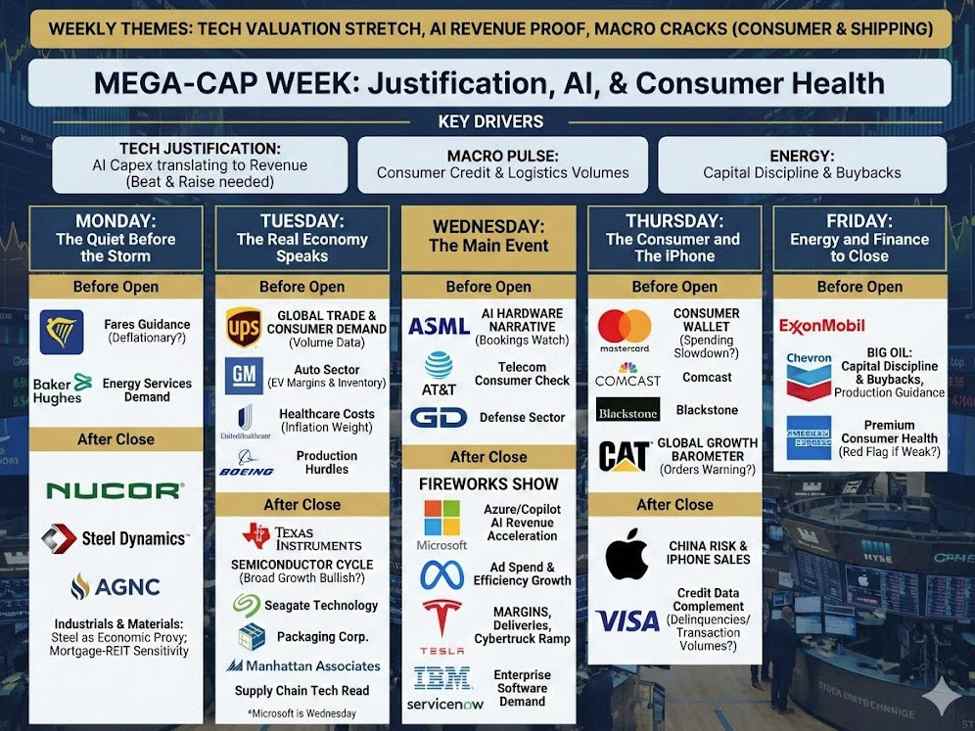
The week ahead: Earnings season shifts into maximum overdrive
We have a massive slate of mega-cap tech, critical industrial bellwethers, and the titans of energy all reporting next week.The key theme will be justification. Valuations are stretched in the tech sector, and the market needs to see not just beat-and-raise quarters, but clear evidence that AI capex is going to translate into revenue. On the macro side, we are looking for signs of cracking in the consumer data from the credit card giants and shipping volumes from the logistics heavyweights.MondayMonday is relatively light, giving markets a moment to position before the volatility ramps up.Before Open: We get a look at the European consumer with Ryanair. Watch their guidance on fares; if they are softening, it is a deflationary signal. Baker Hughes will give us early insight into energy services demand before the oil majors report later in the week.After Close: The focus shifts to industrials and materials. Nucor and Steel Dynamics are the ones to watch here. Steel demand is a proxy for real economic activity—construction and manufacturing. If their outlook is gloomy, it sets a cautious tone for the GDP components. AGNC will also be interesting for the mortgage-REIT space and interest rate sensitivity.TuesdayTuesday is where the macro picture comes into focus. We have diverse sectors reporting that act as pulse checks for the broader economy.Before Open: This is a heavy morning. UPS is the critical report here. As a global shipping bellwether, their volume data tells us exactly what is happening with global trade and consumer demand. GM will update us on the auto sector—keep an eye on their EV margins and inventory levels. We also have UnitedHealthcare, which acts as a massive weight in the Dow and S&P; healthcare costs have been a sticky inflation component, so their commentary matters. Boeing is also on the docket; expect volatility there as they navigate production hurdles.After Close: All eyes will be on Texas Instruments. They are the first major semiconductor name to report this week and arguably the most important for the broad cycle. They sell chips into everything—autos, industrial, appliances. If they call a bottom in the cycle, that is bullish for global growth. Microsoft is listed on some calendars for Tuesday, but looking at this schedule, the heavy tech hitters seem clustered mid-week (Note: double-check confirming Microsoft is Wednesday on this specific graphic). On this graphic, Tuesday PM features Starbucks (correction: that is Seagate and Packaging Corp, the Starbucks logo is not there, it is Seagate, Manhattan, etc). Manhattan Associates is a good read on supply chain tech.Wednesday: The Main EventThis is the day that will likely define the week’s price action. The volume of market cap reporting on Wednesday is staggering.Before Open: ASML is the key. They make the machines that make the chips. If their bookings are weak, the entire AI-hardware narrative takes a hit. AT&T will be a yield play and a check on the telecom consumer. Boeing (checking graphic again—Boeing is Tuesday, Wednesday has General Dynamics). General Dynamics will be relevant for the defense sector amid geopolitical tensions.After Close: This is the fireworks show. Microsoft, Meta, and Tesla all reporting in the same window. We will have more on those closer to the releases:Microsoft: The market wants to see AI revenue acceleration in Azure/Copilot. If they miss on cloud growth, the whole sector could re-rate.Meta: It is all about ad spend and efficiency. Zuckerberg’s “Year of Efficiency” was a hit; now they need to show growth.Tesla: Margins, margins, margins. The EV price war has hurt them. Guidance on deliveries and the Cybertruck ramp will drive the stock.IBM and ServiceNow also report, adding more data points to enterprise software demand.Thursday: If Wednesday is about cloud and AI, Thursday is about the consumer and global hardware.Before Open: We get a massive read on the consumer wallet. Mastercard will tell us if spending is slowing down. We also have Comcast and Blackstone. Caterpillar is the other major one here—often seen as the ultimate global growth barometer. If CAT is warning on orders, the “soft landing” narrative gets harder to defend.After Close: Apple takes center stage. The China story is the biggest risk here. Traders will be parsing every word regarding iPhone sales in Asia. Visa also reports, complementing the Mastercard data from the morning. If both credit giants show rising delinquencies or slowing transaction volumes, the recession bears will come out of hibernation. Friday:We wrap up the week with the energy giants and some final financial names.Before Open: It is Big Oil day. ExxonMobil and Chevron report. With oil prices hovering in a defined range, the focus will be on capital discipline and buybacks. Cash flow should be strong, but production guidance is the variable. Chevron has had some operational hiccups recently, so execution is key. American Express is the final piece of the consumer puzzle; their premium customer base usually holds up better, so any weakness there is a significant red flag. This article was written by Adam Button at investinglive.com. 🔗 Source 💡 DMK Insight Next week’s earnings reports from major sectors could shake up the market, especially for tech stocks. With ETH currently at $2,957.55, traders should be wary of how these earnings impact investor sentiment. If tech giants fail to deliver strong results, we might see a sell-off that could drag down crypto prices as well. The correlation between tech stocks and crypto is becoming more pronounced, especially as institutional investors diversify their portfolios. Keep an eye on key earnings dates and watch for any guidance related to AI investments, as this could set the tone for market direction. If tech stocks falter, ETH could test support levels below $2,900, making it crucial to monitor price action closely in the coming days. 📮 Takeaway Watch for earnings next week; if tech fails to impress, ETH could dip below $2,900.