
 Bitcoin
  Ethereum
  Tether
  BNB
BNB  XRP
XRP  USDC
USDC  Solana
  TRON
TRON  Lido Staked Ether
  Figure Heloc
The Japanese yen currency just spiked higher across the board after stumbling following BOJ governor Ueda’s press conference. The price movement has similar characteristics to a “rate check” call from the MOF, similar to previous episodes we have seen back in 2024 and 2022.For some context, the last reported “rate check” was back in the middle of July 2024, just before Tokyo authorities stepped in to buy up the currency. And before that, the previous “rate check” was in 14 September 2022 and that was a week before actual intervention took place.The “rate check” calls were all meant to give the market a bit of fair warning before they actually intervened after. So, we have some precedence of what to expect next with the Japanese yen. The only question is when.The one in July 2024 saw the MOF step in with actual intervention in just a matter of days whereas the one in 2022 took about a week.USD/JPY was trading up to around 159.22 after BOJ governor Ueda’s press conference earlier but was quickly sent lower to 157.33 before recovering to about 158.20 at the moment of writing. It seems that Tokyo officials aren’t going to risk it getting anywhere near 160.00 before stepping in.If you’re still trading yen pairs at the moment, just be wary that intervention risks have now heightened dramatically after this move here.Personally, this doesn’t look to be actual intervention as any real hit by Tokyo would result in a much larger and stronger move. So, my take is that it’s a “rate check” and we should get some official sources noting that in the hours to come. This article was written by Justin Low at investinglive.com. 🔗 Source 💡 DMK Insight The yen’s recent spike signals potential volatility ahead, and here’s why traders should pay attention: After BOJ Governor Ueda’s press conference, the yen’s movement resembles past ‘rate check’ scenarios, which often precede significant market shifts. Traders should note that these spikes can lead to rapid reversals, especially if the market perceives the BOJ’s stance as more hawkish than anticipated. In the context of broader economic indicators, any signs of tightening could impact not just the yen but also related assets like Japanese equities and U.S. Treasury yields. If the yen breaks above key resistance levels, it could trigger further buying, while a failure to hold these gains might lead to a swift correction. Keep an eye on the 110.00 level for potential support or resistance, as this has historically been a pivotal point. The real story is how the market reacts in the coming days; a sustained move could indicate a shift in sentiment towards the yen, while a pullback might suggest traders are still skeptical about the BOJ’s commitment to tightening. Watch for any further comments from BOJ officials that could influence market expectations. 📮 Takeaway Monitor the yen around the 110.00 level; a break could signal further bullish momentum, while a drop may indicate skepticism about BOJ policy shifts.

France January flash services PMI 47.9 vs 50.5 expected
Prior 50.1Manufacturing PMI 51.0 vs 50.5 expectedPrior 50.7Composite PMI 48.6 vs 50.0 expectedPrior 50.0With a start to the year like this, France is not beating the allegations that it will be the main drag of the euro area for 2026. While political woes are a key issue, the French economy looks to also be stuttering to start the new year.Of note, services activity falls back into contraction territory and marks a fresh 9-month low. That isn’t enough to offset the better news on the manufacturing side of things with the estimate there being a 43-month high. That comes as the manufacturing output index climbs to 51.9, marking a 47-month high.Looking at the details, demand conditions continue to be weak and clients are showing hesitancy to place orders amid the ongoing political deadlock regarding the nation’s fiscal plans. That being said, business optimism was the highest since September 2024 so that may hint that there might be better things to come in the French economy moving forward. But for now, it’s very much a wait and see kind of thing.HCOB notes that:“The French private sector entered the new year on a muted note. The HCOB Flash PMIs point to a broad‑based softening in export conditions, reflecting continued uncertainty on the trade policy front despite prior trade agreements. Renewed tariff threats from the US, which included the prospect of a 200% duty on French champagne, underscore how fragile the external environment remains. Although such threats may merely be being used as a tool to gain political leverage, they still add to the uncertainty faced by export‑orientated firms. A relatively firm euro and intensifying competition from China further weigh on the outlook for exporters. “Nonetheless, the HCOB flash PMIs showed a modest improvement in manufacturing, whereas activity in the services sector weakened notably at the start of the year. The prospect of a resolution over the 2026 national budget offers some relief, as it reduces the risk of a renewed political crisis in the near term. This has contributed to a marked rise in the future activity index. However, the new budget is unlikely to deliver sufficient progress on fiscal consolidation. “Whether the manufacturing industry embarks on a recovery in 2026 remains uncertain. The headline PMI for the sector signalled a mild uptick in growth, but a more durable improvement would require a clear rebound in new orders, which remained in contraction in January. The continued decline in output prices and export orders also suggests that a sustained upswing in growth is not yet in sight.” This article was written by Justin Low at investinglive.com. 🔗 Source 💡 DMK Insight France’s disappointing PMI data signals potential economic stagnation, and here’s why that matters: The Manufacturing PMI at 51.0, while slightly above expectations, shows a slowdown from the previous 50.7, indicating that growth is tepid. The Composite PMI dropping to 48.6 against a 50.0 expectation is particularly concerning, as it suggests contraction in the services sector, which is crucial for overall economic health. For traders, this could mean increased volatility in the euro, especially if the market starts pricing in a weaker economic outlook for the eurozone. Keep an eye on the euro against the dollar; if it breaks below key support levels, it could trigger further selling pressure. Additionally, the broader implications for the European Central Bank’s monetary policy could lead to shifts in interest rate expectations, impacting not just forex but also equities linked to the eurozone. On the flip side, if France manages to stabilize its economic indicators in the coming months, it could provide a buying opportunity for those looking at euro-denominated assets. Watch for upcoming economic reports and political developments that could sway market sentiment significantly. 📮 Takeaway Monitor the euro’s performance against the dollar; a break below key support levels could signal further declines amid France’s economic struggles.

Germany January flash manufacturing PMI 48.7 vs 47.8 expected
Prior 47.0Services PMI 53.3 vs 52.5 expectedPrior 52.7Composite PMI 52.5 vs 51.6 expectedPrior 51.3Full report hereKey Points:Business activity growth quickens in January, but labour market conditions deteriorateComment:Commenting on the flash PMI data, Dr. Cyrus de la Rubia, Chief Economist at Hamburg Commercial Bank, said: “The data show a good start to the new year, overall. Output in the manufacturing sector returned to – albeit meagre – growth, and so did new orders. Even more encouraging is the stronger pickup in activity in the services sector. Looking ahead, confidence has risen noticeably in the services sector and has held at a solid level in manufacturing. “While there are signs of a modest recovery, services companies have trimmed their workforce significantly in January, which might point more to efficiency measures than to concerns about demand. In manufacturing, the process of cutting jobs has continued unabated. Since this has been ongoing since mid-2023, there’s now a lot of debate about whether this is a structural issue, one that would require structural answers in the form of reforms that are anything but easy to implement. “In the services sector, the situation has brightened quite a bit. Pricing power seems to have increased significantly as sales price inflation has moved up. While that partly reflects higher input costs, the rise in sales price inflation has been even stronger. With new business growing more robustly than last month, service providers are becoming more self-confident – something that also shows up in their much higher optimism for future activity. “Meanwhile, the International Monetary Fund has upgraded its 2026 GDP growth forecast for Germany by 0.2 percentage points to 1.1%, reinforcing the sense that growth prospects are improving. Still, the recovery remains rather fragile. The continued drop in inventories and another decline in backlogs of orders in manufacturing are clear examples. Yet, the unusually large fiscal stimulus through much higher spending on defence and infrastructure should provide a noticeable boost to the economy.” This article was written by Giuseppe Dellamotta at investinglive.com. 🔗 Source 💡 DMK Insight The January PMI data shows business activity growth, but the deteriorating labor market could signal trouble ahead. With the Services PMI at 53.3, beating expectations, it’s clear that demand is holding up, which is good news for sectors tied to consumer spending. However, the Composite PMI’s slight dip to 52.5 suggests that while growth is present, it may not be sustainable if labor conditions worsen. Traders should be cautious, as a weakening labor market can lead to reduced consumer confidence and spending, impacting sectors like retail and services. Keep an eye on related assets, particularly those in the consumer discretionary space, as they could feel the pinch if this trend continues. Watch for key levels in the broader market, especially if the PMI data influences central bank policy decisions in the coming weeks. If the Composite PMI falls below 50, it could trigger a bearish sentiment shift across markets, so that’s a critical level to monitor. 📮 Takeaway Watch the Composite PMI closely; a drop below 50 could signal broader market weakness and impact consumer-related stocks.

Oil Technical Analysis with Iran Tensions Looming
Oil Technical Analysis Today: Crude Oil Bears Stay in Control Below $60, but Here Is Exactly When the Bias ChangesDate: January 23, 2026 Market: Light Crude Oil Futures (CL) | Micro Crude Oil (MCL) Author: Itai Levitan, investingLive.comAs I show in my video above, this oil technical analysis for today focuses on the daily structure in light crude oil futures, where price action continues to favor the bears. That said, this is not a one-sided narrative. While the current evidence points lower, we remain very clear about where, when, and how the bearish outlook would be invalidated. Tight risk control and open-mindedness are essential, especially in crude oil.Key takeaways for traders and investorsCrude oil remains inside a well-defined price channel, keeping downside risk active.The $60 round number continues to act as a ceiling rather than support.The 20-day EMA near $59.11 is capping rallies and reinforcing bearish pressure.VWAP and value area levels around $59.77-$59.85 define the current battle zone.A sustained move above $59.85 would quickly weaken the bearish case.Light crude oil technical analysis: the higher-timeframe structureOn the daily chart of crude oil futures, price remains trapped inside a broader channel that has guided market behavior since mid-2025. The upper boundary originates from the June 23, 2025 high near $78.40, with a parallel structure validated again in mid-January 2026.What matters technically is not just the channel itself, but what failed. The most recent test of the upper boundary did not lead to upside continuation. Instead, price sold off sharply back toward the 20-day EMA, signaling disappointment for bulls. When price fails to sustain above resistance and falls back into a channel, it is usually bearish, not neutral.Why the $59-$60 zone is critical in oil price analysisCrude oil is currently compressed between just under $60 and the 20-day EMA at $59.11. This area is reinforced by important VWAP references:Today’s developing VWAP: ~$59.77Yesterday’s Value Area High: ~$59.84This creates a tight resistance band. As long as price trades below this zone, rallies tend to look like mean-reversion moves, not trend reversals. From an oil price prediction perspective, bulls still have work to do.Scenario-based crude oil outlook (not predictions)Bearish scenario – current base caseCondition: Price remains below $59.85 and inside the channel.Implication: Sellers retain control.Technical path: A move toward the lower channel region near $56.80-$57.00 remains technically valid.Risk management: Wider stops above $60 can still produce attractive risk-reward, especially when using MCL for position sizing flexibility.Bullish invalidation – where our bias changesCondition: Two consecutive hourly closes above $59.84-$59.85, followed by acceptance above the channel.Implication: The bearish thesis weakens rapidly.Next focus: Sustained trade above the channel would reopen upside scenarios and shift the analysis toward accumulation rather than distribution.This is how we stay flexible. The stance is bearish because of current information, not because of conviction without limits.Example trade idea shared with our community (educational)This is an example of how we translate oil technical analysis into disciplined trade execution, shared for educational purposes only.Short Crude Oil (Light Crude Futures) Ticker: CL | Micro: MCL Prices in futuresEntries1st sell: 59.69 (filled)2nd sell: 59.82 (pending at the time of publishing idea, but filled already since then)Stop60.03 (not reached yet a tthe time of this analysis but updated to $60.14 at the European Open as a last update)TargetsTP1: 59.39TP2: 59.17TP3 (runner, swing): 56.60 (assumed for RR calculation)Risk-reward breakdownAssumptions:Both sell orders filledAll entries same sizeAll exits same sizeAverage entry: (59.69 + 59.82) / 2 = 59.755Risk (1R): 60.03 − 59.755 = 0.275TP1: RR ≈ 1.33RTP2: RR ≈ 2.13RTP3 (runner): RR ≈ 11.47RAverage RR (equal exits): ≈ 4.98RBig-picture oil outlook for patient tradersFor very patient traders and investors, a deeper move toward ~49.50 (roughly 17% below current prices) is technically possible over the coming weeks. This is not a forecast, but a structural observation. If even a small runner reaches that zone, the RR on that portion becomes extreme and can materially improve overall trade expectancy.Trade management philosophy: defense firstOur approach emphasizes defense before offence:Partial profits reduce emotional pressure.If and when TP1 is reached, unfilled entries are canceled and the stop is moved to entry.Capital protection comes first. Only then do we allow runners to work.Join our free Telegram channelIf you want to follow real-time oil analysis, trade ideas, and professional trade management, you are welcome to join our free Telegram channel: 👉 https://t.me/investingLiveStocksWe regularly share setups like this one, often minutes after execution, along with updates and risk management logic.We do not promise results. This is not financial advice. Everything is shared for educational purposes only.Crude oil can change quickly. Our job is not to predict, but to adapt with clear levels, clear invalidation, and tight risk control.UPDATE – Crude Oil Short Our crude oil short has been stopped out. That is part of trading. But even when we lose on execution, we can still gain valuable information. The key point: Our map has not changed. See the video above for that “map perspective”. What failed this time was our previous bet on where price would sit on that map. The technical framework remains relevant. As long as bulls are able to keep price above certain well-defined thresholds and technical patterns, the bullish case holds together. If that changes, we also know exactly at what (tight) price zone it changes. This is important: It is not about picking any random price and saying “above this is bullish, below this is bearish.” The Value Area High of today now sits at 60.02 and the is the current “line in the sand” between bulls and bears (and bulls regained control). Markets move through junctions. Some technical junctions are far more important, far more watched, and far more meaningful than others. Those are the levels that matter. That is where bias changes. And that is where tehnical decisions should be made. This article was written by Itai Levitan at investinglive.com. 🔗 Source 💡 DMK Insight Crude oil is still under pressure, and here’s why that matters for traders: With prices hovering below $60, bearish sentiment remains dominant in the market. This level is
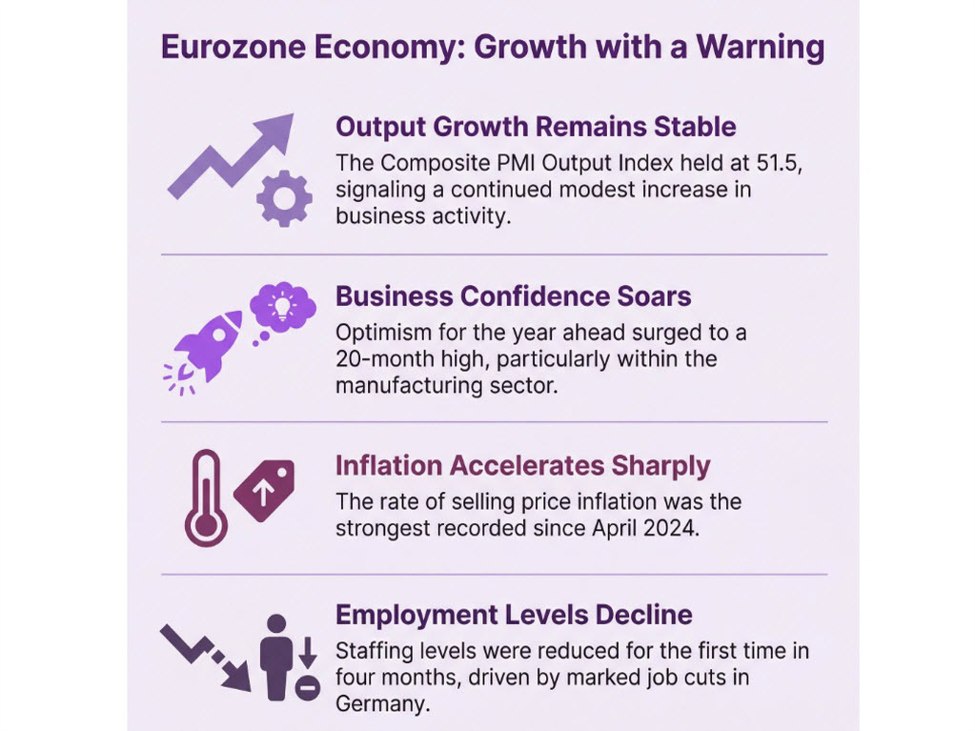
Eurozone January flash services PMI 51.9 vs 52.6 expected
Prior 52.4Manufacturing PMI 49.4 vs 49.1 expectedPrior 48.8Composite PMI 51.5 vs 51.8 expectedPrior 51.5The end of last year was filled with optimism on the recovery but the start of the year dealt a bit of a reality check. The contrast between France and Germany again is for all to see. The former is facing a stuttering month in terms of business activity while the latter is seen more resilient still. That said, firms reduced their staffing levels for the first time in four months amid marked job cuts in Germany. So, there’s that.On the inflation front, both input costs and output prices were seen growing faster than in December. So, there are still some things to be mindful about at the balance.HCOB notes that:“The recovery still looks rather feeble. In manufacturing, the headline PMI continues to signal weakness, while growth in services activity is somewhat more moderate than the month before. Overall economic growth remains unchanged. Looking ahead, the low growth in new orders is certainly no game changer. Instead, the start into the new year points to more of the same in the months to come. For the ECB, these results are anything but reassuring. Inflation in the services sector, which the central bank is watching particularly closely, has increased significantly in terms of sales prices. Input cost inflation remains an issue as well, though it has accelerated less than sales price inflation. As a result, ECB members are likely to feel validated in holding rates where they are. Some of the more hawkish members may even argue that the next move should be up rather than down. Comparing countries, services activity in Germany expanded in January at a fairly robust pace, while in France service companies slipped into contractionary territory. This may be linked to the political difficulties in finalising the 2026 budget. In manufacturing, France shows a slightly better performance than Germany, but in both countries output growth is nothing to write home about. Overall, Germany’s economy started the new year on a growth path, while monthly output in France has declined. While the unemployment rate has been roughly stable over the past year, weakening employment figures in services and ongoing staff cuts in manufacturing point toward a somewhat higher unemployment rate in the coming months. This suggests that the current weak growth trajectory may not be enough to keep employment steady, especially as companies continue striving to become leaner, for example by deploying artificial intelligence solutions.” This article was written by Justin Low at investinglive.com. 🔗 Source 💡 DMK Insight The latest PMI data shows a stark divergence between France and Germany, and here’s why that matters for traders: Germany’s Manufacturing PMI at 49.4, slightly above expectations, indicates a fragile sector still in contraction territory. Meanwhile, France’s Composite PMI at 51.5 suggests moderate growth, but it fell short of expectations. This contrast could signal a broader economic split in the Eurozone, impacting currency pairs like EUR/USD. Traders should watch for potential volatility as these economic indicators influence central bank policies. If Germany’s data continues to lag, it could lead to a weaker Euro, especially if the European Central Bank maintains a hawkish stance despite slowing growth. Keep an eye on the 1.05 support level for EUR/USD; a break below could trigger further selling pressure. But don’t overlook the potential for a bounce-back in France, which could attract capital inflows. The real story is how these economic indicators might affect market sentiment and trading strategies in the coming weeks. Watch for any comments from ECB officials regarding these figures, as they could provide insight into future monetary policy adjustments. 📮 Takeaway Monitor the EUR/USD at the 1.05 support level; a break could signal further downside amid diverging Eurozone PMIs.

Japan finance minister Katayama declines to say if they intervened in the FX market
Declines to respond when asked about talk of ‘rate checks’Says watching forex moves with a sense of urgencyThe silence and lack of follow through remarks says a lot considering how she would normally like to interject and try and jawbone the USD/JPY currency pair lower. It leans towards the tone of action speaks louder than words. And in the case of any intervention, that is always going to be the case.In case you missed it, the Japanese yen saw a sharp spike higher earlier just for a brief period. USD/JPY slowly climbed above 159.00 after BOJ governor Ueda offered little hints on any action by the central bank to help boost the currency. Instead, he focused more on saying that they might work with the government to help keep the calm in the bond market.But after a short climb above 159.00, there was sharp selling which saw the pair drop to 157.33 before keeping close to 158.00 now – down 0.3% on the day.In the case of any actual intervention, the price action would show a much stronger follow up and more persistent selling i.e. yen buying. So, this doesn’t seem to be the MOF stepping in but perhaps performing their usual ‘rate check’ calls before actually intervening.That has been the case previously in July 2024 as well in September 2022, where they had these ‘rate checks’ just before performing actual intervention by buying up the yen currency. This article was written by Justin Low at investinglive.com. 🔗 Source

UK January flash services PMI 54.3 vs 51.7 expected
Prior 51.4Manufacturing PMI 51.6 vs 50.6 expectedPrior 50.6Composite PMI 53.9 vs 51.5 expectedPrior 51.4Full report hereKey Findings:Strongest upturn in UK private sector business activity since April 2024Comment:Chris Williamson, Chief Business Economist at S&P Global Market Intelligence: “UK businesses kicked up a gear in January, showing encouraging resilience in the face of recent geopolitical tensions. Companies are reporting higher demand, both from home and export markets, which has driven output growth to the fastest since April 2024. Firms are also reporting the greatest optimism about the business outlook since before the 2024 Autumn Budget. “The January flash PMI is up to a level indicative of a robust quarterly GDP growth approaching 0.4%. While growth continues to be driven by the service sector, and in particular financial services and tech, the manufacturing sector is also continuing to report a gathering recovery aided by resurgent demand, with goods exports notably rising for the first time in four years. “The good news was tempered, however, by the upturn in order books failing to stem a steep loss of jobs, which companies commonly blamed on the need to reduce high costs. These cost pressures were again often linked to government policies relating to higher National Insurance contributions and the National Minimum Wage, and led to an especially steep drop in hospitality jobs. “High staffing costs were meanwhile again widely reported as a key cause of higher selling prices, hinting at an intensification of price pressures at a level above the Bank of England target.” This article was written by Giuseppe Dellamotta at investinglive.com. 🔗 Source 💡 DMK Insight UK’s manufacturing and composite PMIs beat expectations, signaling potential growth momentum. The Manufacturing PMI at 51.6 and Composite PMI at 53.9 indicate a robust expansion in the private sector, which could shift trader sentiment positively. This uptick suggests that businesses are adapting well, despite economic headwinds, and could lead to increased consumer confidence. Traders should watch for how these figures influence the GBP/USD pair, particularly if it breaks above recent resistance levels. A sustained move above 1.30 could attract more bullish positions. However, it’s worth noting that while the numbers are encouraging, they could also lead to speculation about tighter monetary policy from the Bank of England. If inflationary pressures rise, we might see volatility in the forex market as traders adjust their positions ahead of potential rate hikes. Keep an eye on the upcoming inflation data and central bank communications for further clues on market direction. 📮 Takeaway Watch for GBP/USD to break above 1.30; strong PMI data could trigger bullish momentum.

USDJPY might get stuck in a range after the suspected intervention scared the buyers
FUNDAMENTAL OVERVIEWUSD:The US Dollar weakened across the board again yesterday despite stronger than expected US jobless claims and lack of any other meaningful catalyst. We got a brief rally in the greenback after Trump announced that he reached a “framework” of a deal for Greenland and that he won’t go ahead with tariffs, but it’s clear that it wasn’t enough to remove the bearish pressure on the dollar. Barring another geopolitical escalation somewhere (Iran the most notable one), the focus will likely switch to the US data and the Fed’s interest rate path for 2026. The data has been improving recently, especially on the labour market side. If we get more of such or even better, that will likely keep supporting the US Dollar as rate cuts get slowly priced out.JPY:On the JPY side, the BoJ today left interest rates unchanged as expected and upgraded slightly growth and inflation forecasts due to the expansionary fiscal policies. There was no surprise there. During the Press Conference, Governor Ueda didn’t offer anything new in terms of forward guidance as he just repeated that they will keep raising rates if the economic outlook is realised. He also added that April price behaviour will be a factor to mull over a rate hike. This suggests that April is when they expect to deliver another rate hike if the data supports such a move. During Ueda’s press conference, the Japanese Yen started to roll over again and crossed the 159.00 level on USD/JPY. Soon after that, we got a strong spike lower that brought the pair down by 200 pips in a couple of seconds. It might have been an intervention or a “rate check”, but whatever that was, it has caught the market attention and acted as a warning for JPY bears.USDJPY TECHNICAL ANALYSIS – DAILY TIMEFRAMEOn the daily chart, we can see that USDJPY crossed briefly the 159.00 level before getting smacked down by a suspected intervention. This could limit the upside in the short-term for fears of other interventions. The sellers will likely step in around the 159.00 level with a defined risk above it to position for a correction into the 154.50 support. The buyers, on the other hand, will look for a break higher to pile in for a rally into new highs. USDJPY TECHNICAL ANALYSIS – 4 HOUR TIMEFRAMEOn the 4 hour chart, we can see that we have a minor support zone around the 157.40 level. We might get stuck in a range here with the 159.00 level as resistance. The market participants will likely continue to play the range by buying at support and selling at resistance until we get a breakout on either side.USDJPY TECHNICAL ANALYSIS – 1 HOUR TIMEFRAMEOn the 1 hour chart, there’s not much we can add here as the pair will likely stay in the range until we get some strong catalyst to trigger a breakout. UPCOMING CATALYSTSToday we conclude the week with the US Flash PMIs. This article was written by Giuseppe Dellamotta at investinglive.com. 🔗 Source 💡 DMK Insight The US Dollar’s recent weakness, despite positive jobless claims, signals underlying market concerns. Traders should note that the greenback’s dip comes amid geopolitical noise, like Trump’s Greenland deal, which typically doesn’t sway currency markets significantly. This suggests that traders are focused on broader economic indicators rather than political headlines. The dollar’s performance could be influenced by upcoming economic data releases, particularly inflation figures, which might shift sentiment. If the dollar continues to slide, watch for key support levels that could trigger further selling, especially if risk appetite shifts towards equities or commodities. Keep an eye on correlated assets like gold, which often benefits from a weaker dollar, as it could indicate where traders are reallocating their capital. In the short term, monitor the dollar index closely; a break below recent lows could signal a more pronounced downtrend, while any recovery might hinge on upcoming economic data or Fed commentary. 📮 Takeaway Watch the dollar index closely; a break below recent lows could indicate a deeper downtrend, affecting related assets like gold.

AI meme coin RALPH falls 80% following developer token sale
A meme coin associated with the “Ralph Wiggum” prompting trend declined sharply after on-chain data indicated a wallet sold a substantial amount of tokens within one hour 🔗 Source 💡 DMK Insight The sharp decline in the meme coin linked to the ‘Ralph Wiggum’ trend is a stark reminder of the volatility in speculative assets. When on-chain data reveals a significant wallet offloading tokens, it often triggers panic selling among retail traders, leading to rapid price drops. This is especially true in the meme coin space, where sentiment can shift on a dime. For traders, this highlights the importance of monitoring wallet activity and social media trends, as they can provide early warning signs of potential sell-offs. Look at the broader context: SOL is currently at $127.34, and any significant movement in meme coins can ripple through the crypto market, affecting liquidity and trading strategies. If you’re holding positions in SOL or related assets, keep an eye on the $125 support level; a breach could signal further downside. Conversely, if meme coins stabilize, it might present a buying opportunity for those looking to capitalize on rebounds. 📮 Takeaway Watch for SOL to hold above $125; a drop below could indicate broader market weakness, especially if meme coins continue to face selling pressure.

Bitcoin doesn’t have 20 years because the quantum threat is already here
Bitcoin’s 20-year quantum timeline collapses. 25% of the Bitcoin supply sits in vulnerable addresses requiring urgent migration. 🔗 Source 💡 DMK Insight Bitcoin’s supply vulnerability is a ticking time bomb for traders right now. With 25% of Bitcoin’s supply trapped in addresses that are at risk, the urgency for migration can’t be overstated. This situation could lead to significant market volatility as traders react to potential sell-offs or migration efforts. If these addresses start moving their holdings, we might see a sharp price movement, especially if it coincides with broader market trends. Keep an eye on Bitcoin’s support levels; a breach below recent lows could trigger panic selling, while a successful migration might stabilize prices. Here’s the thing: mainstream coverage might downplay the urgency of this issue, but the reality is that a significant portion of Bitcoin’s liquidity could be compromised. Traders should monitor the migration patterns closely, as they could reveal shifts in market sentiment. Watch for any spikes in transaction volume or unusual activity in these vulnerable addresses, as they could signal upcoming price movements. 📮 Takeaway Monitor Bitcoin’s support levels closely; a breach could trigger panic selling, while successful migration may stabilize prices.