
 Bitcoin
  Ethereum
  Tether
  BNB
BNB  XRP
XRP  USDC
USDC  Solana
  TRON
TRON  Lido Staked Ether
  Figure Heloc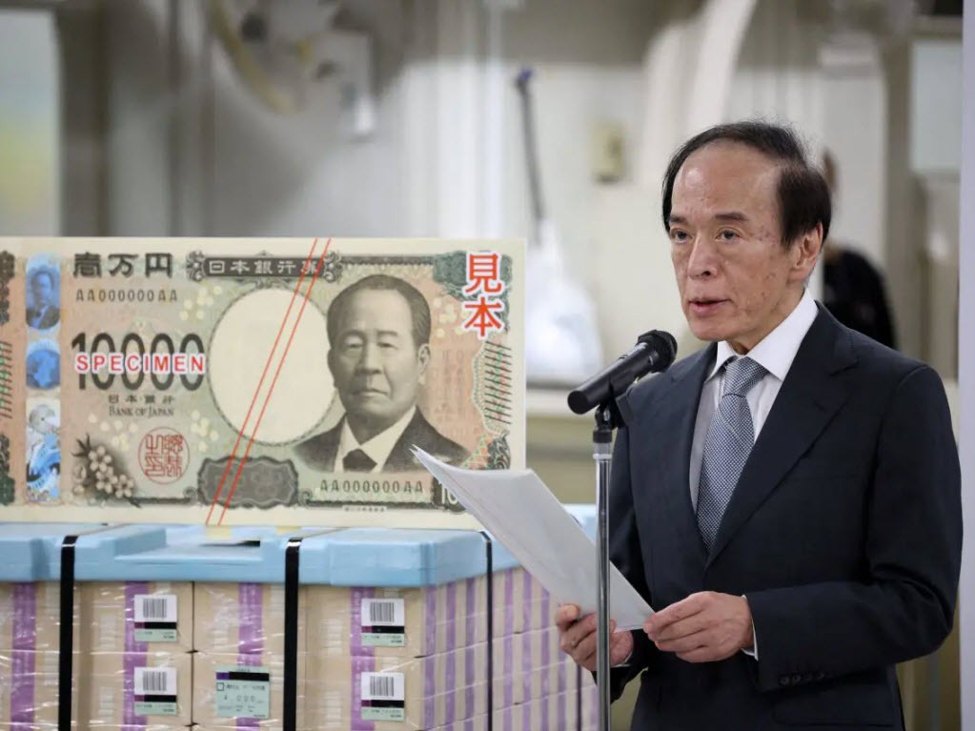
The Bank of Japan (BOJ) left monetary policy unchanged earlier today in a 8-1 vote. The only dissenter was Takata once again as he proposed raising the policy rate to 1.00% instead. The details from earlier as covered by Eamonn:Bank of Japan leaves short term rate on hold, as expectedBOJ holds rates at 0.75%, Lifts core inflation outlook. Dissent highlights inflation riskThe language in the policy statement isn’t anything that stands out. The BOJ continues to retain its stance in waiting to see how wage developments will progress next before pushing for the next rate hike. However, the recent sharp decline in the Japanese yen has definitely made things more complicated for the central bank.For one, Takaichi’s government and fiscal plans are working against the BOJ in wanting to push for further rate hikes. And with the prime minister set to consolidate power via the snap election, it’s again putting pressure on the BOJ to keep playing ball to support her economic and fiscal objectives.But even so, that is putting heavy downside pressure on the Japanese yen currency. And if verbal intervention isn’t helping, there has to be some course of action next from Tokyo officials.Actual intervention from the Ministry of Finance would help in the short-term but unless the fundamentals change, it will be tough to convince markets of a material change to the outlook for the currency.As such, the BOJ might be forced to take action in order to stem the bleeding in the currency instead. For now, they’re not hinting much at that and not really showing the appetite to want to do so. But if Ueda & co. wants to work out a compromise to raise interest rates, this might be the perfect excuse to get it done.I don’t expect Ueda to be explicit about the situation today and to say that the central bank could step in to raise rates just for the sake of boosting the currency. That would be bad form to do so.But in any case, market players will be listening carefully to any subtle messaging on that front. So, pay close attention to what Ueda has to say later. He will be speaking at 0630 GMT, just a little less than an hour from now. This article was written by Justin Low at investinglive.com. 🔗 Source 💡 DMK Insight The BOJ’s decision to keep rates unchanged signals stability, but here’s why it matters: With the vote being 8-1, the dissent from Takata highlights underlying tensions within the committee regarding inflation and economic growth. Traders should note that this decision keeps the yen under pressure, especially against the dollar, as the Fed’s tightening continues. If Takata’s proposal gains traction, it could lead to a shift in market sentiment, particularly for USD/JPY, which has been influenced by interest rate differentials. Watch for any comments from BOJ officials that might hint at future policy changes, as these could create volatility in the forex markets. Additionally, keep an eye on inflation metrics and economic indicators from Japan, as they could sway the BOJ’s stance in the coming months. If inflation rises significantly, it might force the BOJ to reconsider its position sooner than expected, impacting not just the yen but also equities and commodities linked to Japanese economic health. 📮 Takeaway Monitor USD/JPY closely; any shift in BOJ policy could trigger significant volatility, especially if inflation data surprises.
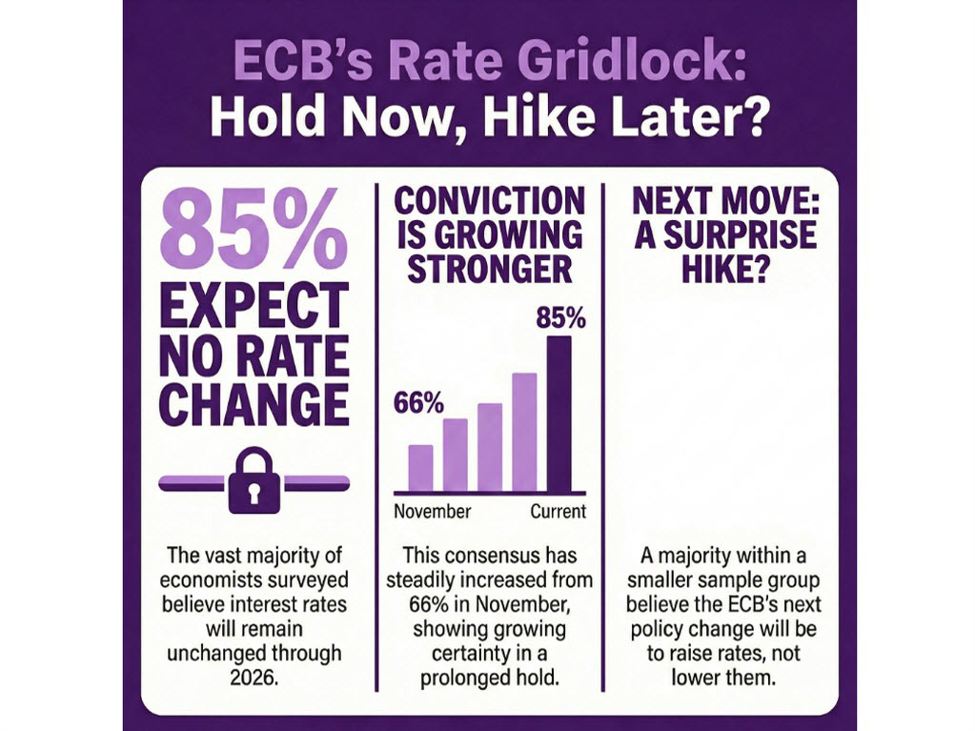
ECB not expected to change policy stance to start the year – poll
67 of 79 (~85%) of economists said rates would remain unchanged through 2026All 83 economists expect no change to the deposit rate for the 5 February policy decisionThe poll numbers sum up very well the market expectations currently towards the ECB. And the ~85% share of opinion of no change in rates for this year is even higher than the poll last month (~75%) and in November (~66%). So, that reflects an increasing and stronger view that the central bank is not going to be able to do much on the policy front in 2026.As things stand, the ECB looks like they have gotten inflation down to as close as 2% as they can get it to. Stubborn price pressures in the likes of Germany and Spain is making it tough for the central bank to take any further action to ease interest rates. And potential stagflation risks in the former is still something that policymakers need to be mindful of.Given the circumstances, they also have to be mindful of the more persistent impact of things like US tariffs. The drive up in inflation may not be over and could circle back in due time. As such, the other side of the coin suggests that they have to retain some flexibility to be open to the idea of perhaps needing to raise interest rates again in the coming year or two.In fact, a majority of a smaller sample of 36 respondents in the poll said that the next step by the ECB would be a rate hike and not a rate cut.So, that’s where we are seeing the ECB now. This article was written by Justin Low at investinglive.com. 🔗 Source 💡 DMK Insight With 85% of economists predicting unchanged rates through 2026, traders need to reassess their strategies now. This consensus reflects a broader market sentiment that could stabilize the euro in the near term, impacting forex pairs like EUR/USD. If the ECB maintains its current stance, it could lead to a stronger euro, especially against currencies where central banks are more hawkish. Traders should keep an eye on key technical levels, particularly if EUR/USD approaches resistance around 1.10 or support near 1.05. The lack of anticipated rate changes could also influence bond markets, potentially keeping yields low and affecting risk appetite across equities. However, there’s a flip side: if inflation pressures mount unexpectedly, the ECB might be forced to pivot, leading to volatility. Traders should monitor inflation indicators and any ECB commentary closely, as these could signal shifts in policy outlook. Watch for the February 5 policy decision as a critical date for potential market reactions. 📮 Takeaway Keep an eye on EUR/USD around 1.10 resistance and 1.05 support as the ECB’s February 5 decision approaches.

FX option expiries for 23 January 10am New York cut
There aren’t any major expiries to take note of on the day, with the full list seen below.The dollar continues to struggle even in the aftermath of a cooler geopolitical climate as Trump backs down from his Greenland threats. The risk mood is better but the greenback falls further with precious metals surging even higher. I think that’s a clear signal as any on the currency debasement narrative and the current disdain for the dollar in general.Gold is on approach to $5,000 with silver closing in on the $100 mark. Those are two major psychological levels to watch out for in trying to gauge how far market players are willing to take this. And in turn, that is also a signal for the dollar sentiment as well.Circling back to major currencies today, there are some large expiries on the board but none should factor into play or have much impact. As such, trading sentiment will continue to revolve around the key drivers noted above.The Japanese yen will remain in focus with Ueda’s press conference coming up as traders continue to weigh up intervention risks.Meanwhile, the euro might see some minor reactions to the PMI data later. But without it materially impacting the ECB outlook, there shouldn’t be any major swings in the single currency to the data.As such, it’s all riding mostly on the dollar for any notable and significant moves in the FX space as we look to wrap things up on the week.For more information on how to use this data, you may refer to this post here.Head on over to investingLive (formerly ForexLive) to get in on the know! This article was written by Justin Low at investinglive.com. 🔗 Source 💡 DMK Insight The dollar’s ongoing struggle signals a shift in trader sentiment, and here’s why that matters: With geopolitical tensions easing, you’d expect the dollar to strengthen, but the opposite is happening. This indicates a potential shift in risk appetite among traders. The lack of major expiries today means that volatility could be driven more by sentiment than by scheduled events. If the dollar continues to weaken, it could lead to a rally in riskier assets like equities and commodities, which traders should monitor closely. Watch for key levels in the DXY index; a break below recent lows could trigger further selling pressure. Conversely, if the dollar finds support, it might signal a reversal, so keep an eye on the 100-day moving average for guidance. The flip side here is that while the dollar is struggling, it’s worth noting that a weaker dollar often boosts commodities priced in dollars, like gold and oil. If you’re trading those, now might be a good time to reassess your positions based on dollar movements. Keep an eye on the broader market context as well, as shifts in sentiment can lead to cascading effects across various asset classes. 📮 Takeaway Watch the DXY index closely; a break below recent lows could signal further dollar weakness, impacting risk assets and commodities.

Gold in Earnings Season Shockwaves
Trade Wars vs Tech Profits: Why Gold is Overshadowing S&P 500Traditionally, earnings season makes the S&P 500 the centre of the financial universe. However, as of today, markets are grappling with a rare collision of geopolitical and institutional shocks. Between President Trump’s tariff threats over the Greenland dispute and a Department of Justice (DOJ) probe into Fed Chair Jerome Powell, the traditional anchors of market stability have been shaken.In this environment, gold shines a beacon, having smashed a fresh historic peak of $4,923 yesterday before stabilising above the $4,840 mark. No longer a defensive play tucked away for a rainy day, it has become the market’s primary volatility valve for cross-asset stress.Gold vs S&P500: The Leadership FlipAs outlined in our recent analysis, the most telling indicator of this shift is the S&P 500-to-Gold ratio, which has plunged to multi-year lows. Despite the Magnificent 7 driving S&P 500 earnings growth expectations, the index itself has struggled with a “Sell America” sentiment. Even as equity rebounds — spurred by the cancellation of immediate 25% tariffs on NATO allies — may not hide the structural pivot: the S&P-to-Gold ratio remains stuck near a five-year low of 1.4. A downward bias in this ratio signals that capital is increasingly allocated to assets with liquidity and macro sensitivity rather than pure growth exposure.Compounding this issue is an unprecedented internal crisis: the DOJ’s criminal investigation into Fed Chair Powell. This friction has led to a risk premium being baked into the U.S. assets. As investors question the future of an independent monetary policy, they are increasingly seeking safer ground in gold.Geopolitical Shocks as a Catalyst for GoldEven before the first month of 2026 ends, the global order is already undergoing a series of shocks that seem to redefine market logic. Two particular events this month have fundamentally altered the risk landscape:The Venezuela Shock: The January 3 military operation in Venezuela has introduced deep uncertainty into global energy flows and maritime security. While intended to secure energy flows, the move introduced deep uncertainty into maritime security. Although gold initially jumped on the news, the long-term impact is a structural de-dollarisation signal, as unilateral intervention erodes traditional sovereignty norms.The Greenland Tariff Crisis: Developments at Davos have been eclipsed by President Trump’s unpredictable announcements of escalating tariffs on eight European allies. When trade routes are weaponised, corporate earnings guidance becomes secondary to capital preservation.Great Rotation, Rates, and Shift in Capital FlowsTwo other macro forces are now driving market behaviour more decisively than individual earnings beats.First is the great rotation. Technology, the market’s most crowded trade throughout 2025, is showing signs of fatigue as growth slows and valuations come under pressure. Even strong earnings are no longer enough to sustain leadership if guidance hints at margin compression or sensitivity to financing conditions. As a result, capital is increasingly rotating toward sectors such as financials, banks, and consumer names, where earnings visibility and pricing power appear more resilient.Second is the expectations for the US dollar and interest rates. In this cycle, earnings reports are shaping rate expectations faster than traditional economic data. With the market now split on whether the Fed will hike or pause in the face of political pressure, any tech giant’s supply chain challenge acts as an immediate propellant for gold.Gold as the Primary Momentum AssetWhile strong earnings from major tech names may still dominate headlines, they no longer tell the full story. Since early 2026, the S&P 500 faces a ceiling where even record profits are overshadowed by tariff threats and Fed instability. For investors and traders, this marks a clear change in focus. As the market increasingly prioritises capital preservation over growth, investors who once reflexively bought dips in technology appear more inclined to rotate toward gold.For those navigating the dynamic of 2026, the most critical data point is not a Silicon Valley earnings beat; it is gold’s ability to absorb the systemic risk that the equity markets are increasingly struggling to keep up with. This article was written by IL Contributors at investinglive.com. 🔗 Source 💡 DMK Insight Gold’s recent rise amidst geopolitical tensions is a signal for traders to reassess their positions. With the S&P 500 facing pressure from tariff threats and trade wars, investors are flocking to gold as a safe haven. This shift highlights a growing skepticism about the sustainability of tech profits, especially as earnings reports roll in. If gold continues to gain traction, it could indicate a broader risk-off sentiment, which might lead to volatility in equities, particularly in tech-heavy sectors. Traders should keep an eye on gold’s performance relative to the S&P 500; a sustained divergence could suggest a significant market rotation. Key levels to watch include gold’s resistance around recent highs, while the S&P 500 may struggle to maintain its upward momentum if geopolitical risks escalate. The real story here is how these external pressures could impact market psychology and trading strategies in the coming weeks, especially as earnings season unfolds. Be prepared for potential cascading effects across asset classes if the situation intensifies. 📮 Takeaway Watch for gold’s resistance levels and S&P 500 performance; a shift in sentiment could lead to increased volatility in tech stocks.

EC Markets Teams up with Liverpool FC to Launch “Hold or Trade” Campaign
EC Markets has announced the launch of its new flagship campaign, “Hold or Trade”, an innovative storytelling experience designed to connect the worlds of football and trading through real decisions, real emotion, and real human instinct.Inspired by the choices players make on the pitch, and the choices traders make in the markets, Hold or Trade brings these two worlds together in a dynamic ‘slice-of-life’ concept, showing how mindset drives outcomes in any arena.The campaign follows everyday people as they’re presented with a simple but high-stakes challenge: Hold their mystery box… or trade it. Each decision echoes the pressure, instinct, and analysis found both in football’s most defining moments and in the financial markets.A New Way to LearnBeyond entertainment, Hold or Trade delivers a mindset-driven content series designed to help audiences explore:How traders assess risk and opportunityHow mindset influences outcomes in any fieldWhat football decision-making can teach us about financial behaviourThrough story-led content, EC Markets aims to make trading concepts feel familiar and human, especially for new audiences entering the financial world.Laoura Salveta, Head of Brand Partnerships at EC Markets, commented:“Hold or Trade captures the energy of real decision-making. In football and in trading, a single choice can change everything. This interactive campaign brings those worlds together in a way that’s entertaining using our Liverpool FC rights, relatable and genuinely educational. Our goal is to help people understand mindset, not just markets, and to build confidence, curiosity and connection within our global community of traders and football fans alike.”A Digital-First Global RolloutEC Markets, a global trading broker, continues to expand its educational resources, market insights and user-focused initiatives. Hold or Trade builds on this mission with interactive content, mindset tools and community-driven discussions, designed to meet users wherever they are online.The campaign kicks off today with high-energy ads and digital content across key regions including Latin America, Asia-Pacific (APAC) and other global markets, introducing audiences to the similarities between football decisions and trading choices, and how understanding mindset can reshape the way we approach opportunity. In the coming weeks, EC Markets will also release exclusive content featuring key Liverpool FC players making their own Hold or Trade decisions, putting their mindset to the test in unexpected ways.Explore the full campaign here. This article was written by IL Contributors at investinglive.com. 🔗 Source

BOJ governor Ueda says underlying inflation will continue to rise moderately
Japan’s economy is recovering moderately albeit with some weaknessUnderlying inflation will continue rising moderatelyUnderlying inflation, rate of increase in core inflation likely to increase graduallyThey will be at a level in line with BOJ price target in the second half of the projection periodEasy monetary conditions will continue to support the economyNeed to pay attention to those risks affecting Japan’s economy and pricesRisk factors include forex and financial market developmentsWill continue to raise policy rate if economy, prices move in line with forecastsTamura and Taka proposed changes to outlook report language but were voted downFinancial environment remains accommodative after December rate hikeIt will take some time until the impact of the rate hike affects the real economy more broadlyFrom the opening comments so far, he doesn’t seem to be one to be in a rush to get to the next rate hike. And he’s not making any standout remarks on the currency and bond market developments, at least not yet. He will definitely make a mention or two in the coming half hour. So, just look out for that. For now though, the comments above mainly covers the reasoning behind their decision making today. This article was written by Justin Low at investinglive.com. 🔗 Source 💡 DMK Insight Japan’s moderate economic recovery is crucial for forex traders, especially with the BOJ’s inflation targets in sight. The Bank of Japan (BOJ) is signaling a gradual rise in core inflation, which could influence monetary policy shifts. If inflation aligns with the BOJ’s targets in the latter half of the projection period, we might see a shift from easy monetary conditions. This could lead to a stronger yen against major currencies, particularly if traders start pricing in potential rate hikes. Keep an eye on USD/JPY; a break below key support levels could indicate a trend reversal. Conversely, if inflation fails to meet expectations, the BOJ may maintain its accommodative stance, keeping the yen under pressure. Watch for upcoming economic data releases that could impact sentiment. The market’s reaction to these figures will be critical, especially for those holding positions in yen pairs. The real story is how quickly the BOJ can pivot if inflation trends upward, so stay alert for any signs of policy changes. 📮 Takeaway Monitor USD/JPY closely; a break below key support could signal a stronger yen if inflation aligns with BOJ targets.

BOJ governor Ueda says will closely coordinate with government on the bond market
May conduct market operations to encourage stability in bond marketMay do so in response to irregular market moves and exceptional casesWon’t specifically comment on forex levelsForex determined by various factors, not just interest rate gapWeak yen could inflate import costs and be passed on to domestic pricesHave to be mindful of the fact that forex could have a larger impact against import costsHe’s sending a subtle message on the bond market and how they might step in to try and help yields come off the boil. However, he’s steering clear of anything related to the Japanese yen currency for now and that is seeing market players start to test the limits once again. USD/JPY is now up 0.3% to 158.90 levels, its highest in a little over a week:It won’t be long until we have to hear more verbal intervention from Tokyo surely.All Ueda is saying so far is that policymakers will pay more attention to forex moves but he isn’t hinting at much urgency otherwise to defend the currency if need be. As mentioned earlier here, that is the expected playbook though.So, the ball is thrown back over to the Ministry of Finance’s court. A “rate check” coming next? This article was written by Justin Low at investinglive.com. 🔗 Source 💡 DMK Insight The central bank’s potential market operations signal a proactive stance on bond stability, and here’s why that’s crucial for traders right now: With the mention of irregular market moves, traders should be on alert for volatility spikes, especially in the forex market. The weak yen is a key concern, as it could lead to higher import costs, impacting inflation and consumer prices domestically. This situation creates a ripple effect—if inflation rises, the central bank may be forced to adjust interest rates, which could further influence forex pairs, particularly USD/JPY. Traders should keep an eye on the 145 level in USD/JPY, as a breach could trigger significant moves. But don’t overlook the broader context; the central bank’s reluctance to comment on forex levels suggests a cautious approach, which could lead to uncertainty in the market. As traders, we need to monitor economic indicators closely, especially inflation data and any statements from the central bank regarding their future policy direction. The next few weeks could be pivotal, so stay sharp and watch for any signs of intervention or policy shifts. 📮 Takeaway Watch the USD/JPY level around 145; a break could signal increased volatility in forex markets amid potential central bank interventions.

UK December retail sales +0.4% vs -0.1% m/m expected
Prior -0.1%Retail sales +2.5% vs +1.1% y/y expectedPrior +0.6%; revised to +1.8%Retail sales ex autos, fuel +0.3% vs -0.2% m/m expectedPrior -0.2%Retail sales ex autos, fuel +3.1% vs +1.7% y/y expectedPrior +1.2%The beat in UK retail sales here comes mainly from a surge in sales from non-store retailers (+4.2%), following declines here in October and November before. It seems like the melt up in gold and silver is spilling over to retail buying as online jewellers reported that demand for precious metals picked up in December.Besides that, the breakdown shows just marginal increases in food store sales (+0.2%), and a slight bump in non-food store sales (+1.0%). Meanwhile, department store sales (-1.9%) showed a sharp decline alongside textile clothing sales (-0.7%) and household goods store sales (-3.4%).Looking at the year as a whole, all main sectors except automotive fuel rose on the year. The breakdown sees food store sales rose for the first time since 2021, but did not fully recover from their fall in 2024. Meanwhile, both non-food stores and non-store retailers rose for the second year in a row, recovering from drops in 2023. However, volumes for non-store retailers remained clearly below their peak in 2021 – which was achieved because of physical store closures during the pandemic. So, there’s that. This article was written by Justin Low at investinglive.com. 🔗 Source 💡 DMK Insight UK retail sales just jumped 2.5%, and here’s why that matters: this unexpected surge could shift market sentiment and impact the pound’s strength. The significant rise in retail sales, especially from non-store retailers, signals robust consumer demand, which could influence the Bank of England’s monetary policy. If this trend continues, we might see a more hawkish stance from the BoE, potentially leading to a stronger pound against major currencies. Traders should keep an eye on the GBP/USD pair, especially if it approaches key resistance levels around 1.30. A sustained break above this level could trigger further bullish momentum. But there’s a flip side: if inflation remains stubbornly high, the central bank might face a dilemma, balancing growth with price stability. This could lead to volatility in the forex market, especially if traders react to any conflicting signals from economic data. Watch for upcoming inflation reports and central bank comments for clearer direction. 📮 Takeaway Monitor GBP/USD closely; a break above 1.30 could signal bullish momentum, but watch for inflation data that could shift sentiment.
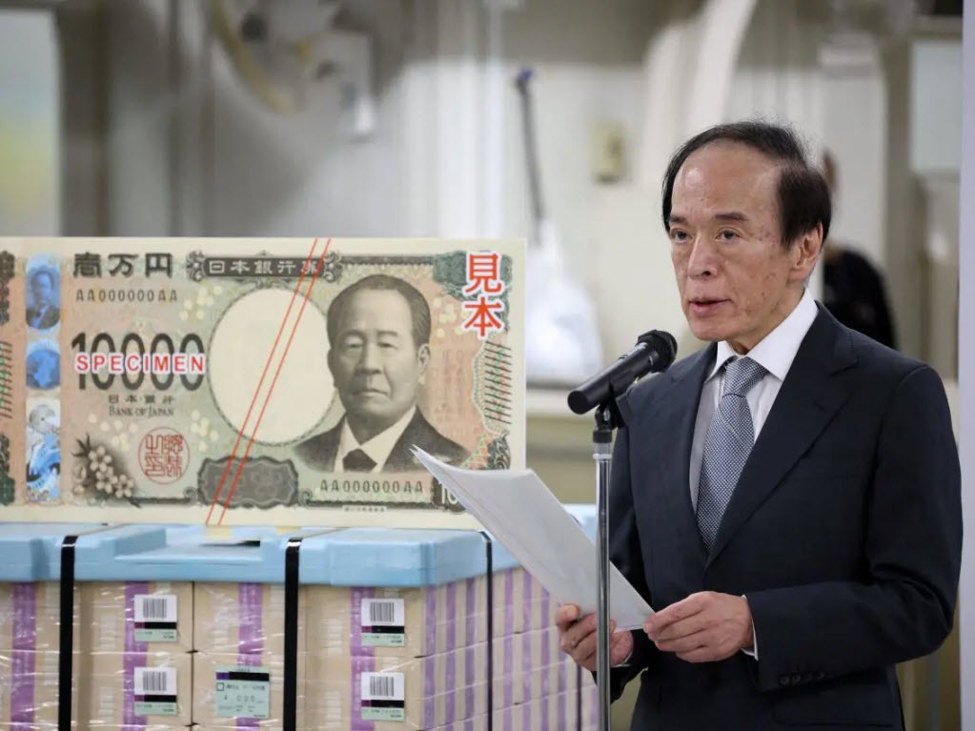
BOJ governor Ueda says will place larger focus on inflation in making policy decisions
It may not seem like it, but the headline remark is arguably the key takeaway from his press conference so far.I mean, he was not expected to be explicit about taking action to defend the sliding Japanese yen currency. But at the balance, he’s reflecting no urgency to participate in this matter and leaving it to the Ministry of Finance to have to handle the situation – at least for now.Ueda is going as far to state that the BOJ is waiting on the wings because of inflation developments, pointing out that:On average, there is still some distance to the 2% inflation targetCompared to October, likelihood of achieving 2% target is heighteningBut compared to December, the likelihood is not all too differentWe are hearing more voices that price hikes are reflecting wage growthPaying attention to price changes in April but that will just be one factor in deciding policyThe messaging in his press conference today is really about reading between the lines. And so far, it suggests that the BOJ has not reached the pain threshold to have to do something about the decline in the currency. However, they appear to be already unsettled by the happenings in the bond market for the time being.In any case, addressing the latter should also help out with the former somewhat. So, I guess they will take a gander with that approach first before really needing to throw the kitchen sink to address any further freefall in the yen. This article was written by Justin Low at investinglive.com. 🔗 Source 💡 DMK Insight The lack of urgency from Japanese officials regarding the yen’s decline is a red flag for traders. With the yen sliding, many were anticipating a more aggressive stance from the Bank of Japan, especially given the recent volatility in global markets. The absence of immediate action signals a potential for further depreciation, which could impact forex pairs like USD/JPY. If the yen continues to weaken, it might trigger a wave of speculative trading, especially among retail traders looking to capitalize on the trend. It’s also worth noting that this situation could ripple into other markets, particularly commodities priced in yen, like gold. Traders should keep an eye on key support levels for the yen, as a breach could lead to a more pronounced sell-off. Watch for any shifts in sentiment or comments from the Bank of Japan in the coming days, as they could provide crucial insights into future monetary policy adjustments. 📮 Takeaway Monitor USD/JPY closely; a break above recent highs could signal further yen weakness and increased volatility.

Japanese Yen jumps across the board on suspected intervention
Seems like the Japanese officials are drawing a line at 159.00 on USD/JPY. That’s also where we got an intensification of verbal intervention last week that helped to ease the pressure on the Japanese Yen. The pair fell from 159.22 to 157.32 in a matter of seconds. Looks like an intervention but some are saying that it could be a “rate check” because an intervention would have had a bigger impact. Whatever that was, it has caught market attention and acted as a warning for the JPY bears.The JPY started to roll over again this morning following the BoJ decision where the central bank kept interest rates unchanged and slightly upgraded its growth and inflation forecasts. We saw more bearish pressure on the yen during Governor Ueda press conference where he didn’t sound as hawkish as the market expected given the weak yen.As mentioned many times before, interventions can help ease some pressure on the currency in the near-term but they don’t change the trend. As long as the fundamentals remain against the currency, the market will keep on selling it. The BoJ needs to step up its “policy normalisation” and turn more hawkish to reverse the trend. This article was written by Giuseppe Dellamotta at investinglive.com. 🔗 Source 💡 DMK Insight The 159.00 level on USD/JPY is becoming a critical pivot point, and here’s why that matters: Japanese officials are clearly signaling their discomfort with a weaker yen, as evidenced by recent verbal interventions. The swift drop from 159.22 to 157.32 indicates that traders are reacting to these cues, which could lead to increased volatility around this level. If USD/JPY approaches 159.00 again, expect heightened scrutiny and potential intervention, which could create trading opportunities for those looking to capitalize on short-term movements. Conversely, if the pair breaks below 157.00, it could signal a more sustained yen recovery, prompting a reevaluation of long positions in USD/JPY. Keep an eye on broader market sentiment as well; if risk appetite shifts, it could impact the dollar’s strength against the yen. Also, watch for any economic data releases from Japan or the U.S. that could influence this pair. The next few sessions will be crucial, especially if USD/JPY tests that 159.00 mark again. 📮 Takeaway Watch USD/JPY closely around the 159.00 level; potential intervention could create sharp movements, especially if it approaches this mark again.