
 Bitcoin
  Ethereum
  Tether
  BNB
BNB  XRP
XRP  USDC
USDC  Solana
  TRON
TRON  Lido Staked Ether
  Figure Heloc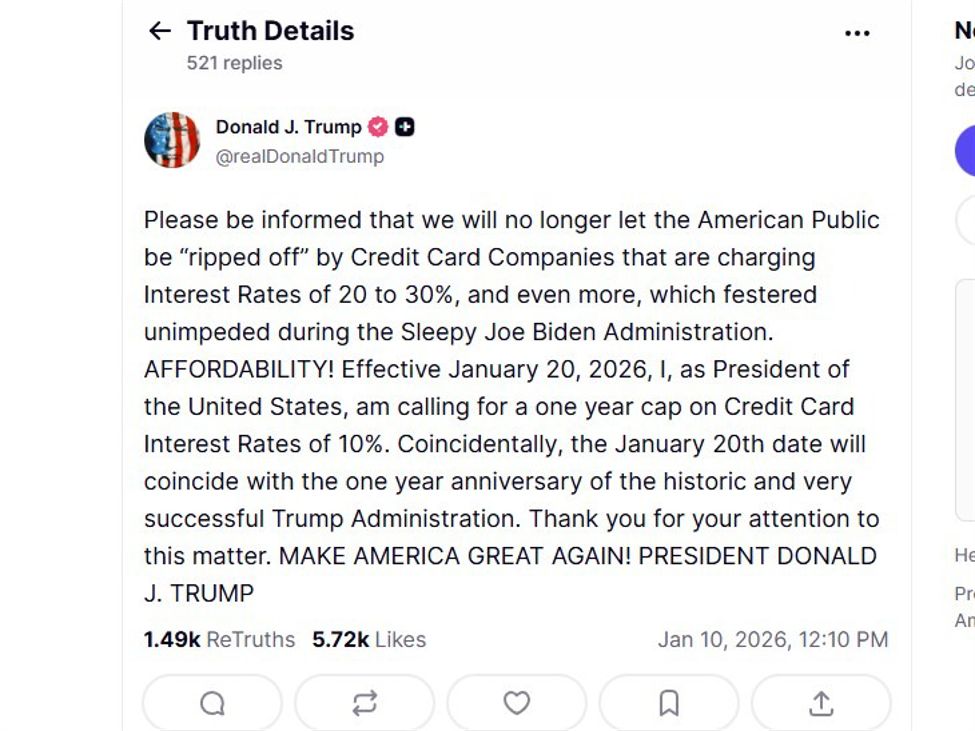
Summary:Trump calls for 10% credit-card APR cap for one year, effective Jan 20, 2026. No enforcement detail: unclear if voluntary or government-mandated. Part of a populist “affordability” burst this week (incl. MBS buying idea and ban on institutional home buyers). Big gap to current pricing: Fed data shows 22.30% (Nov 2025) on the key credit-card rate series. Without legislation / clear authority, this looks like headline politics first, policy mechanics later.President Donald Trump has called for a one-year cap of 10% on US credit-card interest rates, saying consumers are being “ripped off” and framing the move as an “affordability” push. The proposal would start January 20, 2026, the first anniversary of his return to the White House, but Trump provided no detail on the mechanism, leaving open whether he expects voluntary compliance from issuers or is signalling some form of government enforcement. The lack of detail matters, because credit-card pricing is not something a president can simply “announce” into existence. In practice, a hard cap would typically require Congressional legislation and/or actions through the US regulatory framework. Yet the main federal watchdog for card practices, the Consumer Financial Protection Bureau (CFPB), has been a long-running target of conservatives, and the Trump administration has pursued steps that would reduce or constrain its reach. What Trump is doing, clearly, is leaning into a string of populist, social-media-first affordability declarations this week, high on punchy intent, low on executable detail. In the days prior he posted about ordering “his representatives” to buy mortgage bonds to push borrowing costs lower, and about banning institutional investors from buying single-family homes. Together, the sequence reads as an attempt to reclaim the cost-of-living narrative with simple targets (banks, Wall Street, institutions) and headline-friendly numbers (10%). This all, of course, in an election year (mid-terms) with Trump’s popularity continuing to make new lows and therefore threatening the Republican majorities in Congress. I posted earlier in the week that I expect populist announcements and an eventual hit to the US dollar (not yet though, the dollar higher on Friday: investingLive Americas market news wrap: Nonfarm payrolls a touch soft, no tariff decision)On the numbers, the policy would be a dramatic cut versus prevailing rates: the Federal Reserve’s series for commercial bank credit-card interest (accounts assessed interest) shows ~22.30% in late 2025. That gap underscores why markets and issuers will focus on “how” rather than “what”, and why, without a clear legislative pathway, the announcement looks more like political signalling than an immediately actionable policy shift. Congressional interest in caps is real and notably bipartisan, past proposals have sought a 10% ceiling, but they have not become law. Until a bill advances (or a credible regulatory/administrative route is spelled out), the most likely near-term impact is messaging and volatility in related headlines, rather than an instant repricing of consumer credit. This article was written by Eamonn Sheridan at investinglive.com. 🔗 Source 💡 DMK Insight Trump’s proposed 10% credit-card APR cap could shake up consumer spending and financial markets. With current rates hovering around 22.30%, this drastic reduction aims to ease financial pressure on consumers, potentially boosting spending in the short term. Traders should consider how this might influence retail stocks and consumer discretionary sectors, especially if the cap gains traction. But here’s the catch: without clear enforcement details, the actual impact remains uncertain. If this proposal leads to a significant shift in consumer behavior, we could see a ripple effect across related markets, including real estate and credit markets. Keep an eye on how institutional players react—if they perceive this as a serious threat to profitability, we might see volatility in financial stocks. Watch for any updates on enforcement mechanisms or legislative support, as these will be crucial in determining the proposal’s viability and market impact. 📮 Takeaway Monitor developments on Trump’s credit-card APR cap; a shift could impact consumer spending and related stocks significantly.

Pump.fun rejiggers memecoin fees to reward traders, not just creators
Pump.fun is shaking up its creator-fee system after realizing last year’s Dynamic Fees V1 incentivized coin creation over the trading activity that fuels the platform. 🔗 Source 💡 DMK Insight Pump.fun’s shift in its creator-fee system is a game changer for traders and creators alike. By moving away from the Dynamic Fees V1 model, which favored coin creation over actual trading, they’re addressing a critical flaw that could enhance liquidity and trading volume on the platform. This change could attract more serious traders looking for a more balanced ecosystem where trading activity is rewarded. If the new fee structure encourages more trading rather than just coin minting, we might see increased market participation and potentially higher price volatility in the assets traded on Pump.fun. Keep an eye on how this impacts trading volumes and user engagement in the coming weeks, as these metrics will be key indicators of the platform’s health and attractiveness. However, there’s a flip side: if the new fees are perceived as too high or not aligned with trader interests, it could deter participation. Watch for user feedback and trading patterns closely as this transition unfolds, especially in the first month post-implementation. 📮 Takeaway Monitor trading volumes on Pump.fun closely over the next month to gauge the impact of the new fee structure on market activity.

BitMine buys $105M Ether to kick off 2026, still holds $915M in cash
The largest corporate ETH holder started 2026 with a $105 million Ether purchase, while surpassing $2.87 billion in staked Ether, seeking to generate passive yield on its holdings. 🔗 Source 💡 DMK Insight A $105 million Ether buy by the largest corporate holder is a bold move, signaling strong institutional confidence in ETH’s future. With ETH currently at $3,084.14, this purchase not only boosts the corporate holder’s stake but also highlights a growing trend of institutions seeking passive yield through staking. This could lead to increased demand for ETH, especially as more players recognize the potential for yield generation in a volatile market. Traders should keep an eye on the staked Ether figure, which now exceeds $2.87 billion, as it could indicate a shift in market dynamics. If ETH can hold above the $3,000 mark, we might see a bullish momentum building, especially if retail traders follow suit. However, it’s worth questioning whether this institutional confidence can sustain itself amidst potential regulatory headwinds. If the market reacts negatively to any regulatory news, it could trigger a sell-off, impacting not just ETH but the broader crypto market. Watch for ETH’s performance around the $3,000 level and any news that could sway institutional sentiment. 📮 Takeaway Monitor ETH’s ability to hold above $3,000; a sustained position could attract more institutional interest and drive prices higher.

Ethereum is the Linux of blockchain, says co-founder Vitalik Buterin
The Ethereum co-founder made the case that Ethereum occupies a role similar to the Linux operating system, but for transferring value and risk on the internet 🔗 Source 💡 DMK Insight Ethereum’s positioning as a value transfer system is a game-changer for traders right now. With ETH currently at $3,084.14, the comparison to Linux highlights its foundational role in decentralized finance. This narrative could drive institutional interest, especially as more companies look to integrate blockchain solutions. Traders should keep an eye on ETH’s price action around key support levels, particularly the $3,000 mark, which has historically acted as a psychological barrier. If ETH holds above this level, it could signal bullish momentum, attracting more retail and institutional buyers alike. However, there’s a flip side: if ETH fails to maintain this support, we could see a quick retracement that might shake out weaker hands. Watch for volume spikes around this level, as they could indicate whether the market is ready to push higher or if a correction is imminent. The broader market sentiment, especially in relation to Bitcoin, will also play a crucial role in ETH’s next moves. 📮 Takeaway Monitor ETH’s ability to hold above $3,000; a failure here could trigger a significant pullback, while strength could attract more buyers.

Truebit token price falls 99% after reports of $26M exploit
The TRU price fell to $0.0000000029 from $0.16 after the protocol reported a security incident and crypto sleuths tracked stolen Ether. 🔗 Source 💡 DMK Insight TRU’s dramatic drop from $0.16 to $0.0000000029 signals deep market distrust following a security breach. For traders, this incident highlights the fragility of trust in crypto protocols. The swift decline in TRU’s price reflects not just the immediate fallout but also a broader concern about security in the crypto space. With ETH currently at $3,084.14, the ripple effects could extend beyond TRU, potentially impacting other altcoins as investors reassess their risk exposure. Watch for ETH’s price action; if it starts to falter, it could indicate a broader market sell-off. Keep an eye on trading volumes and sentiment shifts, as these will be crucial indicators of whether this is a temporary dip or the start of a more significant trend. On the flip side, this could present a buying opportunity for risk-tolerant traders if they believe the fundamentals of the underlying protocol remain strong. However, caution is warranted—monitor for any further developments regarding the security incident and how it might affect investor confidence moving forward. 📮 Takeaway Watch ETH closely; if it dips below $3,000, it could trigger broader market sell-offs, impacting altcoins like TRU.

Optimism floats OP buyback proposal using Superchain revenue
A new plan would tie OP token value to network performance by using half of all Superchain fee revenue for systematic repurchases. 🔗 Source 💡 DMK Insight Tying OP token value to network performance could shift trader sentiment significantly. By allocating half of Superchain fee revenue for systematic repurchases, this plan aims to create a more stable and potentially appreciating asset. Traders should watch for how this impacts liquidity and price action in the short term. If the repurchase mechanism is effective, it could lead to a bullish trend, especially if the network performance metrics improve. On the flip side, if the network struggles or if fee revenue doesn’t meet expectations, it could lead to increased volatility. Keep an eye on key performance indicators and trading volumes around the OP token, as these will be critical in assessing the success of this initiative. The next few weeks will be crucial for gauging market reaction and potential price movements. 📮 Takeaway Monitor OP token trading volumes and network performance metrics closely; significant repurchases could drive bullish momentum in the coming weeks.

Sharplink pockets $33M from Ether staking, deploys another $170M ETH
Corporate crypto treasuries are increasingly turning to Ether staking, as companies like SharpLink generate recurring yield from onchain operations. 🔗 Source 💡 DMK Insight Corporate treasuries are shifting to Ether staking, and here’s why that matters for traders now: With ETH currently at $3,084.14, the growing interest from companies like SharpLink in staking could signal a bullish trend for Ether. This move not only provides recurring yield but also enhances liquidity and stability in the market. As institutional players enter the staking arena, it could lead to increased demand for ETH, pushing prices higher. Traders should keep an eye on the staking rewards and the overall yield landscape, as these factors can influence short-term price movements. However, there’s a flip side. If staking yields become less attractive due to market fluctuations or increased competition, we could see a pullback in corporate interest. Watch for key resistance levels around $3,200 and support at $2,900. Monitoring these levels will be crucial in determining whether ETH can maintain its upward momentum or if a correction is on the horizon. The next few weeks will be pivotal as more companies announce their staking strategies, potentially impacting ETH’s price trajectory significantly. 📮 Takeaway Watch for ETH to hold above $3,000; a break below could signal a bearish reversal, while sustained interest in staking could push it toward $3,200.

Ethereum co-founder reiterates support for Roman Storm, citing privacy
The Tornado Cash developer was found guilty of operating an unlicensed transmitter business in August and could still be retried on two counts on which a jury deadlocked. 🔗 Source 💡 DMK Insight The Tornado Cash developer’s conviction highlights ongoing regulatory scrutiny in crypto, and here’s why that matters: This case underscores the risks developers face in a rapidly evolving legal landscape. With regulators tightening their grip, especially on privacy-focused protocols, traders should be cautious about projects that could face similar scrutiny. If the developer is retried and found guilty on the deadlocked counts, it could set a precedent that impacts the entire DeFi sector. Watch for potential ripple effects on related assets, particularly those involved in privacy solutions. The market could react negatively to any news that suggests increased regulation is imminent, leading to volatility in tokens associated with privacy protocols. Keep an eye on the broader sentiment in the crypto market, especially as it relates to regulatory news, which could influence trading strategies in the short term. Ultimately, this situation serves as a reminder to assess the regulatory landscape when considering investments in crypto projects. Traders should monitor developments closely, especially any upcoming court dates or legal decisions that could sway market sentiment. 📮 Takeaway Watch for updates on the Tornado Cash developer’s retrial; any adverse ruling could trigger significant volatility in privacy-focused crypto assets.

EUR/USD stays on the back foot after mixed US labour-market report
The Euro (EUR) edges lower against the US Dollar (USD) on Friday as traders react to a mixed batch of US labour-market data. At the time of writing, EUR/USD trades around 1.1638, remaining on the back foot for a seventh straight day as the Greenback retains a firm tone across the board. 🔗 Source 💡 DMK Insight EUR/USD’s drop to 1.1638 signals a bearish trend, and here’s why that’s crucial right now: The recent US labor market data has created a mixed sentiment, but the overall strength of the Greenback is hard to ignore. With EUR/USD declining for seven consecutive days, traders should be wary of potential support levels around 1.1600. If this level breaks, we could see a deeper retracement toward 1.1500. On the flip side, if the Euro manages to regain momentum, traders should watch for resistance near 1.1700. The current bearish trend could also impact related assets like EUR/GBP, which may follow suit if the Euro continues to weaken. Keep an eye on upcoming economic indicators, particularly from the Eurozone, as they could provide the necessary catalyst for a reversal or further decline. Volatility is expected, so adjust your positions accordingly and consider tighter stop-loss orders to manage risk effectively. 📮 Takeaway Watch for EUR/USD at 1.1600; a break could lead to a drop toward 1.1500, while resistance at 1.1700 is key for potential recovery.

EUR slips slightly against USD amid mixed data – Scotiabank
The Euro (EUR) is soft and down a fractional 0.1% vs. the US Dollar (USD) as it extends its latest pullback within the flat range from last June, Scotiabank’s Chief FX Strategists Shaun Osborne and Eric Theoret report. 🔗 Source 💡 DMK Insight The Euro’s fractional decline against the Dollar signals ongoing weakness, and here’s why that matters: The EUR/USD pair is currently caught in a flat range that has persisted since last June, which suggests a lack of momentum in either direction. This recent 0.1% pullback could indicate that traders are still cautious, especially with economic indicators from the Eurozone showing mixed signals. If the Euro fails to break above key resistance levels, we might see further selling pressure, particularly if the Dollar strengthens due to upcoming economic data releases or Federal Reserve announcements. Look for any shifts in sentiment around the 1.05 level; a sustained move below could trigger more aggressive short positions. On the flip side, if the Euro finds support and bounces back, it could catch traders off guard, especially those who are heavily short. Keep an eye on the broader economic context, including inflation rates and employment data, as these will influence central bank policies and, consequently, currency valuations. The next few days will be crucial for determining whether the Euro can regain its footing or if it will continue to slide against the Dollar. 📮 Takeaway Watch for the EUR/USD pair around the 1.05 level; a break below could lead to increased selling pressure.