
 Bitcoin
  Ethereum
  Tether
  XRP
XRP  BNB
BNB  USDC
USDC  Solana
  TRON
TRON  Lido Staked Ether
  Figure Heloc
Headlines:What is the distribution of forecasts for the US NFP?Who’s got the most bullish NFP forecast this time around?Non-farm payrolls seen accelerating as unemployment rate holds steady – JP MorganUS payrolls to stay supported but unemployment rate seen increasing further – CitiTrump: I have cancelled previously expected second wave of attacks on VenezuelaOklo jumps 20% in pre-market as Meta unveils nuclear deals to power data centersWhat are the interest rate expectations for the major central banks at the start of 2026?French stocks eye fresh record highs to start the day in EuropeHere’s why the rest of the world has to keep an eye on China’s deflation storyGermany November industrial production +0.8% vs -0.4% m/m expectedSwiss unemployment rate keeps steady in December but the trend remains clearMarkets:USD leads, JPY lags on the dayEuropean equities higher; S&P 500 futures up 0.1%US 10-year yields up 0.6 bps to 4.189%Gold down 0.1% to $4,470.54WTI crude oil up 0.8% to $58.25Bitcoin down 1.1% to $90,168It’s all about the US labour market report as we look to wrap up the week. And that’s the main event that market players were gearing towards in European morning trade today.There wasn’t too much happening during the session, coming off Asia trading where we saw China miraculously staving off deflation – at least by the number – in 2025. The dollar firmed across the board in European trading but the gains are relatively measured.USD/JPY is the notable gainer, moving up by 0.5% to 157.66, while EUR/USD is just down slightly by 0.2% to 1.1640 on the day. Besides that, USD/CAD is up 0.1% to 1.3875 while AUD/USD is down 0.3% to 0.6677 currently. All in all, the moves are light with no real convictions just yet before we get to the non-farm payrolls.In the equities space, risk sentiment looks to be steadier in Europe but more so on edge in general. Major indices in Europe continue to scale up with the DAX and CAC 40 pressing fresh record highs and looking to end the week with a flourish. Meanwhile, US futures are more tepid with S&P 500 futures just up 0.1% as AI valuation concerns continue to linger after yesterday’s action.Besides that, there wasn’t much else taking place with precious metals holding relatively steadier compared to the volatile price action we’ve been seeing to start the new year. Gold is just marginally lower to $4,470 while silver is up “only” by 1% to $77.92 in a slight rebound after an early drag that carried over from yesterday.Well, it’s all on the US jobs report now as well as the Supreme Court rulings for today, in which the court may release opinions in argued cases during a scheduled sitting at 1500 GMT. On the latter though, do keep in mind that the court does not announce ahead of time which rulings it intends to issue. So, whether or not we’ll see Trump’s tariffs get mentioned remain to be seen. But in any case, just keep a look out on that. This article was written by Justin Low at investinglive.com. 🔗 Source 💡 DMK Insight The upcoming US Non-Farm Payroll (NFP) report is shaping up to be a pivotal moment for traders, especially with forecasts suggesting a potential acceleration in job growth. JP Morgan’s bullish stance indicates confidence in the labor market, which could bolster risk assets, while Citi’s more cautious outlook on rising unemployment hints at underlying economic fragility. For day traders and swing traders, this divergence in forecasts is crucial. If the NFP data comes in stronger than expected, we could see a rally in equities and a potential uptick in the dollar, impacting forex pairs like EUR/USD. Conversely, if the unemployment rate rises as Citi predicts, it could trigger a flight to safety, pushing traders towards gold and US Treasuries. Keep an eye on the 200-day moving average for major indices as a key technical level; a break above could signal bullish momentum, while a failure to hold could lead to a bearish reversal. Watch for the actual NFP release and any revisions to previous data, as these can create volatility. The market’s reaction will likely hinge on whether the job growth narrative holds up against the backdrop of rising unemployment expectations. 📮 Takeaway Monitor the NFP release closely; stronger job growth could boost equities and the dollar, while rising unemployment may trigger a flight to safety.

Nasdaq remains rangebound as traders await key US data before picking a direction
KEY POINTS:Nasdaq price action remains rangebound but with a bullish biasPullback in Fed support turned the focus heavily towards dataReaction to negative labour market data likely to reverse in 2026 as inflation remains a constraint for the FedFUNDAMENTAL OVERVIEWSince the peak in late October, the Nasdaq has been bouncing around as the overstretched long positioning was met with a less dovish Fed. The market maintains the bullish bias amid a strong economy and the Fed’s dovish reaction function, but lacks the momentum seen in 2025 when Trump pulled back on aggressive tariffs and the Fed was in a clear easing mode. This year the main risk for the bullish outlook is inflation. The “run it hot” narrative continues to underpin stocks, and we’ve seen from the latest GDP report and the Atlanta Fed GDPNow how the economy looks to be accelerating. That hasn’t translated into persistent inflationary pressures besides the tariff driven spike in the summer. I have a feeling that US CPI will be more important in the next months because inflation worry is what is constraining the Fed from acting more quickly and with more conviction on rate cuts. In fact, while weak labour market data was seen as positive for the stock market on expectations of more Fed cuts, this year it might be seen as negative if it comes with higher CPI data due to the above-mentioned constraint.NASDAQ TECHNICAL ANALYSIS – DAILY TIMEFRAMEOn the daily chart, we can see that the Nasdaq has been compressing into a rising wedge. These types of patterns can resolve into a downside breakout taking the price to the base of the wedge or an upside breakout leading to a strong rally after the consolidation.NASDAQ TECHNICAL ANALYSIS – 4 HOUR TIMEFRAMEOn the 4 hour chart, we can see more clearly the recent choppy price action that formed the rising wedge. From a risk management perspective, the buyers will have a better risk to reward setup around the bottom trendline to position for a rally into new all-time highs. The sellers, on the other hand, will want to see the price breaking lower to pile in for a drop into the base of the wedge around the 24900 level.NASDAQ TECHNICAL ANALYSIS – 1 HOUR TIMEFRAMEOn the 1 hour chart, we can see that we have a minor upward trendline defining the current bullish momentum on this timeframe. The buyers will likely continue to lean on the trendline to keep pushing into the top trendline of the wedge, while the sellers will look for a break lower to extend the drop into the bottom trendline. The red lines define the average daily range for today.UPCOMING CATALYSTSToday we conclude the week with the US NFP report and potential US Supreme Court decision on Trump’s tariffs. This article was written by Giuseppe Dellamotta at investinglive.com. 🔗 Source 💡 DMK Insight The Nasdaq’s rangebound movement with a bullish bias signals potential volatility ahead. Traders should note that the recent pullback in Fed support is shifting focus to economic data, especially labor market indicators. The market’s reaction to negative labor data could be short-lived, with expectations that inflation will continue to constrain Fed policy into 2026. This creates a scenario where traders might want to position themselves for a breakout, especially if the Nasdaq can hold above key support levels established since late October. Watch for any significant economic releases that could sway sentiment, as they may trigger a decisive move. On the flip side, if inflation data continues to disappoint, it could lead to a more prolonged rangebound scenario, keeping traders on their toes. Keeping an eye on the 13,000 level could be crucial, as a break below that might signal a shift in sentiment. 📮 Takeaway Monitor the Nasdaq’s performance around the 13,000 level for potential breakout opportunities, especially in light of upcoming labor market data.

Locked and loaded for a Friday jobs day with eyes on the Supreme Court
It’s the first ‘big day’ of the year in a year that feels much longer than 9-days already.The non-farm payrolls report is due at the bottom of the hour along with the Canadian jobs report. Before the report is released, read Preview: December non-farm payrolls by the numbers. Finally past the shutdown fogThe consensus is 60K jobs with a 4.5% unemployment rate. The jobs report is always a roll of the dice but the preview outlines why I think risks are skewed towards a higher number.The Canadian number is always volatile and the prior was +53.6K so there’s likely to be a pullback. The consensus is -5K.Both of those events may only see a limited market reaction as traders hold their breath for 10 am ET, when the Supreme Court might release its tariff decision.See:The Supreme Court scheduled Friday as an ‘opinion day’. What’s the tradeHow the White House will pivot if the Supreme Court strikes down current tariffs This article was written by Adam Button at investinglive.com. 🔗 Source 💡 DMK Insight Today’s non-farm payrolls report is a major market mover, and here’s why traders need to pay attention: With the U.S. jobs data set to drop shortly, volatility is likely to spike across forex and crypto markets. Historically, strong payrolls can lead to a bullish dollar, impacting pairs like EUR/USD and USD/JPY. Conversely, weak numbers could trigger a sell-off in the dollar, benefiting commodities and risk assets. Traders should monitor the consensus estimate closely—any deviation could lead to sharp price movements. Also, keep an eye on the Canadian jobs report, as it could influence CAD pairs significantly. The real story is that these reports often set the tone for the week ahead, especially with the Fed’s next meeting looming. If payrolls come in above expectations, it could reinforce the hawkish sentiment around interest rates, leading to a stronger dollar and potential declines in equities. Conversely, a miss could spark a risk-on rally, so be prepared for rapid shifts in sentiment. Watch for key levels around recent highs and lows in major currency pairs, and consider setting alerts to catch any breakout trades. 📮 Takeaway Keep a close eye on today’s non-farm payrolls and Canadian jobs data; deviations from estimates could trigger significant market moves in the dollar and related assets.

The USD is higher ahead of the US jobs report
The U.S. dollar is moving to the upside, with the Dollar Index climbing to its highest level in about a month and notable strength against the JPY (up 0.45%). The greenback is also higher vs the other major currency pairs with USD up 0.11% vs the EUR and 0.19% vs the GBP.The AUDUSD is trading down -0.33% (higher USD) as it reacts to:Weak Trade Data: Australia’s trade surplus narrowed sharply to AUD 2.94 billion in November (well below the AUD 4.9 billion forecast). This was driven by a 2.9% drop in exports.China Inflation Miss: China, Australia’s largest trading partner, released December CPI data showing only a 0.8% rise, missing the 0.9% forecast. This suggests weak demand from China, which is always a bearish signal for the Aussie.Cooling Inflation: Recent Australian CPI data showed a slowdown to 3.4%. While this is good for consumers, it has led markets to scale back expectations for a February interest rate hike from the RBA, removing a key support for the currency.Meanwhile, the NZDUSD is lower by -0.45%The NZD is currently trading near its lowest levels since early December, influenced by:Technical Breakdown: The NZD/USD pair recently broke through support levels (around 0.5750) and is currently facing “Strong Sell” technical signals as momentum shifts downward.RBNZ Stance: The Reserve Bank of New Zealand (RBNZ) has signaled that its easing cycle likely ended in 2025, but Governor Anna Breman has pushed back against near-term rate hikes. This “on-hold” stance makes the NZD less attractive compared to a rebounding US Dollar.Geopolitical Jitters: Heightened tensions in South America and between China and Japan are weighing on the “Kiwi,” which typically suffers when global risk appetite declines. Treasury yields are edging higher helping to support the USD with the:2 year yield at 3505, up 1.7 basis points.5 year yield 3.7499% +1.4 basis points 10 year yield 4.15%, +0.2 basis points 30 year yield 4.847%, -1.0 basis pointsIn commodities, Gold is trading up $13.77 or -0.31% that $4464 Silver is trading up $0.64 or 0.84% at $77.62. Oil is trading up $0.51 at $58.29Bitcoin is trading down $747 and $90,284U.S. stock futures are mostly higher early Friday as markets head into a potentially pivotal day, with investors watching two major risk events: a possible Supreme Court ruling on President Trump’s tariffs and the December nonfarm payrolls report. The Supreme Court is scheduled to meet today, fueling speculation that a decision on the legality of several sweeping tariffs could come soon. While the court does not pre-announce rulings—and a decision could still be weeks or months away—the issue remains a meaningful overhang for markets given the potential implications for U.S. companies, global trade flows, and government tariff revenue.Attention is also firmly on the December jobs report due at 8:30 a.m. ET. Labor market data will be closely scrutinized for signs of cooling that could support the case for further interest-rate cuts later this year. Economists surveyed by the Wall Street Journal are looking for job growth of roughly 60,000 in December, with the unemployment rate expected to tick lower to 4.5%. Any meaningful deviation from expectations could spark volatility across rates, equities, and FX.Looking at the major indices, the futures are implyingDow industrial average rose 2.11 pointsS&P index is up 7.04 pointNASDAQ index is up 40 points This article was written by Greg Michalowski at investinglive.com. 🔗 Source 💡 DMK Insight The U.S. dollar’s recent surge signals a shift in market sentiment that traders can’t ignore. With the Dollar Index hitting a one-month high, this uptick against the JPY and other major currencies suggests a growing confidence in the dollar’s strength. This could be driven by expectations of tighter monetary policy or economic resilience in the U.S., which often leads to capital inflows. For day traders and swing traders, this is a crucial moment to reassess positions in USD pairs, especially if you’re holding long positions in JPY or EUR. Watch for key resistance levels around the recent highs, as a break could lead to further gains. However, it’s worth noting that the dollar’s strength can also create headwinds for commodities priced in USD, like gold and oil. If you’re trading those assets, keep an eye on the correlation; a stronger dollar typically pressures prices down. The immediate focus should be on the upcoming economic data releases that could further influence the dollar’s trajectory. Monitor the 105 level on the Dollar Index as a critical point for potential reversals or breakouts. 📮 Takeaway Watch the Dollar Index around the 105 level; a breakout could signal further dollar strength, impacting USD pairs and commodities alike.

US October housing starts 1.246m vs 1.325m expected
Prior 1.307mBuilding permits 1.412m vs 1.350m expectedPrior 1.330mThis is still old data as government shutdown in October delayed many key economic reports. The last report was in September where it showed housing starts falling to the lowest level since May 2025. Today’s data is the lowest since the Covid pandemic.There’s been persistent housing market weakness due to high mortgage rates and softening labor market. Trump said in a Truth Social post yesterday that he has ordered $200 billion in MBS purchases to lower mortgage rates.Trump said that large-scale MBS buying would narrow mortgage spreads, push borrowing costs lower, and reduce monthly mortgage payments. He described the move as part of a broader strategy to reverse what he characterised as damage inflicted on housing affordability over the past several years. Housing and mortgage-related stocks rallied following Trump’s post.This is just another example of this administration trying to do everything it can to keep the economy hot. This year we also have the mid-term elections and affordability is one of the key concerns for Americans, so you can see why Trump is focusing more on affordability. It could eventually be negative for the housing market if inflation reaccelerates and the Fed is forced to keep rates higher for longer or even raise them. This article was written by Giuseppe Dellamotta at investinglive.com. 🔗 Source 💡 DMK Insight Building permits just came in higher than expected, but here’s the kicker: housing starts are at a pandemic low. This discrepancy is crucial for traders. While permits at 1.412 million suggest potential future construction activity, the drop in housing starts indicates a serious slowdown in actual building. With the government shutdown delaying key reports, this data might not fully reflect current market conditions. If you’re trading in real estate or related sectors, keep an eye on these numbers. They could signal a shift in sentiment, especially if the trend continues. Watch for how this impacts related assets like construction stocks or even broader indices. If housing starts don’t rebound, we could see a ripple effect across the economy, affecting everything from consumer spending to mortgage rates. So, monitor the next set of reports closely. If housing starts remain low, it could lead to bearish sentiment in the housing market and beyond. 📮 Takeaway Watch for upcoming housing start reports; if they stay low, expect bearish sentiment in real estate and related sectors.

US December non-farm payrolls +50K vs +60K expected
Prior was +64K (revised to +56K)October was -105K (revised to -173K)Unemployment rate 4.4% vs 4.5% expectedPrior unemployment rate 4.6%Unrounded unemployment 4.375% vs 4.564% priorParticipation rate 62.4% vs 62.5% priorU6 underemployment rate 8.4% vs 8.7% priorAverage hourly earnings +0.3% m/m vs +0.3% expectedAverage hourly earnings +3.8% y/y vs +3.6% expectedAverage weekly hours 34.2 vs 34.3 expectedChange in private payrolls +37K vs +64K expectedChange in manufacturing payrolls -8K vs -5K expectedGovernment payrolls +27K vs -5K in NovemberThe market was pricing in a 12% chance of a January rate cut before the data and a 40% chance of a cut at the March meeting. For the year, there were 54.7 bps of easing priced in. The US 10-year yield was at 4.187% and USD/JPY was trading at 157.57.The US dollar is mostly lower on this as it reacts to the headline and the poor revisions. I would argue that the market was priced for an upside surprise given that most of the pre-jobs employment numbers were upbeat. The good news in the report is the fall in the unemployment rate, which — without rounding fell nearly 0.2 pp, though a chunk of that was due to people dropping out of the labor force.In terms of markets, USD/JPY is quickly down to 157.44 in a broad USD selloff. S&P 500 futures are up 22 points and 10-year yields are unchanged from prior to the report. This article was written by Adam Button at investinglive.com. 🔗 Source 💡 DMK Insight The latest jobs report shows a mixed bag, and here’s why it matters: unemployment dipped to 4.4%, but revisions to prior months paint a concerning picture for economic momentum. The downward revision of September’s job gains from +64K to +56K and October’s from -105K to -173K suggests that the labor market isn’t as robust as it appeared. A participation rate of 62.4% indicates that fewer people are entering the workforce, which could signal a lack of confidence in job availability. The U6 underemployment rate dropping to 8.4% is a silver lining, but it’s still higher than desired. Average hourly earnings rising by 0.3% month-over-month aligns with expectations, but the year-over-year increase of 3.8% outpaces the previous 3.6%, hinting at inflationary pressures that could influence the Fed’s next moves. Traders should keep an eye on the upcoming Federal Reserve meetings, as these employment figures could sway interest rate decisions. Watch for key levels in related markets, especially in equities and bonds, as volatility may spike if the Fed signals a shift in policy based on these labor metrics. 📮 Takeaway Monitor the Fed’s response to the mixed jobs data, especially if unemployment trends worsen or inflation pressures persist, as this could impact interest rates and market volatility.

Canada employment change 8.2K versus -5.0 K estimate
The Canada December jobs statistics show:Employment change: 8.2 K vs -5.0K estimate, +53.6K priorUnemployment rate: 6.8% vs 6.6% estimate, 6.5% priorFull-time employment change: 50.2K vs -9.4k last monthPart-time employment change: -42.0K vs 63.0K last momthParticipation rate: 65.4% vs 65.1% last monthAvg hourly wages (permanent, YoY): 3.7% vs 4.0% last monthHighlights: Employment was essentially flat in December, rising by 8,200 (0.0%), after three strong monthly gains from September through November.The employment rate —the percentage of the population aged 15 years and older who are employed—held steady at 60.9%.Full-time employment increased by 50,000 (+0.3%), while part-time employment fell by 42,000 (-1.1%), partially reversing gains from October and November.Over the past 12 months, part-time employment grew faster (+2.6%) than full-time employment (+0.7%).Private sector, public sector, and self-employment levels showed little change in December.The unemployment rate rose by 0.3 percentage points to 6.8% in December, partially reversing declines from the prior two months.The number of unemployed increased to 1.6 million, up 73,000 (+4.9%) on the month.The participation rate increased by 0.3 percentage points to 65.4%, reflecting more people entering or re-entering the labor force.On a year-over-year basis, the participation rate was unchanged.Canada’s December labour market report showed mixed but stabilizing conditions. Employment edged up by 8.2K, outperforming expectations for a decline, but marking a sharp slowdown after strong gains in prior months. The unemployment rate rose to 6.8%, slightly above estimates and up from November, largely reflecting an increase in labour force participation rather than renewed job losses. Full-time employment rebounded strongly (+50.2K) after a decline in November, while part-time employment fell (-42.0K), partially unwinding earlier gains. The participation rate increased to 65.4%, indicating more people entering or re-entering the labour market, while the employment rate held steady at 60.9%. Wage growth moderated to 3.7% YoY, down from 4.0% previously. Overall, the data suggest the labour market cooled at year-end but remains relatively resilient, with improving full-time job creation offset by higher unemployment driven by increased labour supply.Summary: 2025 labour market trend (Canada)The Canadian labour market faced headwinds through most of 2025, with hiring slowing amid economic and trade uncertainty, particularly related to U.S. tariffs.From January to August, employment was essentially flat, the employment rate declined, and the unemployment rate rose to a multi-year high of 7.1%, driven mainly by weaker hiring rather than layoffs.Job finding rates deteriorated early in the year, while layoff rates remained near historical norms, indicating softer labour demand rather than widespread job losses.Job vacancies declined, and employers reported less difficulty filling positions, pointing to a cooling labour market.Youth were disproportionately affected, with youth unemployment and student joblessness reaching their highest levels in more than a decade (excluding pandemic years).Conditions improved late in the year, with employment rebounding from August to November and the employment rate recovering to 60.9%.The unemployment rate fell to 6.5% in November before edging higher to 6.8% in December, reflecting renewed labour force participation rather than renewed job losses.USDCAD moved to a new high after the report but backs off USDCAD initially pushed higher following the US and Canada jobs data, reaching a session high at 1.3888, but the rally quickly stalled and the pair has since rotated lower, trading near European session lows around 1.3866. The move higher carried price into a well-defined swing resistance zone between 1.3884 and 1.3896, with the high also falling just shy of the 100-day moving average at 1.3902. That confluence of resistance attracted sellers, capping the upside and triggering the subsequent pullback.On the downside, attention shifts to the 200-bar moving average on the 4-hour chart at 1.38465, with the 200-day moving average at 1.3837 just below. A move down toward—and especially through—this moving-average cluster would increase downside momentum and tilt the near-term bias more firmly in favor of sellers. This article was written by Greg Michalowski at investinglive.com. 🔗 Source 💡 DMK Insight Canada’s job stats just flipped expectations, and here’s why that matters for traders: The employment change of 8.2K versus a forecast of -5.0K is a solid surprise, but the unemployment rate creeping up to 6.8% from 6.6% could signal underlying economic stress. For traders, this mixed bag means volatility could spike in related markets, particularly in the Canadian dollar and commodities. If the trend continues, we might see a shift in the Bank of Canada’s monetary policy stance, which could affect interest rates and, consequently, forex pairs involving CAD. Keep an eye on the participation rate, which ticked up slightly to 65.4%, as this could indicate a more engaged workforce despite the rising unemployment. On the flip side, the average hourly wage growth slowing to 3.7% from 4.0% could dampen consumer spending, adding to the economic uncertainty. Traders should monitor CAD pairs closely, especially if the unemployment rate continues to rise. Watch for key levels around 0.38 and 0.40 for ADA, as these could act as psychological barriers in the crypto market amid broader economic shifts. 📮 Takeaway Watch for CAD volatility as employment data impacts monetary policy; key levels for ADA are 0.38 and 0.40.

Supreme Court Tariff Ruling (Opinion Day) Meets Jobs Day
Important clarification: While markets are watching the US Supreme Court closely, any ruling referenced in this analysis remains potential, not scheduled. The Court does not pre-announce decisions. On a designated “decision day,” it may rule on any case currently before it. For background, see our related update here: https://investinglive.com/news/no-opinion-today-on-tariffs-from-the-us-supreme-court-20260109/Before we go into the expected scenarios and what you may consider trading, here’s where you can watch it live when it starts!Supreme Court & Trump Tariffs: Watch LiveBefore it starts, here is a glimpse of the wisdom of the crowd and what the supreme court, in its view, will decide.Event Risk Window: 8:30 AM ET (NFP) and 10:00 AM ET (Supreme Court opinion release)Markets are heading into a rare convergence of macro, legal, and positioning risk, with traders navigating both the December US non-farm payrolls report and a potentially market-moving Supreme Court decision on Trump-era tariffs.While payrolls normally dominate a Friday morning, attention today is clearly split. Many desks are already treating the jobs report as a secondary catalyst, with positioning light and volatility suppressed ahead of the 10:00 AM ET Supreme Court window.Will the court’s (opinion) be supportive of Trump and tarrifs? What prediction markets are signalingOne of the clearest real-time sentiment gauges is the Polymarket contract asking whether the Supreme Court will rule in favor of Trump’s tariffs.As of this morning:Implied probability: ~25% that the Court upholds the tariffsMarket consensus: ~75% chance the tariffs are struck down or meaningfully limitedTrend: A sustained decline in odds since November, likely reflecting post-argument legal interpretation and positioning shiftsIn short, the “smart money” in prediction markets is leaning heavily toward a negative ruling for the tariffs.Why the Court’s Rulling on Trump Tarrifs Matters for Today’s TradingBecause expectations are already skewed, the risk is asymmetric.Scenario 1: Tariffs Are Struck Down (Consensus Outcome)If the Court rules against the tariffs, markets are likely to interpret this as the removal of a long-standing inflationary and supply-chain risk.Equities: Supportive, particularly for consumer discretionary and import-sensitive namesBroad sentiment: Risk-on, but likely controlled rather than explosive due to expectations already being pricedUS Dollar: Potential downside pressure as tariff-driven inflation risk fadesIn this scenario, the jobs report may act only as a secondary volatility layer, unless payrolls significantly surprise.Scenario 2: Tariffs Are Upheld (Low-Probability Shock)This is where volatility could accelerate.Because markets are not positioned for this outcome, a ruling in favor of the tariffs could trigger rapid repricing:Equities: Sharp downside as cost pressures and policy uncertainty re-enter forecastsSector rotation: Relative strength in domestic steel and materials, weakness elsewhereDollar: Potential spike as inflation expectations and rate-path uncertainty reprice higherWhy NFP Still Matters, but Less Than UsualThe December payrolls consensus sits near +60K jobs with a 4.5% unemployment rate, and some analysts see upside risk. However, even a surprise print may struggle to dominate flows if traders are already bracing for the legal headline.As Adam Button noted earlier, markets appear “locked and loaded” for the Supreme Court release, with both US and Canadian jobs data potentially taking a back seat.Remember, the above are just for you to consider as you do your own research. And watch the price action, be careful of end of the week volatilty as market makers can stop hunt both bulls and bears, in case you’re trading this.For deeper context on the legal timing and market implications, see our full breakdown here:👉 InvestingLive.com analysis: The Supreme Court scheduled Friday as an opinion day: what’s the trade?https://investinglive.com/news/the-supreme-court-scheduled-friday-as-an-opinion-day-whats-the-trade-20260106/Bottom Line for TradersPrediction markets suggest the tariffs are expected to fall. That means calm is priced in, shock is not.From a decision-support perspective, today is less about prediction and more about reaction discipline. Watch the sequencing, respect volatility, and remember that when probabilities cluster this tightly, the minority outcome carries the most risk.We will also be watching the Nasdaq order flow and what it can tell us. This article was written by Itai Levitan at investinglive.com. 🔗 Source 💡 DMK Insight The uncertainty surrounding the US Supreme Court’s upcoming decisions is a critical factor for traders right now. With no set schedule for rulings, especially regarding tariffs, market volatility could spike as traders react to news and speculation. This unpredictability can lead to sharp moves in related assets, particularly in sectors sensitive to trade policies like commodities and equities. Traders should keep an eye on key economic indicators and sentiment shifts as decision days approach. If the Court rules favorably for trade, we might see a rally in sectors like industrials and materials. Conversely, a ruling against tariffs could trigger sell-offs. Watch for price levels in major indices and commodities that could signal shifts in market sentiment. The real story is that while the Court’s decisions are pending, the market’s reaction could create both risks and opportunities, especially for day traders looking to capitalize on volatility. 📮 Takeaway Monitor the US Supreme Court’s decision days closely; they could trigger significant market movements, especially in trade-sensitive sectors.

Japan's Takaichi weighs calling a snap election for mid-February
Prime Minister Sanae Takaichi may be looking to capitalize on high personal approval ratings and a honeymoon period to consolidate power in the lower house.A Yomiuri report says she’s mulling dissolving the lower house for a snap election in mid or mid-February. Takaichi became the first woman ever to lead Japan’s dominant ruling party after winning leadership of the party in October and was sworn in as Prime Minister later that month. However she leads an LDP-Ishin minority after long-time coalition partner Komeito withdrew support due to Takaichi’s hawkish views. Her ability to pass legislation is limited so she may be trying to be the first Japanese woman to win an election as Prime Minister, validating her position and consolidating power.She is polling well right now so this isn’t a big surprise but she has an ambitious agenda and will need a stronger position in parliament to pass it. If dissolved, all 465 Lower House seats become vacant and a general election must be held within 40 days.A big factor in the election may be the yen, which struggled badly in the second half of 2025 and is flirting with a 9-month low today.The USD/JPY chart also flatters the yen’s performance as it hit a record low recently against the euro and the worst levels since the 1990s against the pound.That weakness helps Japanese export competitiveness but it’s a dangerous game to play with imported inflation. Japanese bond markets are also increasingly vulnerable. Long-term borrowing costs have spiked to the highest in decades.If Takaichi runs on increasing spending and wins the support to do that, we could see even more selling in Japanese bonds, something that risks a spiral and a crisis that could spread across borders.Watch Japan very closely this year. The number one risk I see in the foreign exchange market in 2026 is Japan. The yen has been struggling for the past six months and it’s close to a boiling point in Tokyo. There were some stronger warnings about FX intervention late in December. Japan is the most-indebted major economy in the world and the demographics are terrible. The US is leaving a lot of uncertainty around its alliance with Japan and China is eating its lunch in manufacturing. There is something of ‘boy who cried wolf’ situation around Japanese debt as people have been calling for a crisis for 20 years but Japanese borrowing costs are hitting 30 year highs. These things can escalate quickly and could turn into an international problem. This article was written by Adam Button at investinglive.com. 🔗 Source 💡 DMK Insight Takaichi’s potential snap election could shake up market sentiment, especially in sectors tied to government policy. If she dissolves the lower house, traders should watch for volatility in Japanese equities and the yen, as political stability often influences investor confidence. A strong approval rating might signal a favorable environment for pro-growth policies, which could benefit sectors like tech and infrastructure. However, if the election leads to unexpected outcomes, it could trigger a sell-off, particularly in risk-sensitive assets. Keep an eye on the Nikkei 225 and USD/JPY for immediate reactions, especially around mid-February when the election is speculated to occur. The real story is how this political maneuvering could ripple through the broader market, impacting everything from forex to commodities. Watch for any shifts in approval ratings or economic indicators leading up to the election, as these could provide clues on market direction. 📮 Takeaway Monitor the Nikkei 225 and USD/JPY closely as Takaichi’s snap election could trigger significant market volatility in mid-February.
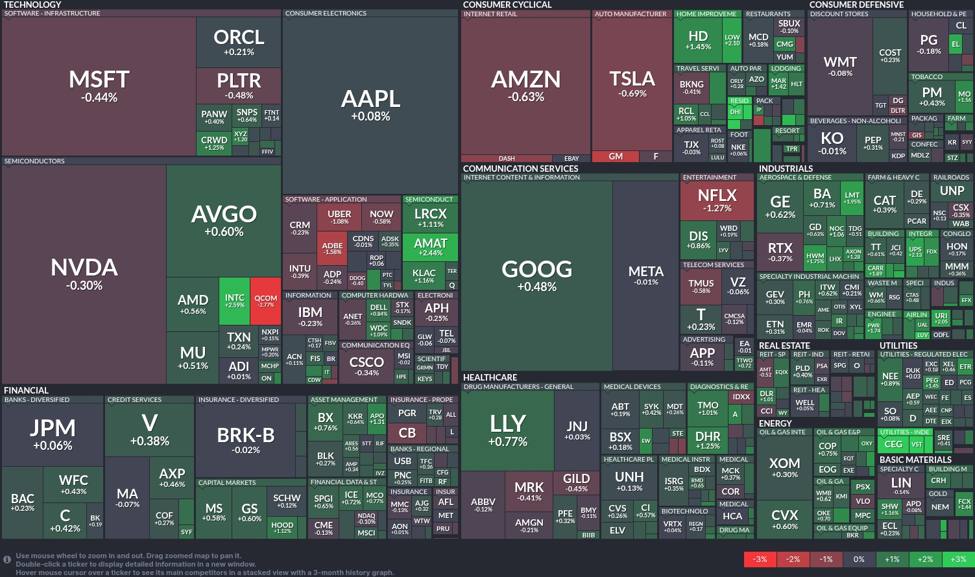
Tech sector dips while industrials rise: Key insights for investors
Sector OverviewToday’s stock market heatmap reveals a contentious battleground across various sectors. Technology sees mixed outcomes, with notable declines and slight advances within sub-sectors. Industrials and Healthcare, however, show promising resilience, driving up overall market sentiment.📉 Tech Sector: Microsoft (MSFT) dropped by 0.44%, paving a cautious path for the broader tech landscape. Nvidia (NVDA) also faced a minor setback with a -0.30% dip. On a positive note, Oracle (ORCL) ticked up by 0.21%.🏗️ Industrials Surge: General Electric (GE) enjoyed a 0.62% rise, and Boeing (BA) inched up by 0.71%, indicating robust investor confidence in industrials amidst broader uncertainties.💉 Healthcare: Eli Lilly (LLY) led with a gain of 0.77%, reinforcing the sector’s continued appeal amid healthcare innovations and solidity.Market Mood and TrendsThe current market mood reflects a spectrum of investor sentiment, with noteworthy caution in technology shadowed by optimism in industrial and healthcare stocks. The juxtaposition indicates a strategic reevaluation among traders, weighed by concerns over tech valuations and potential industrial growth scenarios.Moreover, the downturns in technology may hint at the start of a price correction following months of highs, while industrials seem to captivate investors looking for stable, incremental growth.Strategic RecommendationsFor Investors: This mixed market environment presents unique opportunities and risks. Here are some strategic steps to consider:Analyze and potentially rebalance your tech-heavy portfolios. Look beyond the immediate tech headwinds and seek opportunities within advancing industrial firms.Consider increasing exposure to sectors like healthcare, where consistent growth and innovation could drive portfolio performance.Keep an eye on industrial and healthcare stocks, leveraging their resilience as potential buffers against tech-driven market fluctuations.For more insights and updates, visit InvestingLive.com 📈 and stay informed on the dynamic shifts unfolding in today’s market spaces. This article was written by Itai Levitan at investinglive.com. 🔗 Source 💡 DMK Insight Tech stocks are wobbling, and here’s why that matters for your trades: Microsoft’s recent dip of 0.44% could signal broader weakness in the tech sector, which has been a market leader. With mixed outcomes across tech sub-sectors, traders should be cautious. This decline might not just be a blip; it could indicate a shift in investor sentiment, especially as we approach key earnings reports. If tech continues to falter, it could drag down the overall market, impacting correlated sectors like consumer discretionary and communications. On the flip side, the resilience in Industrials and Healthcare suggests that capital might rotate into these sectors, presenting potential opportunities for swing traders looking for stability. Watch for key support levels in tech stocks; if Microsoft breaks below its recent lows, it could trigger further selling pressure. Conversely, keep an eye on Industrials and Healthcare for bullish setups. The next few trading sessions will be crucial—monitor how these sectors perform as earnings season heats up. 📮 Takeaway Keep an eye on Microsoft’s support levels; a break could signal further tech weakness, while Industrials and Healthcare may offer safer trades.