
 Bitcoin
  Ethereum
  Tether
  XRP
XRP  BNB
BNB  USDC
USDC  Solana
  TRON
TRON  Lido Staked Ether
  Figure Heloc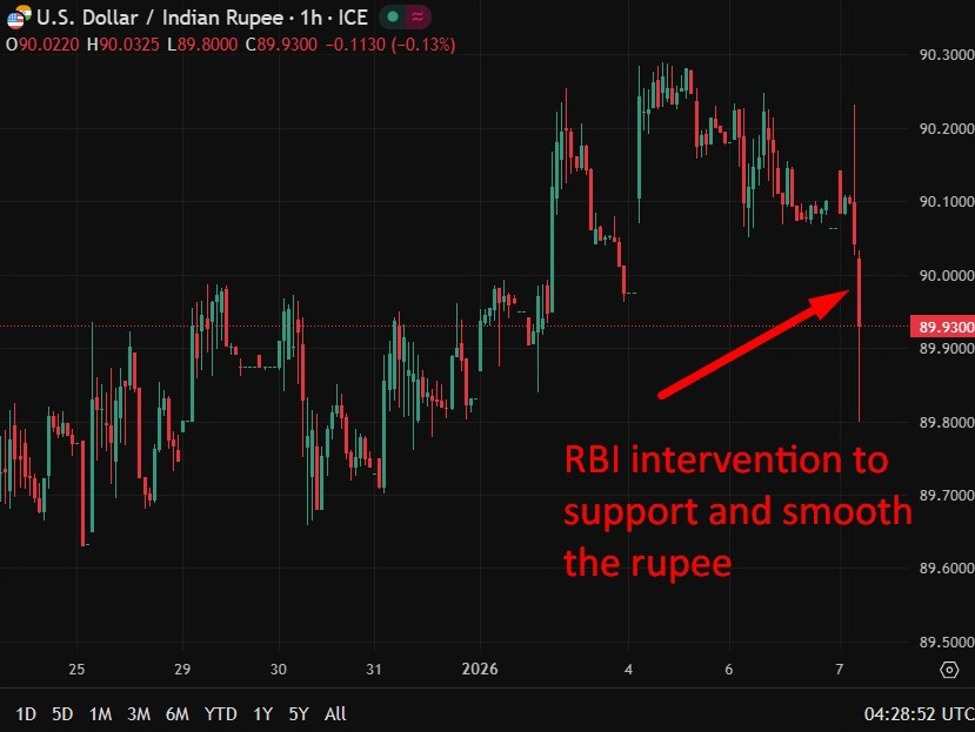
The Reserve Bank of India have stepped into the FX market with intervention so support the rupee. Yesterday I reported on four consecutive days of INR weakness, the RBI acting to avoid a fifth today. The rupee’s recent slide has been driven mainly by early-year importer hedging demand, compounded by a lack of strong foreign equity inflows. Market participants say these persistent structural flows have outweighed sporadic central-bank support, leaving the currency exposed to further downside pressure.Sentiment has also been dented by a deterioration in the US–India trade backdrop. Over the weekend, Donald Trump warned that Washington could consider higher tariffs on India if New Delhi does not rein in purchases of Russian oil. Those comments have added a geopolitical risk premium to the rupee at a time when positioning remains extended.The Reserve Bank of India has continued to play a stabilising role in recent sessions. After initially leaning against the currency’s move through the 90 level, the central bank appears to have reduced its presence as dollar demand persisted, reinforcing the view that officials are focused on managing volatility rather than defending a specific level.There may be some near-term relief from global factors. The US dollar has softened from a recent four-week peak as investors turn their attention to upcoming US data for clues on the Federal Reserve’s policy path. Markets are currently pricing in around two Fed rate cuts this year, a backdrop that could help cap further rupee weakness at the margin. I’m reluctant to see too mkuch releif for the ruppe though. Absent a reversal in portfolio flows, an improvement in global risk appetite, or a clear positive trade-related catalyst, the rupee is likely to remain under pressure. Without such shifts, a test of fresh record lows cannot be ruled out ahead despite today’s intervention efforts. I suspect we’ll see further bouts of RBI ‘smoothing’. This article was written by Eamonn Sheridan at investinglive.com. 🔗 Source 💡 DMK Insight The RBI’s intervention in the FX market signals a critical moment for the rupee’s stability. With four days of consecutive weakness, the RBI’s actions aim to curb further depreciation, which could impact import costs and inflation. Traders should note that this intervention comes amid heightened importer hedging demand, suggesting that the market is reacting to underlying economic pressures. If the rupee continues to weaken, it could trigger more aggressive measures from the RBI, potentially leading to increased volatility in the forex market. It’s also worth considering how this might ripple through related markets, particularly commodities priced in rupees. A weaker rupee could elevate import costs for oil and other essentials, influencing inflation expectations. Keep an eye on the INR’s performance against major currencies, especially if it breaches key support levels. Watch for the RBI’s next moves and any shifts in importer behavior, as these will be crucial for short-term trading strategies. 📮 Takeaway Monitor the INR closely; a breach of key support levels could prompt further RBI intervention and increased market volatility.
investingLive Asia-Pacific FX news wrap: Oil fell further, Aust CPI, RBI FX intervention
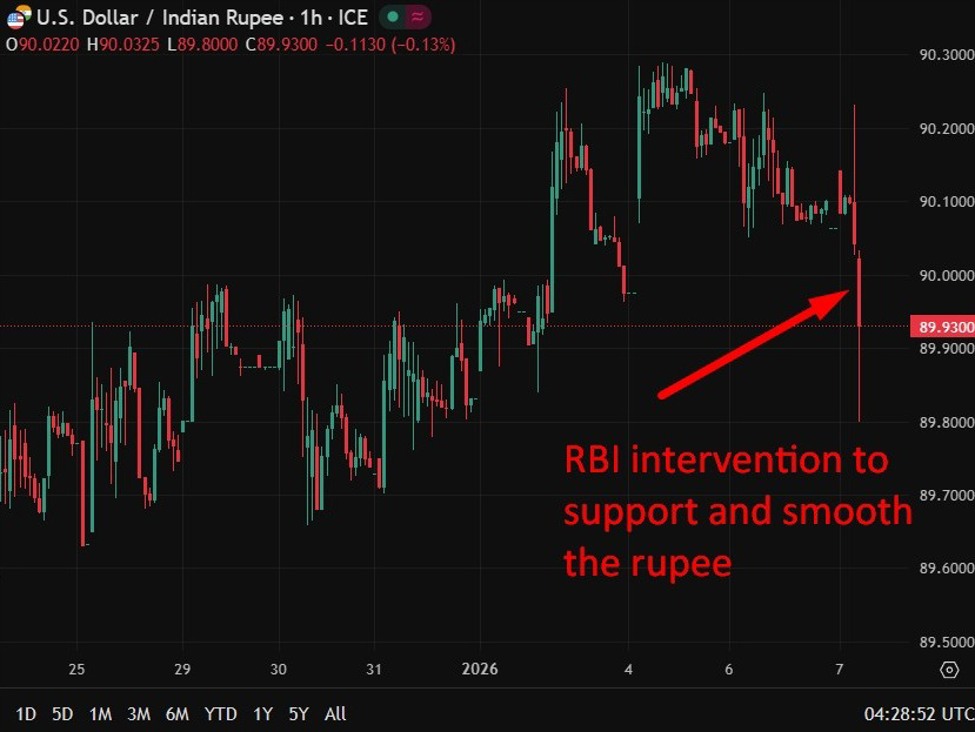
RBI reported to be selling USD/INR ‘heavily’ to support/smooth the rupee (INR)Westpac: softer November CPI reassures RBA, lowers risk of further rate hikesGoldman Sachs sees China equities rising up to 20% by end-2026, earnings-ledBitcoin, solana ETFs planned as Wall Street leans into crypto, Morgan Stanley joins raceChina escalated tensions with Japan, bans exports of goods with potential military usesChina reviews Meta’s $2bn AI deal over export control concernsChina gives banks more leeway to sell bad personal loans, as defaults mountRussia deploys submarine to escort tanker amid U.S. pursuit off VenezuelaPBOC sets USD/ CNY mid-point today at 7.0187 (vs. estimate at 6.9896)Australian CPI slows to 3.4% in November, core inflation still firmly above targetJapan services PMI slows in December as cost pressures intensifyDATA: Australian CPI November 2024 3.4% y/yOIL – Trump says tens of millions of Venezuelan barrels to flow to U.S. marketsChina flags rate and RRR cuts in 2026 as PBoC leans dovishRubio reassures lawmakers on Greenland invasion fear: acquisition diplomatic, not militaryMSCI delays crypto treasury index shake-up , supportive for BTC and other cryptoMorgan Stanley forecasts gold at $4,800 by Q4 2026, sees continued Fed easingOil: Private survey of inventory shows a headline crude oil draw vs. build expectedMarkets across Asia were shaped by softer energy prices, a cooler-than-expected Australian inflation print and policy signals out of China, with FX moves largely contained despite some initial volatility.Oil prices continued to grind lower through the session. WTI crude fell more than USD 1/bbl after US President Donald Trump said interim authorities in Venezuela would hand over 30–50 million barrels of oil to the United States. Trump said the oil would be sold at market prices, with proceeds controlled by the US administration. The Wall Street Journal reported Trump is expected to meet with executives from Chevron, ConocoPhillips and Exxon Mobil later this week to discuss potential investment in Venezuela’s oil sector, reinforcing expectations of increased supply.In Australia, November CPI undershot expectations, though underlying inflation remains sticky. Headline inflation slowed to 3.4% y/y, below forecasts, while monthly CPI was flat. Core inflation eased only marginally, with the trimmed mean at 3.2% y/y, still above the Reserve Bank of Australia’s target band. Black Friday discounting drove price falls in furniture, footwear and clothing, raising questions over how durable the disinflation impulse will be. The data kept rate-hike risks on the radar ahead of the RBA’s 2–3 February meeting, though the balance of evidence still supports a hold (IMO anyway).Australian building approvals data were overshadowed by CPI but printed strongly, rising 15% m/m in November, driven by a 34% surge in volatile private unit approvals. Detached house approvals rose a modest 1%. While the trend remains upward, approvals remain well below the Housing Accord target, and higher-for-longer rate expectations may weigh on momentum ahead.The Australian dollar dipped initially on the CPI release but quickly recovered, rebounding to around 0.6760.In Asia FX, the Chinese yuan pulled back from a 32-month high after the PBoC set a weaker daily fix and reiterated its intention to maintain an appropriately loose policy stance, including scope for RRR and rate cuts. The Indian rupee strengthened after the RBI intervened to smooth volatility.Equities saw pockets of strength. Hyundai Motor shares surged 15% to a record after its CEO met Nvidia’s Jensen Huang at CES, fuelling speculation around an autonomous-driving partnership. Meanwhile, rare-earth related stocks rose across the region after China imposed export restrictions on military-use items to Japan, raising supply-chain concerns. Asia-Pac stocks:Japan (Nikkei 225) -1%Hong Kong (Hang Seng) -1% Shanghai Composite +0.3%Australia (S&P/ASX 200) +0.25% This article was written by Eamonn Sheridan at investinglive.com. 🔗 Source 💡 DMK Insight The RBI’s aggressive selling of USD/INR is a clear signal of its commitment to stabilize the rupee, and here’s why that matters for traders right now. With the rupee under pressure, traders should closely monitor the USD/INR pair for potential volatility. If the RBI continues this strategy, it could lead to a stronger rupee, impacting import costs and inflation expectations. This move also aligns with Westpac’s outlook on softer CPI, which may ease pressure on the RBA to hike rates further. Traders in the forex market should be cautious of any sudden shifts in sentiment, especially if the rupee strengthens significantly, as it could trigger a ripple effect across emerging market currencies. Additionally, the mention of Bitcoin and Solana ETFs indicates a growing institutional interest in crypto, which could lead to increased volatility in those assets. Keep an eye on the correlation between crypto and forex markets, particularly how movements in the INR might affect crypto sentiment. Watch for key levels in USD/INR; if it breaks below a certain threshold, it could signal a more sustained rupee recovery, impacting related assets like Solana, currently priced at $137.55. 📮 Takeaway Monitor USD/INR closely; a significant drop could indicate a stronger rupee, affecting import costs and potentially impacting crypto assets like Solana.
Latest Australian inflation data keeps February interest rate hike on the table
In case you missed the release and the earlier headlines:DATA: Australian CPI November 2024 3.4% y/yAustralian CPI slows to 3.4% in November, core inflation still firmly above targetJust a quick caveat to the latest inflation data here is that this is still a relatively new release. For some context, the October reading was the first complete monthly CPI published by the ABS. So, this is just the second one and is yet to iron out seasonal kinks. As such, the RBA again won’t place too much emphasis on this and will wait on the full December quarter report – which will only be out on 28 January.In any case, let’s take a look at the numbers and what do they mean for the RBA and the Australian dollar currency.Headline annual inflation showed some easing from 3.8% in October to 3.4% in November. However, that will do little to reassure the RBA of falling price pressures as the trimmed mean reading only showed a marginal drop from 3.3% in October to 3.2% in November. As a reminder, the trimmed mean reading is what the RBA focuses on as it is their handle of core inflation so to speak. On a monthly basis, the trimmed mean reading showed a 0.3% increase month-on-month.Of note, new dwelling prices (+2.8%) and rents (+4.0%) continue to hold higher with services inflation also remaining as a sticking point. Even food price inflation isn’t showing much easing, seen at 3.3% and keeping thereabouts since June.So, what does this mean for the RBA?The data today doesn’t shift the direction all too much. As things stand, the RBA is watchful and has to consider when they must take action if inflation actually proves too sticky and in need of policy intervention/action.That’s basically the key trigger question right now, with the trimmed mean reading continuing to keep above the supposed target threshold band of 2% to 3%.As things stand, market players are pricing in ~35% odds of a rate hike at the next RBA policy meeting on 3 February. As for analyst calls, they are more divided. Looking at Australia’s big four, CBA and NAB both have penciled in a rate hike for February while Westpac and ANZ forecast that the RBA will keep rates on hold for a longer period. However, Westpac does note that there are risks on both sides of the equation.So far, the RBA hasn’t made it obvious as to when they might choose to act. However, they have made it clear that they are starting to come around to the view and narrative that Australia has a renewed inflation problem.At most, they might get away with leaving February on hold and then putting out a more convincing storyboard in hiking rates later this year. But as things stand, the risk seems to be that the central bank might have to sooner rather than later.What now for the Australian dollar?With ~35% odds priced in for a 3 February rate hike, the next key risk event to watch will be on 28 January when we get the December quarter data. That will be key in judging if inflation is really too sticky and the RBA might just have to do something about it. But with just ~42 bps of rate hikes priced in so far this year, there is scope to the upside in pricing in a more hawkish RBA if need be based on inflation developments.As for the short-term technical picture, AUD/USD remains largely bullish with the pair trading to its highest since October 2024. There was a bit of a setback on the data release earlier but the near-term outlook hasn’t changed with price action keeping well above the key hourly moving averages. That hints at a more bullish near-term bias for now.There will be some resistance and offers layered closer to 0.6800, so that could offer some room for consolidation. But if the RBA continues to keep the door open for a February move and the broader risk mood holds up, the pair could stay underpinned in targeting the September 2024 highs around 0.6915-40.That being said, do keep in mind the dollar (and risk sentiment) side of the equation as well with the US labour market report due later this week. This article was written by Justin Low at investinglive.com. 🔗 Source

FX option expiries for 7 January 10am New York cut
There are some large expiries on the board for the day but they may not have all too much impact on price action. Let’s take a look with the full list seen below.The first one is for EUR/USD at the 1.1725 level but the pair looks to be consolidating closer to 1.1700 after the overnight drop, which came after a bounce off the 100-day moving average on Monday. The key level is still seen at 1.1663 so that will provide a floor for price action ahead of the US jobs report while upside is more limited by the key hourly moving averages. The 100-hour moving average is at 1.1717 with the 200-hour moving average at 1.1747. So, that will help put a lid on things until we get key headlines to really break the shackles to start the year.Then, there is one for USD/CAD at the 1.3800 level. However, the expiries don’t tie to any technical significance so I would not attach much substance to the potential impact in drawing price action. The pair is very much still continuing a bounce since late December with eyes on the 200-day moving average at 1.3848 currently.For more information on how to use this data, you may refer to this post here.Head on over to investingLive (formerly ForexLive) to get in on the know! This article was written by Justin Low at investinglive.com. 🔗 Source 💡 DMK Insight With SOL at $137.70, traders should keep an eye on the upcoming expiries, especially the EUR/USD at 1.1725, as they could influence market sentiment. Consolidation in EUR/USD suggests a lack of volatility, but large expiries can act as magnets for price action. If SOL maintains its current level, it could attract attention from both retail and institutional traders looking for breakout opportunities. Watch for any shifts in volume or momentum indicators that might signal a breakout or reversal. Additionally, if EUR/USD breaks above or below 1.1725, it could create ripple effects across correlated assets, including SOL, as traders adjust their positions. Here’s the thing: while large expiries might not seem impactful at first glance, they can create unexpected volatility, especially if traders are caught off guard. Keep an eye on the daily chart for SOL; a close above $140 could trigger further buying interest, while a dip below $135 might lead to a reassessment of bullish positions. 📮 Takeaway Monitor SOL closely; a break above $140 could signal bullish momentum, while a drop below $135 may prompt selling pressure.

Will energy get cheaper after the U.S. operation in Venezuela?
Not even a week into 2026, and things are already getting lively, especially in geopolitics. In the early hours of January 3, the United States launched a swift military operation in Venezuela aimed at capturing and extracting President Nicolás Maduro and his wife, both accused by Washington of narcoterrorism.But the motivations likely go beyond the immediate target. Based on statements from U.S. President Donald Trump and Secretary of State Marco Rubio, this could be just the first step in America’s broader effort to reassert influence in the Western Hemisphere.That said, markets don’t seem overly worried, with the Dow Jones hitting record highs on Monday and the S&P 500 also moving higher.Why such indifference?The operation hasn’t escalated into a full-scale war, the U.S. seems to have achieved its stated objectives, and investors see little reason to expect further conflict. Additionally, Venezuela’s massive oil reserves raise hopes that crude oil prices could fall, easing energy inflation and potentially allowing the Fed to cut rates more quickly.However, that last point is far from straightforward. Venezuelan oil is unlikely to reach global markets anytime soon, unless we’re talking about oil already loaded onto tankers.The problem is that Venezuela primarily produces heavy crude, which is more difficult and expensive to extract, requiring sophisticated infrastructure and logistics. After years of sanctions and underinvestment, the country’s oil industry is in poor condition. Restoring production to pre-sanctions levels would likely take years, by which time U.S. geopolitical priorities may have shifted again.The good news is that even if the U.S. doesn’t manage to bring Venezuelan oil to market quickly, some companies are poised to see faster profits, particularly those involved in rebuilding infrastructure, drilling, and refining.No wonder the biggest gains went to the stocks of oil service companies, especially Halliburton and SLB Limited, which handle the nuts and bolts of oil extraction. Chevron, the only major U.S. oil company still operating in Venezuela, saw its stock rise only about half as much, with ConocoPhillips and ExxonMobil trailing behind.The takeaway is that while markets are clearly optimistic, quick profits from the U.S. operation in Venezuela are far from guaranteed for all involved. Much will depend on how the situation unfolds — specifically, whether the new authorities in Caracas comply with U.S. demands or whether “Madurismo” and “Chavismo” persist under a new guise. This article was written by IL Contributors at investinglive.com. 🔗 Source

Germany November retail sales -0.6% vs +0.2% m/m expected
Prior -0.3%; revised to +0.3%Retail sales +1.1% vs +0.9% y/y expectedPrior +0.9%; revised to +1.6%That’s a steep drop in retail sales, missing on estimates but the blow is softened by a more positive revision to the October figure at least. The breakdown shows a drop in retail sales of food products (-1.9%) with the non-food retail sector posting slight growth in sales (+0.3%).The German stats office notes that 2025 retail sales is seen at +2.4% in real terms, based on their preliminary estimates. The range is projected somewhere between +2.3% to +2.6% in real terms for better accuracy. Looking into more detail, retail sales in the first half of 2025 showed a growth of around 3.8% before slowing in the second half of the year to 1.1%.The jump in the first half of the year is noted to be attributed to a one-off effect resulting from the restructuring of a large online and mail-order company in August 2024, among other things. This article was written by Justin Low at investinglive.com. 🔗 Source 💡 DMK Insight Retail sales just dropped, and here’s why that matters: a 1.1% increase year-over-year is below expectations, but revisions to prior data soften the blow. Traders need to pay attention to how this impacts consumer sentiment and spending patterns. A decline in food retail sales could signal broader economic concerns, especially if consumers are tightening their belts. This could lead to volatility in related sectors, particularly consumer discretionary stocks. If the trend continues, it might prompt shifts in monetary policy or influence interest rates, which are crucial for forex traders. Keep an eye on key support levels in the consumer sector and broader market indices as they react to these figures. On the flip side, the upward revision of the October figure could be a sign of resilience. If subsequent data supports this, it might mitigate fears. Watch for upcoming economic indicators that could confirm or contradict this trend, particularly in the next monthly reports. 📮 Takeaway Monitor consumer discretionary stocks and retail sector performance closely; a sustained drop could trigger broader market volatility.

The Green Revolution in Forex: How ESG Metrics Are Reshaping FX Markets
The forex market, once driven mainly by interest rates and GDP figures, has reached a turning point as it is now increasingly influenced by sustainability considerations. To this point, an estimated $30 trillion is currently held in assets aligned with ESG criteria globally, signalling a structural shift in how capital is allocated. Therefore, countries demonstrating strong environmental policies and transparent governance are becoming more attractive to long-term foreign investors, especially with sustainability metrics beginning to play a growing role in shaping sovereign risk perception and capital confidence.The European Central Bank (ECB), for instance, has already integrated climate considerations into its monetary policy, helping the Euro gain serious favor among ESG-focused institutional investors in the process. Moreover, nations like Norway have expanded their renewable energy capacity, including a 45 billion kroner investment in offshore wind projects, positioning its native currency as a beneficiary of the ongoing ESG capital inflows. Exploring the evolution of sustainable trading infrastructureOver the last couple of years traders are increasingly gaining access to sophisticated filtering systems that overlay sovereign ESG scores onto holistic technical and fundamental analysis frameworks. Trade W, for example, offers traders access to 100 financial instruments through a mobile-first platform designed for the next generation of market participants. With more than five million active users across fifty regions and a monthly trading volume approaching sixty billion dollars, its native architecture reflects the broader industry movement toward reducing the carbon footprint associated with financial services.That said, the quantitative evidence supporting ESG integration in forex has continued to strengthen in recent years as evidenced by the robust performance of sustainable funds that posted median returns of 12.5% over the first half of 2025 (across equities, bonds, and mixed assets) compared to 9.2% for their traditional counterparts. Even ESG-enhanced instruments like green bonds have started representing an increasing portion of the global forex market, thus indirectly enabling traders to capitalize on ESG themes on daily timeframes. Similarly, ESG investing too is projected to reach $167.49 trillion by 2034 (from its current levels of $35.48 trillion), signalling that institutional rebalancing toward high-ESG jurisdictions will continue to reshape currency valuations in the near to mid term. Problems still persist but nothing that can’t be tackled with easeDespite these developments, unique challenges remain when it comes to ESG adoption in forex, especially given the short-term nature of many forex trades and how they conflict with the multi-year horizon over which ESG factors typically manifest. But the reality is messier and more interesting than that tension alone suggests.Take Brazil’s real (BRL) for example. Between 2024 and 2025, even though deforestation fell by 11% yoy, hitting the lowest annual clearing rate since 2014 as President Lula’s environmental policies took hold. Yet the currency did not uniformly strengthen for the simple reason that forex markets priced in competing risks. However, at the same time, currencies from genuinely high-ESG jurisdictions captured premium flows, with the Swiss franc (CHF) hitting a 14-year high against the US dollar in September, driven not by interest rates (which were at near zero) but by investor demand for ESG stability. Similarly, New Zealand’s dollar (NZD) has been trading as a proxy for renewable energy credibility, backed by its well established Emissions Trading Scheme and carbon pricing mechanisms.The data doesn’t lieOn the fund side of things, the outperformance spoke for itself with Tocqueville Dividende ISR posting returns of nearly 20% through Q1 2025, beating both the Morningstar Global TME Index and the MSCI ACWI Large Cap Index. Beyond individual funds, renewable energy-focused sustainable funds dominated the roost (particularly in May), with eight of these funds averaging 15.8% returns versus 4.2% for the broader sustainable fund universe. Not only that, the tools to track this in real time are now accessible with remote sensing satellites providing imagery at a 1-meter resolution range, thus allowing traders to literally watch environmental policy enforcement or reversals as they happen.In practical terms what this means is that a trader monitoring the World Bank’s Sovereign ESG Data Portal could have potentially identified New Zealand’s strengthening carbon policy implementation in Q2 2025 (tracking actual emissions reductions and regulatory data) and establish a long NZD position ahead of the subsequent institutional capital rotation. Last but not least, for traders looking to build real positions, the infrastructure now exists with the Luxembourg Stock Exchange’s ESG bond database tracking over 20,000 sustainable instruments, updated continuously. These aren’t theoretical data troves. They’re live, updated daily, available to any trader willing to use. Therefore, as these tools mature and become more accessible, retail traders have something institutional players have long protected jealously, i.e. the ability to trade on real-time ESG shifts before they fully price into markets. In simple terms, the barrier isn’t data anymore. It’s knowing where to look! This article was written by IL Contributors at investinglive.com. 🔗 Source 💡 DMK Insight The forex market’s pivot towards sustainability isn’t just a trend—it’s reshaping trading strategies. With $30 trillion in ESG-aligned assets, traders need to consider how these factors will influence currency valuations. Traditional metrics like interest rates and GDP are still crucial, but now they must be viewed through the lens of environmental, social, and governance criteria. This shift could lead to increased volatility as currencies tied to sustainable practices gain traction, while those lagging may face downward pressure. Keep an eye on how major economies are integrating ESG into their monetary policies, as this could create new trading opportunities or risks. For instance, currencies from countries leading in sustainability initiatives may strengthen against those that don’t prioritize these factors. Watch for upcoming economic reports that highlight ESG commitments, as these could serve as catalysts for currency movements. The real story is how quickly traders adapt to this new paradigm—those who do will likely find themselves ahead of the curve. 📮 Takeaway Monitor ESG-related economic reports closely; they could significantly impact currency valuations in the coming months.

French consumer confidence rises slightly in December
France December consumer confidence 90 vs 90 expectedPrior 89The reading marks a slight improvement in household sentiment, though continuing to rest well below the long-term average of 100. For some context, the last time that French consumer confidence hit that mark was all the way back in October 2021.Looking at the details, households’ opinion on past standard of living (-70) in France rebounded but the one related to future standard of living (-57) eased slightly on the month. Both remain well below their respective long-term averages as well.Meanwhile, unemployment fears also eased with the reading (45) continuing to drop off after peaking in June (57). Household sentiment towards inflation also picked up with the balance of opinion of households who consider that prices have risen sharply over the past twelve months climbing to its highest since February 2025.Overall, it points to French consumer confidence not really showing much optimism last year but at least there is some improvement in fortunes after a rather worrying period in the first half of the year. This article was written by Justin Low at investinglive.com. 🔗 Source 💡 DMK Insight French consumer confidence is inching up, but it’s still a long way from healthy levels. At 90, the December reading matches expectations but remains below the long-term average of 100, indicating persistent caution among households. This slight uptick from 89 could suggest a marginal improvement in sentiment, yet it’s crucial to recognize that the last time confidence hit the average was over two years ago. Traders should consider how this sentiment impacts the euro, especially against the backdrop of broader economic indicators like inflation and employment rates. If consumer confidence continues to rise, it could bolster the euro against the dollar, but any signs of stagnation or decline could lead to renewed bearish pressure. Keep an eye on the EUR/USD pair, particularly around key support and resistance levels, as shifts in consumer sentiment often precede broader economic trends. Watch for the upcoming economic reports that could provide further insight into consumer spending patterns, as these will be critical for gauging the euro’s strength in the near term. 📮 Takeaway Monitor the EUR/USD pair closely; a sustained rise in consumer confidence could signal a bullish trend, while stagnation may lead to bearish pressure.

China gold reserves continue to climb, up for a 14th month running
China gold reserves at the end of December: 74.15 million troy ounces ↑In November: 74.12 million troy ouncesChina gold reserves value at the end of December: $319.45 billion ↑In November: 310.65 billionThe streak continues with this being a cycle that started all the way back in November 2024. Central bank buying has been a key reason in underpinning the price of gold over the past year and China is arguably at the forefront of it all. As mentioned before, there are suspicions that Beijing is buying way more than what is advertised. So, make what you will of the numbers above.But as we look to the new year, fiscal concerns in major economies alongside the de-dollarisation push will continue to prompt central banks to stick with gold buying. As such, don’t expect this driver to dissipate any time soon.After a hot start to the new year, gold is taking a bit of a breather today with price down 0.7% to $4,465 currently. The low earlier today touched $4,441 as the latest bounce starts to run into some selling pressures.Going long in precious metals is arguably the heaviest consensus trade to start the year and with anything that has such one-sided sentiment, they can be dangerous on any pullbacks. So, just be mindful of that. This article was written by Justin Low at investinglive.com. 🔗 Source 💡 DMK Insight China’s gold reserves are climbing, and here’s why that matters right now: With reserves increasing from 74.12 million to 74.15 million troy ounces, the value surged to $319.45 billion. This trend reflects a broader strategy among central banks to diversify away from the dollar, especially amid rising geopolitical tensions. For traders, this could signal a bullish trend in gold prices, particularly if the upward momentum continues. Watch for how this impacts related assets like gold ETFs or mining stocks, which often follow gold’s lead. If gold breaks above key resistance levels, it could trigger further buying from both retail and institutional investors. But don’t overlook the flip side: if the dollar strengthens or if inflation fears subside, gold could face headwinds. Traders should monitor the U.S. dollar index and inflation data closely, as these will influence gold’s trajectory. Keep an eye on the $1,900 level for gold; a sustained break above could indicate a strong bullish sentiment. Conversely, a dip below $1,850 might signal a bearish reversal. Timing is crucial here, so stay alert for upcoming economic indicators that could sway market sentiment. 📮 Takeaway Watch for gold to break above $1,900; a sustained move could signal strong bullish momentum, while a drop below $1,850 may indicate a reversal.

Big risks for gold on Friday with US NFP and US Supreme Court on the agenda
KEY POINTS:Gold remains supported amid geopolitical tensions and weak US dataRisks in the short-term include the US NFP report on Friday and potential US Supreme Court decision on tariffsBig picture uptrend should remain intact amid the Fed’s dovish reaction functionFUNDAMENTAL OVERVIEWGold continues to be supported by the geopolitical tensions and the weak US data. The bullish momentum for now remains intact but the US NFP report on Friday could challenge that. In fact, while the previous report might have been taken with a pinch of salt due to shutdown related issues, this one should give us a clearer picture. Strong data might lead to a bigger pullback as traders push back on expectations of an imminent Fed rate cut, while soft figures should keep on supporting the upside.Moreover, yesterday the US Supreme Court scheduled Friday as an opinion day, which could see a decision on Trump’s tariffs. In case the tariffs are struck down, gold will likely fall amid easing stagflation risks. On the other hand, if tariffs are kept in place, it shouldn’t change much although it would keep the upside intact. In the bigger picture, gold should remain in an uptrend as real yields will likely continue to fall amid the Fed’s dovish reaction function. But in the short term, a hawkish repricing in interest rate expectations could weigh on the market.GOLD TECHNICAL ANALYSIS – DAILY TIMEFRAMEOn the daily chart, we can see that gold recovered almost all the losses from last week’s selloff. Nevertheless, from a risk management perspective, the buyers will have a better risk to reward setup around the trendline to position for a rally into a new all-time high. The sellers, on the other hand, will want to see the price breaking lower to pile in for a drop into the 3887 level next.GOLD TECHNICAL ANALYSIS – 4 HOUR TIMEFRAMEOn the 4 hour chart, we can see that we have a minor support zone around the 4400 level. If we get a pullback, the buyers will likely step in around the support with a defined risk below the minor trendline to position for a rally into new all-time highs. The sellers, on the other hand, will want to see the price breaking lower to pile in for a drop into the major trendline.GOLD TECHNICAL ANALYSIS – 1 HOUR TIMEFRAMEOn the 1 hour chart, we can see that we have the lower bound of the average daily range for today standing right around the support. This should give the buyers more conviction to pile in around the support in case we get a pullback into it. The sellers, on the other hand, will need a break below the trendline to open the door for a bigger pullback into the major trendline.UPCOMING CATALYSTSToday we have the US ADP, the US ISM Services PMI and the US Job Openings data. Tomorrow, we get the latest US Jobless Claims figures. On Friday, we conclude the week with the US NFP report and potential US Supreme Court decision on Trump’s tariffs.VIDEO This article was written by Giuseppe Dellamotta at investinglive.com. 🔗 Source 💡 DMK Insight Gold’s resilience in the face of geopolitical tensions is a key indicator for traders right now. With the upcoming US NFP report and potential Supreme Court decisions looming, volatility could spike. If the NFP data disappoints, expect gold to gain further traction as a safe haven. The Fed’s dovish stance continues to support a bullish outlook for gold, suggesting that any dips could be buying opportunities. Traders should keep an eye on the $1,950 level; a solid hold above this could signal a continuation of the uptrend. Conversely, a drop below this level might trigger profit-taking and a reassessment of positions. It’s worth noting that while gold is currently favored, any unexpected positive economic data could shift sentiment quickly. So, stay alert for market reactions post-NFP and be prepared for potential whipsaws in both gold and related assets like silver or mining stocks. 📮 Takeaway Watch for gold to hold above $1,950; a failure here could lead to a quick sell-off, especially with NFP data on the horizon.