
 Bitcoin
  Ethereum
  Tether
  BNB
BNB  XRP
XRP  USDC
USDC  Solana
  TRON
TRON  Lido Staked Ether
  Figure Heloc
KEY POINTS:Australia inflation data in focus tomorrowThe market is pricing 32% probability of a rate hike in February Total tightening expected in 2026 is around 42 bpsASX 200 is trading inside a rising channelSoft data is expected to trigger a rally, while hot figures will likely add more pressureFUNDAMENTAL OVERVIEWThe ASX 200 went into a meaningful drawdown back in November following the hot inflation data at the end of October. That triggered a hawkish repricing in interest rate expectations which were then followed by a more hawkish RBA decision. The central bank even discussed whether a rate hike might be needed at some point in 2026. The market is pricing a 32% probability of a rate hike at the upcoming meeting in February with a total of 43 bps of tightening seen by year-end. Tomorrow, we get the monthly Australian inflation data. Even though the RBA focuses more on the quarterly reports, traders will likely react to the monthly report. Given the hawkish expectations, a soft report will likely have a bigger impact on Australian assets. In such a case, we will likely see the ASX 200 rallying as the hawkish expectations fade. On the other hand, another hot report will likely weigh further on the stock market, potentially taking it back to November lows.ASX 200 TECHNICAL ANALYSIS – DAILY TIMEFRAMEOn the daily chart, we can see that the ASX 200 (CFD contract) has been trading inside a rising channel. From a risk management perspective, the buyers will have a better risk to reward setup around the bottom trendline to position for a rally into new all-time highs, while the sellers will look for a break below the trendline to push the price back into the 8415 level.ASX 200 TECHNICAL ANALYSIS – 4 HOUR TIMEFRAMEOn the 4 hour chart, we can see that we have a downward trendline defining the pullback into the lower bound of the channel. If the price rallies into the downward trendline, we can expect the sellers to lean on it with a defined risk above it to position for a drop into the lower bound of the channel. The buyers, on the other hand, will want to see the price breaking higher to increase the bullish bets into the upper bound of the channel.ASX 200 TECHNICAL ANALYSIS – 1 HOUR TIMEFRAMEOn the 1 hour chart, we can see that we have a minor support zone around the 8670 level. The buyers will likely continue to step in around this level with a defined risk below it to keep targeting the downward trendline, while the sellers will wait for a break lower to extend the drop into the bottom of the channel.UPCOMING CATALYSTSTomorrow we have the Australian monthly inflation data, the US ADP, the US ISM Services PMI and the US Job Openings data. On Thursday, we get the latest US Jobless Claims figures. On Friday, we conclude the week with the US NFP report. This article was written by Giuseppe Dellamotta at investinglive.com. 🔗 Source 💡 DMK Insight Australia’s inflation data is about to shake things up, and here’s why you should care: With a 32% chance of a rate hike in February, traders are on edge. If the inflation figures come in hot, expect the ASX 200 to face downward pressure, especially since it’s currently trading within a rising channel. Soft data could trigger a rally, but the market’s already pricing in a tightening cycle that anticipates around 42 basis points by 2026. This means that any deviation from expected inflation could lead to significant volatility. Keep an eye on the 7,000 level for the ASX 200; a break below could signal a shift in sentiment. Conversely, if inflation surprises to the downside, we might see a push towards 7,200. Traders should also monitor the broader economic indicators, as they could ripple through related markets like the AUD/USD. If the Australian dollar strengthens on positive data, it could impact forex positions significantly. So, watch for those inflation numbers—they’re not just numbers; they could dictate your next move. 📮 Takeaway Watch the ASX 200 around the 7,000 level; inflation data tomorrow could trigger significant volatility and impact your trading strategy.

How to Use Crypto Safely While Gaming Online
Key Takeaways: Crypto gaming has grown to a $24.4 billion market in 2025, but security threats remain a major concern. Using blockchain-based payment methods offers faster transactions, but requires understanding The post How to Use Crypto Safely While Gaming Online appeared first on NFT Evening. 🔗 Source 💡 DMK Insight Crypto gaming’s growth to a $24.4 billion market by 2025 is huge, but security risks can’t be ignored. With Ethereum currently at $3,234.91, traders should be aware that the rise in crypto gaming could drive demand for ETH as a payment method, especially if blockchain transactions become the norm. However, the emphasis on security highlights a potential volatility risk; if major breaches occur, it could lead to a swift sell-off in related assets. Traders should keep an eye on the correlation between ETH and gaming tokens, as any negative news could impact both sectors. Watch for key support levels in ETH around $3,200 and resistance near $3,300. Understanding the security landscape will be crucial for positioning in this evolving market. 📮 Takeaway Monitor ETH’s support at $3,200 and resistance at $3,300, especially as crypto gaming expands and security threats emerge.

Japan’s finance minister backs exchanges as gateway for digital assets
Japan’s finance minister signaled that crypto’s future lies inside regulated exchanges as Japan advances tax, disclosure and market reforms. 🔗 Source 💡 DMK Insight Japan’s push for regulated exchanges could reshape crypto trading dynamics significantly. With the finance minister advocating for reforms in tax and disclosure, traders should brace for a more structured market environment. This could lead to increased institutional participation, as clearer regulations often attract larger players who were previously hesitant. For day traders and swing traders, this might mean more volatility in the short term as the market adjusts, but potentially more stability and legitimacy in the long run. Keep an eye on related assets like Bitcoin and Ethereum, as regulatory clarity in Japan could influence their price movements globally. However, there’s a flip side: increased regulation might stifle some of the innovation that has driven crypto’s growth. Traders should monitor how these reforms unfold and be cautious of any knee-jerk reactions in the market. Watch for key announcements from the Japanese government in the coming weeks, as these could serve as catalysts for price movements. 📮 Takeaway Watch for Japan’s regulatory announcements; they could impact crypto volatility and institutional interest significantly.

China’s financial associations reclassify RWAs as ‘risky,‘ report says
Wu Blockchain reported the policy change listing Real-World Asset tokenization alongside stablecoins, ”air coins” and crypto mining as illegal in China. 🔗 Source 💡 DMK Insight China’s crackdown on Real-World Asset tokenization is a game changer for crypto traders. This policy shift signals a tightening regulatory environment that could stifle innovation and investment in tokenized assets. Traders need to be aware that this move may lead to increased volatility in related markets, particularly stablecoins and any assets tied to real-world applications. If you’re holding positions in these areas, consider reevaluating your risk exposure. The broader implications could ripple through the crypto ecosystem, affecting liquidity and market sentiment. Watch for how major exchanges respond and whether they adjust their listings accordingly. This could also impact the price action of cryptocurrencies that rely on tokenized assets for utility. Keep an eye on key support and resistance levels in the market as traders digest this news, especially in the coming days as sentiment shifts. Here’s the thing: while some might see this as a setback, it could also create opportunities for projects that comply with regulations. Stay alert for any signs of regulatory clarity that could emerge from this situation. 📮 Takeaway Monitor how this policy impacts stablecoins and tokenized assets, especially in the next week, for potential trading opportunities.

Crypto companies contribute $21M to Trump PAC ahead of US midterms
The Gemini Trust Company and parent company of Crypto.com sent millions of dollars to the Trump-supporting PAC in September and October. 🔗 Source 💡 DMK Insight So, Gemini and Crypto.com just funneled millions to a Trump-supporting PAC, and here’s why that matters: this move could signal a shift in how crypto companies engage with political landscapes. For traders, this isn’t just about political donations; it’s about the potential ripple effects on regulatory scrutiny and market sentiment. If these companies are aligning themselves with specific political figures, it could influence their lobbying efforts on crypto regulations, which are already a hot topic. Keep an eye on how this might affect their operational strategies and public perception. Also, consider the broader implications for the crypto market. If regulatory pressures increase due to political affiliations, we might see volatility in major assets like Bitcoin and Ethereum. Watch for key support levels in these assets, especially if negative sentiment starts to build. The next few weeks could be crucial as traders react to any fallout from this news. 📮 Takeaway Monitor Bitcoin and Ethereum for volatility; watch key support levels as political affiliations may influence regulatory scrutiny.

South Korea considers pre-emptive crypto account freezes, report says
The proposal highlights South Korea’s push to align crypto oversight with securities markets, raising stakes for exchanges and traders alike. 🔗 Source 💡 DMK Insight South Korea’s move to align crypto oversight with securities regulations is a game changer for traders. This shift could mean stricter compliance for exchanges, impacting liquidity and trading strategies. Traders should brace for potential volatility as exchanges adapt to new rules, which could alter market dynamics significantly. If you’re holding positions in South Korean assets or trading pairs, keep an eye on how this regulatory environment unfolds. The real story is how this could ripple through the broader Asian markets, especially if other countries follow suit. Watch for any announcements or updates from the Financial Services Commission, as they could provide clues on enforcement timelines and specific compliance requirements. In the short term, traders might want to monitor key support and resistance levels in affected cryptocurrencies, as regulatory news often triggers sharp price movements. Stay alert for any shifts in trading volumes that could indicate market sentiment changes in response to these developments. 📮 Takeaway Watch for regulatory updates from South Korea’s Financial Services Commission, as they could impact trading strategies and market volatility in the coming weeks.

Nvidia launches Rubin platform with Vera Rubin superchip at CES 2026
Summary:NVIDIA launches Rubin platform at CES 2026Vera Rubin superchip integrates CPU and dual GPUsPlatform targets agentic AI and MoE modelsDesigned for training and inference at scaleReinforces NVIDIA’s annual AI hardware cadenceAI hardware leader NVIDIA has formally lifted the curtain on its next-generation Rubin platform, announcing the launch of the Vera Rubin superchip during CES 2026 in Las Vegas. The new processor marks a significant step in the company’s accelerated computing roadmap and reinforces its strategy of delivering annual generational upgrades to meet surging AI demand.Vera Rubin is one of six chips that collectively make up the Rubin platform, which NVIDIA is positioning as its most advanced AI system architecture to date. The superchip integrates one Vera CPU with two Rubin GPUs into a single processor, reflecting NVIDIA’s continued emphasis on tight hardware co-design across compute, memory and interconnect. That approach has become a defining feature of the company’s AI offerings, enabling performance gains that go beyond incremental silicon improvements.NVIDIA is pitching the Rubin platform as purpose-built for the next wave of artificial intelligence workloads, particularly agentic AI, advanced reasoning models and mixture-of-experts (MoE) architectures. These models rely on routing tasks dynamically across specialised “expert” systems, placing heavy demands on compute efficiency, memory bandwidth and inter-chip communication. By combining multiple high-performance components into a unified superchip, Rubin is designed to accelerate both AI training and inference at scale.The timing of the launch underscores NVIDIA’s view that AI compute demand remains structurally strong. Speaking alongside the announcement, CEO Jensen Huang said Rubin arrives as demand for AI computing is “going through the roof,” spanning hyperscale data centres, enterprise deployments and increasingly complex model architectures. He framed the platform as a major leap forward enabled by NVIDIA’s rapid product cadence and deep integration across its silicon stack.CES has increasingly become a venue for NVIDIA to outline long-term strategic direction rather than simply showcase consumer-facing technology. The Rubin announcement fits that pattern, highlighting the company’s focus on AI infrastructure rather than end-user devices. It also reinforces NVIDIA’s ambition to remain at the centre of the global AI build-out, as governments, cloud providers and enterprises race to deploy more capable and efficient AI systems.With Rubin, NVIDIA is signalling that the next phase of AI growth will be driven not just by larger models, but by more sophisticated reasoning, orchestration and real-world deployment — workloads that demand an entirely new class of AI supercomputing platforms. This article was written by Eamonn Sheridan at investinglive.com. 🔗 Source 💡 DMK Insight NVIDIA’s unveiling of the Rubin platform is a game-changer for AI traders and tech investors alike. This superchip, integrating a CPU with dual GPUs, is designed for agentic AI and mixture of experts (MoE) models, which could significantly enhance training and inference capabilities at scale. For traders, this matters because it reinforces NVIDIA’s position as a leader in AI hardware, potentially driving demand for their products and impacting stock prices. With AI adoption accelerating across industries, NVIDIA’s innovations could lead to increased revenue and market share, making it a key player to watch. However, it’s worth noting that while NVIDIA’s advancements are impressive, the market may have already priced in some of this optimism. Traders should keep an eye on technical levels around NVIDIA’s stock price, particularly any support or resistance around recent highs. If the stock breaks above those levels, it could signal further bullish momentum. Conversely, a failure to maintain upward momentum could lead to profit-taking, especially if broader market conditions shift. Watch for earnings reports and analyst upgrades as potential catalysts in the coming weeks. 📮 Takeaway Monitor NVIDIA’s stock around key technical levels; a break above recent highs could signal bullish momentum, while a downturn may prompt profit-taking.
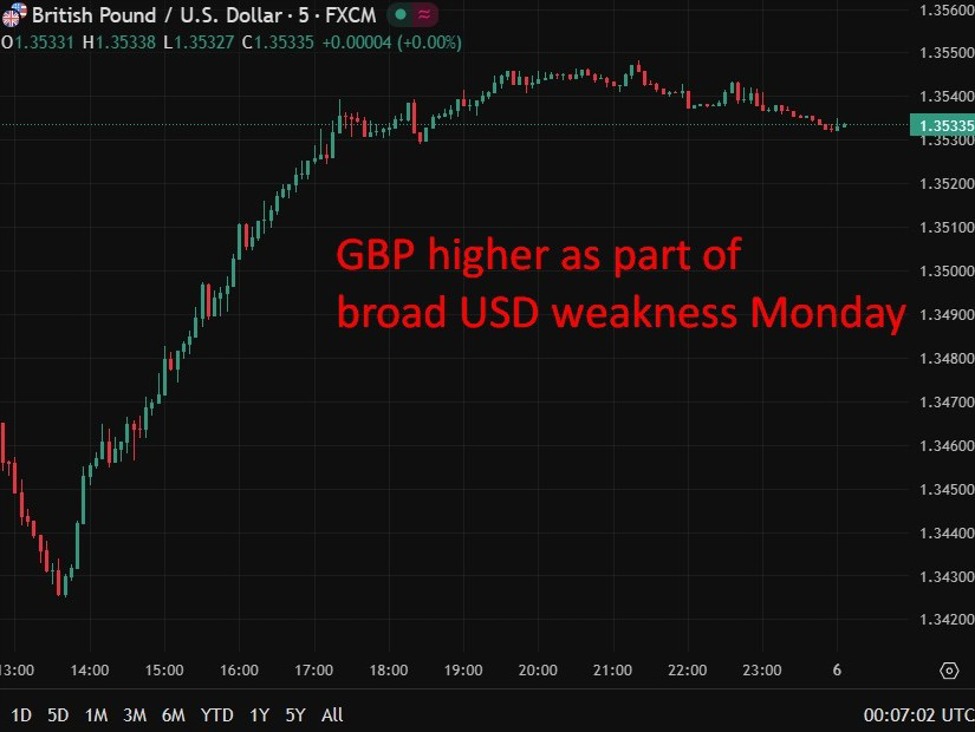
UK retailers warn on sticky inflation as business confidence edges higher
Summary:UK shop price inflation rose to 0.7% in DecemberFood inflation accelerated while non-food prices fellRetailers warn higher wages and regulation may keep prices stickyBusiness confidence improved but remains below averageCapex intentions rose to a 2.5-year highUK retailers raised prices at a faster pace in December and warn that further increases may be difficult to avoid in 2026, even as broader business confidence shows early signs of stabilisation, according to new industry data and corporate surveys released Tuesday.Figures from the British Retail Consortium showed annual shop price inflation edged up to 0.7% in December (0.6% expected) from 0.6% in November, remaining in line with its three-month average. While overall inflation remains modest, the composition of price pressures is becoming more concerning for policymakers.Food inflation accelerated to 3.3% year-on-year, up from 3.0% the previous month, reflecting ongoing cost pressures across supply chains. By contrast, prices for non-food items continued to fall, declining 0.6% annually, unchanged from November, as retailers used discounting to stimulate demand and clear inventories.BRC chief executive Helen Dickinson said retailers would continue efforts to limit price rises, but warned that easing pressures from lower energy costs and improved crop conditions may be offset by rising policy-driven costs. She highlighted increasing regulation and higher labour expenses as key risks to keeping inflation contained.Those labour pressures are set to intensify in April, when the UK’s minimum wage rises by 4.1% to £12.71 an hour. Staffing costs have already been lifted by measures introduced in Chancellor Rachel Reeves’ first budget in October 2024, adding to the challenge for price-sensitive sectors such as retail. The Bank of England is monitoring food prices closely, given their role in shaping household inflation expectations, even as headline CPI eased to 3.2% in November.Against that backdrop, separate survey data suggest corporate sentiment is improving slightly. A quarterly CFO survey from Deloitte showed the net balance of business optimism rose to -13% in Q4 from -24% in Q3, though confidence remains below historical averages. Deloitte’s chief economist Ian Stewart described sentiment as cautious but improving, noting reduced perceptions of external uncertainty and a modest pickup in risk appetite. Preliminary December PMI data from S&P Global echoed that view.Notably, the share of executives prioritising capital expenditure rose to a two-and-a-half-year high of 17%, signalling tentative willingness to invest. Still, the contrast between improving confidence and persistent cost pressures suggests UK firms face a difficult balancing act in 2026. This article was written by Eamonn Sheridan at investinglive.com. 🔗 Source 💡 DMK Insight UK shop price inflation hitting 0.7% in December signals potential volatility for traders: Food inflation is on the rise, while non-food prices are declining, creating a mixed bag for retail sentiment. This divergence could lead to strategic shifts in trading positions, especially for those focused on consumer staples versus discretionary goods. With retailers warning of sticky prices due to higher wages and regulations, traders should keep an eye on related sectors, particularly food stocks, which might see increased volatility. The uptick in business confidence, despite still being below average, suggests a cautious optimism that could influence market movements. For day traders, monitoring the retail sector’s response to these inflationary pressures could provide actionable insights. Key price levels to watch would be the performance of major retail indices, particularly if they break above or below recent trading ranges. Additionally, with capital expenditure intentions at a 2.5-year high, this could signal a longer-term bullish trend in certain sectors, but the immediate focus should remain on inflation metrics and their impact on consumer behavior. 📮 Takeaway Watch for how retail stocks react to the 0.7% inflation rate; key levels to monitor are major retail indices for potential breakouts or reversals.
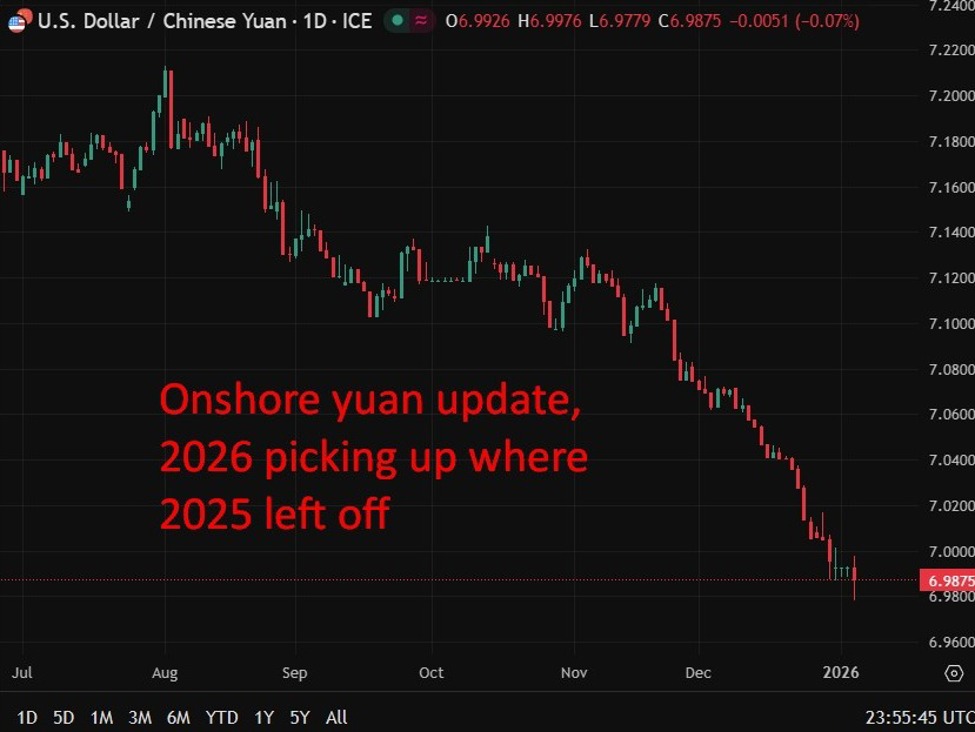
PBOC is expected to set the USD/CNY reference rate at 6.9730 – Reuters estimate
The People’s Bank of China is due to set the daily USD/CNY reference rate at around 0115 GMT (2115 US Eastern time), a fixing that remains one of the most closely watched signals in Asian foreign exchange markets. China operates a managed floating exchange rate system, under which the renminbi (yuan) is allowed to trade within a prescribed band around a central reference rate, or midpoint, set each trading day by the PBOC. The current trading band permits the currency to move plus or minus 2% from the official midpoint during onshore trading hours. Each morning, the PBOC determines the midpoint based on a range of inputs. These include the previous day’s closing price, movements in major currencies, particularly the US dollar, broader international FX conditions, and domestic economic considerations such as capital flows, growth momentum and financial stability objectives. The midpoint is not a purely mechanical calculation, allowing policymakers discretion to guide market expectations. Once the midpoint is announced, onshore USD/CNY is free to trade within the allowable band. If market pressures push the yuan toward either edge of that range, the central bank may step in to smooth volatility. Intervention can take the form of direct buying or selling of yuan, adjustments to liquidity conditions, or guidance through state-owned banks. As a result, the daily fixing is often interpreted as a policy signal rather than just a technical reference point. A stronger-than-expected CNY midpoint is typically read as a sign the PBOC is leaning against depreciation pressure, while a weaker fixing for the CNY can indicate tolerance for a softer currency, often in response to dollar strength or domestic economic headwinds.In periods of heightened global volatility, such as shifts in US rate expectations, trade tensions or capital flow pressures, the fixing takes on added significance. For investors, it provides insight into Beijing’s currency priorities, balancing competitiveness, capital stability and financial market confidence. This article was written by Eamonn Sheridan at investinglive.com. 🔗 Source 💡 DMK Insight The upcoming USD/CNY reference rate fixing is crucial for traders navigating Asian forex markets right now. With the People’s Bank of China setting the rate, expect volatility, especially if it deviates from market expectations. A stronger renminbi could signal confidence in China’s economic recovery, impacting commodities and regional currencies. Conversely, a weaker fix might raise concerns about economic stability, leading to sell-offs in risk assets. Watch for reactions in correlated markets like AUD/USD and commodities like copper, which often respond to shifts in Chinese demand. Key levels to monitor include the psychological 7.00 mark for USD/CNY, as a breach could trigger significant trading activity. Keep an eye on the fixing time—traders should be ready for potential spikes in volatility around 0115 GMT. 📮 Takeaway Watch the USD/CNY reference rate closely; a fix above or below 7.00 could trigger major market moves in Asian currencies and commodities.
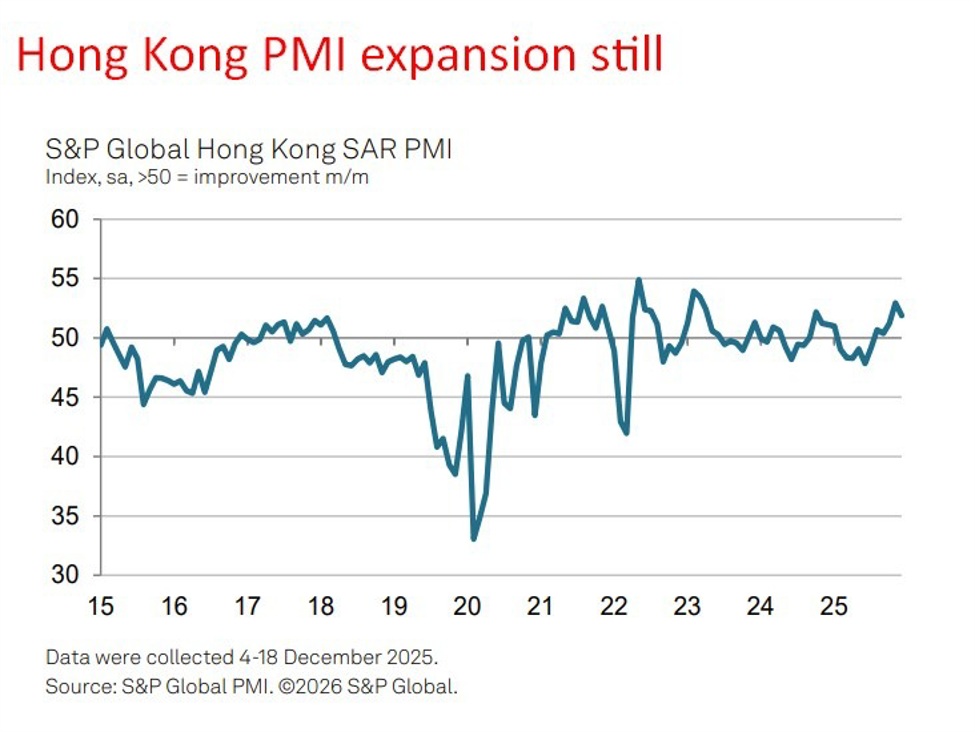
Hong Kong PMI shows sustained growth as price pressures intensify
Summary:Hong Kong PMI remains in expansion for fifth month, 51.9 in December vs. 52.9 in November Output and new orders grow at solid but slower paceBacklogs rise for first time in a yearSelling prices increase at fastest rate since 2023Business confidence improves into 2026Business conditions across Hong Kong’s private sector continued to improve at the end of 2025, marking a fifth consecutive month of expansion, though momentum eased slightly as cost pressures intensified, according to the latest PMI data from S&P Global.The headline Hong Kong SAR PMI slipped to 51.9 in December from 52.9 in November, remaining firmly above the 50 threshold that separates expansion from contraction. The reading points to a moderate but sustained improvement in business conditions and capped the strongest quarterly performance since early 2023.Output rose for a fifth straight month, with growth easing from November but still among the strongest seen over the past three years. Firms cited continued improvements in demand conditions as the key driver, with sales increasing across both domestic and external markets. New orders also expanded at a solid pace, posting the second-strongest increase since April 2023, supported by higher customer numbers and improved client confidence. Notably, demand from mainland China and international markets contributed meaningfully to the upturn.The sustained rise in new business began to stretch capacity. Backlogs of work increased for the first time in a year, a development often viewed as a forward-looking signal of further production gains ahead. While the accumulation of unfinished work remained modest, it was the most pronounced since November 2024, suggesting demand is increasingly testing firms’ operational limits.Despite rising workloads, employment declined for a second consecutive month, largely due to the non-replacement of voluntary departures. At the same time, purchasing activity continued to rise, albeit at a slower pace, while input inventories increased for a seventh month. Firms also reported the first improvement in supplier delivery performance since May, reflecting more timely arrivals of inputs.Price pressures were a standout feature of the December survey. Input costs rose at a solid pace, driven by higher raw material prices and a sharp acceleration in staff-related expenses, which increased at the fastest rate since June 2024. In response, firms raised selling prices at the quickest pace in 26 months, marking the strongest charge inflation since October 2023.Looking ahead, sentiment improved further. While firms remained cautious about global growth and tariff risks, pessimism about the year-ahead outlook eased to its lowest level since mid-2023, underpinned by growing confidence in domestic economic conditions.Commenting on the data, Usamah Bhatti, Economist at S&P Global Market Intelligence, said rising backlogs point to potential further output gains, while easing pessimism suggests the recovery has gained firmer footing into 2026. This article was written by Eamonn Sheridan at investinglive.com. 🔗 Source 💡 DMK Insight Hong Kong’s PMI hitting 51.9 signals a mixed bag for traders: growth continues, but at a decelerating pace. The fact that output and new orders are still expanding is a positive sign, but the slowdown from November’s 52.9 could raise eyebrows among day traders looking for momentum. The increase in backlogs suggests that while demand is there, supply chain issues might be creeping back in, which could impact sectors reliant on timely deliveries. For crypto and forex traders, this could mean volatility in related markets, especially if business confidence continues to improve into 2026. Watch how SOL, currently at $137.76, reacts to these economic indicators; a break below $135 could trigger selling pressure, while a rally past $140 might attract bullish sentiment. Keep an eye on the broader implications for risk assets. If business conditions in Hong Kong strengthen, it could lead to increased capital inflows, impacting crypto valuations positively. Conversely, if the slowdown raises concerns about economic stability, we might see a flight to safety, affecting both crypto and forex markets negatively. 📮 Takeaway Monitor SOL closely; a drop below $135 could signal bearish sentiment, while a rise above $140 may attract buyers amid improving business conditions.