
 Bitcoin
  Ethereum
  Tether
  BNB
BNB  XRP
XRP  USDC
USDC  Solana
  TRON
TRON  Lido Staked Ether
  Figure Heloc
The Canadian manufacturing sector remains stuck in the mud as the final Canadian S&P Global survey of manufacturers was released. It’s another soft reading for the Canadian economy, and the details here are painting a stagflationary picture that the Bank of Canada isn’t going to like.Here are the details from the S&P Global Manufacturing PMI for December:48.6 vs 48.4 prior.Output Index: Declined at a quicker rateNew Orders with a ‘solid decline’Employment: 11th consecutive month of job shedding.Prices: Selling price inflation hit a six-month high.The report explicitly blames tariffs for driving up prices while simultaneously killing demand. Fortunately, the consumer side of the economy has remained strong as manufacturing gets left behind. A year of prolonged uncertainty around USMCA negotiations isn’t going to help.Firms reported that average lead times lengthened because of customs delays, specifically with US imports. Even worse, the uncertainty around trade policy is causing a “general air of uncertainty” that is weighing on output for the year ahead, something that will hit capexPaul Smith, Economics Director at S&P Global:“Canada’s manufacturing economy ended the year on a subdued note, with output and new orders both falling again – as they have done in each month of 2025 apart from January. Once again, tariffs remained an important theme amongst PMI survey respondents, with a general air of uncertainty continuing to negatively weigh on current and expected output levels for the year ahead. “This means firms remain naturally cautious, and seeking an operating leanness, either in terms of labour capacity or inventory holdings. Purchasing activity was also cut again in December, although supply-chain delays continue, and the price of inputs shifted higher – which firms once again closely linked to tariffs.” This is a reminder that there are problems in Canadian manufacturing as this survey has been in contraction for 11 straight months, shedding jobs the whole way down. Normally, that would scream for more cuts but look at the inflation component: Input price inflation picked up, and selling price inflation is at a six-month high. Firms are passing those tariff costs right along to consumers.USD/CAD is up 16 pips on the first real trading day of 2026 after falling about 5% last year.Yesterday, I wrote a Canadian dollar outlook for 2026 and later today I will be on BNNBloomberg TV talking about it. This article was written by Adam Button at investinglive.com. 🔗 Source 💡 DMK Insight The Canadian manufacturing sector’s stagnation at a time when ADA is at $0.38 could signal broader economic issues ahead. With the S&P Global survey showing weak performance, traders need to consider how this affects the Canadian dollar and, by extension, ADA’s performance. A sluggish manufacturing sector often leads to reduced consumer spending and investment, which could pressure the Bank of Canada to adjust monetary policy. If the central bank leans towards easing, it might weaken the CAD, potentially making ADA more attractive to investors looking for alternatives. However, if the Bank decides to maintain a hawkish stance to combat inflation, it could lead to increased volatility in both CAD and ADA. Watch for ADA’s support around $0.35; a break below that could trigger further selling pressure. Conversely, if the CAD weakens significantly, ADA might see a short-term rally. Keep an eye on upcoming economic indicators and Bank of Canada announcements, as these could provide critical insights into market direction. 📮 Takeaway Monitor ADA’s support at $0.35 and watch for Bank of Canada policy shifts that could impact CAD and ADA’s relative strength.
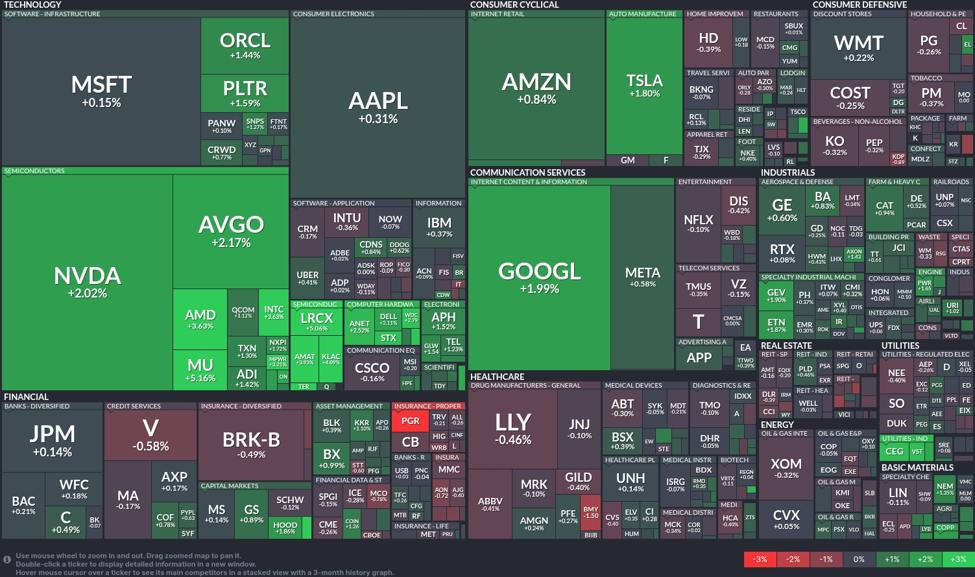
Semiconductors surge as tech leads market rebound
Sector OverviewThe stock market witnessed a notable rally today, with the semiconductor sector leading the charge. Key players like Nvidia (NVDA) and Advanced Micro Devices (AMD) surged by 2.02% and 3.63% respectively, reflecting robust investor confidence in tech hardware advancements.🚀 Technology: Broad gains were observed with companies like Oracle (ORCL) and Palantir (PLTR) climbing up by 1.44% and 1.12%.📈 Consumer Cyclical: The sector stayed bullish with leaders such as Amazon (AMZN) and Tesla (TSLA) rising by 0.84% and 1.80% respectively.🏦 Financial: It was a mixed day in financials, with JPMorgan Chase (JPM) posting a modest gain of 0.14%, whereas Visa (V) slightly fell by 0.58%.📉 Healthcare: Sectors like healthcare showed minor setbacks with Eli Lilly (LLY) slipping by 0.46%.Market Mood and TrendsOverall, the market sentiment was bullish, primarily fueled by the impressive performance in the tech industry. The ongoing investor optimism in tech upgrades and innovations propelled this momentum. On the other hand, caution remains in the financial sector, reflecting uncertainties around economic policies.Strategic RecommendationsAmidst this surge in the tech sector, investors are recommended to keep a balanced approach toward their portfolios. Here are some strategic insights:✨ Focus on Technology: With semiconductors showing strength, tech appears promising for both short-term momentum and long-term growth.🔍 Monitor Financial Sector: Given the mixed performance, it’s wise to keep an eye on economic indicators that could shift dynamics within financial stocks.📊 Diversify Across Sectors: To mitigate risks, diversifying investments can safeguard against potential volatility in the healthcare and consumer defensive sectors.As always, keeping abreast of market data and analyses is crucial for strategic planning. Stay updated with InvestingLive.com for ongoing insights and personalized advice. This article was written by Itai Levitan at investinglive.com. 🔗 Source 💡 DMK Insight The semiconductor sector’s rally, led by Nvidia and AMD, signals strong investor confidence in tech hardware advancements. This surge isn’t just a flash in the pan; it reflects broader market optimism, particularly as tech stocks often set the tone for overall market sentiment. With Nvidia up 2.02% and AMD rising 3.63%, traders should watch for potential follow-through in these stocks, especially if they break key resistance levels. If Nvidia can hold above its recent highs, it could attract more institutional buying, while AMD’s momentum might pull in retail investors looking for growth. However, keep an eye on broader economic indicators, like inflation data or interest rate announcements, which could impact tech valuations. On the flip side, if the market faces headwinds—like disappointing earnings from other sectors or geopolitical tensions—these gains could quickly reverse. So, it’s crucial to monitor not just these stocks but also the overall market sentiment and economic news. Watch for Nvidia around its resistance levels and AMD for any signs of profit-taking. 📮 Takeaway Traders should monitor Nvidia and AMD closely; a sustained breakout above recent highs could signal further gains, but watch for broader market indicators that might trigger volatility.

BitMine chairman proposes 1,000x increase in company's authorized shares, to 50B
Being able to strategically raise capital by having shares ready to issue was one of the secondary reasons Lee gave for the proposal. 🔗 Source 💡 DMK Insight So, the push to raise capital through share issuance is more than just a financial maneuver—it’s a strategic play that could reshape market dynamics. When companies signal their intent to issue shares, it often reflects confidence in their growth prospects, but it can also dilute existing shareholder value. Traders should be cautious here; if the market perceives this as a sign of weakness or desperation, it could lead to a sell-off. Moreover, this move could affect related sectors, especially if it involves companies in high-growth industries where capital is crucial for expansion. Keep an eye on how this impacts stock prices in the short term, particularly if the issuance is substantial. Here’s the kicker: if the market reacts negatively, we might see a ripple effect across similar stocks, especially those with high valuations. Watch for any shifts in trading volume or sentiment indicators that could signal a broader market reaction. The next few trading sessions will be critical to gauge how investors digest this news. 📮 Takeaway Monitor share price reactions closely; a negative sentiment shift could trigger broader sell-offs in related sectors.

India FX Reserves, USD rose from previous $693.32B to $696.61B in December 22
India FX Reserves, USD rose from previous $693.32B to $696.61B in December 22 🔗 Source 💡 DMK Insight India’s FX reserves hitting $696.61B is a significant shift, and here’s why it matters now: An increase in foreign exchange reserves can bolster the rupee’s stability, making it less susceptible to external shocks. For traders, this could mean a more favorable environment for long positions in INR pairs, especially against currencies like the USD. The recent uptick also suggests that the Reserve Bank of India (RBI) might have more leeway to intervene in forex markets, which could impact volatility in the short term. Keep an eye on the USD/INR pair; if it breaks below key support levels, it could signal a stronger rupee. However, don’t overlook potential risks—global economic shifts or changes in U.S. monetary policy could quickly alter the landscape. Watch for the RBI’s next moves and any commentary on these reserves, as they could provide insights into future monetary policy. If the reserves continue to rise, it could also attract foreign investment, further strengthening the rupee and impacting related markets like equities. 📮 Takeaway Monitor the USD/INR pair closely; a break below key support could indicate a stronger rupee and trading opportunities.

USD/CHF stalls below 0.7940 in a calm New Year session
The US Dollar is trading practically flat against the Swiss Franc, right below the 0.7940 line, ahead of the US session opening on Friday, The pair has edged up from three-month lows at the 0.7860 area in late December, but it closed the 2025 year with a more than 12% decline.A combination of market 🔗 Source 💡 DMK Insight The US Dollar’s stagnation against the Swiss Franc at 0.7940 signals a critical juncture for traders. After bouncing from three-month lows at 0.7860, the dollar’s inability to gain traction suggests a cautious market sentiment. This flat trading could indicate that traders are waiting for clearer signals from upcoming economic data or geopolitical developments. With the dollar closing 2025 up over 12%, there’s potential for profit-taking, which could lead to increased volatility. If the pair breaks above 0.7940, it may attract bullish momentum, but a failure to hold this level could trigger a sell-off back towards 0.7860. Keep an eye on the US economic indicators set to release soon, as they could provide the catalyst needed for a decisive move. Also, monitor how the Swiss Franc reacts to any shifts in risk sentiment, as it often serves as a safe haven during market turbulence. 📮 Takeaway Watch for a breakout above 0.7940 or a drop below 0.7860 to gauge the next move in USD/CHF.

India Bank Loan Growth increased to 12% in December 8 from previous 11.5%
India Bank Loan Growth increased to 12% in December 8 from previous 11.5% 🔗 Source 💡 DMK Insight India’s bank loan growth hitting 12% is a key indicator for traders: it signals increasing economic activity and potential inflationary pressures. This uptick from 11.5% could influence interest rates, prompting the Reserve Bank of India to adjust monetary policy sooner than expected. Traders should keep an eye on the banking sector, as rising loan growth often correlates with increased demand for financial stocks. Look for key levels in bank Nifty indices, as a sustained move above recent highs could attract more institutional interest. However, there’s a flip side; if inflation rises too quickly, it could lead to tighter monetary conditions, impacting overall market sentiment. Watch for the upcoming RBI meeting for any hints on interest rate changes, and keep an eye on related sectors like real estate and consumer goods, which could feel the ripple effects of this loan growth. Immediate focus should be on how this growth trend plays out in the coming weeks, especially in relation to inflation metrics. 📮 Takeaway Monitor the RBI’s next moves closely; a shift in interest rates could significantly impact market sentiment and trading strategies in the coming weeks.

Gold Price Forecast: XAU/SD extends its recovery to the $4,400 area
Gold (XAU/USD) accelerated its recovery on a holiday-thinned session on Friday, with markets in Japan and China closed for the New Year festivities. The precious metal is 1.75% up on the day, reaching levels near $4,400, after bouncing from $4,274 earlier this week. 🔗 Source 💡 DMK Insight Gold’s recent surge to nearly $4,400 is significant, especially with holiday trading volumes low. The 1.75% increase reflects a strong bounce from $4,274 earlier this week, suggesting bullish momentum. Traders should note that this price action could be driven by safe-haven demand amid ongoing geopolitical tensions and inflation concerns. With Japan and China out for the New Year, liquidity is thinner, which can amplify price moves. However, this also means that once markets return to normal, volatility could spike as traders reassess positions. Watch for resistance around $4,400; a break above could lead to further gains, while a retreat below $4,274 might signal a reversal. Keep an eye on correlated assets like silver (XAG/USD) and the US dollar, as shifts in these markets could influence gold’s trajectory. In the coming days, monitor economic indicators that could impact gold, such as inflation data or central bank announcements, as these will be crucial for determining the next direction. 📮 Takeaway Watch for gold’s resistance at $4,400; a breakout could fuel further gains, while a drop below $4,274 may signal a reversal.

EUR/USD is on its back foot, awaiting US Manufacturing PMI data
EUR/USD extends losses on Friday’s European session, trading near 1.1720 heading into the US trading session, down from highs past 1.1800 in late December. 🔗 Source 💡 DMK Insight EUR/USD’s drop to around 1.1720 signals potential bearish momentum, and here’s why that matters: The pair has slipped from recent highs above 1.1800, indicating a shift in trader sentiment. This decline could be tied to broader market dynamics, including shifts in interest rate expectations and geopolitical tensions affecting the Eurozone. Traders should keep an eye on the 1.1700 level; a break below could trigger further selling pressure, while a rebound might suggest a consolidation phase. Additionally, the upcoming US economic data could amplify volatility, impacting both the Euro and the Dollar. It’s worth noting that while some analysts might see this as a temporary pullback, the underlying fundamentals—like inflation rates and central bank policies—could lead to a more sustained downtrend if not addressed. Watch for reactions from institutional players who might be looking to capitalize on this volatility, as their moves can significantly influence price action in the short term. 📮 Takeaway Monitor the 1.1700 support level closely; a break could lead to further declines in EUR/USD.

Brazil S&P Global Manufacturing PMI: 47.6 (December) vs previous 48.8
Brazil S&P Global Manufacturing PMI: 47.6 (December) vs previous 48.8 🔗 Source 💡 DMK Insight Brazil’s Manufacturing PMI just dropped to 47.6, signaling contraction and here’s why that matters: A PMI below 50 indicates a shrinking manufacturing sector, which could lead to reduced economic growth. For traders, this is a crucial signal to watch, especially if you’re holding positions in Brazilian assets or related commodities. The decline from 48.8 to 47.6 suggests a worsening economic outlook, which could pressure the Brazilian real and equities tied to manufacturing. Keep an eye on how this impacts the broader Latin American markets, as investor sentiment may shift towards safer assets. Also, consider the potential ripple effects on commodities like iron ore and soybeans, which are significant to Brazil’s economy. If the trend continues, we might see increased volatility in these markets. Watch for any policy responses from the Brazilian Central Bank, as they may adjust interest rates to counteract economic slowdown. The next PMI reading will be critical—if it continues to decline, it could trigger a broader sell-off in Brazilian assets. 📮 Takeaway Monitor Brazil’s Manufacturing PMI closely; a continued decline could lead to increased volatility in the Brazilian real and related commodities.

Singapore Manufacturing PMI increased to 50.3 in December from previous 50.2
Singapore Manufacturing PMI increased to 50.3 in December from previous 50.2 🔗 Source 💡 DMK Insight Singapore’s Manufacturing PMI ticked up to 50.3, and here’s why that matters: a reading above 50 indicates expansion, which could signal a rebound in economic activity. For traders, this slight uptick could influence sentiment in related markets, particularly in commodities and currencies tied to Singapore’s export-driven economy. If this trend continues, we might see increased demand for the Singapore dollar, impacting forex pairs like SGD/USD. Keep an eye on the broader Asian manufacturing data as well; if other countries follow suit, it could bolster regional currencies and commodities. However, a single month’s increase doesn’t guarantee sustained growth, so watch for confirmation in upcoming data releases. Also, consider the potential for volatility in the markets as traders react to this news. If the PMI can hold above 50 in the coming months, it might shift sentiment towards more bullish positions in Singaporean assets. Conversely, if subsequent data disappoints, we could see a quick reversal. Watch the next PMI release closely for confirmation of this trend. 📮 Takeaway Monitor the next Singapore Manufacturing PMI release; sustained readings above 50 could strengthen the SGD and impact related forex pairs.