
 Bitcoin
  Ethereum
  Tether
  XRP
XRP  BNB
BNB  USDC
USDC  Solana
  TRON
TRON  Lido Staked Ether
  Figure Heloc
Ethereum OG Kain Warwick, the founder of Infinex and Synthetix, missed the mark by about $20,000. 🔗 Source

Precious metals continue to hog the spotlight to start the new year
Markets won’t be back in full swing until next week but we’re getting a bit of a teaser of what the focus will be today already. US futures are running higher but it is once again commodities that are hogging the spotlight, in particular precious metals. After melting higher in December, we’re starting to get a taste of that again to start the new year with both gold and silver running up today.The former is up nearly 2% to $4,393 with the latter up over 4% to $74.38. The gains have largely been sustained in European morning trade, with buyers not getting too carried away just yet amid quieter trading. In part, the technicals are also hinting at some near-term resistance perhaps despite all the heat.As indicated by the charts above, both gold and silver are running up to contest their respective 100-hour moving average (red line) now.The silver chart looks more promising after buyers looked to have put on a defense around the 200-hour moving average (blue line) after the latest pullback from the post-Christmas highs.As for gold, its own 200-hour moving average (blue line) now acts as a second near-term resistance layer in limiting the upside. But if buyers can clear the $4,400 mark, it will be a good first step in reestablishing momentum to chase back the recent highs above $4,500 to start the new year.The seasonal strength for gold in December played out accordingly and what is scary is that January promises to be an even stronger seasonal month for the precious metal. You can check out the seasonal pattern here, where January has historically been the best month for gold over the past two decades.If that is any indication for the start of 2026, precious metals might still have scope to travel higher before meeting the point where a rather significant pullback is warranted.Just a word of caution though, we have seen before how seasonal strength in gold is frontrun in December before a less convincing showing in January. That especially since the period after the Covid pandemic. So, just take note of that.Gold put on a solid December showing in gaining 2.5% on the month and is up over 33% since August last year. The numbers for silver look even more absurd with 27% gains in December and it being up 102% since August last year. Is there one last breath to the run before we hit an air pocket? This article was written by Justin Low at investinglive.com. 🔗 Source 💡 DMK Insight Commodities, especially precious metals, are stealing the show as US futures rise, hinting at market sentiment shifts. With traders eyeing the upcoming week, the current uptick in gold and silver prices could indicate a flight to safety, especially if economic data releases disappoint. Watch for key resistance levels in gold around recent highs, as a breakout could signal further bullish momentum. If the dollar weakens, which often correlates with rising commodity prices, expect increased volatility in both the forex and commodity markets. This could also impact related assets like mining stocks, which often move in tandem with precious metals. But here’s the flip side: if the upcoming economic indicators show strength, we might see a reversal as traders pivot back to equities. Keep an eye on the economic calendar for any surprises that could shift sentiment quickly. The real story is how traders react to these signals in the coming days, especially as we approach the end of the month. 📮 Takeaway Watch for gold’s resistance levels; a breakout could lead to bullish momentum, especially if the dollar weakens.

Digital ID, CBDCs risk turning US into ‘surveillance state,’ lawmaker says
US Representative Warren Davidson said the stablecoin-focused GENIUS Act may backfire on Americans by stripping them of their financial freedom and privacy. 🔗 Source 💡 DMK Insight Warren Davidson’s warning about the GENIUS Act highlights a critical tension in the stablecoin debate: regulation versus freedom. For traders, this isn’t just political rhetoric; it could impact the regulatory landscape for stablecoins, which are crucial for liquidity in crypto markets. If the GENIUS Act passes and imposes stringent regulations, we might see a shift in how stablecoins operate, potentially affecting their peg stability and usability in trading strategies. Traders relying on stablecoins for arbitrage or as a safe haven during volatility should keep a close eye on this legislation. Moreover, if the act leads to a reduction in privacy and financial autonomy, it could drive users towards decentralized alternatives, impacting the demand for regulated stablecoins. Watch for any updates on this legislation, as they could create volatility in the stablecoin market and related assets, like Bitcoin and Ethereum, which often rely on stablecoins for trading pairs. 📮 Takeaway Keep an eye on the GENIUS Act’s progress; its implications could shake up stablecoin liquidity and impact trading strategies significantly.

Crypto privacy in 2026: Compliance-friendly tools take center stage
Crypto privacy is approaching an inflection point as relevant lawsuits near their conclusions and developers pivot toward designs that ensure privacy while appeasing regulators. 🔗 Source 💡 DMK Insight Crypto privacy is at a crucial juncture, and here’s why traders need to pay attention: As lawsuits surrounding privacy protocols reach their conclusions, the outcomes could significantly impact the regulatory landscape for cryptocurrencies. Developers are now focusing on creating privacy features that comply with regulations, which could lead to new innovations but also potential limitations on privacy itself. This shift might affect trading strategies, especially for those holding privacy coins like Monero or Zcash. If these assets face increased scrutiny or regulatory hurdles, we could see volatility in their prices. On the flip side, if the outcomes of these lawsuits are favorable for privacy advocates, we might witness a resurgence in demand for privacy-focused cryptocurrencies. Traders should keep an eye on key developments in these legal cases and be ready to adjust their positions accordingly. Monitoring sentiment around privacy coins and any regulatory announcements will be crucial in the coming weeks, as these could serve as catalysts for price movements. 📮 Takeaway Watch for legal outcomes on crypto privacy lawsuits; they could trigger volatility in privacy coins and influence trading strategies significantly.

Happy New Year, Mark Cuban: Judge dismisses lawsuit over Voyager Digital
The class-action suit, filed against Cuban and others in August 2022 shortly after Voyager filed for bankruptcy, alleged “false representations and other deceptive conduct.“ 🔗 Source 💡 DMK Insight So, the class-action suit against Mark Cuban and others is heating up, and here’s why that matters: it could shake investor confidence in crypto platforms. As the lawsuit alleges deceptive practices related to Voyager’s bankruptcy, traders should be wary of how this might ripple through the broader crypto market. Legal troubles like this can lead to increased regulatory scrutiny, which often results in volatility and uncertainty for assets tied to the involved parties. Look, if you’re trading crypto or considering investments in platforms that might be implicated, keep an eye on the sentiment around Voyager and similar exchanges. The outcome of this suit could set a precedent for how investor protections are enforced in the crypto space. Watch for any significant price movements in related assets, especially if there’s a sudden shift in public perception or regulatory announcements. If the suit gains traction, we might see a sell-off in assets tied to Voyager, so be prepared to adjust your positions accordingly. 📮 Takeaway Monitor the developments of the class-action suit against Cuban, as it could trigger volatility in crypto assets associated with Voyager and impact investor sentiment.

Crypto tax data to be collected in 48 counties ahead of CARF 2027
Crypto service providers in Crypto-Asset Reporting Framework-participating jurisdictions will start ramping up transaction data collection and begin sharing information in 2027. 🔗 Source 💡 DMK Insight The 2027 deadline for crypto transaction data sharing is a game changer for traders. As jurisdictions align under the Crypto-Asset Reporting Framework, expect increased regulatory scrutiny. This could lead to heightened volatility as traders adjust to new compliance requirements. For those in the crypto space, understanding how this impacts liquidity and market dynamics is crucial. The potential for sudden price swings around this timeline is significant, especially for assets that have been less regulated. Watch for how major exchanges and wallets adapt their reporting practices in the lead-up to 2027, as this will likely influence trading strategies. On the flip side, this could also present opportunities for traders who can navigate the new landscape effectively. Keeping an eye on regulatory news and market reactions will be key in the coming months. The real story is how these changes will affect institutional participation and retail sentiment, so stay alert for shifts in trading volumes and price patterns as we approach the deadline. 📮 Takeaway Monitor regulatory developments closely as the 2027 data-sharing deadline approaches; it could lead to increased volatility and trading opportunities.

Bitcoin ETF momentum builds in South Korea as regulation lags behind
With trading-hour extensions and digital finance upgrades underway, Korea Exchange is positioning for crypto ETFs while approvals remain stalled. 🔗 Source 💡 DMK Insight Korea Exchange’s push for crypto ETFs amidst stalled approvals is a game changer for traders. This move signals a growing institutional interest in digital assets, which could lead to increased liquidity and volatility in the crypto markets. As the exchange enhances its trading-hour extensions and digital finance capabilities, traders should keep an eye on how this affects trading volumes and price movements in major cryptocurrencies. If the ETF approvals eventually come through, we could see a significant influx of capital, particularly from institutional players who have been waiting on the sidelines. This could create upward pressure on prices, especially for assets like Bitcoin and Ethereum, which are often seen as the primary beneficiaries of ETF products. However, it’s worth noting that the delay in approvals could also lead to frustration among retail investors, potentially resulting in short-term sell-offs. Traders should monitor key price levels and sentiment indicators closely, especially if we see any announcements from regulatory bodies. Watch for a breakout above recent highs or a dip below support levels to gauge market sentiment and positioning. 📮 Takeaway Keep an eye on Korea Exchange’s developments; a successful ETF approval could trigger significant price movements in major cryptocurrencies.

Canadian dollar outlook 2026: Tariff risks are overblown
There are two big events to watch for in 2026 that will swing the outlook for the loonie, including one that could be just days away:1) Supreme Court decision on tariffsThe Supreme Court has until late June to decide on the legality of US tariffs on Canada but because this was an expedited hearing, we expect a decision this month or in February. The decision itself is important, especially in terms of possible refunds but there is a critical signaling mechanism here. The vote margin and the argument will tell us about what will happen if Trump tries to put on tariffs in other ways, which is something administration officials have said they will do. If it looks like Trump will largely lose the power of tariffs then I’d expect a large positive reaction in risk assets and anything global growth related, like commodities. I would expect gold to decline.On the flip side, if tariffs are allowed to continue then it starts to look like the Supreme Court is a rubber stamp for whatever Trump wants to do and you can use your imagination around that but none of those outcomes are good for global growth and I’d expect to see capital flight out of the US. It probably also sets up another big rally in gold and precious metals in 2026.There is plenty of nuance and murky middle territory as I don’t expect either outcome to be entirely straightforward but I expect the Supreme Court to defeat tariffs and that should be good for the Canadian dollar as it tees up the second big question:2) USMCANow on Dec 17-18, the USTR seemed to indicate that it would pursue staying in the agreement and extending it but it would be contingent on changes.This flew under the radar because it was so close to year end but it was generally good news. The US is going to lean on dairy concessions again but the vast majority of the 1514 comments from stakeholders were supportive of the agreement.Unfortunately, the USTR decided to do most of the briefing behind closed doors but reports from Senators in those hearings were positive.Greer “came out with a very clear statement that they are supportive of the three-nation agreement,” Republican Senator James Lankford said. A WSJ report citing “over a dozen” lawmakers also noted that Greer didn’t bring up exiting the agreement.What’s perhaps lost in all the tariff angst is that the US saying it intends to leave and then triggering the sunset clause Article 34.7) in July doesn’t end the deal. This mechanism is a review mechanism and it would simply kick off annual reviews for the next decade rather than a 16 year extension. The agreement would stay in force.Now each country has a separate mechanism to leave the agreement on six months notice at any point (Artilce 34.6). Trump could have triggered this at any point and hasn’t. Now maybe he goes nuclear and does that but why now?The bottom line here is that there is some uncertainty but the issues the US outlined aren’t critical for the Canadian economy. Dairy is a small part of the economy and even on steel, the concerns highlighted were on the Mexico side. Canada can simply play the annual review game. There is upside here as well as many Senators are pushing for a ‘fortress North America’ strategy that mainly blocks China but could also target other foreign goods. If that ends up being the case, it’s ultimately a boon for Canada as it would affirm zero tariffs. Ultimately, as this process plays out, expect some intense bluster from Trump but I think those are dips to buy. By year end 2026, we should be on the other side of this and that will mean certainly plus a very likely drop in steel/aluminum tariffs and maybe even lumber. Now it will take some courage but unless you’re in one of those industries or dairy, I think you can tune out negotiations.There are also three other things I think will drive the loonie this year:1) Commodities2025 was a good year for commodities and 2026 should be the same. Rates are coming down and global growth looks solid. There is some momentum here with oil as the big exception. It doesn’t look great for oil this year but it should be the year we find a bottom. US production has flatlined and the market has a pretty good view into OPEC. We’re a couple years from potential oil market deficits, and that’s without OPEC holding back barrels. I think the clearest view on that is Canadian oil company stocks. They are much higher than they were in April or any other point in the past few years when crude prices were around these levels. I think that reflects a growing long-term belief that there’s value in the oil sands. 2) PoliticsCoupled with that commodity outlook, Canada looks like a much better place to invest than it did a year ago. The Carney government is trying to make it easier for natural resources. There’s work to do but removing Stephen Guilbault from cabinet is a sign of which way it’s heading. Moreover, commodity projects take many years but if you look at the Canadian political landscape you can have a lot of confidence that it will either be Carney’s Liberals or Conservatives in charge. There aren’t many jurisdictions where you can find that sort of certainty. If you look at 2025, the loonie gained about 5%. That puts it in the middle of the pack of G10 currencies. I would argue that underprices some of the positive political changes in the past year. 3) Housing and ConsumersA big risk I outlined last year was in Canadian housing and that unfolded about how I expected. Toronto housing prices fell another 6% and 2026 isn’t looking any better. The big question though was about how consumers would respond to the declining wealth effect. What happened was that it was very limited.

Economic & event calendar in Asia Friday, January 2, 2026. Also, opening FX rates.
If you would like to stay in holiday mode again today I’ve good news for you. The vacation mood will carry on for today, Friday, January 2, 2026, with professional activity mainly returning on Monday the 5th. I thought we might have Rating Dog services PMI from China today, after we got official PMIs and Rating Dog Manufacturing PMI back on Friday:China official December 2025 PMIs: Manufacturing 50.1 (exp 49.2) Non-manu 50.2 (exp 49.8)China S&P Global/Rating Dog December 2025 Manufacturing PMI 50.1 (expect 49.8, prior 49.9)But, no, we’ll be waiting until Monday for that. Instead today it’s a couple of minor data points from Australia:The manufacturing PMI is the ‘final’ for December. We had the, preliminary / flash back in mid-December:Australia preliminary December PMI: Manufacturing 52.2 (prior 51.6) services 51.0 (52.8)The headline S&P Global Flash Australia Composite PMI Output Index eased to 51.1 in December from 52.6 in November, marking the lowest reading in seven months but remaining above the 50 threshold that separates expansion from contraction. The result extended the current expansionary run to fifteen consecutive months, underscoring ongoing growth across both services and manufacturing.If you’ve read down this far, here’s a bit more. Some early FX pricing for the session. Its not from New Zealand markets as is usual at this time, NZ is out for a holiday today. It’s the “Day after New Year’s Day” holiday. Smart move, that. But, what is usual is my standard caveat. Its not Monday, but given the global holiday on Thursday market conditions re thin liquidity are worthy of a caution:As is usual for a Monday morning, market liquidity is very thin until it improves as more Asian centres come online … prices are liable to swing around, so take care out there.Not too much change from late Wednesday.Whoops, nearly forgot … Happy New Year! This article was written by Eamonn Sheridan at investinglive.com. 🔗 Source
ICYMI: China slaps 55% tariff on excess beef imports under new three-year safeguard regime
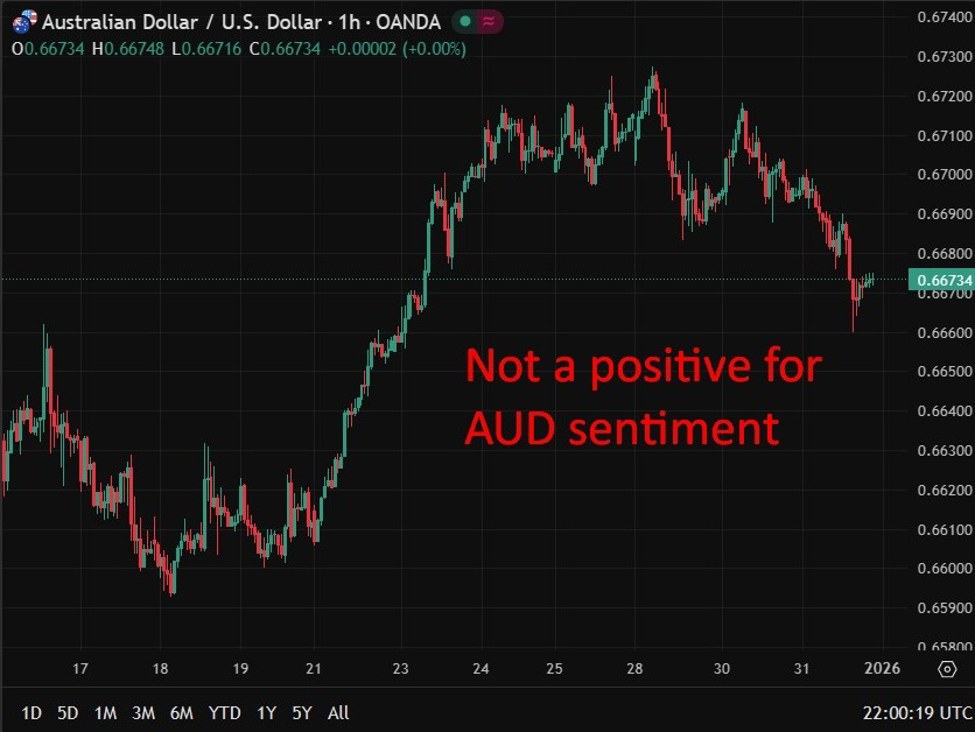
TL;DR summary, and note there is AUD risk in this news:China will impose a 55% tariff on beef imports exceeding newly set quotas from January 1, 2026, under a three-year safeguard regime.The 2026 total import quota is set at 2.7 million tonnes, broadly in line with 2024 imports but below 2025 shipment levels for key suppliers.Brazil and Australia are most affected, with quota caps falling well below their recent export volumes to China.Beijing says the measures are needed to protect the domestic cattle industry, citing damage from rising imports and weak competitiveness.Analysts warn the policy is unlikely to fix structural weaknesses in China’s beef sector and may disrupt global trade flows amid tight supply.Exporters have pushed back, with Australia calling the move disappointing and Brazilian industry groups warning of billions in potential revenue losses.China has announced new safeguard measures on beef imports, imposing a steep 55% tariff on volumes that exceed newly defined country-level quotas, in a move aimed at protecting its domestic cattle industry. The measures will take effect from January 1, 2026, and remain in place for three years, with quotas set to rise modestly each yearUnder the new framework, China has set a total import quota of 2.7 million metric tonnes for 2026, broadly in line with the 2.87 million tonnes imported in 2024 but below shipment levels recorded by several major suppliers during 2025. Brazil and Australia, China’s two largest beef exporters, face quota limits that sit well under their year-to-date shipments, meaning a significant portion of current trade flows could be subject to punitive tariffs.China’s commerce ministry said the surge in imported beef has caused “serious damage” to the domestic industry, following an investigation launched late last year. Officials argue the safeguards will help stabilise breeding-cow inventories and give domestic producers time to restructure, modernise and upgrade operations. Policymakers have already stepped up sector support in 2025, noting cattle farming profitability has improved in recent months.Analysts, however, remain sceptical that tariffs alone can resolve structural challenges. Industry experts point out that China’s beef-cattle sector remains fundamentally uncompetitive relative to producers in Brazil and Argentina, for example, a gap unlikely to be closed quickly through policy or technological change.The decision lands amid a tight global beef market, with supply shortages driving prices to record highs in several regions, including the United States. Exporters have responded cautiously. Australian officials described the move as disappointing, while industry representatives stressed that alternative export destinations remain available. Brazilian authorities struck a more measured tone, signalling potential negotiations with Beijing and an ability to redirect shipments, though domestic lobby groups warned the measures could cost Brazil up to US$3 billion in export revenue in 2026.Overall, the safeguards underscore Beijing’s willingness to prioritise agricultural self-sufficiency, even at the cost of trade friction with key partners. This article was written by Eamonn Sheridan at investinglive.com. 🔗 Source 💡 DMK Insight China’s upcoming 55% tariff on beef imports is a game changer for traders in the agricultural sector. Starting January 1, 2026, this tariff will significantly impact Australian beef exporters, especially with the quota set at 2.7 million tonnes. Traders should be aware that this could lead to increased volatility in the AUD, as beef is a major export. If demand from China drops due to these tariffs, we might see a ripple effect on related commodities and currencies. Keep an eye on the AUD/USD pair; if it breaks below recent support levels, it could signal further weakness. The broader context here is the ongoing trade tensions and how they affect global supply chains. As we approach 2026, monitoring China’s import policies and any potential retaliatory measures will be crucial for positioning. On the flip side, this could open opportunities for other beef-exporting countries to fill the gap left by Australia. Traders should watch for shifts in market sentiment and potential price adjustments in beef futures as the tariff date approaches. 📮 Takeaway Monitor the AUD/USD closely; a break below key support levels could indicate further weakness as the 2026 tariff approaches.