
 Bitcoin
  Ethereum
  Tether
  XRP
XRP  BNB
BNB  USDC
USDC  Solana
  TRON
TRON  Lido Staked Ether
  Figure Heloc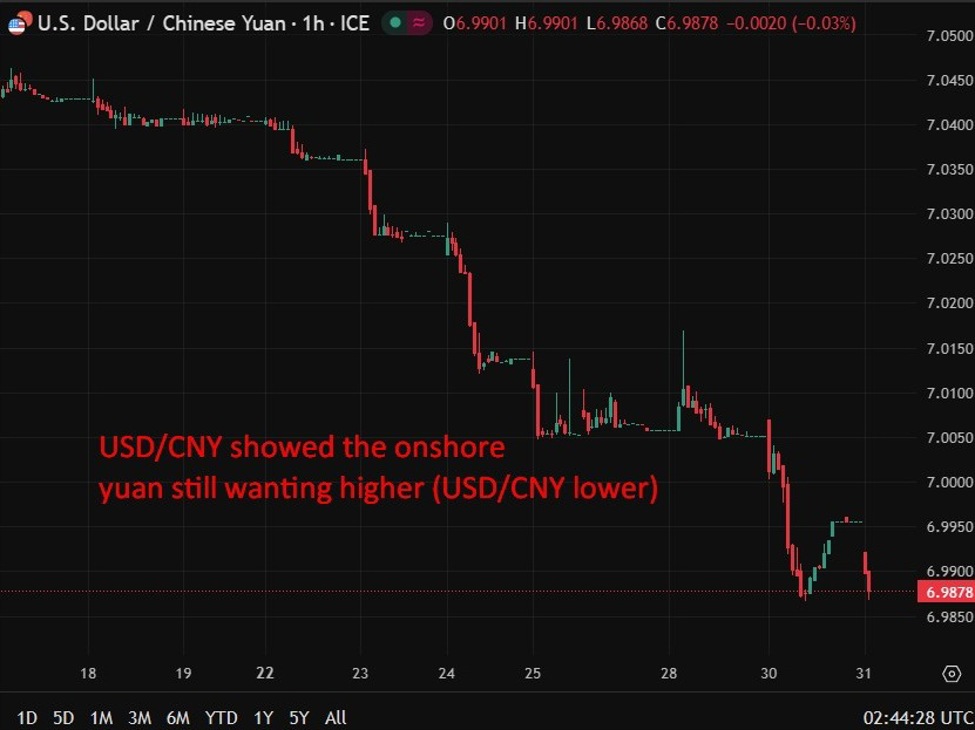
OPEC+ expected to maintain output pause amid growing global oil surplus, January 4 meetingChina S&P Global/Rating Dog December 2025 Manufacturing PMI 50.1 (expect 49.8, prior 49.9)China official December 2025 PMIs: Manufacturing 50.1 (exp 49.2) Non-manu 50.2 (exp 49.8)PBOC sets USD/ CNY reference rate for today at 7.0288 (vs. estimate at 6.9945)China eases property taxes but avoids bold housing stimulus (property downturn drags on)China boosts consumer trade-in subsidies, expands scheme to digital products in 2026ICYMI: FOMC minutes reveal finely balanced rate cut and rising caution on inflation risksOil: Private survey of inventory shows a headline crude oil build less than expectedIt was a relatively subdued New Year’s Eve session across financial markets, with professional participants largely still in holiday mode. Liquidity was thin and price action muted, with most desks effectively waiting for markets to return in earnest from January 5. Despite the quiet backdrop, China delivered a cluster of data points that were notably better than expected and provided a modestly constructive end-of-year signal.China’s official manufacturing sector unexpectedly returned to expansion in December, snapping an eight-month run of contraction. The headline manufacturing PMI rose to 50.1 from 49.2 in November, moving back above the 50 threshold that separates expansion from contraction. The outcome surprised economists, who had expected no change from contracting the prior month, according to a Reuters poll. The rebound came even as factory profits recorded their steepest year-on-year decline in more than a year last month, highlighting the fragile nature of the recovery.Encouragingly, activity in China’s non-manufacturing sector also improved. The non-manufacturing PMI, which captures services and construction, climbed to 50.2 in December from 49.5 previously, following a dip into contraction in November. The composite PMI, combining manufacturing and non-manufacturing activity, rose to 50.7 from 49.7, signalling a broader pickup in overall business conditions. The data were released by the National Bureau of Statistics.The private-sector survey painted a similar, though still cautious, picture. The S&P Global/RatingDog manufacturing PMI edged up to 50.1 from 49.9, pointing to tentative stabilisation in operating conditions. The improvement was driven primarily by firmer domestic demand and new product launches, while export orders remained under pressure amid weak global conditions. Output returned to modest growth, but firms continued to pare back hiring, with employment contracting for a second month. Cost pressures intensified as input prices rose for a sixth consecutive month, yet manufacturers continued to cut selling prices to support sales, keeping margins under strain.Overall sentiment among Chinese manufacturers remained positive heading into 2026, though optimism eased and stayed below historical averages. The data suggest the sector may be finding a floor, but the recovery remains fragile and heavily dependent on sustained domestic demand and ongoing policy support. In chip news, the South China Morning Post reported that ByteDance will splurge US$14 billion into Nvidia chips in 2026, citing computing demand surging. Asia-Pac stocks:Japan (Nikkei 225) -0.37%Hong Kong (Hang Seng) -0.85% Shanghai Composite +0.16%Australia (S&P/ASX 200) -0.1%Have a safe and happy NY eve everyone! This article was written by Eamonn Sheridan at investinglive.com. 🔗 Source 💡 DMK Insight OPEC+ is likely to keep output steady, and here’s why that matters: a growing global oil surplus could pressure prices further. With China’s Manufacturing PMI coming in at 50.1, slightly above expectations, it suggests a stable economic environment, but the overall demand for oil remains uncertain. If OPEC+ maintains its output pause, traders should watch for potential price fluctuations around key levels. A sustained surplus could push crude prices down, impacting related assets like energy stocks and ETFs. Keep an eye on the $70 mark for WTI crude; a break below could trigger further selling pressure. Conversely, if OPEC+ surprises the market with cuts, we could see a sharp rebound. The real story is how these dynamics play out in the coming weeks, especially with the January 4 meeting looming. Traders should monitor any shifts in sentiment from major players in the oil market, as their reactions could create significant volatility. 📮 Takeaway Watch for WTI crude around the $70 level; a break could signal further downside, while unexpected OPEC+ cuts could reverse the trend.

Technology and the Future of Real Estate: How Innovation Is Reshaping the Market in 2025
The real estate market, long seen as one of the most traditional, relationship-driven industries, is undergoing a profound technological transformation. In 2025, this shift isn’t just incremental; it’s structural. New technologies from artificial intelligence (AI) to blockchain and immersive reality tools are changing how properties are marketed, bought, financed, and managed, blurring the line between physical assets and digital innovation. PropTech: More Than Just a BuzzwordAt the heart of this transformation is proptech—a catch-all term for technologies that digitize and automate processes across real estate. Once limited to basic property management software, proptech now spans a broad landscape of tools that touch every part of the property lifecycle. From initial property search and valuation to management and investment, tech is making the industry faster, more efficient, and far more data-driven. Proptech’s growth reflects not just innovation, but a fundamental shift in expectations. Millennial and Gen-Z buyers, who dominate today’s housing demand, expect digital-first experiences: on-demand home tours, instant pricing models, and mobile-optimized platforms. Real estate firms that fail to meet these expectations risk losing market relevance. AI and Machine Learning: From Valuations to Virtual AssistantsAI has arguably emerged as the most influential technology in the real estate sector. Advanced machine learning models now power automated property valuations, helping buyers and investors price homes with unprecedented speed and accuracy. These tools analyze vast datasets, ranging from historical sales to macroeconomic indicators and neighborhood trends, to deliver valuations in seconds that previously took days. Generative AI also plays a growing role in administrative and customer-facing tasks. Chatbots and virtual assistants can handle inquiries, schedule showings, and automate messaging, freeing human agents to focus on high-value relationships. In property management, AI can analyze maintenance schedules and automate routine communications, significantly reducing operational costs. Despite these gains, leaders caution about overreliance on automation. While AI improves efficiency and insight, it can sometimes produce misleading or superficial results, especially in areas like automated media generation where AI may hallucinate features in listings. Maintaining a balance between efficiency and accuracy remains a key challenge as AI adoption accelerates. Blockchain and Tokenization: Redefining InvestmentBlockchain technology is creating entirely new ways to invest in real estate. Tokenization, the process of converting property ownership into digital tokens on a blockchain, could democratize access to real estate investment. Instead of requiring large capital outlays, fractional ownership allows investors to buy and trade shares of properties easily and transparently. In commercial real estate, blockchain can streamline complex transactions, reduce fraud, and automate contract execution through smart contracts. These programmable contracts execute automatically once predefined conditions are met, significantly reducing the need for intermediaries and accelerating closing times. Crowdfunding platforms have already begun leveraging these technologies to bring billions of dollars of new capital into property markets. Major institutional players, such as BlackRock, are exploring tokenized funds, indicating that tokenization is not just a fringe experiment but a mainstream investment evolution. Immersive Tech: Virtual Tours and Digital TwinsIn an era where buyers conduct much of their research online, virtual experiences have become essential. Virtual reality (VR) and augmented reality (AR) allow potential buyers and tenants to tour homes and commercial spaces without stepping inside, a capability that expanded significantly during the pandemic and continues to gain traction. Beyond tours, some developers are creating digital twins, precise 3D digital replicas of buildings that simulate performance, energy use, and occupant experience in real time. These tools help property managers and investors make more informed decisions about renovations, energy efficiency upgrades, and long-term asset planning.Drone technology and high-resolution imaging are also enhancing listing quality and marketing, giving prospective buyers aerial views and context that were once expensive and rare. Investing and Market Intelligence: Data as a Strategic AssetBig data and predictive analytics are transforming how decisions are made in real estate. Platforms that aggregate transaction histories, economic indicators, demographic shifts, and consumer behavior patterns give investors and developers unprecedented clarity about market opportunities and risks. Predictive models anticipate pricing trends and demand shifts, enabling stakeholders to allocate capital more strategically. These analytics are particularly valuable in commercial real estate, where long-term leases and macroeconomic conditions heavily influence performance. The Future Is Hybrid: Human + TechDespite the rapid adoption of technology, real estate remains fundamentally human. Buying or selling a property is one of life’s most significant decisions, and trust, negotiation, and personal relationships still matter. Technology enhances these interactions but doesn’t replace the need for skilled professionals who can interpret data, manage relationships, and guide clients through emotional and financial complexities. In 2025, the most successful real estate firms are those that blend technological prowess with human expertise, leveraging automation and data while maintaining a people-centered approach.ConclusionFrom AI-driven valuations to blockchain-enabled investing, immersive virtual tours, and predictive analytics, technology is not just supporting real estate, it’s redefining it. As proptech continues to mature, both residential and commercial markets will become more efficient, more accessible, and more data-driven. For buyers, sellers, investors, and agents alike, the message is clear: embrace innovation or risk being left behind. This article was written by IL Contributors at investinglive.com. 🔗 Source 💡 DMK Insight The real estate market’s tech transformation is a game changer for traders and investors alike. As AI, blockchain, and immersive reality tools reshape how properties are marketed and financed, savvy traders should pay attention to the ripple effects on related sectors like construction and financial services. This shift could lead to increased efficiency and transparency, potentially driving up property values and altering investment strategies. For instance, blockchain’s ability to streamline transactions might reduce costs and timeframes, making real estate more attractive to institutional investors. But here’s the flip side: traditional players might resist these changes, creating volatility as the market adjusts. Traders should keep an eye on key indicators like transaction volumes and price movements in tech-adopting markets versus those lagging behind. Watch for significant announcements from tech firms entering the real estate space, as these could signal broader market shifts. In the coming months, monitor how these technologies influence property valuations and investor sentiment,

What Is Prop Trading – A Beginner’s Guide to Proprietary Trading
Introduction: What Is Prop Trading?Prop trading, short for proprietary trading, occurs when a financial firm uses its own money to trade in the market instead of using clients’ funds. Instead of making money by charging fees or commissions to customers, these firms aim to make direct profits from their trading activities.For traders, working with a prop firm offers a chance to use larger amounts of money, advanced trading technology, and professional tools that they might not have access to with their personal accounts. In return, the firm retains a share of the earnings, while the trader keeps the remainder.Example: For example, if you have a $100,000 account and make a $10,000 profit in a month with an 80/20 profit-sharing agreement, you keep $8,000 and the firm takes $2,000.Unlike regular investing or trading with personal funds, this trading model requires you to undergo strict evaluations to demonstrate your ability to manage risks effectively. This approach has gained popularity in recent years, particularly with the rise of online trading firms that enable participants from anywhere in the world.How Does Prop Trading Work?This trading model provides individual traders access to a firm’s resources while enforcing strict rules and risk management. The main goal is to make profits for both the trader and the firm. Here’s how it typically works:Evaluation or Challenge Phase: Most online prop firms require traders to pass an evaluation test before they receive funding. This usually involves:Reaching a profit target (for example, 8–10%).Staying within a set limit for maximum losses.Following daily loss and risk management rules.Getting Funded: Once you pass the evaluation, you receive a funded account, which can range from $25,000 to $200,000 or more.Trading the Firm’s Capital: You will trade in markets such as forex, stocks, cryptocurrencies, indices, or commodities. You must follow the firm’s guidelines regarding how much to trade and how much risk to take on.Profit Sharing: You keep a percentage of the profits, which is often between 70% and 90%, while the firm takes the rest.Scaling Up: Many firms reward traders who consistently make profits by increasing the amount of capital they can trade over time.Example: If you start with a $50,000 funded account and make a profit of $5,000 in a month, you would keep $4,000 if the profit-sharing agreement is 80% for you and 20% for the firm.This system benefits both parties: traders can access significant funds without risking their personal money beyond the evaluation fee, and firms earn returns by supporting skilled traders.Types of Prop Trading FirmsNot all trading firms operate in the same manner. Different types of prop trading firms exist based on their structure and business model:Traditional In-House Prop Firms: These are long-standing firms usually located in major financial cities like New York, London, or Chicago. Traders work in the office, using the firm’s resources, and often focus on fast-moving markets like futures, options, or stocks. These firms typically hire experienced traders and may offer salaries plus bonuses based on performance.Online Funded Account Providers: This is the most common model today, allowing traders to join from anywhere in the world. Traders pay a fee to take an evaluation test, and if they succeed, they receive a funded account. This model has opened up prop trading to a much larger audience.Remote Prop Desks: Similar to funded account providers, but with more focus on teamwork. Traders connect through online platforms, share ideas, and sometimes receive mentorship. These firms often provide community features, educational programs, and opportunities to grow.Hybrid Firms: Some firms combine elements of traditional prop trading with online funding models. For instance, they may have a team working in an office while also offering remote funded accounts for traders globally.Tip for beginners: If you’re just starting, remote online prop firms are often the easiest option. They allow you to trade global markets using the firm’s money after proving your skills, without needing to move or invest a lot of your own money.Why Trade With a Prop Firm? (Advantages)This trading style has gained traction because it offers advantages that personal trading accounts may not provide. Here are the main reasons why traders choose prop firms:Access to Larger Capital: Instead of being limited to your own savings, prop firms can offer accounts from $25,000 to over $1,000,000, depending on your performance. This gives you more buying power and the potential for larger profits.Reduced Personal Risk: You are not risking your own money beyond the evaluation fee. The firm covers the losses as long as you follow their rules.Profit Sharing: Most of these firms offer favorable profit splits, often 70/30, 80/20, or 90/10 in favor of the trader. This means you keep most of your earnings.Professional Tools and Platforms: Prop traders usually have access to advanced trading platforms, data feeds, and research tools that can be expensive for individual traders to buy.Training and Mentorship: Some firms offer coaching, strategy reviews, or mentorship from experienced professionals, which can be very helpful for beginners looking to improve quickly.Scaling Opportunities: Firms often increase your account size as you show consistent profits. For example, a $50,000 funded account might grow to $200,000 after you meet certain performance goals.Community and Networking: Remote prop trading firms often have communities where participants can exchange ideas, strategies, and experiences with others from around the world.Example: A beginner trader who saves $2,000 to trade on their own can instead use that money to pay for evaluation fees, pass the challenge, and trade with a $100,000 account something they couldn’t do with personal funds alone.Risks of Prop TradingWhile prop trading offers exciting opportunities, it also comes with real risks that every beginner should be aware of:Evaluation Challenges Are Tough: Most prop firms require individuals to pass strict tests before they get funded. Meeting profit targets while staying within daily loss limits can be challenging, and many traders fail several times before succeeding.Strict Rules and Termination Risk: Even after receiving funding, breaking a firm’s rules like exceeding daily loss limits, using excessive leverage, or holding positions overnight (if not permitted) can result in losing

TRUMP deployer deposits $94M USDC to Coinbase over 3 weeks
Wallets tied to the deployer of the TRUMP memecoin have moved tens of millions of dollars to Coinbase, drawing fresh attention to how liquidity is being unwound. Over the past three weeks, the deployment address behind the TRUMP meme token… 🔗 Source 💡 DMK Insight The recent movement of tens of millions from TRUMP memecoin wallets to Coinbase raises red flags for liquidity and market sentiment. When large amounts of capital are shifted, especially from a memecoin, it often signals a potential sell-off or profit-taking phase. Traders should be wary of the implications this has on the token’s price stability. If the liquidity continues to dwindle, we could see increased volatility, which might attract day traders looking for quick gains but could also deter longer-term investors. Keep an eye on the trading volume and price action over the next few days; a significant drop could trigger a cascading effect, impacting not just TRUMP but other meme tokens and potentially broader crypto sentiment. Here’s the thing: while some might see this as a simple liquidity move, it could also indicate a broader trend of profit-taking in speculative assets. Watch for any sudden price shifts or increased selling pressure, particularly if the price approaches key support levels. 📮 Takeaway Monitor TRUMP’s price action closely; a drop below recent support could signal further sell-offs and increased volatility in the memecoin market.

US prosecutors oppose Defi Education Fund brief ahead of potential MEV case retrial
The possible retrial of two brothers alleged to have exploited the Ethereum blockchain could come soon, but the US government argued one amicus brief isn’t relevant to consider. 🔗 Source 💡 DMK Insight The potential retrial of the brothers accused of exploiting Ethereum could shake trader confidence in the network’s security. With ETH currently at $2,966.33, any negative sentiment stemming from this case might lead to increased volatility. Traders should be aware that legal issues surrounding blockchain technology can impact investor perception and market dynamics. If the retrial garners significant media attention, we might see a dip in ETH as fear takes hold, especially if it leads to broader discussions about regulatory scrutiny. On the flip side, if the outcome is favorable, it could bolster confidence and push ETH higher. Keep an eye on the $3,000 resistance level; a break above could signal renewed bullish momentum, while a drop below $2,900 might trigger selling pressure. Watch for any updates on the trial as they could provide critical insights into market sentiment and trading strategies in the coming weeks. 📮 Takeaway Monitor ETH closely around the $3,000 level; legal outcomes could significantly impact price action in the short term.

RY (Royal Bank of Canada) favors rally to 187.25 or higher
Royal Bank of Canada., (RY) operates as diversified financial service company worldwide. It operates through personal finance, commercial banking, wealth management & Insurance segments. It comes under Financial services sector & trades as “RY” ticker at NYSE. 🔗 Source 💡 DMK Insight So the Royal Bank of Canada is making waves in the financial sector, and here’s why that matters for traders right now: with ADA currently at $0.35, any shifts in traditional banking could impact crypto sentiment. As banks like RY continue to innovate in personal finance and wealth management, they might inadvertently influence the adoption of digital assets. If RY or similar institutions start integrating crypto services, it could legitimize the space further, attracting more institutional money into assets like ADA. But there’s a flip side—if traditional banks tighten regulations or show reluctance towards crypto, it could dampen investor enthusiasm. Traders should keep an eye on RY’s quarterly earnings and any announcements regarding crypto initiatives. These could serve as leading indicators for broader market sentiment. Watch for ADA’s price action around $0.30 and $0.40; breaking below $0.30 could trigger a wave of selling, while a push above $0.40 might attract buyers looking for a bullish trend. Keep your charts ready and monitor RY closely for any clues on how the financial sector views crypto. 📮 Takeaway Watch ADA closely around $0.30 and $0.40; RY’s moves in crypto could signal broader market trends.

SPY confirms Elliott Wave mastery with blue box rally
In this technical blog, we will look at the past performance of the 1-hour Elliott Wave Charts of SPY. We presented to members at the elliottwave-forecast. In which, the rally from the 21 November 2025 low is unfolded as an impulse structure. 🔗 Source 💡 DMK Insight The recent analysis of SPY’s 1-hour Elliott Wave Charts reveals a bullish impulse structure stemming from the November 21, 2025 low, which is crucial for traders to understand current momentum. This pattern suggests that SPY could be in a strong uptrend, and traders should look for confirmation through volume spikes or breakouts above key resistance levels. If SPY maintains this impulse structure, it could lead to further gains, but it’s also essential to monitor for any signs of exhaustion or reversal patterns that might indicate a pullback. Given the broader market context, where volatility is high, this could impact correlated assets like QQQ or IWM, making it vital to keep an eye on their movements as well. Watch for any significant shifts in sentiment or economic indicators that could disrupt this bullish trend. 📮 Takeaway Monitor SPY for breakouts above recent highs to confirm the bullish impulse; watch for volume and sentiment shifts that could signal reversals.

WTI climbs amid geopolitical tensions, API stockpile report eyed
West Texas Intermediate (WTI) US Oil trades around $58.20 on Tuesday at the time of writing, up 0.90% on the day, extending its upward momentum amid persistent geopolitical tensions. 🔗 Source 💡 DMK Insight WTI crude oil’s rise to $58.20 signals a strong reaction to geopolitical tensions, and here’s why that matters: With oil prices climbing 0.90% today, traders should consider the implications of these tensions on supply chains and potential disruptions. The market’s current bullish sentiment could be further fueled if tensions escalate, making it crucial to watch for resistance levels around $60. If WTI breaks through this level, it could trigger a wave of buying, especially from institutional players looking to capitalize on momentum. Conversely, if geopolitical tensions ease, we might see a sharp pullback, so keep an eye on any news developments. Also, don’t overlook correlated assets like energy stocks or ETFs, which often move in tandem with oil prices. Monitoring the daily chart for WTI, a close below $57 could signal a reversal, so traders should be prepared for volatility. The real story is how these geopolitical factors can shift market sentiment quickly, making timing essential for your trades. 📮 Takeaway Watch for WTI to test $60; a breakout could lead to significant buying, while a drop below $57 may indicate a reversal.

Q1 2026 equity outlook: Trends intact, sensitivity rising
Q1 2026 sits at a point in the market cycle where many of the obvious questions have already been answered. Inflation is no longer accelerating, the Federal Reserve is no longer tightening aggressively, and recession fears that dominated prior years have eased. 🔗 Source 💡 DMK Insight With inflation stabilizing and the Fed easing its tightening, Q1 2026 could be a turning point for traders. The current market sentiment suggests a shift towards risk-on assets, as recession fears fade. This environment may favor equities and cryptocurrencies, which often thrive when liquidity is more abundant. Traders should keep an eye on key technical levels in these markets; for instance, if major indices break above resistance levels, it could trigger further buying momentum. Conversely, if any unexpected economic data emerges, it could lead to volatility, so being prepared for quick adjustments is crucial. But don’t overlook the potential for a contrarian play. If the market gets too complacent, a sudden shift in economic indicators could catch many off guard. Watch for any signs of renewed inflationary pressures or Fed commentary that hints at a change in policy direction. Keeping tabs on the 10-year Treasury yield could also provide insights into market sentiment and risk appetite moving forward. 📮 Takeaway Monitor key resistance levels in equities and crypto as Q1 2026 unfolds, and stay alert for any unexpected economic data that could trigger volatility.

United States Redbook Index (YoY) increased to 7.6% in December 26 from previous 7.2%
United States Redbook Index (YoY) increased to 7.6% in December 26 from previous 7.2% 🔗 Source 💡 DMK Insight The Redbook Index’s jump to 7.6% YoY is a signal for traders: consumer spending is holding strong. This uptick suggests that retail sales may remain robust, which could influence the Federal Reserve’s stance on interest rates. If consumer spending continues to rise, it might lead to tighter monetary policy sooner than expected, impacting both forex and crypto markets. Traders should keep an eye on related assets like retail stocks and the USD, as they could react sharply to any shifts in Fed policy. Watch for key resistance levels in the USD against major pairs, especially if economic data continues to support a hawkish outlook. On the flip side, while this data is positive, it’s worth questioning whether it can sustain momentum amid potential economic headwinds. If inflation pressures persist, consumer confidence could wane, leading to volatility in the markets. Keep an eye on the next retail sales report for further confirmation of this trend. 📮 Takeaway Monitor the USD’s performance against major pairs as the Redbook Index suggests strong consumer spending; watch for resistance levels that could indicate shifts in Fed policy.