
 Bitcoin
  Ethereum
  Tether
  XRP
XRP  BNB
BNB  USDC
USDC  Solana
  TRON
TRON  Lido Staked Ether
  Figure Heloc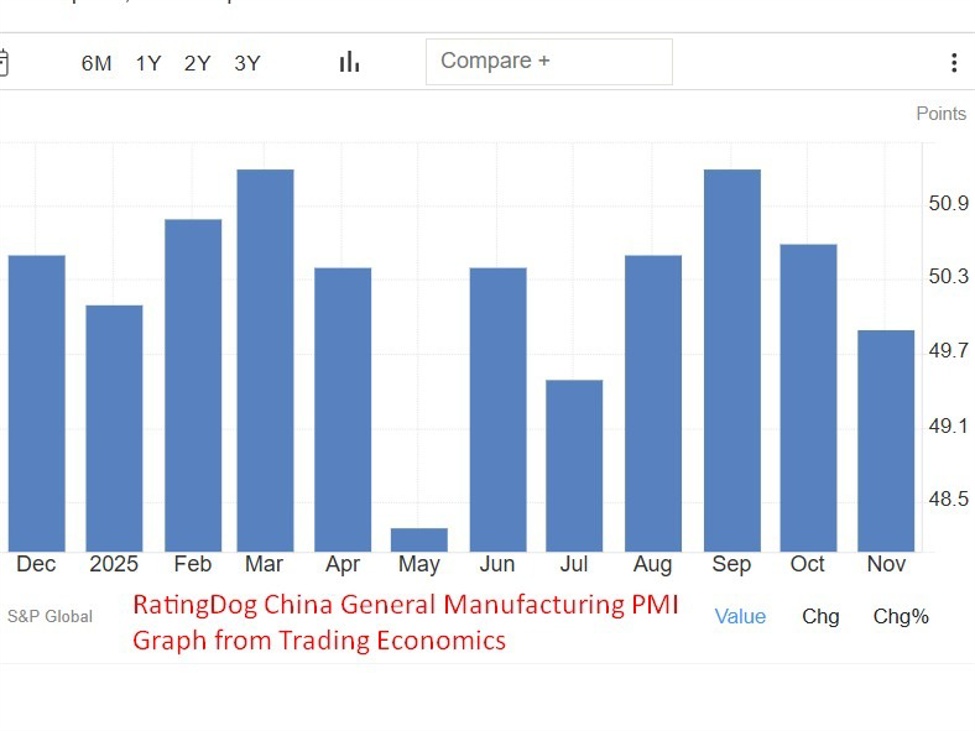
China is set to publish a fresh round of Purchasing Managers’ Index (PMI) data later today, Wednesday, December 31, offering another timely snapshot of economic momentum at the end of a difficult year for the world’s second-largest economy. China publishes two main PMI surveys, each capturing different parts of the industrial landscape. The official PMI is compiled by the National Bureau of Statistics and focuses primarily on large, state-owned and government-linked enterprises. Alongside this, the private-sector PMI, produced by S&P Global / RatingDog, places greater emphasis on small and medium-sized enterprises, making it a closely watched gauge of conditions in China’s private economy.The distinction matters. While the official PMI tends to reflect conditions among larger firms with better access to credit and policy support, the private-sector survey is often seen as more sensitive to shifts in domestic demand, pricing power and employment conditions. Methodological differences also play a role, with the Caixin/RatingDog survey drawing from a broader and more diverse sample of companies. Despite these contrasts, the two PMIs often move in the same direction, offering complementary signals on the health of China’s manufacturing sector.Today’s release includes the official manufacturing and non-manufacturing PMIs, alongside the private-sector manufacturing PMI. Economists surveyed by Reuters expect China’s official manufacturing PMI to remain at 49.2 in December, unchanged from November and firmly below the 50 threshold that separates expansion from contraction. If confirmed, it would mark a ninth consecutive month of contraction in factory activity.Persistent weakness reflects a combination of subdued domestic demand, falling industrial profits and ongoing uncertainty around global trade. Chinese manufacturers continue to face the lingering effects of high U.S. tariffs, even as they attempt to diversify export markets. A broader global slowdown has also weighed on orders, complicating Beijing’s efforts to rebalance the economy away from heavy reliance on exports and investment.Separate data released over the weekend showed China’s industrial profits falling 13.1% year-on-year in November, the sharpest decline in more than a year, underlining the pressure on the manufacturing sector. Against that backdrop, analysts expect the private-sector PMI to edge down to 49.8 from 49.9 previously, remaining in contractionary territory.Taken together, today’s PMI readings are likely to reinforce expectations for further policy support in 2026, as Chinese authorities seek to stabilise growth, shore up confidence and arrest the slide in industrial activity heading into the new year. Markets are likely to view another sub-50 PMI print as reinforcing the narrative of persistent slack in China’s industrial cycle, with limited immediate upside for risk assets. Chinese equities and broader Asia-Pacific markets may struggle to find traction, while base metals could remain capped on concerns around weak end-demand. In FX, the data should keep the yuan biased to the downside at the margin, particularly if the private-sector PMI confirms ongoing stress among smaller firms. From a policy perspective, soft PMIs strengthen expectations for additional targeted stimulus in early 2026, including fiscal support and incremental monetary easing, which may limit downside risk over the medium term. For global markets, weak China data is likely to reinforce disinflationary impulses, supporting bonds and keeping a lid on global yields, while offering modest support to the US dollar against cyclical and commodity-linked currencies. This article was written by Eamonn Sheridan at investinglive.com. 🔗 Source 💡 DMK Insight China’s upcoming PMI data could shake up markets—here’s what to watch for: As traders gear up for the release, keep in mind that PMI figures are crucial indicators of economic health. A strong PMI could signal recovery, potentially boosting commodities and risk assets, while a weak reading might reignite fears of a slowdown, impacting global markets. Given the current economic backdrop, where inflation and interest rate policies are in flux, the PMI could influence central bank strategies worldwide. Watch for any surprises that could lead to volatility in the forex markets, particularly with USD/CNY and commodity currencies like AUD. But here’s the flip side: if the data comes in weaker than expected, it could trigger a flight to safety, benefiting the USD and gold. Traders should monitor the 50-level on the PMI, as readings above indicate expansion and below suggest contraction. This data release is a key event to watch, especially with the year-end positioning in play, which could amplify market reactions. 📮 Takeaway Keep an eye on the PMI release today; a reading above 50 could boost risk assets, while below 50 may trigger a flight to safety.
Oil: Private survey of inventory shows a headline crude oil build less than expected
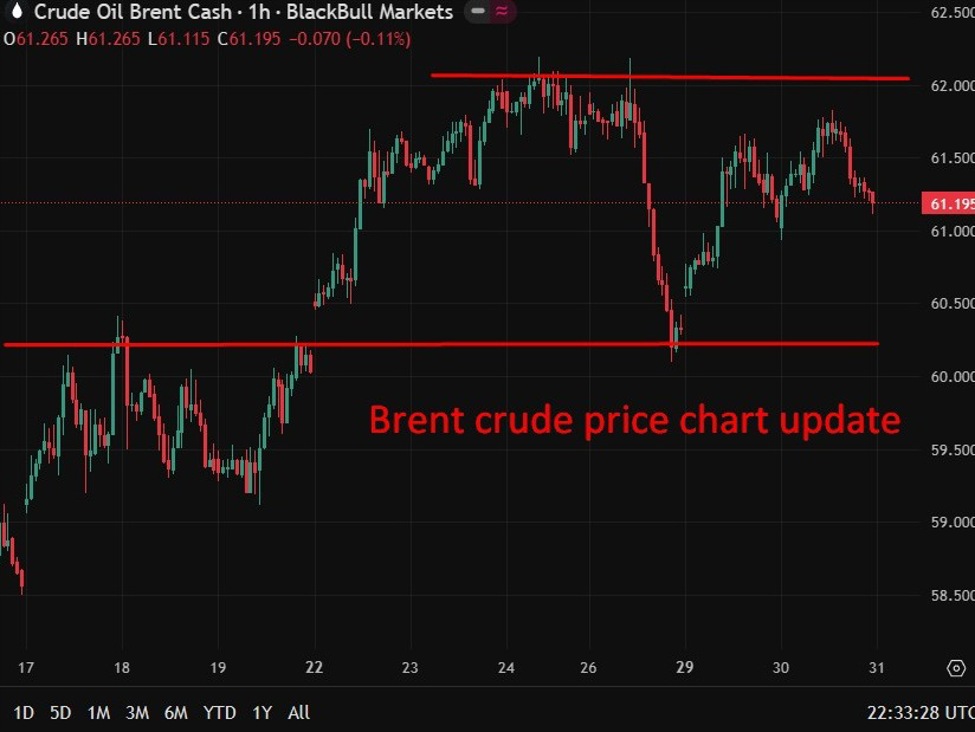
Via oilprice.com:While the headline and distillates showed smaller builds than expected the gasoline build was much greater. –Expectations I had seen centred on:Headline crude +2.39 mn barrelsDistillates +1.75 mn bblsGasoline +1.55 mn—This data point is from a privately-conducted survey by the American Petroleum Institute (API).It’s a survey of oil storage facilities and companiesThe official government inventory report is due Wednesday morning US time.The two reports are quite different.The official government data comes from the US Energy Information Administration (EIA)Its based on data from the Department of Energy and other government agenciesWhereas information on total crude oil storage levels and variations from the previous week’s levels are both provided by the API report, the EIA report also provides statistics on inputs and outputs from refineries, as well as other significant indicators of the status of the oil market, and storage levels for various grades of crude oil, such as light, medium, and heavy.the EIA report is held to be more accurate and comprehensive than the survey from the API— There are plenty of moving parts in oil markets right now, including a resurfacing of tensions amongst ostensible close allies:Oil traders note – Saudi airstrikes in Yemen expose escalating tensions with UAEFrom yesterday:Saudi Arabia said it carried out strikes targeting weapons depots linked to the Southern Transitional Council (STC), a UAE-backed southern separatist faction seeking to restore an independent South Yemen along pre-1990 borders. According to Saudi officials, the weapons were delivered via two ships from Fujairah port in UAE, a claim that sharply escalates the political significance of the operation. Any visible rupture between Riyadh and Abu Dhabi introduces a new layer of uncertainty for energy markets. Both countries sit at the heart of global oil supply chains, and rising intra-Gulf tensions risk inflating geopolitical risk premiums, particularly if disputes spill into maritime chokepoints or shipping logistics.For now, the confrontation remains indirect. This article was written by Eamonn Sheridan at investinglive.com. 🔗 Source 💡 DMK Insight Gasoline inventories are rising faster than expected, and here’s why that matters: The recent API report shows a significant gasoline build of 1.55 million barrels, which is well above market expectations. This could indicate weaker demand or oversupply in the gasoline market, potentially leading to downward pressure on crude oil prices. Traders should keep an eye on how this impacts correlated assets like SOL, currently at $126.13, as energy prices often influence broader market sentiment. If crude prices start to drop due to these inventory builds, we might see a ripple effect across various sectors, including cryptocurrencies, as risk appetite shifts. On the flip side, if gasoline demand rebounds unexpectedly, it could stabilize crude prices and support SOL. Watch for key levels in crude oil; a break below recent support could trigger further selling pressure. Keep an eye on the upcoming EIA report for confirmation of these trends, as it could provide more clarity on market direction. 📮 Takeaway Monitor crude oil’s support levels closely; a break could impact SOL’s price action significantly in the coming days.
ICYMI: FOMC minutes reveal finely balanced rate cut and rising caution on inflation risks
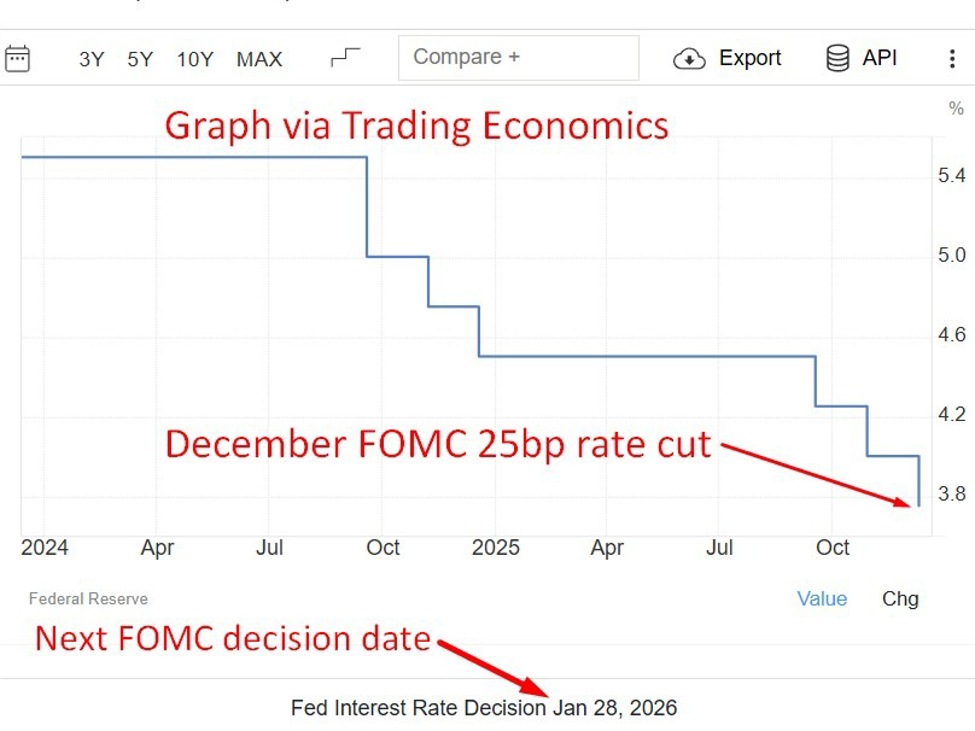
Summary: The December meeting minutes from the Federal Open Market Committee reveal a finely balanced debate over the decision to cut interest rates, with policymakers divided between growing labour-market risks and lingering concerns over inflation credibility. While most participants see scope for further easing if disinflation resumes, several warned against moving too quickly while inflation remains above target.—Minutes from the Federal Reserve’s December policy meeting, released on December 30, show a central bank increasingly split between supporting a softening labour market and preserving confidence in its inflation-fighting credentials.Several participants who ultimately supported lowering the federal funds rate said the decision was “finely balanced,” noting they could have supported leaving rates unchanged. Some policymakers preferred holding steady to gain greater confidence that inflation is returning to the Fed’s 2% target, while one participant (political appointee Miran) favoured a larger 50-basis-point reduction. Those backing the cut judged that downside risks to employment had increased, while upside inflation risks appeared to be easing.Most participants supported lowering the target range to 3.50%–3.75%, and judged that further rate cuts would likely be appropriate if inflation continued to decline broadly in line with expectations. However, two(Goolsbee and Schmid dissented in favour of no rate cut) argued for keeping rates unchanged for a period following the December move, in order to assess the lagged effects of recent policy easing as the Fed shifts toward a more neutral stance.Inflation remained a key source of caution. Participants noted that price pressures had risen through September and remained above target, with core services inflation easing but core goods inflation picking up, a development staff largely attributed to higher tariffs. While many expected near-term inflation to remain elevated before gradually returning to 2% as tariff effects faded, several warned that cutting rates too aggressively could risk inflation becoming entrenched or be misinterpreted as weakening the Fed’s commitment to its target.On the labour market, most participants observed continued softening, with hiring subdued and unemployment edging higher. Labour-market risks were broadly seen as tilted to the downside, particularly for cyclically sensitive groups, even as overall economic activity was judged to be expanding at a moderate pace. Consumption remained supported by higher-income households, while lower-income spending was more muted. Many participants expect growth to pick up in 2026 and run near potential over the medium term, albeit with elevated uncertainty.The minutes also highlighted technical discussions around balance-sheet policy, with agreement that reserves have declined to ample levels and that reserve-management purchases may soon be warranted to maintain smooth money-market functioning. This article was written by Eamonn Sheridan at investinglive.com. 🔗 Source 💡 DMK Insight The Fed’s December meeting minutes highlight a critical tug-of-war between inflation concerns and labor market risks, and here’s why that matters for traders right now: Policymakers are clearly divided, which suggests that any future rate cuts could be more data-dependent than previously thought. If disinflation trends continue, we might see a shift towards easing, but the warning signs from those concerned about inflation could keep the Fed on a cautious path. This uncertainty can lead to increased volatility in both the forex and crypto markets, particularly for assets sensitive to interest rate changes. Traders should keep an eye on economic indicators like employment data and inflation reports, as these will likely dictate the Fed’s next moves. On the flip side, if inflation shows signs of stability, the market might react positively, pushing equities and risk assets higher. Watch for key levels in the S&P 500 and major currency pairs like EUR/USD, as these could signal broader market sentiment shifts. The next few weeks will be crucial, so stay alert for any economic data releases that could sway the Fed’s stance. 📮 Takeaway Monitor upcoming employment and inflation data closely; they could dictate the Fed’s next move and impact market volatility significantly.
China boosts consumer trade-in subsidies, expands scheme to digital products in 2026
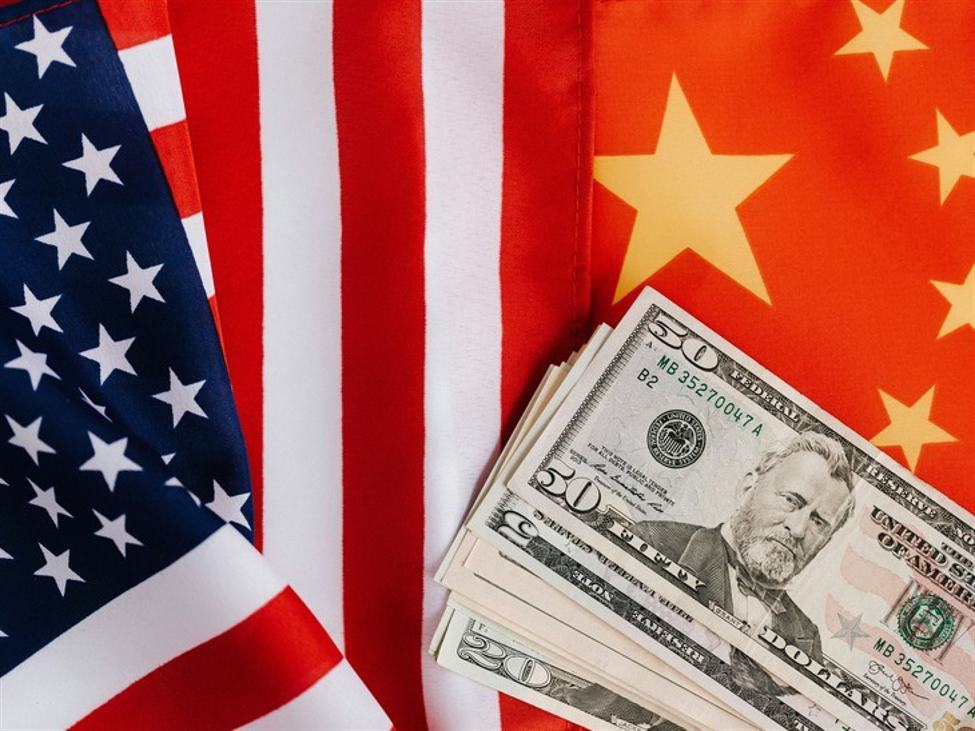
TL;DR summary:China is stepping up efforts to revive household spending, allocating fresh funding from ultra-long special treasury bonds to expand its consumer trade-in subsidy scheme. The programme, first launched in 2024, will be broadened in 2026 to include digital and smart products, as policymakers look to counter weak growth momentum and rebalance the economy toward consumption. Even more summarised:LOL, this is a drop in the ocean ;-)—China will initially allocate 62.5 billion yuan (around US$11.5 billion) from ultra-long special treasury bond funds this year to support its consumer subsidy programme, according to a report by Chinese state media outlet Xinhua. The scheme offers financial incentives for households to replace older consumer goods, forming part of Beijing’s broader push to shore up domestic demand amid persistent economic and trade headwinds.Launched in 2024, the programme provides subsidies when consumers replace ageing home appliances, bicycles and vehicles. Authorities are now preparing to expand its scope further in 2026, with digital and smart products set to be included for the first time. Under the new plan, consumers purchasing smartphones, tablets, smartwatches and smart wristbands will qualify for a 15% rebate, capped at 500 yuan per item, according to a joint statement from China’s state planner and finance ministry.While the total size of the 2026 funding envelope has not yet been disclosed, China has already earmarked 300 billion yuan in special treasury bonds this year, with funds to be released in batches. Of that amount, 62.5 billion yuan will be deployed initially to support the trade-in programme.The scheme also continues to target big-ticket household and vehicle purchases. Consumers buying any of six major categories of home appliances, including refrigerators, washing machines and televisions, are eligible for subsidies of up to 15% of the purchase price, capped at 1,500 yuan per item. In the auto sector, buyers scrapping older vehicles receive subsidies equivalent to 12% of the purchase price of new energy vehicles (NEVs), capped at 20,000 yuan. Those replacing older cars with new NEVs without scrappage qualify for subsidies of up to 8%, capped at 15,000 yuan.The expanded incentives come as China’s economy showed renewed signs of strain in November, with factory output growing at its slowest pace in 15 months and retail sales recording their weakest performance since the lifting of zero-Covid restrictions. The data underline the urgency for Beijing to cultivate new growth drivers as it heads into 2026.Chinese leaders have pledged to significantly raise the share of household consumption over the next five years. Consumption currently accounts for around 40% of gross domestic product, well below levels seen in advanced economies such as the United States. Some government advisers have called for stronger policy support for services spending and argue the consumption share should be lifted to around 45% over the medium term. —Note, coming up from China today (preview): China PMIs for December This article was written by Eamonn Sheridan at investinglive.com. 🔗 Source 💡 DMK Insight China’s push to boost household spending is a game changer for global markets. By allocating funds from ultra-long special treasury bonds to enhance its consumer trade-in subsidy scheme, China is signaling a serious commitment to reviving its economy. This move, which expands the program to include digital and smart products by 2026, could lead to increased consumer confidence and spending. For traders, this is crucial as it may impact commodity prices, particularly in sectors like electronics and automotive, which are directly tied to consumer spending. Watch for potential ripple effects on related markets, such as tech stocks and commodities like copper and lithium, which are essential for manufacturing. However, there’s a flip side. If this initiative fails to stimulate the desired growth, it could lead to increased volatility in the yuan and related forex pairs. Traders should keep an eye on the Chinese economic indicators, especially retail sales and manufacturing PMI, as these will provide insight into the effectiveness of these measures. The immediate focus should be on how these policies unfold in the coming months, particularly as we approach key economic reporting dates. 📮 Takeaway Monitor China’s retail sales and manufacturing PMI closely; a failure to boost spending could trigger volatility in the yuan and related forex pairs.
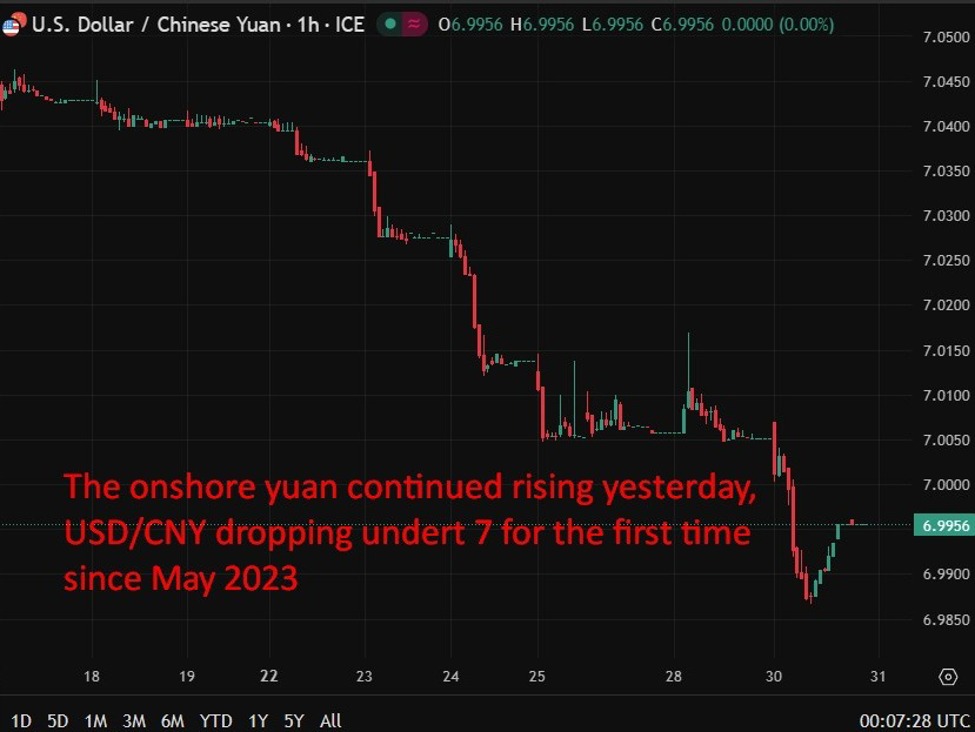
PBOC is expected to set the USD/CNY reference rate at 6.9945 – Reuters estimate
The People’s Bank of China is due to set the daily USD/CNY reference rate at around 0115 GMT (2115 US Eastern time), a fixing that remains one of the most closely watched signals in Asian foreign exchange markets. China operates a managed floating exchange rate system, under which the renminbi (yuan) is allowed to trade within a prescribed band around a central reference rate, or midpoint, set each trading day by the PBOC. The current trading band permits the currency to move plus or minus 2% from the official midpoint during onshore trading hours. Each morning, the PBOC determines the midpoint based on a range of inputs. These include the previous day’s closing price, movements in major currencies, particularly the US dollar, broader international FX conditions, and domestic economic considerations such as capital flows, growth momentum and financial stability objectives. The midpoint is not a purely mechanical calculation, allowing policymakers discretion to guide market expectations. Once the midpoint is announced, onshore USD/CNY is free to trade within the allowable band. If market pressures push the yuan toward either edge of that range, the central bank may step in to smooth volatility. Intervention can take the form of direct buying or selling of yuan, adjustments to liquidity conditions, or guidance through state-owned banks. As a result, the daily fixing is often interpreted as a policy signal rather than just a technical reference point. A stronger-than-expected CNY midpoint is typically read as a sign the PBOC is leaning against depreciation pressure, while a weaker fixing for the CNY can indicate tolerance for a softer currency, often in response to dollar strength or domestic economic headwinds.In periods of heightened global volatility, such as shifts in US rate expectations, trade tensions or capital flow pressures, the fixing takes on added significance. For investors, it provides insight into Beijing’s currency priorities, balancing competitiveness, capital stability and financial market confidence. This article was written by Eamonn Sheridan at investinglive.com. 🔗 Source 💡 DMK Insight The upcoming USD/CNY reference rate setting is crucial for traders navigating the Asian forex markets. With the People’s Bank of China (PBOC) influencing the renminbi’s value through its managed floating exchange rate system, fluctuations in this rate can signal broader economic trends. Traders should be on alert for any deviations from expected levels, as these can lead to volatility not just in the CNY, but also in correlated assets like commodities and equities. If the PBOC sets a weaker reference rate, it could trigger risk-off sentiment, impacting global markets. Conversely, a stronger rate might bolster confidence in the Chinese economy, affecting trade flows and investment decisions. Watch for the reference rate announcement around 0115 GMT, as it could set the tone for trading in the Asian session and beyond. 📮 Takeaway Keep an eye on the USD/CNY reference rate set for 0115 GMT; deviations could spark significant market movements.

China eases property taxes but avoids bold housing stimulus (property downturn drags on)
TL;DR summary:China is extending a value-added tax (VAT) exemption on certain residential property sales, adding another incremental policy measure aimed at stabilising its long-running real estate downturn. While the move lowers transaction costs for homeowners, it underscores Beijing’s preference for targeted relief rather than more forceful intervention.—China will extend a policy waiving value-added tax on selected home sales, as authorities continue to search for ways to ease the country’s persistent property slump without deploying more aggressive stimulus measures.Under the policy, individuals selling residential properties they have owned for at least two years will remain exempt from paying VAT, according to a statement from the Ministry of Finance issued on Tuesday. The exemption will take effect from Friday, 2 January 2026. Homes sold within two years of purchase will continue to attract a VAT charge of 3%.The extension marks a modest but symbolically important easing compared with previous rules in some major cities. In markets such as Shanghai, sellers of homes held for less than two years were previously subject to VAT rates as high as 5%. Many of China’s largest cities had already rolled out VAT exemptions in late 2024, but the latest move formalises and extends the policy at a national level.The measure comes against the backdrop of a prolonged real estate crisis that has weighed heavily on economic growth, local government finances and household confidence. China’s once-dominant property sector has been hit by falling home sales, weak buyer sentiment and tightening developer liquidity, leading to the collapse or restructuring of several major firms, including China Evergrande Group. Even China Vanke Co, long viewed as one of the sector’s most resilient players, has come under mounting pressure amid rising debt concerns and declining home prices.Official data showed that home prices in China recorded their steepest year-on-year decline in more than a year, underscoring the depth of the downturn. The property sector’s weakness continues to drag on consumer sentiment and investment, complicating Beijing’s efforts to stabilise growth as the economy slows.Chinese leaders have pledged to increase policy support for the housing market following a key economic meeting this month. Measures under discussion include encouraging government purchases of existing housing stock, particularly for conversion into affordable housing. However, policymakers have so far stopped short of adopting the more forceful steps some economists argue are necessary, such as direct cash subsidies for homebuyers or large-scale government investment to clear excess inventory.As a result, the VAT exemption extension is likely to be seen as another incremental step rather than a decisive turning point. While it reduces transaction costs and may help unlock some pent-up supply, analysts caution that restoring confidence in the housing market will require broader measures to address weak demand, developer balance sheets and expectations around falling prices. This article was written by Eamonn Sheridan at investinglive.com. 🔗 Source 💡 DMK Insight China’s VAT exemption on residential property sales is a small step, but it signals deeper issues in the real estate market. For traders, this policy reflects Beijing’s cautious approach to economic stabilization, opting for targeted measures instead of sweeping reforms. This could mean ongoing volatility in related markets, particularly in commodities linked to construction and housing. If you’re trading in sectors like steel or cement, keep an eye on how these policies affect demand. Watch for any shifts in property sales data over the coming months, as that could provide insights into the effectiveness of these measures. The real story is whether this will be enough to turn the tide in a market that’s been struggling for years. On the flip side, if these incremental changes fail to stimulate the market, we might see a more significant downturn, impacting not just real estate but also broader economic indicators. Traders should monitor key economic releases from China, especially housing market metrics, to gauge the potential ripple effects on global markets. 📮 Takeaway Keep an eye on China’s housing market data in the coming months; any signs of recovery could impact related commodities significantly.
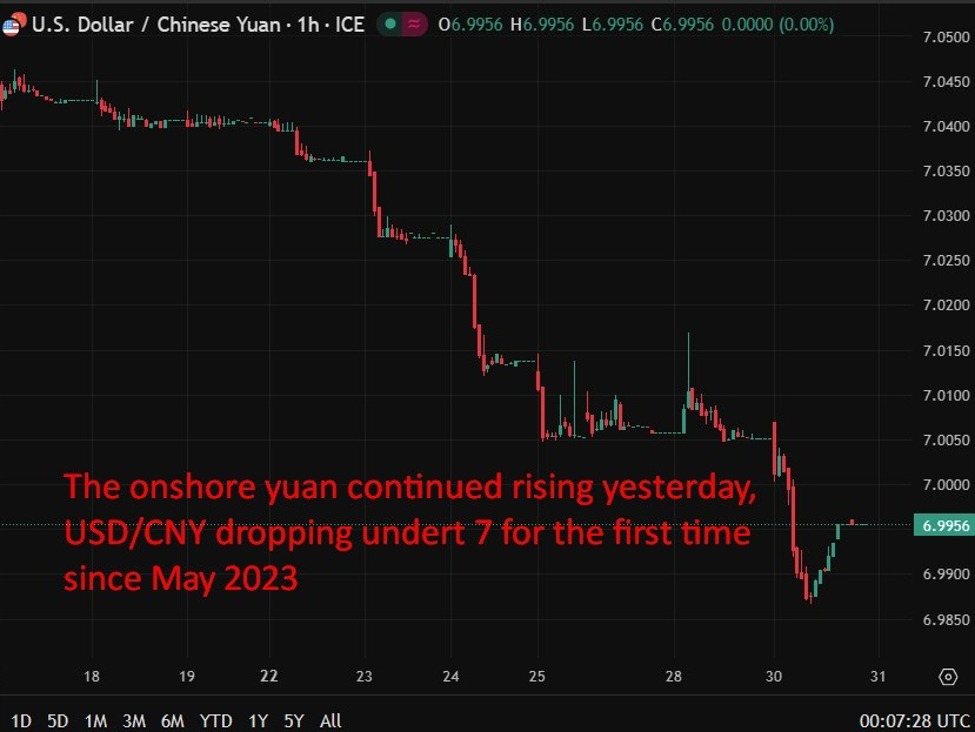
PBOC sets USD/ CNY reference rate for today at 7.0288 (vs. estimate at 6.9945)
The People’s Bank of China (PBOC), China’s central bank, is responsible for setting the daily midpoint of the yuan (also known as renminbi or RMB). The PBOC follows a managed floating exchange rate system that allows the value of the yuan to fluctuate within a certain range, called a “band,” around a central reference rate, or “midpoint.” It’s currently at +/- 2%.The previous close was 6.9940.People’s Bank of China injects 528.8bn yuan via 7-day reverse repos in open market operations, rate remains 1.4%.—Earlier:PBOC is expected to set the USD/CNY reference rate at 6.9945 – Reuters estimateThe daily fixing of this mid-rate is often interpreted as a policy signal rather than just a technical reference point. A higher-than-expected USD/CNY midpoint is typically read as a sign the PBOC is leaning against CNY appreciation pressure, like today. In recent months, the People’s Bank of China has taken deliberate steps to moderate the speed of appreciation in the onshore yuan, signalling a preference for stability over sharp currency gains. Rather than targeting a specific level, policymakers appear focused on preventing an overly rapid rise in CNY that could disrupt trade, capital flows and domestic financial conditions. Yesterday USD/CNY fell below 7.0 for the first time since May 2023. The PBoC is slowing the appreciation of the yuan, but hasn’t stopped it. —Piecemeal stimulus steps continue from China:China eases property taxes but avoids bold housing stimulus (property downturn drags on)China is extending a value-added tax (VAT) exemption on certain residential property sales, adding another incremental policy measure aimed at stabilising its long-running real estate downturn. While the move lowers transaction costs for homeowners, it underscores Beijing’s preference for targeted relief rather than more forceful intervention.China boosts consumer trade-in subsidies, expands scheme to digital products in 2026China is stepping up efforts to revive household spending, allocating fresh funding from ultra-long special treasury bonds to expand its consumer trade-in subsidy scheme. The programme, first launched in 2024, will be broadened in 2026 to include digital and smart products, as policymakers look to counter weak growth momentum and rebalance the economy toward consumption.—Still to come (very soon!)Economic and event calendar in Asia Wednesday, December 31, 2025 – China PMIs for December This article was written by Eamonn Sheridan at investinglive.com. 🔗 Source 💡 DMK Insight The PBOC’s management of the yuan’s midpoint is crucial for traders navigating the forex market right now. With the yuan’s value fluctuating within a set band, any significant adjustments by the PBOC can create volatility not just in the yuan but also in correlated currencies like the USD and JPY. Traders should be particularly alert to any announcements or policy shifts from the PBOC, as these could signal changes in China’s economic stance or influence global trade dynamics. If the yuan weakens significantly, it could lead to a ripple effect, impacting commodities priced in dollars and potentially altering the risk appetite among investors. Keep an eye on the daily midpoint adjustments and any related economic indicators from China, as they could provide actionable insights for short-term trading strategies, especially for those focused on forex pairs involving the yuan. Also, consider the broader implications for emerging market currencies, which often react to shifts in the yuan. If you’re trading in this space, monitor the 7.0 level against the USD as a psychological barrier that could trigger more aggressive moves in either direction. 📮 Takeaway Watch for PBOC announcements and the yuan’s midpoint adjustments, especially around the 7.0 level against the USD, to gauge potential market volatility.

China official December 2025 PMIs: Manufacturing 50.1 (exp 49.2) Non-manu 50.2 (exp 49.8)
Data released by China’s National Bureau of Statistics (NBS) for the official manufacturing and non-manufacturing PMIs in December 2025. -The screenshot adds in the priors, not mentioned in the text.The screenshot does not show the ‘Composite’ which has come in at 50.7, up from 49.7 in November. -China publishes two main PMI surveys, each capturing different parts of the industrial landscape. The official PMI is compiled by the National Bureau of Statistics and focuses primarily on large, state-owned and government-linked enterprises. Alongside this, the private-sector PMI, produced by S&P Global / RatingDog, places greater emphasis on small and medium-sized enterprises, making it a closely watched gauge of conditions in China’s private economy. The RatingDog PMI is due at 0145 GMT. The distinction matters. While the official PMI tends to reflect conditions among larger firms with better access to credit and policy support, the private-sector survey is often seen as more sensitive to shifts in domestic demand, pricing power and employment conditions. Methodological differences also play a role, with the Caixin/RatingDog survey drawing from a broader and more diverse sample of companies. Despite these contrasts, the two PMIs often move in the same direction, offering complementary signals on the health of China’s manufacturing sector.This release includes the official manufacturing and non-manufacturing PMIs, alongside the private-sector manufacturing PMI.Taken together, today’s PMI readings are likely to reinforce expectations for further policy support in 2026, as Chinese authorities seek to stabilise growth, shore up confidence and arrest the slide in industrial activity heading into the new year.Markets are likely to view the PMI prints as encouraging, but as still reinforcing the narrative of persistent slack in China’s industrial cycle, with limited immediate upside for risk assets. Chinese equities and broader Asia-Pacific markets may struggle to find traction, while base metals could remain capped on concerns around weak end-demand. In FX, the data should keep the yuan biased to the downside at the margin, particularly if the private-sector PMI confirms ongoing stress among smaller firms. From a policy perspective, soft PMIs strengthen expectations for additional targeted stimulus in early 2026, including fiscal support and incremental monetary easing, which may limit downside risk over the medium term. For global markets, weak China data is likely to reinforce disinflationary impulses, supporting bonds and keeping a lid on global yields, while offering modest support to the US dollar against cyclical and commodity-linked currencies. This article was written by Eamonn Sheridan at investinglive.com. 🔗 Source 💡 DMK Insight China’s December PMI data shows a rebound, with the Composite PMI rising to 50.7 from 49.7, signaling a potential recovery in economic activity. This uptick is crucial as it suggests that manufacturing and services are gaining momentum, which could influence global market sentiment, especially in commodities and currencies linked to China. Traders should note that a Composite PMI above 50 indicates expansion, which might lead to increased demand for raw materials and could boost commodity prices. However, it’s worth considering that while this data is positive, it might not reflect the entire economic picture. Other factors like ongoing geopolitical tensions and domestic policy shifts could dampen this optimism. Additionally, if the market overreacts to this news, we could see a pullback in related assets, particularly if the anticipated growth doesn’t materialize. Keep an eye on the 50.0 level as a psychological barrier for the Composite PMI, and monitor how this data influences the Chinese yuan and commodities like copper and oil in the coming weeks. 📮 Takeaway Watch for how the Composite PMI’s rise impacts commodity prices and the yuan; a sustained move above 50 could signal stronger demand.
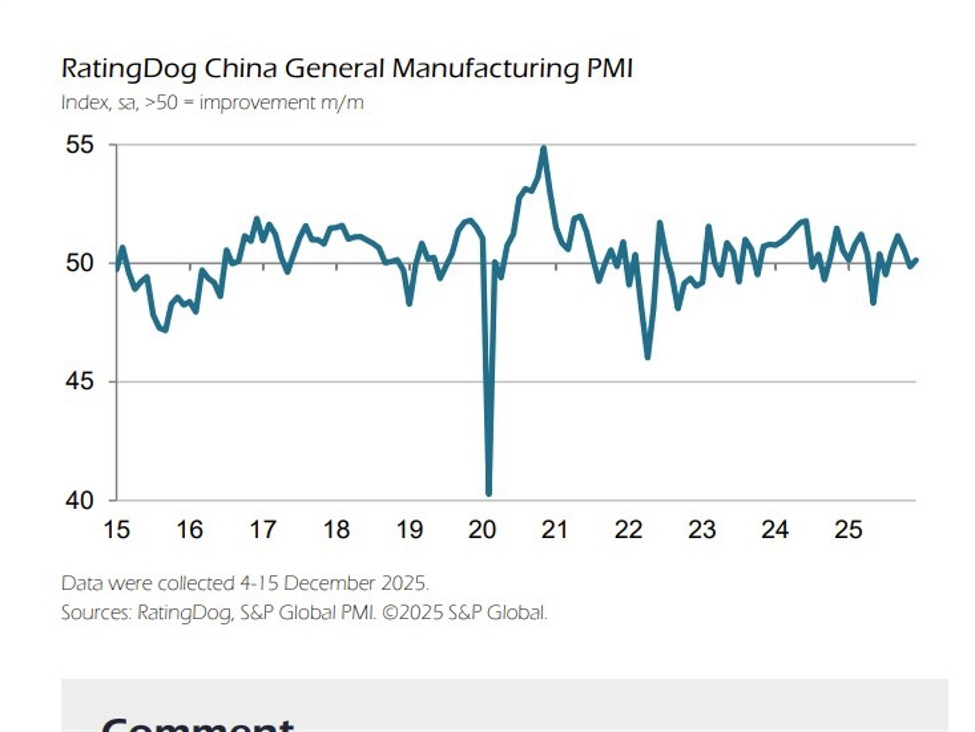
China S&P Global/Rating Dog December 2025 Manufacturing PMI 50.1 (expect 49.8, prior 49.9)
China’s manufacturing sector showed tentative signs of stabilisation at the end of 2025, with business conditions edging back into expansion territory, according to the latest S&P Global/Rating Dog Purchasing Managers’ Index data. While the improvement was modest, the rebound marked a welcome shift after months of subdued momentum, driven primarily by stronger domestic demand rather than a recovery in exports.The result echoed the earlier official PMIs:China official December 2025 PMIs: Manufacturing 50.1 (exp 49.2) Non-manu 50.2 (exp 49.8)The headline seasonally adjusted PMI rose to 50.1 in December from 49.9 in November, moving just above the 50 threshold that separates contraction from expansion. The reading signalled a fractional improvement in operating conditions and marked the fourth month of improvement in the past five months, suggesting the sector may be bottoming out after a prolonged period of weakness.Manufacturing output returned to growth in December after stagnating earlier in the fourth quarter. Producers cited stronger inflows of new work, supported by domestic new product launches and business development efforts, which helped lift overall sales. However, the recovery remained uneven. New export orders declined for the second time in three months, reflecting still-subdued external demand and highlighting the ongoing drag from weak global conditions.Despite rising new orders, firms remained cautious in their purchasing behaviour. Overall purchasing activity stagnated as many manufacturers reported holding sufficient stocks of raw materials and semi-finished goods. Nevertheless, inventories of inputs increased after declining in November, partly reflecting improvements in supplier performance. Vendor delivery times shortened again in December, aided by better communication and service levels among suppliers.Employment continued to contract, with staffing levels falling for a second consecutive month. Survey respondents pointed to a combination of resignations and redundancies, with job cuts frequently linked to restructuring efforts and cost-control measures. Reduced workforce capacity, combined with higher sales volumes, contributed to a faster accumulation of backlogs, with unfinished work rising at the quickest pace in three months. To meet demand, firms increasingly drew down existing stocks of finished goods, leading to another decline in post-production inventories.Cost pressures intensified toward year-end, driven mainly by higher raw material prices, particularly metals. Input prices rose for a sixth consecutive month, with the pace of increase the fastest since September. Despite this, manufacturers continued to cut selling prices in an effort to support sales and clear inventories, extending a divergence that has weighed on profit margins. Exporters were an exception, with export prices rising for the first time in three months as firms sought to defend margins.Business sentiment remained positive heading into 2026, although optimism softened from November and stayed below historical averages. Manufacturers expressed cautious confidence that new products, expansion plans and expected policy support would underpin a gradual recovery next year, even as uncertainty around the durability of the current upturn persists. -China publishes two main PMI surveys, each capturing different parts of the industrial landscape. The official PMI is compiled by the National Bureau of Statistics and focuses primarily on large, state-owned and government-linked enterprises. Alongside this, the private-sector PMI, produced by S&P Global / RatingDog, places greater emphasis on small and medium-sized enterprises, making it a closely watched gauge of conditions in China’s private economy.The distinction matters. While the official PMI tends to reflect conditions among larger firms with better access to credit and policy support, the private-sector survey is often seen as more sensitive to shifts in domestic demand, pricing power and employment conditions. Methodological differences also play a role, with the Caixin/RatingDog survey drawing from a broader and more diverse sample of companies. Despite these contrasts, the two PMIs often move in the same direction, offering complementary signals on the health of China’s manufacturing sector. This article was written by Eamonn Sheridan at investinglive.com. 🔗 Source 💡 DMK Insight China’s manufacturing sector is showing signs of life, and here’s why that matters: a modest rebound in the S&P Global/Rating Dog Purchasing Managers’ Index indicates potential stabilization after a prolonged downturn. For traders, this could signal a shift in global demand dynamics, particularly in commodities and currencies tied to Chinese economic activity. If this trend continues, we might see a ripple effect across markets, especially in sectors like industrial metals and energy, which are sensitive to manufacturing output. But let’s not get too excited just yet. The improvement is described as tentative, which means volatility could still be lurking. Traders should keep an eye on key levels in related assets, such as copper and oil, which often react to changes in Chinese demand. If the PMI can hold above a certain threshold, say 50, it could reinforce bullish sentiment in these markets. Watch for upcoming economic data releases that could either confirm or contradict this stabilization narrative, as they will be crucial in shaping market expectations moving forward. 📮 Takeaway Monitor the S&P Global PMI closely; a sustained reading above 50 could trigger bullish momentum in commodities linked to Chinese manufacturing.
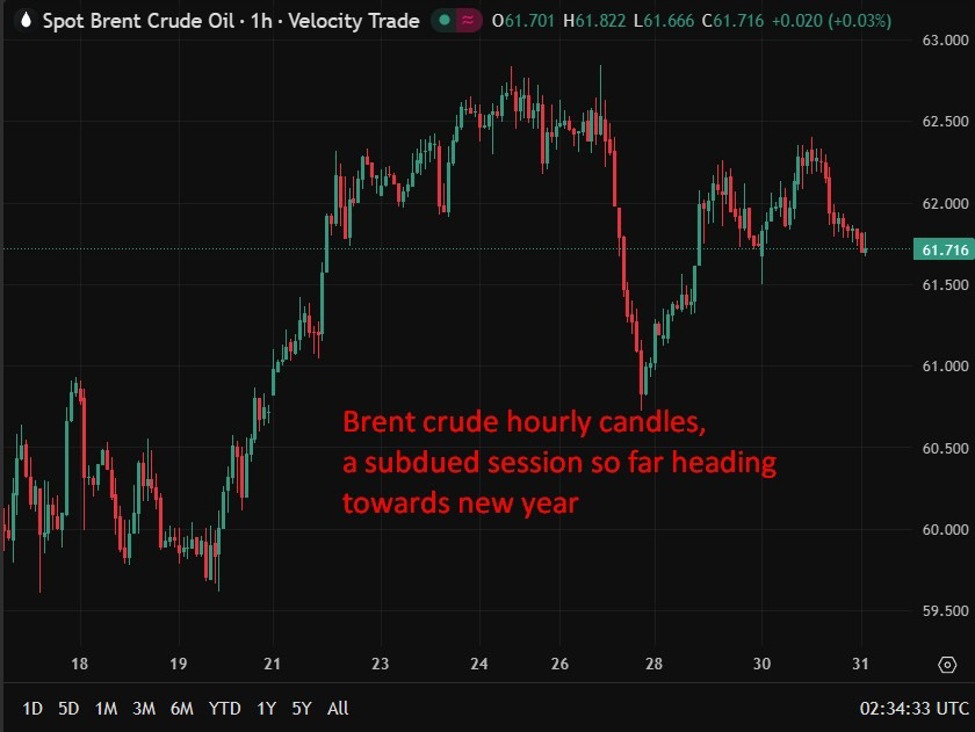
OPEC+ expected to maintain output pause amid growing global oil surplus, January 4 meeting
TL;DR summary: OPEC+ is widely expected to reaffirm its planned pause in oil output increases at a meeting this weekend, as evidence builds of a growing global supply surplus and slowing demand growth. With crude prices under sustained pressure, the group appears inclined to prioritise market stability over further production hikes.—OPEC+ is expected to stick with its decision to pause further oil supply increases when it meets this weekend, amid rising concerns that the global market is already slipping into oversupply, according to multiple delegates familiar with the group’s discussions.Key members of the alliance, led by Saudi Arabia and Russia, are scheduled to hold a monthly video conference on January 4. The meeting will review a policy decision first taken in November to halt additional production hikes during the first quarter, following a rapid revival of output earlier this year. The group reconfirmed that stance at a gathering earlier this month and is widely expected to do so again, delegates said, speaking on condition of anonymity due to the private nature of the talks.The cautious approach reflects a sharply deteriorating price environment. Crude futures have fallen more than 15% over the course of this year and are on track for their steepest annual decline since the 2020 pandemic-driven collapse. Prices have been weighed down by rising supply from both OPEC+ producers and non-OPEC competitors, while global demand growth has slowed as economic momentum softens across key consuming regions.Oversupply risks are becoming harder to ignore. Forecasters, including the International Energy Agency, are warning that the oil market could face a record surplus next year if current trends persist. Even OPEC’s own secretariat, which typically presents a more optimistic outlook, is now projecting a modest supply glut in 2026, a notable shift that underscores the challenge facing producers.For OPEC+, the decision to hold production steady reflects a delicate balancing act. On one hand, further supply restraint risks ceding market share to rival producers, particularly in the Americas. On the other, pushing ahead with output increases in the face of weakening demand could deepen price losses and strain the fiscal positions of oil-dependent economies.The planned pause also buys the group time to assess how global demand evolves into the first half of the year, particularly as monetary policy remains restrictive in many advanced economies and China’s recovery continues to disappoint. Any signs of further demand weakness or accelerating inventories are likely to reinforce the case for continued caution.As a result, markets are likely to view this weekend’s meeting less as a catalyst for immediate change and more as confirmation that OPEC+ is shifting into a defensive posture, focused on preventing a sharper downturn rather than engineering a price rebound. This article was written by Eamonn Sheridan at investinglive.com. 🔗 Source 💡 DMK Insight OPEC+ is likely to hold its ground on output, and here’s why that matters: With crude prices facing downward pressure, the group’s decision to pause output increases signals a commitment to stabilize the market amid rising supply and waning demand. Traders should keep an eye on how this affects not just oil prices but also correlated markets like energy stocks and commodities. If OPEC+ maintains its stance, we could see a short-term floor around current price levels, but any unexpected announcements could lead to volatility. It’s worth noting that while OPEC+ aims for stability, the underlying fundamentals suggest a potential oversupply could linger, especially if global economic indicators continue to show weakness. This could lead to a bearish sentiment in the oil market, impacting related assets like energy ETFs or even broader indices. Watch for key price levels around recent lows, as a breach could trigger further selling pressure, while a rebound could offer a short-term buying opportunity for those looking to capitalize on potential volatility. 📮 Takeaway Keep an eye on OPEC+’s output decisions this weekend; a reaffirmation could stabilize prices, but watch for any unexpected announcements that might trigger volatility.