
 Bitcoin
  Ethereum
  Tether
  XRP
XRP  BNB
BNB  USDC
USDC  Solana
  TRON
TRON  Lido Staked Ether
  Figure Heloc
Russia’s Justice Ministry proposed fines and prison for illegal crypto mining, as officials say most miners still haven’t joined the tax register. 🔗 Source 💡 DMK Insight Russia’s crackdown on illegal crypto mining could shake up the market significantly. With the Justice Ministry proposing fines and prison time for unregistered miners, this move signals a serious regulatory shift. Traders should pay attention to how this affects the overall mining landscape, especially given that many miners are still operating outside the tax system. If enforcement ramps up, we could see a reduction in hash rates, which might impact Bitcoin’s price in the short term. Additionally, this could push miners to relocate to more favorable jurisdictions, potentially leading to increased competition in those areas. Keep an eye on Bitcoin’s price action as it reacts to these developments, particularly if it approaches critical support levels. On the flip side, this could create opportunities for established miners who comply with regulations, as they may gain market share. Watch for any announcements from Russian authorities regarding implementation timelines or specific penalties, as these could provide clearer signals for market movement. 📮 Takeaway Monitor Bitcoin’s price closely as Russia’s mining regulations unfold; key support levels could be tested if hash rates drop significantly.

South Korea delays crypto bill over stablecoin concerns: Report
The introduction of a stablecoin bill pioneered by South Korean President Lee Jae-myung will reportedly be delayed into 2026 on concerns about issuers. 🔗 Source 💡 DMK Insight The delay of South Korea’s stablecoin bill until 2026 is a significant red flag for crypto traders. This postponement raises questions about regulatory clarity in a market already grappling with uncertainty. Traders should be wary of the potential ripple effects on existing stablecoins, especially those tied to South Korean exchanges. If the bill’s concerns about issuers aren’t addressed, we could see increased volatility in the stablecoin market, impacting liquidity and trading strategies. Watch for how this news influences the broader crypto market sentiment, particularly against Bitcoin and Ethereum, which often react to regulatory developments. Keep an eye on trading volumes and price action around key support levels for these assets, as they may indicate how traders are positioning themselves in light of this news. 📮 Takeaway Monitor Bitcoin and Ethereum’s price action closely; a significant drop below key support levels could signal increased volatility due to the stablecoin bill delay.

US prosecutors oppose Defi Education Fund brief ahead of potential MEV case retrial
A retrial of two brothers alleged to have exploited the Ethereum blockchain may possibly come soon, but the US government argued one amicus brief isn’t relevant to consider. 🔗 Source 💡 DMK Insight The upcoming retrial regarding the Ethereum blockchain could shake trader confidence in ETH’s stability. With ETH currently at $2,977.86, any legal developments could trigger volatility, especially if the case reveals systemic vulnerabilities or regulatory scrutiny. Traders should keep an eye on market sentiment as legal outcomes often lead to knee-jerk reactions. If the retrial leans negatively for the defendants, we might see ETH testing key support levels, potentially around $2,800. Conversely, a favorable outcome could bolster bullish sentiment, pushing ETH towards resistance at $3,200. It’s worth noting that legal battles like this can create ripple effects across the crypto space, impacting related assets like DeFi tokens or even Bitcoin. So, watch for news updates closely as they could dictate short-term trading strategies. 📮 Takeaway Monitor ETH closely; a retrial outcome could push it towards $2,800 support or $3,200 resistance in the coming weeks.

Coinbase exec warns Senate stablecoin misstep could hand China global edge
A Coinbase executive said changes to the GENIUS Act could weaken US dollar stablecoins as China moves to boost the digital yuan by allowing interest-bearing wallets. 🔗 Source 💡 DMK Insight The potential weakening of US dollar stablecoins due to the GENIUS Act changes is significant for traders right now. As China ramps up efforts to promote the digital yuan with interest-bearing wallets, US dollar stablecoins could face increased competition, impacting liquidity and trading strategies. Traders should keep an eye on how this affects the USD’s dominance in crypto markets, especially with stablecoins like USDC and USDT. If these stablecoins lose traction, we might see a shift in trading volumes and price stability, which could ripple through related markets like forex and commodities. Watch for any legislative updates on the GENIUS Act and monitor the performance of US dollar stablecoins against the digital yuan. Key levels to watch would be the current trading ranges of major stablecoins and any shifts in market sentiment towards the digital yuan, which could indicate a broader trend in stablecoin adoption and usage. 📮 Takeaway Keep an eye on the GENIUS Act developments and monitor US dollar stablecoin performance against the digital yuan for potential trading opportunities.

This year has been a rough one for US home builders and there's no help coming
If not for the AI boom and massive government deficits, I suspect the broader US economy would look more like the housing industry.The massive hangover from ultra-low rates during covid continued this year, despite early hope for optimism. The home builders’ ETF ($XHB) tells the story. It was rocked early in the year along with the Liberation Day trade, then attempted a reversal from April only to stumble again in the fourth quarter, finishing the year fractionally lower.The chart itself flatters the performance of overall home builders, as high-end builders did better due to divergence in the US economy. The latest index of home builder sentiment from the NHB was at 39, which is near rock bottom levels.At various points in the year hopes for lower rates helped home-builder sentiment but we’re now in some kind of trough of disillusionment. There are a couple of rate cuts fully priced in for next year but there is fear that any cuts won’t work their way to the long end of the curve, and may even steepen it. US home buyers generally use 30-year fixed mortgages so the Fed has little power to control that with overnight rates, and even in Trump’s most-dovish dreams, the potential for further QE to drive down long-term yields is remote. That means there are few levers to pull to offer a strong boost to housing.Yesterday, there was some stronger economic data on the housing front. Pending home sales rose 3.3% compared to 1.0% expected. There is pent-up demand building and at some point that could be released. Ironically, it could come when consumers start to sense higher rates coming.Today we get another housing indicator on the economic calendar with the CaseShiller house price index and the price numbers from the FHA (the US regulator). Those are expected up 1.2% y/y and 1.7% y/y, respectively.Other data on the US economic calendar today includes the Dallas Fed services sector survey, which always has some interesting commentary, and the FOMC minutes from the Dec 9-10 meeting. The later could be a market mover if it highlights a timeline for further rate cuts (or not). It was one of the more-contentious decisions of the past decade.Aside from the data, look for the ebb and flow to dominate markets today as it’s the last full trading day of the year. S&P 500 futures are currently flat. This article was written by Adam Button at investinglive.com. 🔗 Source 💡 DMK Insight The housing sector’s struggles reflect broader economic vulnerabilities, and here’s why that matters for traders: The home builders’ ETF ($XHB) has faced significant volatility, indicating that the market is still grappling with the aftermath of ultra-low interest rates. As the AI boom and government deficits continue to dominate headlines, the housing market’s sluggishness could signal a broader economic slowdown. Traders should keep an eye on $XHB’s performance, as it often correlates with consumer sentiment and spending. If $XHB breaks below key support levels, it could trigger further sell-offs, impacting related sectors like construction and home improvement. Moreover, the Fed’s monetary policy will be crucial in shaping the housing market’s trajectory. If rates remain elevated, the pressure on home builders will likely intensify, leading to potential ripple effects across the economy. Watch for $XHB’s movement around its recent lows; a decisive break could indicate a shift in market sentiment that traders can’t afford to ignore. 📮 Takeaway Monitor $XHB closely; a break below recent support levels could signal deeper economic issues and impact related sectors.

It’s not just the U.S. struggling with government debt; China also has its problems
There has been a lot of talk lately about the rise in U.S. debt, and rightly so. This year alone, it has increased by more than $2 trillion. What is even more worrying is that interest payments on the debt continue to rise. According to the Congressional Budget Office’s summary for fiscal year 2025, net interest on the public debt has exceeded $1 trillion for the first time as the debt continues to grow.Even if the Federal Reserve continues to cut rates despite the economy’s strength and persistent inflation risks, interest costs are unlikely to fall in the short term. The public debt is expected to continue to rise, especially after this year’s “One Big Beautiful Bill Act,” which, according to the CBO, will add $3.4 trillion to the deficit over the next decade. In the longer term, the outlook is not much better. The CBO’s long-term budget outlook for 2025-2055 predicts that by 2055, U.S. debt could reach 156% of GDP, and it is expected to continue rising after that date. Such enormous debt could slow economic growth, increase payments to foreign holders of U.S. debt, and pose serious risks to the country’s fiscal and economic health.Given all this, the dollar index is expected to weaken, and Treasury yields are unlikely to drop anytime soon, even if the Fed maintains a loose monetary policy and the S&P 500 continues to rise. But it’s worth remembering that the U.S. isn’t alone in this. Besides Japan, where sovereign debt exceeds $10 trillion — approximately 2.4 times the country’s GDP — with interest payments consuming nearly 25% of the national budget, China is facing its own debt challenges. IMF data shows that over the past 15 years, China’s gross debt as a percentage of GDP has jumped from 33% to over 96%. With China planning to expand fiscal spending in 2026 to support growth in a challenging global environment, things are unlikely to improve soon.At first glance, it might seem that China’s debt situation isn’t as dire as the U.S., but that figure doesn’t include hidden local government debt. Using the IMF’s broader definition, China’s general government debt jumps to an estimated 124% of GDP once off-budget local obligations are counted. Meanwhile, total non-financial debt exceeds 300% of GDP.If China’s debt burden continues to rise, it could lead to higher government financing costs, local defaults, and increased stock market volatility. This article was written by IL Contributors at investinglive.com. 🔗 Source 💡 DMK Insight The surge in U.S. debt, now exceeding $2 trillion this year, is a critical concern for traders. Rising interest payments could lead to tighter fiscal conditions, impacting everything from consumer spending to corporate earnings. If the government struggles to manage this debt, we might see increased volatility in both the stock and forex markets. Traders should keep an eye on the U.S. dollar’s strength, as a weaker dollar could emerge if investors lose confidence in U.S. fiscal stability. Moreover, this situation could ripple through to commodities, particularly gold, which often attracts investors during times of economic uncertainty. If interest payments continue to rise, we might see a shift in market sentiment that favors safe-haven assets. Watch for key economic indicators, such as inflation rates and employment data, which could further influence the dollar and related markets. The real story here is how these rising debt levels could trigger broader market corrections, so staying alert to shifts in sentiment is crucial. 📮 Takeaway Monitor U.S. debt developments closely; rising interest payments could weaken the dollar and boost safe-haven assets like gold.

US home prices were a tad stronger than anticipated in October
The latest CaseShiller housing price index of the 20-largest US cities showed prices up 1.3% year-over-year, just a shade above the +1.2% consensus but a deceleration from the +1.4% y/y reading in September.On a monthly basis, home prices rose 0.3%, beating the +0.1% consensus. The September reading was revised to +0.2% from +0.1%.A separate data set from the FHFA painted a similar picture with prices up 1.7% year-over-year nationally. That number was the lowest in 13 years. It’s a weak data point to cap off a miserable year for home builders. There is some regional disparity with Mid-Atlantic prices rising 5.3% and lower Midwest prices down 0.7% y/y.The silver lining is that it improves affordability for home buyers, at least in inflation-adjusted terms. Home affordability is a major and growing political issue.Trump promised “aggressive’ housing reform next year, though few details have leaked.“There are a lot of things that we can do with regulations to try to help get stuff approved quicker,” said National Economic Council Director Kevin Hassett said on Fox Business. “And we can also do things like reward states that make it easier for people to build a new home.” At the same time, Trump acknowledge the conflict of improving affordability while preserving home values.”I don’t want to knock those numbers down, because I want them to continue to have a big value for their house. At the same time, I want to make it possible for young people out there and other people to buy housing,” he said.”In other words, you create a lot of housing all of a sudden, and it drives the housing prices down. So I want to take care of the people that have houses that have a value to their house that they never thought possible, that have sort of made them wealthy and happy, and especially in their later years. Got to be careful with that. I want to keep them up. At the same time, I want to make it possible for people to go buy houses,” he continued.That’s a tough needle to thread but one thing Trump is sure to do is try to drive down borrowing costs, something he will lean on a new Fed chair to do. He also floated the idea of suing Fed chair Powell on Monday. This article was written by Adam Button at investinglive.com. 🔗 Source 💡 DMK Insight Home prices are showing slight growth, but the deceleration could signal caution for traders. The Case-Shiller index’s 1.3% year-over-year increase, while above expectations, is a slowdown from September’s 1.4%. This trend could impact related markets, especially in sectors tied to consumer spending and mortgage rates. If home prices continue to rise but at a slower pace, it may affect consumer confidence and spending, which are crucial for economic growth. Traders should keep an eye on the housing market’s influence on interest rates, as a cooling market might lead to more dovish monetary policy from the Fed. On the flip side, if prices stabilize or increase in the coming months, it could indicate resilience in the housing sector, potentially leading to bullish sentiment in related equities and REITs. Watch for the next monthly readings and any shifts in consumer sentiment, as these will be key indicators of market direction moving forward. 📮 Takeaway Monitor the upcoming monthly housing data closely; a continued slowdown could influence Fed policy and related markets significantly.
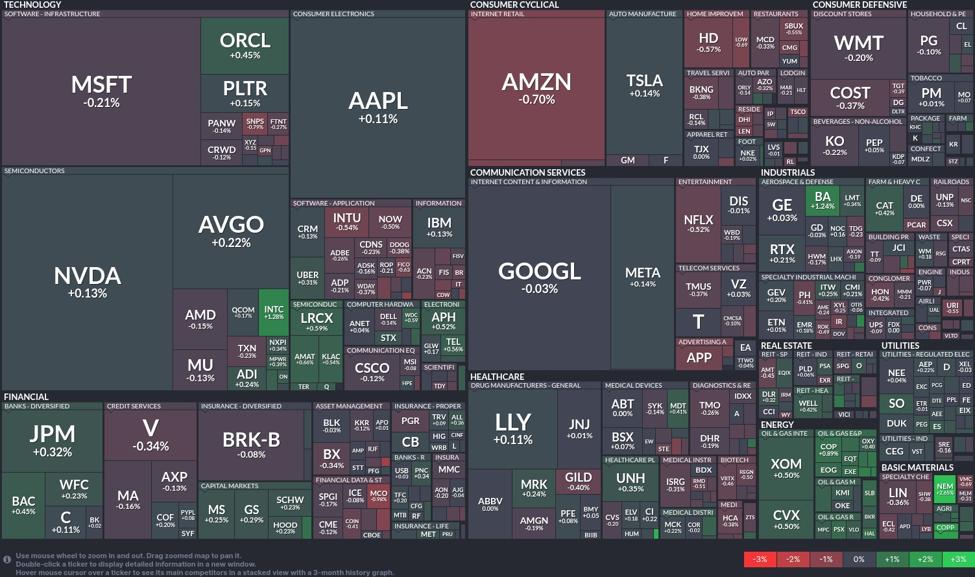
Mixed market signals: Industrials gain while consumer cyclical falters
Sector OverviewThe industrials sector is showing notable gains today, with Boeing (BA) leading the pack with a rise of 1.24%. This uptick might be attributed to positive developments in aerospace and defense, providing a lift to the overall sector.Conversely, the consumer cyclical sector appears to be under pressure. Amazon (AMZN) has dipped by 0.70%, highlighting investor caution or potential apprehension regarding future consumer spending trends.The semiconductor sector, with companies like LAM Research (LRCX) gaining 0.59%, and slight advances in Intel (INTC) at 1.28%, indicates a cautiously optimistic mood among investors.Market Mood and TrendsToday’s market sentiment is a mix of cautious optimism and sector-specific reactions. The positive sentiment in the industrials sector contrasts sharply with the hesitancy seen in consumer cyclicals. This divergence might signify a focus on durable goods and infrastructure improvements, overshadowing short-term consumer behavior concerns.The fluctuations within technology, particularly semiconductors, underscore a nuanced market outlook, where tech giants maintain strategic importance despite mixed performances.Strategic RecommendationsGiven the current climate, investors might consider reinforcing positions in industrial stocks, particularly within the aerospace sector, to capitalize on stability and growth potential. Attention should be paid to potential catalysts in defense and manufacturing that could drive further gains.On the other hand, caution is advised regarding consumer cyclical stocks, with a focus on understanding consumer sentiment and spending behavior assumptions.The modest advancements in semiconductors suggest room for strategic investment, especially in companies showing resilience amid fluctuating market conditions.To stay informed on these dynamic market shifts, continually follow up-to-date reports and analyses at InvestingLive.com for strategic adjustments and opportunities. This article was written by Itai Levitan at investinglive.com. 🔗 Source 💡 DMK Insight Boeing’s 1.24% rise signals a potential rebound in the industrials sector, but consumer cyclicals like Amazon are struggling. This divergence highlights a critical moment for traders. The aerospace and defense sectors are benefiting from renewed optimism, possibly due to government contracts or increased demand for air travel. If Boeing can maintain this momentum, it could set a bullish tone for other industrial stocks. However, the pressure on consumer cyclicals, particularly Amazon, suggests a cautious consumer sentiment that could weigh on broader market performance. Traders should keep an eye on key technical levels for Boeing; a sustained break above recent highs could attract more buyers. Conversely, if Amazon continues to falter, it might drag down sentiment across the consumer sector, impacting related stocks. Watch for Boeing’s performance over the next few days to gauge if this trend is sustainable, and keep an eye on Amazon’s earnings reports for potential volatility. 📮 Takeaway Monitor Boeing’s price action for bullish signals above recent highs, while watch Amazon for signs of recovery or further declines impacting consumer sentiment.
Goldman Sachs 2026 commodity outlook: Buy gold to $4,900, sell oil
The team at Goldman Sachs is out with their big 2026 Commodities Outlook, and they aren’t mincing words. If you’re looking for a theme to hang your hat on next year, Daan Struyven and the team call it: “Ride the Power Race and Supply Waves.”The gist? The US-China fight for AI and geopolitical dominance is going to light a fire under metals, while a massive wave of new supply is going to drown energy markets.We’ve seen this divergence already in 2025—precious metals ripping higher while oil lags—and Goldman thinks that trade will continue.Here are the 5 themes:Goldman’s Top Trade: Long Gold to $4,900/oz by Dec ’26Brent seen averaging just $56 in 2026The “LNG Supply Wave” is huge: US exports to surge 50% by 2030Copper to consolidate near $11,400 before the next AI leg higherBattery metals (lithium/nickel) to get crushed by Chinese supplyGoldman’s framework is simple. On the macro side, you have the “Power Race”—the US and China competing for AI supremacy and geopolitical leverage. That is bullish for strategic metals. On the micro side, you have “Supply Waves”—massive new capacity coming online in energy.Here is the breakdown of the actionable ideas:1. Buy GoldGoldman calls gold their “single favorite long commodity.” They see prices hitting $4,900/oz by the end of 2026. The driver is central banks Goldman expects them to buy 70 tonnes per month in 2026. That is 4x the pre-2022 average.Goldman Sachs also notes that gold ETFs are just 0.17% of US private portfolios. We’re not even close to crowded on the retail side yet.Sell OilThey see oil as a supply victim with brent averaging $56/bbl and WTI at $52/bbl next year (spot at $62 and $58, respectively). They say the supply wave will end in 2026 but it doesn’t matter because the surplus is already here. Unless OPEC+ makes massive cuts or we see major disruptions (Russia/Iran), the inventory builds are going to weigh on price.3. Hold copperCopper has had a monster run — one I’ve been forecasting for years — but Goldman sees it taking a breather, consolidating around $11,400/t in 2026. They say not to ‘t get shaken out by the consolidation. They call copper their “favorite industrial metal” for the long run. The AI/Data center build-out and electrification demand will put a floor under prices. If China stockpiles strategic metals,, that floor gets even higher.4. Avoid battery metalsIf you’re looking for a bottom in Lithium or Nickel, Goldman says keep waiting. China is heavily investing in overseas supply (Africa, Indonesia) to guarantee security for the AI/Tech race. That means a flood of supply is hitting the market regardless of price. They see lithium prices dropping another 25% by year-end 2026.5. Natural gas: global glut, but the US is differentThey see a multi-year LNG supply wave: global LNG supply +50% by 2030 vs 2024, implying lower ex-US gas prices over time. But because the US is the big supplier, LNG exports become export demand for US gas — tightening the US market enough to keep Henry Hub supported in 2026/27. That shows up in the spread call: TTF–Henry Hub narrowing from $8.40 to $5.40/$3.05 in 2026/27, with TTF at 29/20 EUR/MWh and US gas at $4.60/$3.80.Another notable tidbit is that they estimate US power demand growth near 3%, with many regions already at/below critical spare capacity levels. This article was written by Adam Button at investinglive.com. 🔗 Source 💡 DMK Insight Goldman Sachs’ 2026 Commodities Outlook is a wake-up call for traders, emphasizing the escalating competition between the US and China. This rivalry is likely to drive commodity prices, particularly in energy and metals, as both nations ramp up their production capabilities and seek to secure resources. Traders should be aware that this geopolitical tension could lead to volatility in related markets, especially if supply chains are disrupted or if tariffs are imposed. The phrase “Ride the Power Race and Supply Waves” suggests that traders should position themselves to capitalize on fluctuations in energy prices and raw materials. Look for key technical levels in commodities like oil and copper, which could serve as indicators of broader market trends. If energy prices break above recent resistance levels, it could signal a bullish trend, while a failure to hold these levels might prompt a sell-off. Keep an eye on the upcoming economic indicators from both the US and China, as these will likely influence market sentiment and trading strategies moving forward. 📮 Takeaway Watch for key resistance levels in energy commodities; a breakout could signal a bullish trend driven by US-China tensions.
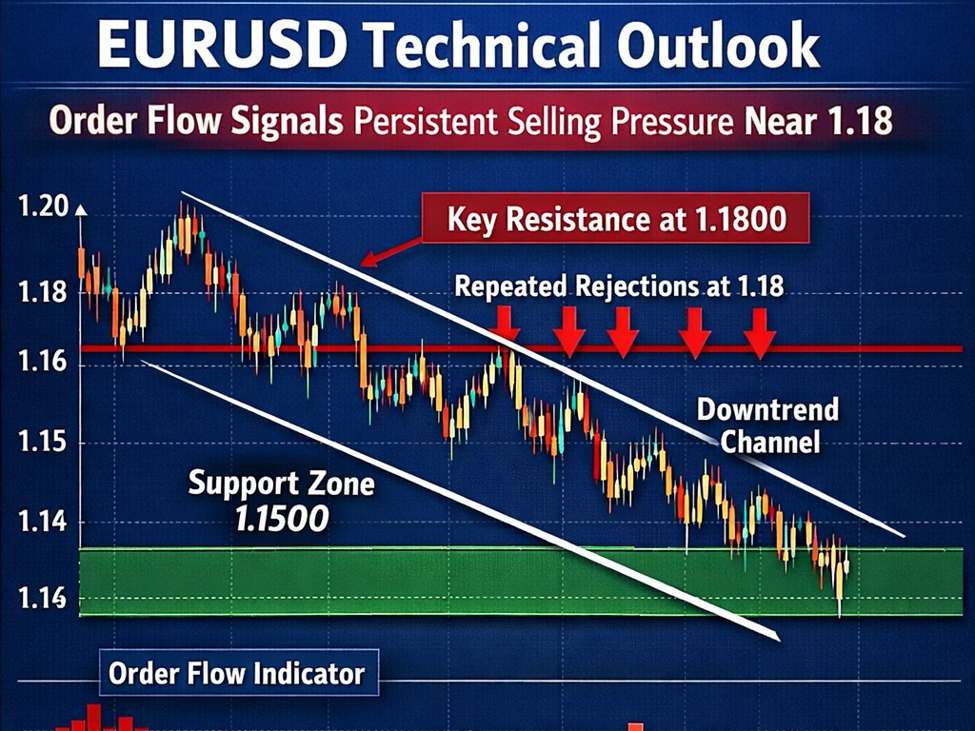
EURUSD Technical Outlook: orderFlow Intel Signals Persistent Selling Pressure Near 1.18
Seems like everyone wants to get in the gold crowded Long. Even Goldman Sachs says to buy gold and sell oil, but what about our Euro traders and investors? EURUSD continues to trade in a technically sensitive zone, where order flow dynamics reveal more than standard price charts alone. While spot price action may appear orderly, under-the-hood execution tells a clearer story about who is in control and where the pressure points lie.Using orderFlow Intel, which tracks buy and sell aggression, delta behavior, and value acceptance, we can frame the current EURUSD environment as one that still leans bearish, unless proven otherwise by sustained acceptance above key reference levels.EURUSD Tecnical Analysis and Bigger Picture: Distribution, Not AccumulationFrom a higher-level perspective, order flow suggests that EURUSD has been distributing rather than building a base.Key observations:Buying activity has become less efficient, requiring more volume to achieve less upside progress.Value has gradually migrated lower instead of expanding upward.Positive delta bursts have repeatedly failed to translate into sustained acceptance at higher prices.This combination typically reflects seller control through absorption, not panic selling, but persistent enough to keep rallies capped.In short, the market is not collapsing, but it is also not preparing for a clean bullish continuation.Another technical analysis perspective, the 1hr chart below for EURUSD futures, shows price activated te bear flag (yellow channel broken to the downside) and price travelling in a downtrend, shown via the pitchfork below.EURO USD Lower-Timeframe Insight: Execution Confirms the BiasZooming into the lower-level order flow reveals how this weakness is expressing itself intraday.What stands out:Multiple pullbacks show little to no buyer defense at the lows.Temporary positive delta readings appear reactive, not initiative-driven.After brief bounces, selling pressure quickly reasserts itself.This behavior supports a sell-the-rally environment, rather than a buy-the-dip one, as long as price remains below key VWAP-based references.Key Levels That Matter Right Now for EURUSD Futures (6E1!)Several levels stand out as decision points, not predictions.1. 1.18135 – Yesterday’s VWAPThis level acts as a line in the sand for the bearish case.As long as price remains below and rejected from this level, downside scenarios remain valid.Sustained acceptance above yesterday’s VWAP would challenge the bearish premise and signal that sellers are losing control.This is not about a quick spike above, but about holding and building value above it.2. 1.1806 – Today’s VWAPThis is a near-term execution level.If price retraces upward toward 1.1806 and shows weak buying response, it could act as a potential short-entry area to consider.From an order flow perspective, this level often attracts both liquidity and algorithmic interest.As always, execution decisions are at your own risk, and confirmation matters.3. 1.18 – Semi-Round Psychological LevelThe 1.18 handle carries psychological and structural significance.Repeated interaction around this area increases its importance.A clean break below with acceptance would strengthen the bearish continuation case.Failure to break, followed by strong acceptance above VWAP levels, would weaken it.Markets often rotate around such semi-round numbers before committing to direction.What Would Change the Bias for the Bearish Bias on EURUSD?For EURUSD to shift away from its current bearish tilt, orderFlow Intel would need to show:Sustained positive delta with improving efficiency.Clear buyer defense at pullbacks.Value building and holding above yesterday’s VWAP.Until then, rallies are suspect, and patience favors waiting for price to come to key reference levels rather than chasing moves.Final Thoughts for Euro Traders and InvestorsEURUSD is currently offering a structured environment for decision support, not a high-conviction breakout. OrderFlow Intel suggests that sellers still have the upper hand, but also defines clear invalidation points.For traders, this means focusing on context, levels, and confirmation, not prediction. For investors, it highlights a market that remains fragile near resistance, rather than one that has decisively turned higher.As always, this analysis is a decision-support tool, not financial advice. Trade at your own risk. Visit investingLive.com for additional views. This article was written by Itai Levitan at investinglive.com. 🔗 Source 💡 DMK Insight Gold’s bullish sentiment is overshadowing the EURUSD’s precarious position, and here’s why that matters: With Goldman Sachs pushing for gold buys while advising to sell oil, the market’s focus is shifting. This could lead to increased volatility in the EURUSD as traders react to broader commodity trends. Currently, EURUSD is trading in a technically sensitive zone, which means any significant movement in gold could trigger a chain reaction in the forex market. If gold continues to rally, we might see a stronger dollar, putting downward pressure on the euro. Traders should keep an eye on key levels around 1.0500 for potential support or resistance, as a break could lead to a swift move in either direction. But let’s not ignore the flip side; if gold’s rally falters, we could see a reversal in sentiment that strengthens the euro. This dynamic makes it crucial to monitor not just gold prices but also economic indicators affecting the eurozone, like inflation data or ECB announcements. Keep your charts open for any shifts in order flow that could signal a breakout or breakdown in EURUSD. 📮 Takeaway Watch for EURUSD around the 1.0500 level; a break could signal significant volatility influenced by gold’s movements.