
 Bitcoin
  Ethereum
  Tether
  XRP
XRP  BNB
BNB  USDC
USDC  Solana
  TRON
TRON  Lido Staked Ether
  Figure Heloc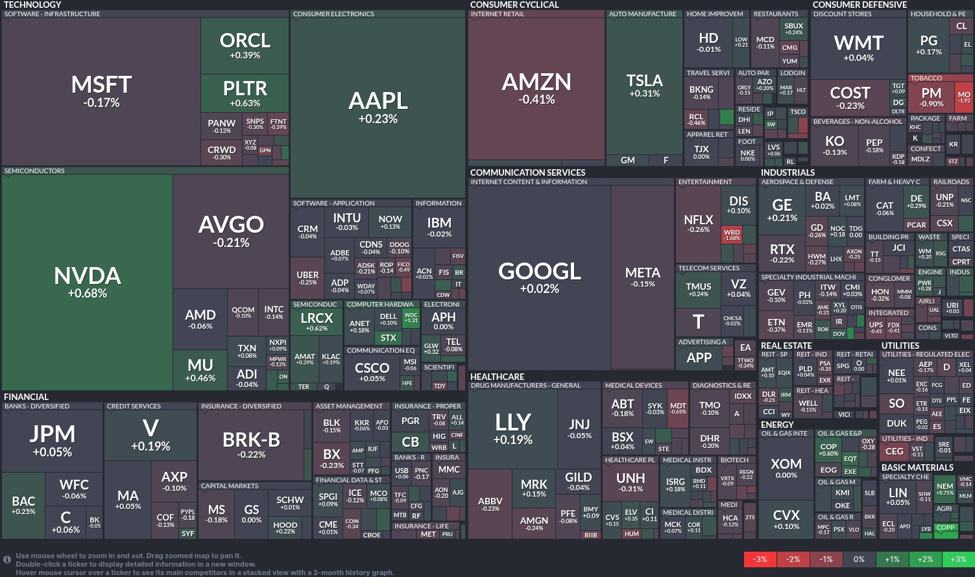
Mixed sector performances as tech and healthcare show gainsThe US stock market today presents a diverse picture, with sectors displaying varied performances, reflecting both investor optimism and cautious sentiment ingrained in today’s trading dynamics.🔍 Sector OverviewTechnology Sector: The technology sector shows promise with NVDA leading gains at 0.68%, highlighting positive investor sentiment. ORCL and PLTR also showcase mild additions of 0.39% and 0.63% respectively, reflecting ongoing strength in software infrastructure.Semiconductors: Displaying moderate mixed performances, with MU advancing by 0.46% and LRCX increasing by 0.62%. However, AVGO edges down by 0.21%, symbolizing sector-specific fluctuations.Consumer Electronics:AAPL increases by 0.23%, suggesting soft rally traction driven by recent product launches from major players.Financial Sector: Relatively stable, led by JPM and V with marginal gains of 0.05% and 0.19%. However, some instruments like BX are down by 0.23%, signifying pockets of apprehension.Communication Services: A lukewarm response as GOOGL remains nearly flat at 0.02%, while META sees slight losses of 0.15%.Healthcare:LLY posts a 0.19% increase, illustrating potential in drug manufacturing concerns amidst broader market interest.📈 Market Mood and TrendsOverall, today’s market reflects a mixed sentiment, juxtaposing growth aspirations against emerging cautiousness. Successful performances in technology suggest continuing innovation-led resilience while subdued movements in communication services and financials indicate areas of hesitation due to market uncertainties.💡 Strategic RecommendationsInvestors might consider:Increasing positions in the technology and semiconductor sectors due to evident bullish activity.Minding potential overvaluations or corrections in certain financial stocks, adjusting their exposure as necessary.Monitoring emerging trends in healthcare as pharmaceutical entities look promising amidst an evolutionary market landscape.Staying abreast of real-time data is crucial. For further insights, visit InvestingLive.com and explore our extensive market coverage to bolster your investment strategies amid evolving conditions. This article was written by Itai Levitan at investinglive.com. 🔗 Source 💡 DMK Insight Tech stocks are showing resilience, but mixed sector performances signal caution among investors. With NVDA up 0.68%, it’s clear that tech is still a favorite, likely buoyed by ongoing AI trends and strong earnings reports. However, the broader mixed performance across sectors suggests that not all investors are on board with the current rally. This divergence could lead to volatility, especially if economic indicators shift or if earnings reports from other sectors disappoint. Traders should keep an eye on key support levels in the tech sector, as a failure to maintain upward momentum could trigger profit-taking. Watch for the S&P 500’s performance relative to its 50-day moving average; a break below could signal a shift in sentiment. Also, consider how these sector performances might impact related assets, like ETFs focused on tech or healthcare, which could see increased trading volume based on sector sentiment shifts. 📮 Takeaway Monitor the S&P 500’s 50-day moving average; a break below could indicate a shift in market sentiment, prompting potential volatility.

Oil drops again but OPEC’s market share war could create a generational buying opportunity
One of the big surprises of 2025 was OPEC+ abandoning efforts to prop up the price of oil. For years, OPEC had been a strong market backstop, managing supply to maintain a floor under crude. However, a combination of eroding market share, resilient non-OPEC production finally forced a change in strategy and perhaps a nudge from US President Trump led to an abrupt change of strategy.The shift began in the spring of 2025, when Saudi Arabia and its allies signaled they were no longer willing to shoulder the burden of production cuts while producers in the US, Guyana, and Brazil continued to hit record output levels. By mid-year, the ‘price-over-volume’ mantra was replaced by a more aggressive pursuit of market share, reminiscent of the 2014 price war.Internal tensions reached a breaking point as several member nations, notably Iraq and Kazakhstan, repeatedly overproduced their assigned quotas. Frustrated by the lack of discipline, the core leadership decided that a period of lower prices would serve as a ‘reset’ to force adherence to future agreements.OPEC may have also wanted to punish US shale players (the source of all supply growth in the past decade) for the ‘drill, baby, drill’ mantra.Today, WTI crude fell $1.61 to $56.74. That wipes out the gains on Monday/Tuesday and leaves oil flat on the week and it continues to sit close to five year lows.As we move toward 2026, the question is no longer when OPEC+ will cut again, but how long they can tolerate the fiscal pain of sub-$70 oil in their quest to reassert dominance over the global energy landscape. Ultimately, the cure for low prices is low prices. US shale producers cut drilling budgets and will continue to do so. Few are making money below $60 WTI as costs have far outstripped crude prices since covid.My guess is that buying crude will be one of the great trades of 2026 — similar to how it was in late 2020. The question is ‘when to buy?’. There is a school of argument that all the excess oil is already priced in and that global balances aren’t as bad as they seem. I’ll be sympathetic to that argument if we can get through the winter without a disorderly oil breakdown. So I believe the trade will be to buy a puke in the oil market below $40 or to wait until April when the seasonals begin to improve. This article was written by Adam Button at investinglive.com. 🔗 Source 💡 DMK Insight OPEC+’s shift away from supporting oil prices is a game changer for traders. This move signals a potential oversupply in the market, especially with non-OPEC production holding strong. For day traders and swing traders, this could mean increased volatility in crude oil prices, creating both risks and opportunities. If OPEC+ is no longer the safety net it once was, traders should brace for potential price drops, especially if demand doesn’t keep pace with supply. Look at key technical levels around recent support and resistance points. If crude breaks below a certain threshold, say a significant psychological level, we could see a cascade effect impacting related markets like energy stocks and even currencies tied to oil exports. Keep an eye on the upcoming inventory reports and geopolitical developments that could further influence supply dynamics. The real story here is how quickly traders react to this new landscape—watch for shifts in sentiment and positioning as the market adjusts to OPEC+’s new stance. 📮 Takeaway Monitor crude oil prices closely; a break below key support levels could trigger significant volatility and trading opportunities.

Dogecoin price forms scary patterns as DOGE ETF drought continues
Dogecoin price continued its recent downward trend, reaching its lowest level since Oct. 10, and its technicals points to more downside as the DOGE ETF drought continued. Dogecoin (DOGE) token was trading at $0.1227, down by 75% from its highest… 🔗 Source 💡 DMK Insight Dogecoin’s drop to $0.12 signals a critical moment for traders: With the price hitting its lowest since early October, the lack of ETF developments is weighing heavily on sentiment. The 75% decline from its peak indicates a significant loss of momentum, and technical indicators suggest further downside could be on the horizon. Traders should keep an eye on support levels around $0.10, which, if breached, could trigger more selling pressure. But here’s the flip side: if DOGE can hold above this support, it might attract bargain hunters looking for a rebound. Watch for volume spikes that could indicate a shift in sentiment. In the broader context, this downturn could also affect related assets like Shiba Inu (SHIB), which often moves in tandem with DOGE. As we approach the end of the month, any news on potential ETF approvals could change the game, so stay alert for developments that could shift the narrative. 📮 Takeaway Watch for DOGE to hold above $0.10; a break below could lead to increased selling pressure.

2026 is the year Ethereum starts scaling exponentially with ZK tech
The lowdown on how the switchover to ZK-proofs is expected to work this year as part of Ethereum’s plan to scale to 10,000 TPS. 🔗 Source 💡 DMK Insight Ethereum’s transition to ZK-proofs could redefine scalability, and here’s why that’s crucial for traders: With ETH currently at $2,926.49, the anticipated shift to zero-knowledge proofs (ZK-proofs) aims to enhance transaction throughput to 10,000 TPS. This isn’t just a technical upgrade; it could significantly reduce gas fees and improve user experience, making ETH more attractive for both retail and institutional investors. Traders should keep an eye on how this transition unfolds, especially as it could lead to increased demand and price volatility. If ETH can maintain above the $2,900 level, it might signal bullish momentum, while a drop below could trigger profit-taking or panic selling. But let’s not overlook the potential risks. If the implementation faces delays or technical issues, we could see a sharp correction. Also, watch for how competing Layer 2 solutions react; they might either bolster or undermine ETH’s position. Key metrics to monitor include transaction speeds and gas fees post-transition, as these will directly impact market sentiment and trading strategies in the short term. 📮 Takeaway Watch for ETH to hold above $2,900; a sustained move could signal bullish momentum as ZK-proofs roll out.

Tokenized commodities near $4B, as gold extends all-time rally
Tokenized commodities are increasing amid growing investor demand for more accessible onchain financial products, following new all-time highs for gold and silver. 🔗 Source 💡 DMK Insight Tokenized commodities are gaining traction, and here’s why that matters right now: as gold and silver hit new all-time highs, investors are looking for ways to tap into these assets without the traditional barriers. This shift could signal a broader trend towards digital assets that mirror physical commodities, making them more accessible for everyday traders. With the rise in tokenized commodities, traders should keep an eye on how this impacts the broader market. If gold and silver continue to rally, we might see increased volatility in related assets like ETFs that track these commodities. The key levels to watch are the psychological barriers for gold and silver; if they break through these, expect a surge in tokenized trading volume. Additionally, monitor the trading volumes and liquidity of these tokenized products, as they could provide insights into market sentiment and potential price movements. But here’s the flip side: while tokenization offers accessibility, it also introduces new risks, such as regulatory scrutiny and market manipulation. Traders should be cautious and consider these factors when entering positions in tokenized commodities. 📮 Takeaway Watch for continued momentum in gold and silver; if they break new highs, expect increased trading in tokenized commodities, but stay alert to potential regulatory risks.

Bitcoin’s current setup looks like 2019, says Benjamin Cowen
In an exclusive Cointelegraph interview, the crypto analyst pointed to macro headwinds, muted sentiment and cycle dynamics shaping Bitcoin’s path into 2026. 🔗 Source 💡 DMK Insight Bitcoin’s trajectory into 2026 is clouded by macroeconomic pressures and lackluster sentiment. Traders need to pay attention to how these factors could affect price action, especially if we see continued tightening in monetary policy or geopolitical tensions. The current market sentiment is tepid, which often leads to increased volatility. If Bitcoin fails to reclaim key resistance levels, it could trigger further sell-offs, especially among retail investors. Watch for any shifts in macro indicators, as they could signal a change in sentiment. If we see a break below recent support levels, it might be time to reassess long positions. On the flip side, if institutional interest picks up, it could provide a much-needed boost. Keep an eye on institutional buying patterns and any news that could shift sentiment positively, as these could be the catalysts for a rally. Overall, the next few months will be crucial for setting the tone heading into 2026. 📮 Takeaway Monitor macroeconomic indicators and Bitcoin’s support levels; a break below could signal further downside risk.

Etheruem’s tokenization role takes focus as Tom Lee outlines bullish outlook
Fundstrat’s head of research said institutional tokenization supports a $7,000–$9,000 Ether price in early 2026 and a longer-term case for $20,000. 🔗 Source 💡 DMK Insight Fundstrat’s bullish Ether forecast could ignite speculative trading, but here’s why caution is key. While the $7,000–$9,000 target for early 2026 sounds enticing, traders should consider the volatility and market sentiment that often accompany such predictions. Institutional interest in tokenization is growing, but the crypto market is notoriously reactive to regulatory news and macroeconomic shifts. If Ether is currently at $2,926.49, a move towards the $7,000 mark represents a significant upside, but it also invites profit-taking and potential pullbacks along the way. Watch for resistance around $3,200 and support near $2,700 as key levels to gauge market sentiment in the short term. On the flip side, if the broader market faces headwinds—like tightening monetary policy or regulatory scrutiny—those lofty price targets could be unrealistic in the near term. Keep an eye on institutional buying patterns and any shifts in trading volume, as these could signal whether the market is ready to embrace such bullish forecasts or if it’s merely a speculative bubble waiting to burst. 📮 Takeaway Monitor Ether’s resistance at $3,200 and support at $2,700; institutional buying could drive prices toward $7,000, but volatility remains a risk.
Ethereum's TVL could skyrocket '10X' in 2026: Sharplink CEO
A surge in stablecoins, tokenized RWAs and growing sovereign wealth fund interest could drive a major increase in Ethereum’s TVL in 2026, Sharplink’s co-CEO said. 🔗 Source 💡 DMK Insight Ethereum’s TVL could see a significant boost by 2026, and here’s why that matters: The recent uptick in stablecoin adoption and interest from sovereign wealth funds indicates a shift in institutional sentiment towards Ethereum. As these funds look for stable, yield-generating assets, Ethereum’s DeFi ecosystem stands to benefit immensely. This could lead to increased liquidity and a higher Total Value Locked (TVL), which is crucial for the overall health of the Ethereum network. If TVL rises, it often correlates with price appreciation, making ETH a compelling asset for both short-term traders and long-term investors. However, it’s worth noting that while the bullish narrative is strong, traders should remain cautious. Market sentiment can shift rapidly, especially with regulatory scrutiny looming over DeFi. Watching for key resistance levels around $3,000 could provide insight into whether this bullish trend is sustainable. If ETH can hold above this level, it may signal further upward momentum. Keep an eye on the broader crypto market as well; a surge in Bitcoin could also positively influence Ethereum’s performance. 📮 Takeaway Watch for ETH to maintain above $3,000; a sustained hold could signal further upward momentum as institutional interest grows.

Russia Unemployment Rate below forecasts (2.2%) in November: Actual (2.1%)
Russia Unemployment Rate below forecasts (2.2%) in November: Actual (2.1%) 🔗 Source 💡 DMK Insight Russia’s unemployment rate just dipped to 2.1%, and here’s why that matters: This figure beats forecasts and signals a tightening labor market, which could influence the Central Bank of Russia’s monetary policy. A lower unemployment rate often leads to increased consumer spending, potentially boosting the economy and affecting inflation rates. Traders should keep an eye on how this impacts the Russian Ruble (RUB) and related assets. If the trend continues, we might see the Central Bank leaning towards tightening measures, which could strengthen the RUB against major currencies. But don’t overlook the flip side—if the economy overheats, it could lead to higher inflation, prompting a more aggressive rate hike than expected. This could create volatility in forex pairs involving the RUB. Watch for key resistance levels around 75.00 against the USD, as a break above could signal further strength in the Ruble. Keep an eye on upcoming economic indicators, especially consumer spending data, to gauge the broader implications. 📮 Takeaway Monitor the RUB closely; a sustained drop in unemployment could push it above 75.00 against the USD, signaling potential strength.

AI-era internet: Can blockchain prove what’s real anymore?
As AI blurs the line between real and synthetic media, strategies for restoring user trust online are still taking shape as we enter 2026. 🔗 Source