
 Bitcoin
  Ethereum
  Tether
  XRP
XRP  BNB
BNB  USDC
USDC  Solana
  TRON
TRON  Lido Staked Ether
  Figure Heloc
Prior week 224K revised to 224KThe 4-week moving average was 216,750, a decrease of 750 from the previous week’s unrevised average of 217,500Continuing claims 1.923M vs 1.900 estimate. Prior week 1.897M revised to 1.885MThe 4-week moving average was 1,893,750, a decrease of 5,250 from the previous week’s revised average. The previous week’s average was revised down by 3,000 from 1,902,000 to 1,899,000. Initial jobless claims track the weekly number of Americans filing for unemployment benefits for the first time and are one of the most timely indicators of U.S. labor-market health and overall economic momentum. Rising claims can signal increasing job losses and a slowing economy, while declining claims suggest that hiring is outpacing layoffs, pointing to underlying economic strength. Released every Thursday by the U.S. Department of Labor, the report is closely watched by economists and markets alike, with particular emphasis on the four-week moving average, which helps smooth out weekly volatility and provides a clearer view of underlying labor-market trends.The largest increases in initial claims for the week ending December 13 were in Rhode Island (+452), West Virginia (+325), Connecticut (+128), Mississippi (+57), and New Mexico (+51), while the largest decreases were in Illinois (-7,242), New York (-5,720), Pennsylvania (-5,129), Minnesota (-4,361), and Georgia (-4,325). Yesterday, ADP released their weekly 4-week moving average of employment: ADP Pulse for the week ending December 6 comes in at +11.5K vs a revised +17.5K last weekThe ADP released their monthly report for November earlier in the month and it showed a net decline for the month at 32K. The report yesterday suggests a rebound in December. This article was written by Greg Michalowski at investinglive.com. 🔗 Source 💡 DMK Insight Jobless claims data just came in, and here’s why it matters: the continuing claims are higher than expected, signaling potential economic weakness. With continuing claims at 1.923 million versus an estimate of 1.900 million, this could indicate that more people are struggling to find work. The 4-week moving average also shows a slight decrease, but the overall trend suggests that the labor market might be cooling off. For traders, this could impact sectors sensitive to consumer spending, like retail and discretionary stocks. If the trend continues, we might see a shift in market sentiment, particularly if economic indicators point toward a recession. Keep an eye on the broader economic data releases in the coming weeks, as they could provide further context. Watch for key levels in related markets, especially in the S&P 500, which could react to any signs of economic slowdown. If we see a break below recent support levels, it could trigger a wave of selling, especially from institutional players looking to hedge against potential downturns. 📮 Takeaway Monitor the S&P 500 for potential support breaks; a downturn could signal broader economic concerns as jobless claims rise.
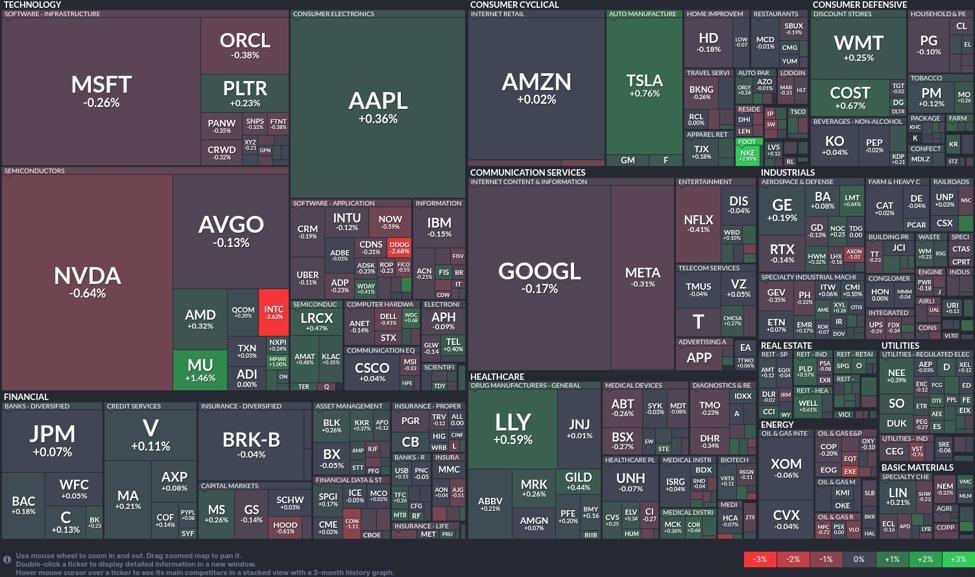
Tech sector dips: Mild losses for Nvidia and Oracle, while Tesla accelerates
Sector OverviewIn today’s market snapshot, the overall sentiment appears cautious with the technology sector exhibiting minor declines. Notably, Nvidia (NVDA) has slipped by 0.64%, leading the sector’s retreat. Meanwhile, Oracle (ORCL) marked a decrease of 0.38%.Conversely, the consumer cyclical sector offered a beacon of positivity, with Tesla (TSLA) gaining 0.76%. The consumer defensive sector, including stalwart Walmart (WMT) and Costco (COST), also showed slight upward movements, up by 0.25% and 0.67% respectively.Market Mood and TrendsThe day’s market mood reflects a mixed bag, heavily characterized by sector-specific dynamics rather than an overarching market trend. The modest downturn in tech, particularly among major players like Nvidia, highlights ongoing investor apprehension within the sector despite generally upbeat economic indicators.The rise in consumer cyclical stocks, however, suggests that investors are placing some confidence in economic resilience, positioning these stocks as potential hedges against tech volatility.Strategic RecommendationsInvestors should consider diversifying their portfolios beyond the tech sector, which currently reflects vulnerability to broader economic narratives. The consistent performance of consumer defensive stocks indicates a safer harbor amidst market fluctuations.Given Tesla’s strong performance, a closer look at the auto manufacturing segment might uncover further opportunities for growth. Meanwhile, vigilance is advised with regards to any evolving trends that might impact technology and semiconductor stocks adversely.For a strategic blend, consider increasing exposure to sectors showing resilience, such as consumer cyclical and consumer defensive industries, while trimming potential excess from tech holdings. As always, stay informed with InvestingLive.com for cutting-edge news and insights. This article was written by Itai Levitan at investinglive.com. 🔗 Source 💡 DMK Insight Tech stocks are wobbling, and here’s why that matters for traders: With Nvidia down 0.64% and Oracle slipping 0.38%, the tech sector’s cautious sentiment could signal broader market weakness. If these giants continue to falter, it might trigger a sell-off across related tech assets, impacting ETFs and other stocks tied to this sector. Traders should keep an eye on key support levels for Nvidia, which could be critical in determining whether this decline is a short-term blip or the start of a more significant downturn. On the flip side, Tesla’s 0.76% gain in the consumer cyclical sector shows that not all sectors are feeling the pinch, which could provide opportunities for those looking to diversify. Watch for Nvidia to hold above its recent support levels; failure to do so could lead to increased volatility. Additionally, keep an eye on the overall market sentiment as it could affect trading strategies, especially for those heavily invested in tech stocks. The next few trading sessions will be crucial in determining the direction of both tech and consumer cyclical stocks. 📮 Takeaway Monitor Nvidia’s support levels closely; a break below could signal broader tech weakness, while Tesla’s gains suggest potential opportunities in consumer cyclicals.
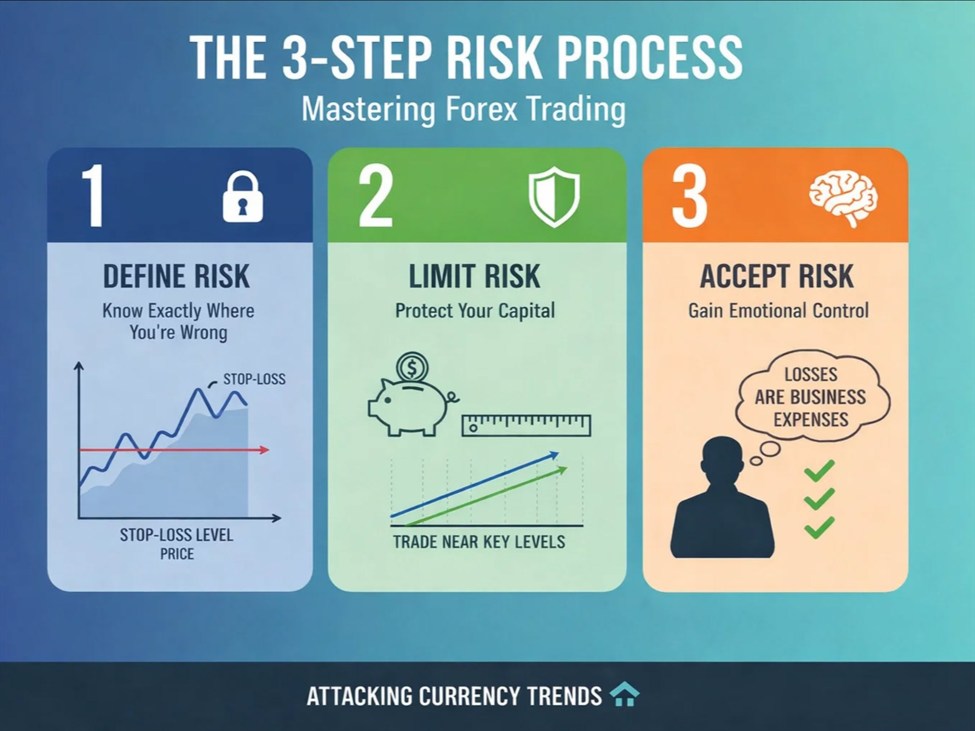
Forex Risk Management: The 3-Step Process to Successful Trading
Quick Summary:Success in Forex isn’t about predicting the win; it’s about defining where you are wrong. This guide covers the 3-step risk process: Defining (Technical levels), Limiting (Position sizing/proximity), and Accepting (Mental edge).A Text That Boosted My Ego (And Proved My Point)A few years ago, at a social gathering, I met someone through a mutual friend who traded Forex. Naturally, we got to talking shop. During the conversation, I hammered home a point I make to anyone who will listen: risk management is the most important aspect of trading.I didn’t hear from her for a long time. But this week, I received a surprise text that gave my ego a bit of a boost. She wrote:”I wanted to acknowledge something you said to me… You told me that risk management was the most important aspect of trading. At the time, I probably didn’t even know what that meant. But I do now, and I have finally come to understand exactly what you were trying to tell me!”In my reply, I told her: “We—as a people—tend to prefer focusing on the reward in trading (and in life). It’s more positive, after all. But if you focus on the risk, you know exactly where you are wrong. If you can live with that, and you aren’t ‘risked out’ (stopped out), you still get your rewards. Targeting where you are going is just the next step.”Cracking the “Trader Code”If you follow my videos or my posts, you know I’m a stickler for defining risk. I might write something like this in a market update:”…The bias for the EURUSD is negative following the break of those two moving averages and remains so below the rising trend line. Traders would now NOT want to see the price moving back above those moving averages—at least in the short term. That would disappoint the sellers on the break to the downside and likely lead to more upside momentum.”To a casual observer, that’s just technical analysis. But in “trader code,” those words actually mean: “This is your risk-defining level RIGHT HERE. This is your stop-loss area.”Traders need to know where they are wrong. They need to know the exact point where a negative bias turns positive, or where a positive bias turns sour. Technicals define those action areas.One of the core messages in my book, Attacking Currency Trends, is that successful trading starts with risk, not reward. Before you ever think about profit targets, you must be clear on what the risk is, how it is limited, and whether it is acceptable. This framework creates the discipline and emotional control needed in volatile FX markets where fear often drives bad decisions.The 3-Step Risk Process1. Defining Risk: Know Exactly Where You Are WrongRisk must be defined before entering a trade. In Attacking Currency Trends, I define risk technically—it is a specific price level that invalidates your trade idea.Risk is not a random dollar amount; it is a price level. On investinglive.com, I take the approach that readers want to know what the chart is telling them right now and why. That story always revolves around key technical levels: trend lines, moving averages, swing highs/lows, or Fibonacci retracements.If price breaches that level, the premise of the trade is wrong—not just in my eyes, but in the eyes of the “market.” By defining risk at entry, you answer the most important question first: Where am I wrong? It takes discipline and humility to accept that defeat, but you need as much conviction in your exit point as you do in your entry.2. Limiting Risk: The Math of FearOnce risk is defined, you must strive to limit it. I tell traders: we must take risk to make money, but we should try to limit that risk as much as humanly possible.Logic over Emotion: Stops are placed at technical levels “followed by many,” not where you “feel” like putting them.Proximity is Key: Trading as near to a risk-defining level as possible limits your downside and makes reaching profit objectives easier.Think about the math: If you risk 20 pips, you only need a 20-pip move to reach a 1:1 reward-to-risk ratio. If you enter 50 pips away from your risk level, you need a massive 100-pip move just to reach a 2:1 target.Trading near your risk level is the ultimate “fear killer.” If you don’t think fear impacts your trading, think again. Defining and limiting risk are the two mechanical steps that keep fear from driving the bus.3. Accepting Risk: The Mental EdgeDefining and limiting risk is mechanical. Accepting risk is psychological.You need to be able to tell yourself: “I have done the work to define my risk. I have limited my monetary exposure. I accept this risk in my core being.” Once you do that, the fear disappears because:The risk is already “paid for” mentally the moment you click ‘buy’ or ‘sell.’There is no “hoping,” bargaining, or second-guessing.Losses are treated as business expenses, not personal failures.Why This Framework MattersTrends can only be “attacked” consistently when risk is under control. Traders who skip these steps might win occasionally, but they won’t survive the long game.Defined Risk creates clarity.Limited Risk preserves capital.Accepted Risk frees the mind to execute.The Bottom Line: When risk is defined, limited, and accepted, you put the probabilities on your side and give yourself the best chance to succeed over time.Merry Christmas and Happy New Year to all. Peace on Earth. Goodwill to all. This article was written by Greg Michalowski at investinglive.com. 🔗 Source 💡 DMK Insight In Forex trading, the focus should shift from merely predicting outcomes to managing risk effectively. The three-step risk process—Defining, Limiting, and Accepting—provides a structured approach that can significantly enhance a trader’s performance. Defining your technical levels is crucial; knowing where to enter and exit can make or break your strategy. This isn’t just about setting stop-loss orders; it’s about understanding market dynamics and your own trading psychology. Limiting your exposure through proper position sizing is equally important. If you’re too heavily invested in
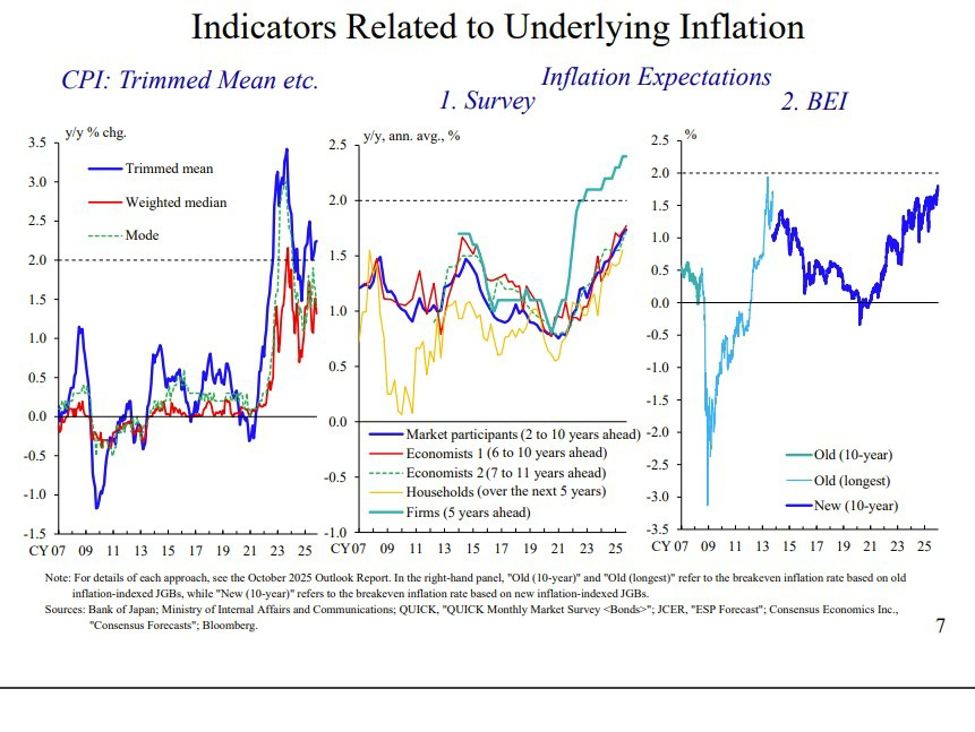
BOJ’s Ueda sees wages and inflation reinforcing rate-hike case
Bank of Japan Governor Ueda spoke at the Meeting of Councillors of Keidanren (Japan Business Federation) in Tokyo in Thursday, December 25, 2025. The title of the speech, reflective of its content, was “Toward the Achievement of the Price Stability Target Accompanied by Wage Increases”.Summary:Ueda said underlying inflation is steadily approaching 2%, supported by tight labour markets and changing wage-price behaviour. With real rates still very low, the BOJ is prepared to keep raising rates as economic conditions improve.-Bank of Japan Governor Kazuo Ueda said Japan’s underlying inflation is continuing to accelerate gradually and is steadily approaching the central bank’s 2% target, reinforcing the case for further interest-rate increases as economic conditions improve.Speaking to Japan’s business lobby Keidanren, Ueda said tight labour market conditions are likely to persist barring a major economic shock, putting sustained upward pressure on wages. He pointed to irreversible structural factors, including Japan’s declining working-age population, as key drivers of ongoing labour shortages.Ueda said companies are increasingly passing on higher labour and raw-material costs not only for food, but across a wider range of goods and services. This, he argued, is evidence that Japan is finally seeing a virtuous cycle take hold in which wages and prices rise together — a dynamic the Bank of Japan has long sought to establish.“Amid tightening labour market conditions, firms’ wage- and price-setting behaviour has changed significantly in recent years,” Ueda said, adding that achievement of the 2% inflation target, accompanied by wage growth, is now steadily approaching.With real interest rates still deeply negative, Ueda reiterated that the BOJ remains prepared to continue raising rates if its baseline outlook for the economy and prices is realised. He stressed that policy adjustments would be calibrated in line with economic and inflation developments rather than follow a preset path.Adjusting the degree of monetary accommodation, Ueda said, will allow the central bank to smoothly secure its inflation goal while supporting sustainable, long-term economic growth — signalling confidence that Japan’s shift away from ultra-easy policy is becoming increasingly durable. This article was written by Eamonn Sheridan at investinglive.com. 🔗 Source 💡 DMK Insight Bank of Japan Governor Ueda’s recent remarks on inflation and wage growth are crucial for traders to understand Japan’s monetary policy trajectory. With underlying inflation reportedly steady, this signals a potential shift in the Bank’s stance on interest rates, which could impact the yen’s value against major currencies. Traders should be particularly attentive to any hints about future rate hikes, as these could influence forex positions significantly. Moreover, if wage increases accompany inflation stabilization, it could lead to a stronger consumer spending outlook, further bolstering the economy. This scenario might attract foreign investment, pushing the yen higher. However, there’s a flip side: if inflation remains stubbornly high without corresponding wage growth, the Bank may face pressure to tighten policy more aggressively, which could lead to volatility in both the forex and equity markets. Keep an eye on the USD/JPY pair, especially around key resistance levels, as any unexpected shifts in Ueda’s tone could trigger significant market reactions. Watch for upcoming economic data releases that could provide context to Ueda’s statements, particularly on wage growth and consumer spending metrics. 📮 Takeaway Monitor the USD/JPY pair closely; any shifts in Ueda’s tone could lead to significant volatility, especially around key resistance levels.

Crypto heads into 2026 with privacy, decentralized identity on the line
As crypto, governments and Big Tech converge on digital identity, selective disclosure and zero-knowledge proofs are emerging as a privacy-first alternative to surveillance systems. 🔗 Source 💡 DMK Insight The rise of selective disclosure and zero-knowledge proofs is a game changer for crypto privacy. As governments and Big Tech push for more control over digital identities, these technologies offer a way to maintain user privacy while still enabling necessary verification. For traders, this could mean a shift in how digital assets are perceived and regulated. If these privacy solutions gain traction, we might see increased institutional interest in cryptocurrencies that prioritize user anonymity. Keep an eye on projects that are integrating these technologies, as they could outperform others in a more privacy-conscious market. However, there’s a flip side: increased scrutiny from regulators could lead to volatility in the short term, especially for assets that don’t adapt quickly. Watch for developments in regulatory frameworks around digital identity, as they could significantly impact market sentiment and trading strategies in the coming months. 📮 Takeaway Monitor the adoption of zero-knowledge proofs in crypto projects, as they could reshape market dynamics and regulatory responses over the next few months.

United States MBA Mortgage Applications declined to -5% in December 19 from previous -3.8%
United States MBA Mortgage Applications declined to -5% in December 19 from previous -3.8% 🔗 Source 💡 DMK Insight Mortgage applications dropping 5% is a big deal for traders: it signals a cooling housing market. This decline could impact related sectors, especially real estate and mortgage-backed securities. A sustained downturn in mortgage applications often indicates rising interest rates or economic uncertainty, which can lead to broader market volatility. Traders should keep an eye on the correlation between mortgage rates and housing stocks, as a continued decline might trigger sell-offs in those areas. Watch for any shifts in the Fed’s stance on interest rates, as that could further influence mortgage applications and housing market sentiment. On the flip side, if applications rebound, it could indicate a stabilization in the housing market, offering potential buying opportunities in real estate stocks. For now, monitor the upcoming economic indicators and Fed announcements closely, as they could provide insight into future trends. 📮 Takeaway Keep an eye on mortgage application trends; a continued decline could signal broader market volatility and impact related sectors like real estate.

Mexico Jobless Rate s.a: 2.7% (November) vs 2.6%
Mexico Jobless Rate s.a: 2.7% (November) vs 2.6% 🔗 Source 💡 DMK Insight Mexico’s jobless rate ticked up to 2.7% in November, and here’s why that matters: This slight increase could signal underlying economic pressures that traders need to watch closely. A rising unemployment rate often correlates with reduced consumer spending, which can impact various sectors, including retail and services. For forex traders, this could mean a potential weakening of the Mexican Peso against major currencies, especially if the trend continues. Keep an eye on economic indicators like GDP growth and inflation rates, as they can provide context for this jobless rate shift. On the flip side, if the jobless rate stabilizes or decreases in the coming months, it could bolster confidence in the Mexican economy, potentially leading to a stronger Peso. Traders should monitor key levels around 18.50 to 19.00 MXN/USD for any significant moves. Watch for upcoming economic reports that could influence market sentiment and trading strategies. 📮 Takeaway Keep an eye on the Mexican Peso around 18.50 to 19.00 MXN/USD as the jobless rate impacts market sentiment and potential currency strength.

Mexico Jobless Rate meets expectations (2.7%) in November
Mexico Jobless Rate meets expectations (2.7%) in November 🔗 Source 💡 DMK Insight Mexico’s jobless rate holding steady at 2.7% is a mixed bag for traders right now. While it meets expectations, this stability could signal a resilient labor market, potentially supporting the Mexican peso in the forex arena. A strong labor market often correlates with increased consumer spending, which can boost economic growth. However, traders should watch for any shifts in monetary policy from the Bank of Mexico, especially if inflation pressures persist. If the peso strengthens, it could impact related assets like Mexican equities or commodities tied to the economy. On the flip side, if global economic conditions worsen, even a steady jobless rate might not be enough to shield the peso from broader market volatility. Keep an eye on the upcoming economic indicators and any statements from the central bank that could influence market sentiment in the coming weeks. 📮 Takeaway Monitor the Mexican peso closely; a stable jobless rate could support it, but watch for central bank signals that might change the game.

EUR/GBP declines as BoE cautious tone supports Pound, ECB limits downside
EUR/GBP trades in negative territory around 0.8725 on Wednesday at the time of writing, extending a sequence of declines that began earlier in the week. The pair remains under pressure as the Pound Sterling (GBP) benefits from the Bank of England’s (BoE) relatively hawkish communication. 🔗 Source 💡 DMK Insight EUR/GBP’s drop to 0.8725 signals a bearish trend, and here’s why that matters: The ongoing decline reflects the Pound’s strength, bolstered by the Bank of England’s hawkish stance. Traders should note that this could lead to further selling pressure, especially if the BoE continues to signal rate hikes while the European Central Bank (ECB) remains more dovish. The 0.8700 level is crucial; a break below could trigger additional selling, while a rebound could indicate a potential reversal. Look for economic data releases from both the UK and Eurozone that might influence this pair’s trajectory. Also, keep an eye on market sentiment—if risk appetite shifts, it could impact GBP’s strength against the Euro. On the flip side, if the ECB surprises with a more aggressive policy shift, it could provide a lifeline for the Euro. So, while the current trend favors the GBP, the landscape could change quickly based on upcoming central bank communications and economic indicators. Watch the 0.8700 support level closely; it could be a pivotal point for traders looking to enter or exit positions. 📮 Takeaway Monitor the 0.8700 level in EUR/GBP; a break could signal further declines, while a rebound might indicate a reversal opportunity.

GBP/JPY Price Forecast: Overbought signals hint at a pause
The British Pound (GBP) trades slightly lower against the Japanese Yen (JPY) on Wednesday, though thin holiday trading conditions are keeping price action contained within a tight range. 🔗 Source 💡 DMK Insight The GBP/JPY’s slight dip in thin holiday trading highlights a lack of momentum, but here’s why that matters: With the market operating in a tight range, traders should be cautious about overcommitting to positions. The holiday season often leads to reduced liquidity, which can amplify volatility when significant news does hit. Keep an eye on key support and resistance levels; if the pair breaks below recent lows, it could trigger further selling. Conversely, a bounce back could signal a buying opportunity for those looking to capitalize on a potential reversal. Also, watch for any economic data releases from the UK or Japan that could shake up this stagnant trading environment. The real story is that while the GBP/JPY may seem quiet now, the underlying fundamentals could shift quickly, leading to unexpected price movements. In this context, monitoring the daily chart for breakout patterns or reversals will be crucial. Traders should also be aware of how other currency pairs are reacting, as correlations can provide additional insights into market sentiment. 📮 Takeaway Watch for GBP/JPY to break key support or resistance levels; thin holiday trading could lead to sudden volatility.