
 Bitcoin
  Ethereum
  Tether
  XRP
XRP  BNB
BNB  USDC
USDC  Solana
  TRON
TRON  Lido Staked Ether
  Figure Heloc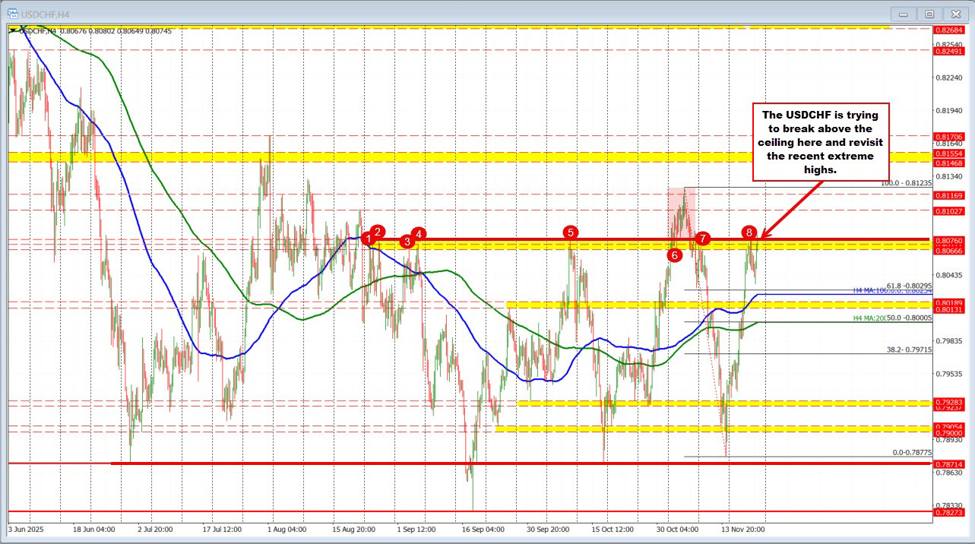
The USDCHF pushed up to the high end of the 0.8066-0.8076 key swing area yesterday, where sellers emerged and subsequently pushed the price lower today.Today’s decline found support just ahead of the broken 61.8% retracement at 0.80295, sparking a renewed rally back towards the mentioned swing area.The pair is now attempting to clear the upper bound of this range. A sustained break higher would open the path for traders to target 0.81027, then 0.81235.From here, buyers’ main concern is a move back below 0.8066. This would suggest a failed breakout, likely converting current buyers into sellers. This article was written by Greg Michalowski at investinglive.com. 🔗 Source 💡 DMK Insight The USDCHF’s bounce off the 61.8% retracement at 0.80295 is crucial right now. This level has historically acted as a significant pivot point, and the recent rejection at the 0.8066-0.8076 swing area indicates strong selling pressure. Traders should be cautious; if the price breaks below 0.80295, it could signal a deeper correction. Conversely, a sustained rally back into the swing area could attract buyers, potentially leading to a test of higher resistance levels. Keep an eye on volume and momentum indicators as they could provide insights into the strength of any upcoming moves. If you’re trading this pair, watch for a clear breakout above 0.8076 or a breakdown below 0.80295 to inform your next steps. 📮 Takeaway Watch for a breakout above 0.8076 or a drop below 0.80295 to guide your trading decisions on USDCHF.

US November S&P Global services flash PMI 55.0 vs 54.6 expected
Prior was 54.8Manufacturing 51.9 vs 52.0 expPrior manufacturing 52.5Composite PMI 54.8 vs 54.5 priorPrior composite 54.6Chris Williamson, Chief Business Economist at S&P Global Market Intelligence: “The flash PMI data point to a relatively buoyant US economy in November, signalling annualised GDP growth of about 2.5% so far in the fourth quarter. The upturn also looks encouragingly broad-based for now, with output rising across both manufacturing and the vast services economy. “A marked uplift in business confidence about prospects in the year ahead adds to the good news. Hopes for further interest rate cuts and the ending of the government shutdown have boosted optimism alongside a broader undercurrent of improved economic optimism and reduced concerns over the political environment. “However, manufacturers reported a worrying combination of slower new orders growth and a record rise in finished goods stock. This accumulation of unsold inventory hints at slower factory production expansion in the coming months unless demand revives, which could in turn feed through to lower growth in many service industries. “Furthermore, although jobs continued to be created in November, the rate of hiring continues to be constrained by worries over costs, in turn linked to tariffs. Both input costs and selling prices rose at increased rates in November, which will be of concern to the inflation hawks.” This article was written by Adam Button at investinglive.com. 🔗 Source 💡 DMK Insight The latest PMI data shows a mixed bag, and here’s why that matters: the manufacturing sector is underperforming while the composite PMI suggests resilience in the broader economy. Manufacturing came in at 51.9, below expectations of 52.0 and down from 52.5 prior, which could signal a slowdown in production and supply chain issues. However, the composite PMI at 54.8 indicates that services are still driving growth, suggesting that consumer spending remains strong. This divergence could lead to volatility in sectors tied to manufacturing, while service-oriented stocks might continue to thrive. Traders should keep an eye on the 52.0 level for manufacturing; a break below could trigger further bearish sentiment. On the flip side, the overall GDP growth projection of 2.5% for Q4 is a positive sign, but it’s worth questioning how sustainable this growth is if manufacturing continues to lag. Watch for reactions from the Fed, as these numbers might influence their stance on interest rates. Keep an eye on the upcoming economic indicators for further clarity. 📮 Takeaway Monitor the 52.0 level in manufacturing PMI; a drop below could signal further bearish trends, while service sector strength may keep overall growth buoyant.
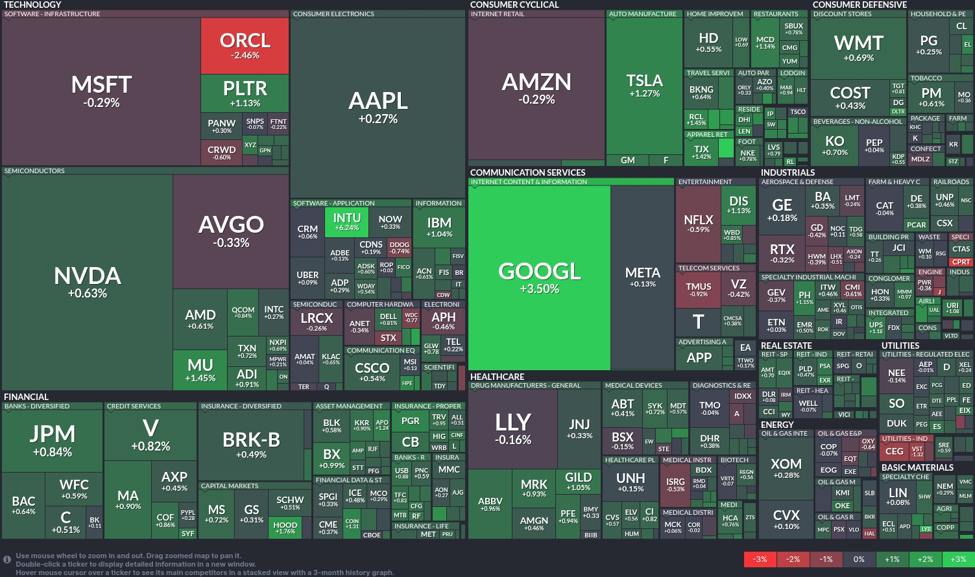
Tech leads rebound: Google and Tesla drive market optimism
Sector OverviewToday’s stock market heatmap reveals a mix of dynamic sector performances, with technology leading the charge. Notably:Communication Services: Google (GOOGL) surged by 3.50%, boosting confidence in the sector as investor sentiment turns optimistic.Consumer Cyclical: Tesla (TSLA) saw a rise of 1.27%, showing strength in the auto manufacturing space, while Amazon (AMZN) dipped slightly by 0.29% despite broader sector gains.Semiconductors: Nvidia (NVDA) saw a modest increase of 0.63%, alongside a 1.45% rise for Micron (MU), suggesting renewed interest in chipmakers.Financials: Major players like JPMorgan (JPM) and Visa (V) were both up by over 0.80%, indicating resilience in the financial sector.Market Mood and TrendsThe market exhibits a generally positive sentiment, buoyed by gains in technology and financial sectors. This optimism suggests investors are regaining confidence despite recent market volatility. The significant uptick in certain tech stocks points toward renewed interest in growth-oriented sectors, while steady performance in capital markets sustains the financial sector’s momentum.Strategic RecommendationsGiven the day’s trends, investors might consider strategically increasing exposure to the technology and automotive sectors, capitalizing on the positive momentum of leading stocks like Google and Tesla. Additionally, maintaining a diversified portfolio continues to be key:Technology: Focus on major players with strong upward trajectories such as Google.Automotive: Tesla’s growth potential makes it a promising bet within consumer cyclical stocks.Financials: Explore opportunities with resilient giants like JPMorgan and Visa.To navigate the current landscape effectively, stay informed with real-time data and consider hedging against potential inflation impacts across sectors. For detailed insights and analysis, visit InvestingLive.com. This article was written by Itai Levitan at investinglive.com. 🔗 Source 💡 DMK Insight Tech stocks are on fire, and here’s why that matters for traders right now: With Google (GOOGL) jumping 3.50%, it’s clear that investor sentiment is shifting positively in the tech sector. This surge could signal a broader rally, especially as earnings season approaches. If GOOGL can maintain momentum, it might pull other tech stocks along, creating a favorable environment for day traders looking to capitalize on short-term gains. Watch for key resistance levels around recent highs, as a breakout could lead to further upside. On the flip side, don’t overlook potential risks. If the broader market sentiment shifts due to macroeconomic factors—like inflation data or interest rate changes—tech stocks could face volatility. Keep an eye on correlated assets like the Nasdaq, which often mirrors tech movements. For now, focus on the daily charts for entry points, and consider setting alerts around GOOGL’s performance to catch any shifts quickly. 📮 Takeaway Watch GOOGL closely; a sustained breakout above recent highs could signal a tech rally, impacting related stocks and indices.
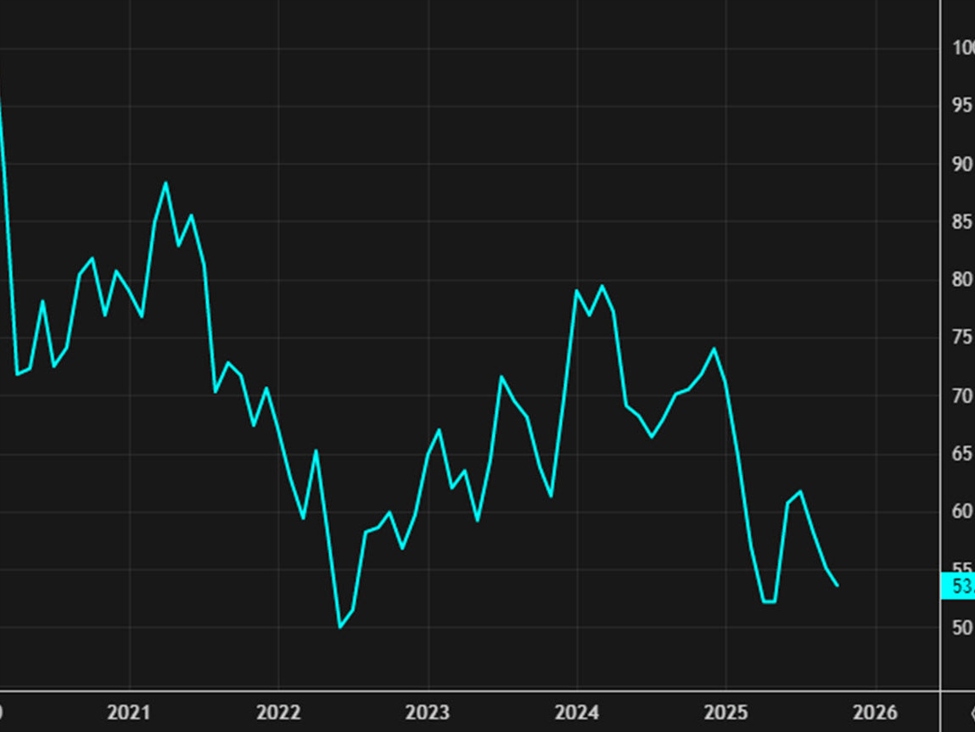
US November final UMich consumer sentiment 51.0 vs 50.5 expected
Prelim was 50.5Prior was 53.6Conditions 51.1 vs 58.6 priorExpectations 51.0 vs 50.3 priorThe UMich numbers are unreliable and haven’t tracked consumer spending for a long time. This article was written by Adam Button at investinglive.com. 🔗 Source 💡 DMK Insight The recent UMich consumer sentiment numbers show a drop to 51.1, and here’s why that matters for ADA: With ADA currently at $0.40, traders should be cautious. The decline from 53.6 to 51.1 indicates a weakening consumer outlook, which could dampen demand for cryptocurrencies as investors may pull back on riskier assets. Historically, when consumer sentiment dips, it often correlates with reduced spending, impacting overall market confidence. This could lead to increased volatility in ADA, especially if it breaks below key support levels. Look for ADA to hold above $0.38 to maintain bullish momentum. If it fails to do so, we might see a deeper correction. Keep an eye on the broader market reaction, as a negative sentiment can ripple through related assets, particularly altcoins that often follow Bitcoin’s lead. The real story is how traders react to these sentiment shifts—monitor trading volumes and sentiment indicators closely for potential entry or exit points. 📮 Takeaway Watch ADA closely; if it drops below $0.38, it could signal a bearish trend, prompting a reassessment of positions.

US wholesale sales for August 0.1% versus 0.4% estimate
Prior month 1.3% (revised from 1.4%)Wholesale sales for the month of August 0.1% versus 0.4% estimate.Wholesale inventories 0.0% versus -0.2% estimate. Inventory to sales ratio 1.28 months versus 1.28 months last month.The ratio is near the low levels going back to midyear 2022 This article was written by Greg Michalowski at investinglive.com. 🔗 Source 💡 DMK Insight Wholesale sales missed estimates, and here’s why that matters for traders: The August wholesale sales came in at 0.1%, significantly below the 0.4% forecast, indicating a potential slowdown in consumer demand. This could signal a broader economic cooling, which might impact various sectors, especially retail and manufacturing. With the inventory-to-sales ratio holding steady at 1.28 months, it suggests that while inventories are stable, they aren’t moving quickly enough to support growth. Traders should keep an eye on related sectors like retail stocks and commodities, as they could react negatively to this data. Moreover, the revision of prior month sales from 1.4% to 1.3% raises questions about the reliability of economic recovery narratives. If this trend continues, we could see a shift in market sentiment, leading to increased volatility in equities and possibly a flight to safer assets like bonds or gold. Watch for any further economic indicators, particularly consumer spending data, as they could provide more context on the health of the economy and influence trading strategies moving forward. 📮 Takeaway Monitor upcoming consumer spending data closely; a continued slowdown could trigger volatility in retail and related sectors.

USD/JPY makes a quick move lower
USD/JPY made a quick move lower, running stops below 156.60 down to 156.20 where it’s bounced.With the intervention talk in USD/JPY, that’s always a threat but I think this is more a case of stops being set on fears of intervention and triggering some quick selling.Moreover, the volatility in stocks markets is a drag on this pair. This article was written by Adam Button at investinglive.com. 🔗 Source 💡 DMK Insight USD/JPY’s drop to 156.20 highlights the fragility of current market sentiment. The recent move lower, triggered by stop-loss orders, suggests traders are increasingly jittery about potential intervention from Japanese authorities. This isn’t just a technical play; it’s a reaction to broader volatility in equities, which often spills over into forex markets. If USD/JPY can hold above 156.20, it might signal a short-term recovery, but a sustained breach could open the door to further declines. Keep an eye on the 156.60 level as a key resistance point; failure to reclaim this could lead to more aggressive selling. On the flip side, if intervention rumors escalate, we could see a sharp reversal, especially if the pair approaches critical psychological levels. Traders should monitor the broader stock market for cues, as a continued downturn could exacerbate selling pressure in USD/JPY. Watch for any news from the Bank of Japan or related economic indicators that could influence market sentiment in the coming days. 📮 Takeaway Watch for USD/JPY to hold above 156.20; a failure to reclaim 156.60 could trigger further selling pressure.
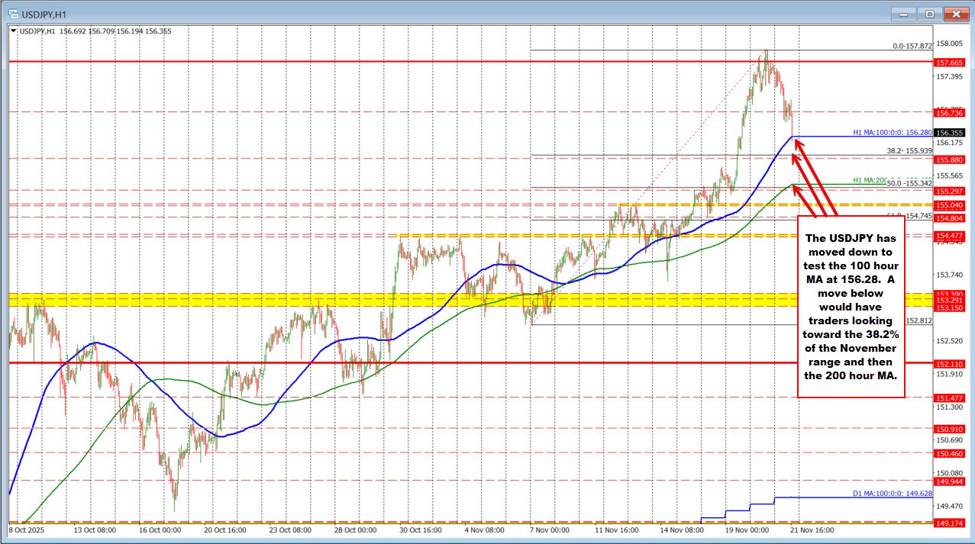
USDJPY corrects lower. Tests the 100 hour MA as the first key downside target
The USDJPY has experienced weakness in the last hour, extending its decline to the 100-hour moving average at 156.28, with a low print of 156.22 just beneath it.The 100-hour MA is the initial key target for sellers seeking to continue the correction. Further downside focus would shift to the 38.2% retracement of the November range at 155.939. A break below that level would bring the 50% retracement and the rising 200-hour moving average (between 155.34 and 155.39) into play. Decisive moves below all these supports are required for sellers to establish control.Currently, the corrective dip has met its first objective. The price action around this level reflects indecision, with sellers needing to push through with conviction to assert dominance. This article was written by Greg Michalowski at investinglive.com. 🔗 Source
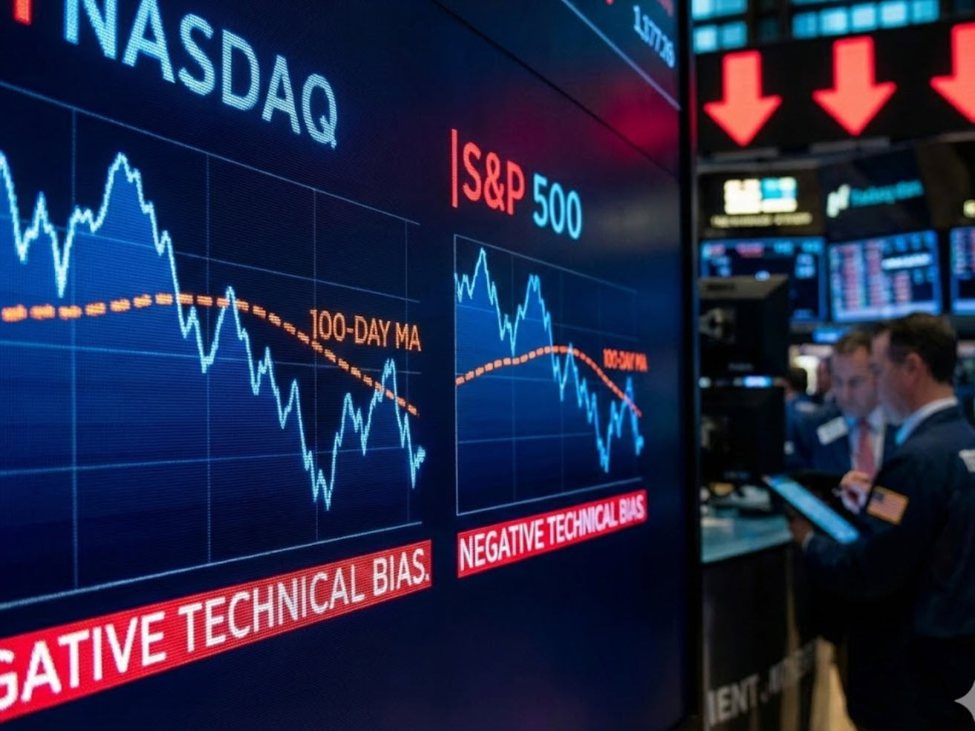
The NASDAQ index trading to new lows and breaking below the 100 day moving average
Both the NASDAQ and S&P 500 are breaking lower, hitting new session lows and crossing below their 100-day moving averages (MA) for the first time since May.S&P 500: The index is currently trading at 6,526.66 (down 0.17%), having slipped below its 100-day MA of 6,547.38.NASDAQ: The index is under significant pressure, down 166 points (-0.75%) to trade at 21,915, well below its 100-day MA of 22,054Technical Outlook: To shift momentum back in favor of the buyers, price action must reclaim the 100-day moving average. As long as prices remain below this key threshold, the market bias remains to the downside. This article was written by Greg Michalowski at investinglive.com. 🔗 Source 💡 DMK Insight The S&P 500 and NASDAQ are both breaking below critical support levels, and here’s why that matters: With the S&P 500 currently at 6,526.66, dipping below its 100-day moving average of 6,547.38, traders should be on high alert. This marks a significant shift in market sentiment, as these moving averages often serve as key support levels. A sustained break below could trigger further selling pressure, especially if we see increased volume on the downside. Look for potential cascading effects across tech stocks, which are heavily weighted in the NASDAQ. If the index continues to falter, it could lead to a broader market correction, impacting related assets like ETFs and individual tech stocks. But here’s the flip side: if the market finds a way to reclaim these levels quickly, it could present a buying opportunity for those looking to capitalize on a rebound. Keep an eye on the 6,500 level as a psychological barrier; a close below this could signal a more extended downturn. Watch for any news catalysts or economic data releases that might sway sentiment in the coming days. 📮 Takeaway Monitor the S&P 500’s performance around the 6,500 level; a close below could signal deeper losses, while a quick recovery might present a buying opportunity.

ECB's Muller: Seems we have inflation close enough to 2% for foreseeable future
Must remain vigilantSeparately from the ECB’s Kocher:There are geopolitical and economic risks that are at a level we haven’t seen in a long timeAt the moment, we seem to be in a good place This article was written by Adam Button at investinglive.com. 🔗 Source 💡 DMK Insight ADA’s current price at $0.40 is a critical juncture amid rising geopolitical tensions. With the ECB’s Kocher highlighting unprecedented risks, traders need to assess how these factors could impact market sentiment. ADA has been relatively stable, but external shocks could trigger volatility. If geopolitical tensions escalate, we might see a flight to safety, affecting not just ADA but the broader crypto market. Keep an eye on support levels around $0.35 and resistance at $0.45. A breach below $0.35 could signal a bearish trend, while a push above $0.45 might attract more buyers. Here’s the thing: while the market seems stable now, the underlying risks are significant. Traders should monitor news closely, especially any developments that could impact the Eurozone or global economic conditions. This isn’t just about ADA; related assets like BTC and ETH could also react strongly to shifts in sentiment. 📮 Takeaway Watch ADA closely; a break below $0.35 could signal a bearish trend, while a push above $0.45 might attract buyers.

Trump: Ukraine is losing land. Thursday is an appropriate deadline for Ukraine plan
Pres. Trump is saying:Ukraine is losing land Russian Pres. Putin does not want to get more landThursday is an appropriate deadline for Ukraine planMeanwhile: Ukraine, France, Germany, and UK are reportedly working on a counterproposal to US peace plan. The proposed 28-point peace plan aimed at ending the war in Ukraine was drafted by U.S. special envoy Steve Witkoff and Russian officials1. Territorial & Border SettlementsThe plan proposes freezing the conflict largely along current front lines, requiring Ukraine to accept the de facto loss of territory:Crimea & Donbas: The U.S. would recognize Crimea, Luhansk, and Donetsk as de facto Russian territory.Frozen Front Lines: Control over the Kherson and Zaporizhzhia regions would be frozen along the current line of contact.Demilitarized Zone: A neutral, demilitarized buffer zone would be established in parts of the Donetsk region currently held by Ukraine.Troop Withdrawal: Ukrainian forces would be required to withdraw from specific contested areas to establish these zones.2. NATO and Military NeutralityA central pillar of the plan is the formal neutralization of Ukraine:No NATO Membership: Ukraine would be required to amend its constitution to renounce any future NATO membership.NATO Stance: Conversely, NATO would formally agree not to admit Ukraine into the alliance.Troop Limitations: The Ukrainian Armed Forces would be capped at 600,000 personnel (a reduction from current wartime levels).No Foreign Troops: The plan explicitly bans the stationing of NATO or other foreign troops on Ukrainian soil.3. Security GuaranteesIn exchange for neutrality, Ukraine would receive “reliable security guarantees” from the United States:The Guarantee: The U.S. would commit to a decisive response (including renewed sanctions and potential military action) if Russia invades Ukraine again.Conditions: These guarantees would be voided if Ukraine were to attack Russian territory or launch unprovoked missile strikes.European Air Support: While troops would be banned from Ukraine, European fighter jets would reportedly be stationed in Poland to provide a defensive umbrella.4. Economic & Reconstruction MeasuresThe plan includes a massive economic component designed to incentivize both Kyiv and Moscow:Reconstruction Fund: A $100 billion fund would be created to finance Ukraine’s reconstruction, funded largely by frozen Russian assets.Sanctions Relief: Russia would see Western sanctions lifted in stages and would be reintegrated into the global economy, including a potential invitation to rejoin the G8.EU Path: While NATO is off the table, the plan affirms Ukraine’s eligibility for European Union membership and offers expedited access to European markets.Current Reactions (November 2025)Ukraine: President Volodymyr Zelenskyy has publicly stated he is ready to discuss the proposal to end the “suffering,” calling it a U.S. “vision.” However, private reports suggest Ukrainian officials view the terms—specifically the territorial concessions and NATO ban—as “absurd” and near-capitulation.Russia: The Kremlin has not publicly endorsed the plan in full, but Russian officials have reportedly expressed optimism, noting that their core security concerns (neutrality and territory) are being addressed.Europe: European leaders have reportedly expressed frustration at being sidelined during the drafting of the proposal, with concerns about the security implications for NATO’s eastern flank. This article was written by Greg Michalowski at investinglive.com. 🔗 Source 💡 DMK Insight So, with Trump weighing in on Ukraine’s territorial losses, traders need to pay attention. This isn’t just political chatter; it could influence energy markets and risk sentiment globally. If Ukraine is indeed losing ground, that could escalate tensions, impacting oil prices and the euro, especially as Europe braces for winter energy demands. The proposed peace plan’s deadline adds urgency, and if negotiations falter, we might see volatility spike in related assets. Keep an eye on crude oil prices; a surge could signal heightened geopolitical risk. Also, watch the euro against the dollar—if the situation deteriorates, the euro might weaken further. But here’s the flip side: if a credible peace plan emerges, we could see a rally in risk assets. Traders should monitor key levels in oil and the euro, particularly the $80 mark for crude and the 1.05 level for the euro. These could be pivotal points in the coming days as the situation unfolds. 📮 Takeaway Watch for crude oil prices around $80 and the euro at 1.05; these levels could signal market reactions to geopolitical developments.