
 Bitcoin
  Ethereum
  Tether
  XRP
XRP  BNB
BNB  USDC
USDC  Solana
  TRON
TRON  Lido Staked Ether
  Figure Heloc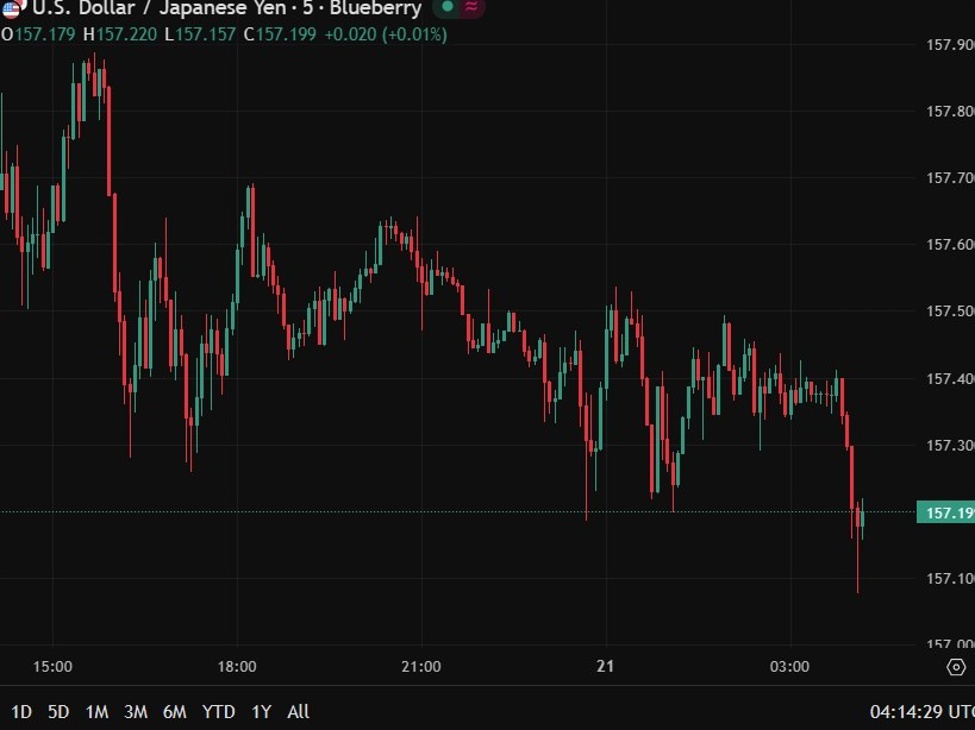
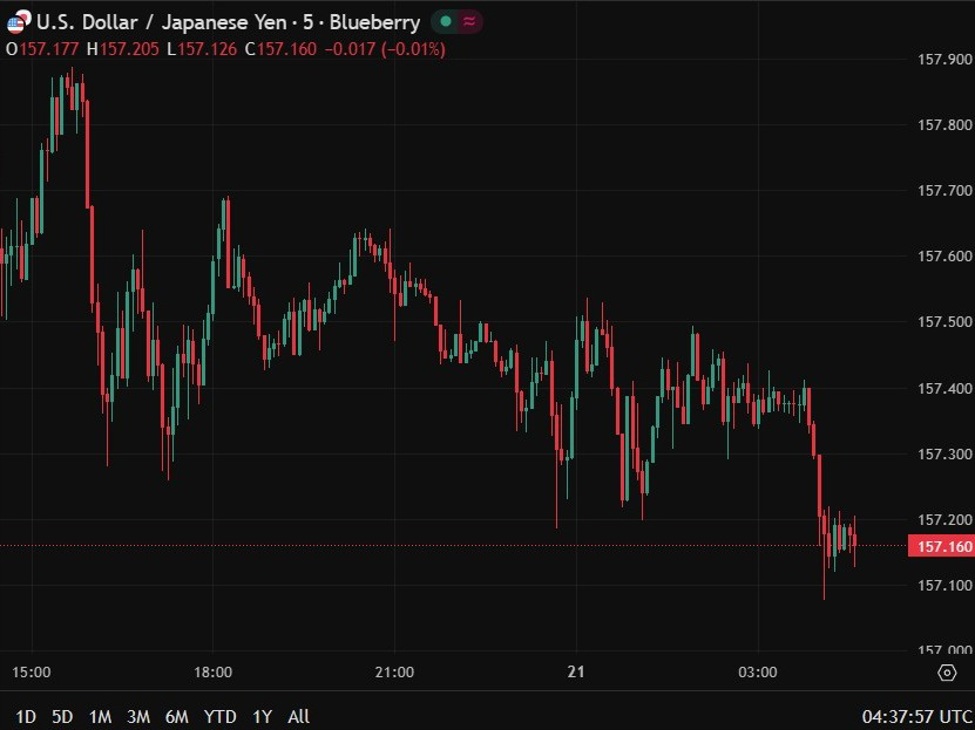
USD/JPY and yen crosses have fallen a little in the wake of Japan’s Cabinet approving the 21.3tln yen economic stimulus package:17.7tln JPY of fresh spending via extra budgetmeasures ranging from price relief to investment support in priority sectorsbiggest portion will go to price relief, ¥11.7 trillion, subsidies, cash handouts and suchThis is the largest round of extra spending since the pandemic.If you’ve been following along today you’ll have noted the multiple rounds of verbal intervention. These had very little yen impact but did cut a little from JGB yields. Yen finally responding now. In a very limited way! This article was written by Eamonn Sheridan at investinglive.com. 🔗 Source
investingLive Asia-Pacific FX news wrap: Japan approved a ¥21.3 trillion stimulus package
Yen finally finding some small bids as Japan’s Cabinet approves 21tln stimulus packageU.S. charges four in Nvidia chip-smuggling case, revives calls for chip trackingBitcoin, Ether continue to slide – crypto crushUeda:inflation to converge around our target sometime from latter half of next fiscal yearOffshore yuan not artificially cheap, Mizuho says, citing stronger regional positioningBoJ Gov Ueda says prospect of economy, price forecasts materializing increasing (rate hikeRecap – Japan export rebound continues in October despite lingering U.S. weaknessJapan says debt ratio to edge lower as govt, BOJ work toward stable inflationEquities here in APAC taking a hit, as you’d expectPBOC sets USD/ CNY reference rate for today at 7.0875 (vs. estimate at 7.1154)EU explores investment in Australian resources as trade talks set to restartBank of Japan Governor Ueda says weak yen pushes up import prices, factor in higher CPIJapan preliminary manufacturing PMI for November 48.8 (prior 48.2)Bessent wants more Fed rate cuts (Yes, I know, Bessent parroting Trump is not news)Japanese finance minister Katayama – another attempt at verbal intervention yen supportUK consumer confidence falls ahead of budget as households brace for tax hikesSingapore lifts 2025 growth forecast after Q3 GDP beats expectationsJapan exports beat expectations in October as Asia and EU demand pick upFed’s Paulson urges caution on December rate cut decision as job risks edge higherJapan fin min with some verbal intervention to try to support the yenJapan November Core CPI 3.0% (3.0% expected, prior 2.9%)Recap – Japan readies ¥21.3tn (USD 135bn) stimulus, largest since CovidICYMI – Morgan Stanley drops December Fed cut call after strong September payroll reboundICYMI – Trump’s latest cave in, slashes tariffs on Brazil. Every day brings a TACO story.Top Bitcoin whale sells entire $1.3bn BTC stack as sentiment fadesAustralian preliminary November PMIs: Manufacturing 51.6 (prior 49.7)investingLive Americas market news wrap: Ugly price action in a big stock market reversalNew Zealand October trade improves, both imports and exports higher m/m$20bn extra bail out for Argentina – banks say NoJapan trying some verbal yen intervention after the close, can’t blame ’em for tryingThe major indices tumble as buyers that the open sell into the closeFed’s Goolsbee is uneasy about cutting interest rates in the face of too-high inflationNasdaq and the S&P 500 break the October lowMajor FX traded in subdued, narrow ranges. Even the yen — the market’s focal point thanks to a wave of data, policy hints and fresh fiscal headlines — barely budged, with USD/JPY holding around 157.46, until a final dip.Japan’s November flash PMIs were mixed:Manufacturing remained in contraction for a fifth month at 48.8, an improvement from 48.2.Services held firm at 53.1, marking continued resilience.The composite PMI rose to 52.0, its eighth month in expansion.Inflation firmed modestly, staying well above the 2% target on all three measures:Core CPI: 3.0% y/y (prior 2.9%)Headline CPI: 3.0% y/yCore-core (ex-food & energy): 3.1%All readings aligned with expectations and support the case for near-term BOJ tightening.Exports were a bright spot. Shipments rose 3.6% y/y, beating the 1.1% consensus and marking a second month of gains, helped by resilient demand in Asia and a softer yen. Exports to the U.S. fell 3%, the seventh straight monthly decline, though the tariff impact appears more limited than feared.Governor Ueda emphasised that currency volatility is increasingly feeding into import prices and inflation expectations. He said the BOJ will scrutinise FX pass-through closely and reiterated that the bank’s baseline remains further rate hikes if the economy and inflation track forecasts. Ueda noted that the likelihood of those projections materialising is increasing, reinforcing expectations of further, gradual policy normalisation.The yen finally gained a little more on headlines that the cabinet approved a ¥21.3 trillion stimulus package, Japan’s largest since the pandemic, with ¥17.7 trillion in fresh spending. Investors remain wary of the heavy funding requirements.—EU Trade Commissioner Maros Šefčovič said Brussels is exploring equity stakes, long-term offtake agreements, and joint investments in Australian resources projects as part of renewed trade-deal momentum.He expects another round of Australia–EU FTA talks early next year, with critical minerals emerging as a central pillar. Australian equities underperformed, falling to a five-month low.-Singapore’s economy beat expectations in Q3, prompting the government to lift its 2025 GDP forecast to ~4.0% (from 1.5–2.5%). Stronger global demand and resilient regional growth drove the upgrade.The Monetary Authority of Singapore (the country’s central bank) said its policy stance remains appropriate with the output gap positive this year and normalising in 2026.-Chicago Fed President Austan Goolsbee warned against front-loading rate cuts, saying inflation has been “steady at best, and worse by some measures.” He remains uneasy about adding a third consecutive cut in December and stressed the Fed needs more clarity before easing further. -Crypto fell again. Bitcoin whale Owen Gunden, the world’s eighth-largest individual BTC holder, fully liquidated his 11,000-BTC stack (~$1.3bn) over the past month, delivering a psychological blow to sentiment.Oil remained heavy amid broader risk caution. Asia-Pac stocks:Japan (Nikkei 225) -2.4%Hong Kong (Hang Seng) -2.1% Shanghai Composite -1.9%Australia (S&P/ASX 200) -1.6%, hit five month lows This article was written by Eamonn Sheridan at investinglive.com. 🔗 Source 💡 DMK Insight Ethereum’s drop to $2,712.01 is a signal for traders to reassess their positions. With Bitcoin and Ether both sliding, it’s clear that the broader crypto market is under pressure, likely influenced by macroeconomic factors like Japan’s stimulus package and ongoing U.S. regulatory scrutiny. The approval of a 21 trillion yen stimulus could provide temporary support for risk assets, but it also raises concerns about inflation, which could impact crypto valuations. Traders should watch for key support levels around $2,600 for ETH; a breach could trigger further selling. On the flip side, if the market finds footing here, it could present a buying opportunity, especially if sentiment shifts positively after the stimulus effects are felt. Keep an eye on the correlation between crypto and equities, particularly tech stocks, as they often move in tandem during volatile periods. Monitoring the daily RSI for oversold conditions could also provide insights into potential reversals. 📮 Takeaway Watch for Ethereum to hold above $2,600; a drop below

Takaichi: Japan may issue bonds for stimulus but total JGB supply to stay below last year
Japanese Prime Minister Sanae Takaichi said the government is prepared to issue new bonds to help fund the latest stimulus package if stronger tax revenues fall short, but stressed that overall JGB issuance will still be smaller than last year’s total.Takaichi reiterated that Japan must pursue sustainable public finances through economic growth, signalling her administration’s intention to balance near-term fiscal support with longer-term consolidation. —The commitment to keep JGB issuance below last year’s levels may help steady debt-market sentiment, though reliance on new bonds underscores lingering fiscal pressure. This article was written by Eamonn Sheridan at investinglive.com. 🔗 Source 💡 DMK Insight Japan’s potential bond issuance could shake up the JGB market and impact forex trading. With Prime Minister Takaichi’s comments on new bonds to fund stimulus, traders should keep an eye on how this affects the Japanese yen. If tax revenues don’t meet expectations, increased JGB issuance could lead to higher yields, making the yen less attractive. This scenario might trigger a sell-off in JPY pairs, especially against the USD, which has been showing strength recently. Watch for key levels around USD/JPY; a break above recent highs could signal further upside for the dollar. On the flip side, if the government manages to keep issuance lower than last year while still stimulating the economy, it could bolster confidence in the yen. Traders should monitor economic indicators closely, particularly tax revenue reports and inflation data, as these will influence the Bank of Japan’s stance on monetary policy. The next few weeks are crucial, so keep an eye on the daily charts for volatility spikes around these announcements. 📮 Takeaway Watch USD/JPY closely; a break above recent highs could indicate further dollar strength if JGB issuance increases.

FX option expiries for 21 November 10am New York cut
EUR/USD1.1680 (EUR 1.30 bn)1.1625 (EUR 1.39 bn)1.1500 (EUR 1.50 bn)USD/JPY 155.00 (US$ 761.93 mn)GBP/USD1.3435 (GBP 282.82 mn)USD/CHF0.8050 (US$ 408.74 mn)0.7870 (US$ 212.00 mn)USD/CAD1.4200 (US$ 519.71 mn)1.4120 (US$ 723.08 mn)1.3970 (US$ 770.60 mn)1.3900 (US$ 693.89 mn)AUD/USD0.6550 (AUD 3.03 bn)NZD/USD0.5480 (NZD 1.01 bn)EUR/GBP0.8810 (EUR 409.27 mn)For more information on how to use this data, you may refer to this post here. This article was written by Giuseppe Dellamotta at investinglive.com. 🔗 Source 💡 DMK Insight EUR/USD is hovering around 1.1680, and here’s why that matters right now: With significant liquidity at key levels—1.1625 and 1.1500—traders should watch for potential volatility as these levels could act as support or resistance. The current sentiment in the forex market is influenced by recent economic data releases and central bank communications, particularly from the ECB and the Fed. If the EUR/USD breaks below 1.1625, it could trigger further selling pressure, while a bounce back could signal a bullish reversal, especially if it manages to reclaim 1.1700. Additionally, the USD/JPY at 155.00 is another critical level to monitor, as it reflects broader dollar strength and can impact cross-currency pairs. Keep an eye on the upcoming economic indicators that could sway these pairs, particularly any shifts in interest rate expectations or inflation data. On the flip side, if the market remains range-bound, traders might consider scalping strategies around these key levels. The real story is how these currency pairs react to macroeconomic news in the coming days, so stay alert for any surprises. 📮 Takeaway Watch for EUR/USD’s reaction at 1.1625 and 1.1700; a break could signal a shift in momentum.

UK October retail sales -1.1% vs +0.0% m/m expected
Prior +0.5%; revised to +0.7%Retail sales +0.2% vs +1.5% y/y expectedPrior +1.5%; revised to +1.0%Retail sales ex autos, fuel -1.0% vs -0.3% m/m expectedPrior +0.6%; revised to +0.7%Retail sales ex autos, fuel +1.2% vs +2.5% y/y expectedPrior +2.3%; revised to +1.7%Full report hereThese are all big misses and the initial reaction saw of course the GBP falling across the board.From the agency: “The quantity of goods bought (volume) in retail sales is estimated to have risen by 1.1% in the three months to October 2025 compared with the three months to July 2025. Clothing store sales rounded off a strong performance in those three months, peaking in September, while computer and telecommunication retailers rose across September and October 2025.””Retail sales volumes are estimated to have fallen by 1.1% in October 2025, following an increase of 0.7% in September 2025 (revised up from a 0.5% rise in our previous publication) and of 0.5% in August 2025 (revised down from a 0.6% rise in our previous publication). This was the first monthly fall since May 2025. Supermarkets, clothing, and mail order retailers fell in October 2025, which some retailers attributed to consumers delaying their spending in the lead up to Black Friday.” This article was written by Giuseppe Dellamotta at investinglive.com. 🔗 Source 💡 DMK Insight Retail sales data just missed the mark, and here’s why that matters for ETH: With ETH currently at $2,712.01, the disappointing retail sales figures—especially the -1.0% month-over-month drop in sales excluding autos and fuel—signal a potential slowdown in consumer spending. This could lead to a bearish sentiment in the broader market, impacting risk assets like Ethereum. Traders should be wary of how this data could influence the upcoming Federal Reserve decisions on interest rates, as weaker economic indicators often lead to a more dovish stance. Look for ETH to test key support levels around $2,650. If it breaks below that, we might see further downside pressure. Conversely, if it holds, it could be a buying opportunity for those looking to capitalize on potential rebounds. Keep an eye on correlated assets like Bitcoin, which often moves in tandem with ETH; any significant shifts there could amplify ETH’s volatility. Watch for any news from the Fed or economic indicators in the coming weeks that could shift market sentiment significantly. 📮 Takeaway Monitor ETH’s support at $2,650 closely; a break could signal further downside, while holding could present a buying opportunity.

Japan Finance Minister: Will pursue a responsible fiscal policy, not just a proactive one
Can’t comments on expected size of additional bond issuance to fund the latest package Believe markets have stabilised after various announcementsVarious factors contribute to market developmentsDon’t believe latest package is sufficiently big to ignite demand-driven inflationTotal bond issuance this fiscal year to be below last fiscal yearThe Japanese Yen caught a bit on these comments likely because of Katayama’s comment on lower bond issuance. Couple that with the recent intensification of verbal intervention and the chance of a rate hike in December due to the fast depreciation of the currency. This article was written by Giuseppe Dellamotta at investinglive.com. 🔗 Source 💡 DMK Insight The Japanese Yen’s recent movements signal a potential shift in market sentiment, and here’s why that’s crucial right now: With the announcement of a new bond issuance package, traders are weighing its impact on inflation and currency strength. The expectation that total bond issuance will be below last fiscal year suggests a tighter monetary environment, which could support the Yen in the short term. However, the belief that the package isn’t large enough to spark demand-driven inflation raises questions about the effectiveness of these measures. If inflation remains subdued, the Bank of Japan may maintain its accommodative stance longer than anticipated, which could lead to further Yen weakness against currencies like the USD. Watch for key levels around recent support and resistance points, as a break below these could signal a bearish trend for the Yen. Additionally, keep an eye on global risk sentiment; if markets stabilize, we might see a stronger Yen as safe-haven demand increases. In summary, the interplay between bond issuance and inflation expectations is critical, and traders should monitor the Yen closely for any signs of volatility or trend shifts. 📮 Takeaway Watch the Japanese Yen closely; a break below recent support levels could indicate further weakness, especially if inflation remains low and bond issuance is limited.

France November business confidence 98 vs 100 expected
Prior 101Services sector confidence 98 vs 95 priorA little miss here but it’s not a market-moving report and it certainly won’t change anything for the ECB. This article was written by Giuseppe Dellamotta at investinglive.com. 🔗 Source 💡 DMK Insight The slight dip in services sector confidence from 98 to 95 isn’t a game changer, but it does reflect underlying economic concerns. For traders, this report signals a cautious sentiment that could influence ECB policy discussions. While it won’t prompt immediate action, keep an eye on how this plays into broader economic indicators. If we see a continued trend of declining confidence, it could lead to a more dovish stance from the ECB, impacting euro pairs. Watch the EUR/USD closely; if it breaks below key support levels, it could trigger further selling pressure. Also, consider how this might ripple into related markets like equities, where investor sentiment could wane further. The real story is whether this is an isolated blip or part of a larger trend. So, monitor upcoming economic data releases for confirmation of this sentiment shift. 📮 Takeaway Watch the EUR/USD for potential breakdowns below key support levels, as declining services confidence could signal a shift in ECB policy.

Nasdaq Market Update from orderFlow Intel at investingLive.com
investingLive.com Stock Market Update NowNasdaq Futures Struggle After Yesterday’s Reversal. Caution Still WarrantedNasdaq futures remain under pressure this morning after a dramatic session yesterday that caught many traders off guard. The market opened Wednesday with strong enthusiasm following Nvidia’s earnings beat, and for several hours the sentiment was decisively positive. By the afternoon, however, that strength reversed sharply. What looked like a clean continuation day suddenly turned into a full fade, and traders who entered late on the bullish side found themselves on the wrong side of a fast pivot.Today’s session has carried that weakness forward. Nasdaq futures have already taken out last month’s low at 24158.5, dropping as far as 24018 earlier, and the price continues to trade below key intraday reference points such as the developing value area, VWAP, and the session’s point of control. At the time of writing, NQ is trading near 24077, with price rotation occurring mostly inside a broad horizontal band between 24130 and 24070.While yesterday’s NVDA optimism may tempt some traders and investors to buy the dip, the structure so far suggests caution. The market has not yet shown evidence of sustained buyer commitment. Instead, repeated attempts to stabilize have been met with heavier volume on declines than on rebounds, a pattern that often signals distribution rather than accumulation. In simpler terms, sellers appear more active than buyers within the current range, and the buying that does appear has not yet proven durable.One important reference level to watch is the round number at 24000. Round figures often act as magnets in markets, especially when price hovers nearby without fully testing them. Since NQ already took out last month’s low and is trading below the core intraday levels that typically support bullish reversals, a test of 24000 would not be surprising. Such a move would flush remaining liquidity at that psychological level and help reveal whether buyers are finally prepared to step in.This does not rule out the possibility of a rebound later today, but from a decision support perspective, traders should be aware that early bullish attempts have not held and that market structure remains weak. For short-term traders and longer-term investors alike, the message is simple: the market is still leaning bearish until price can reclaim and hold above key intraday levels, particularly the developing value area and VWAP.investingLive.com will continue monitoring these developments closely. As always, this is not a prediction of certainty but a snapshot of the current balance of forces in the market. When structure improves, it will show up in the data. For now, the evidence argues for patience, discipline, and a healthy respect for the downside risk until the Nasdaq proves otherwise.We may dish out some trade ideas on our Telegram channel ( https://t.me/investingLiveStocks ) , come on over, it’s free. Always invest and trade at your own risk only as we do this for educational purposes only. This article was written by Itai Levitan at investinglive.com. 🔗 Source 💡 DMK Insight Nasdaq futures are feeling the heat after yesterday’s unexpected reversal, and here’s why that’s crucial for traders: The initial excitement from Nvidia’s earnings report quickly faded, leaving many traders scrambling. This kind of volatility can be a double-edged sword; while it presents opportunities for quick gains, it also raises the stakes for risk management. Traders should be wary of the broader market context—if the Nasdaq continues to struggle, it could signal a shift in sentiment that impacts tech stocks across the board. Watch for key support levels around recent lows; if those break, it could trigger further selling pressure. Additionally, keep an eye on correlated assets like semiconductor stocks, which often follow Nvidia’s lead. Here’s the flip side: if the Nasdaq finds its footing and rallies back, it could reignite bullish sentiment. So, monitor the next few trading sessions closely—if we see a bounce off support, it might be worth considering long positions. But if the downward trend continues, tightening stops and reassessing positions will be essential. 📮 Takeaway Watch for Nasdaq futures to hold above key support levels; a break could lead to further declines, while a bounce might present buying opportunities.

France November flash services PMI 50.8 vs 48.4 expected
Prior 48.Manufacturing PMI 47.8 vs 49.0 expectedPrior 48.8Composite PMI 49.9 vs 48.1 expectedPrior 47.7Full report hereKey Findings:Fresh expansion in services activity helps French economy stabilise in NovemberComment:Commenting on the flash PMI data, Jonas Feldhusen, Junior Economist at Hamburg Commercial Bank, said: “The French private sector shows signs of stabilisation in November after October’s moderate decline, which we attributed largely to political turmoil and the resulting uncertainty. In November, the HCOB Flash PMIs point to economic consolidation, but sectoral momentum is divided: while the service sector is strengthening, the manufacturing sector remains under pressure. Given the unresolved budget and persistent political tension, the foundation of this stabilisation remains on shaky ground. “The situation in the service sector has brightened somewhat. Demand-related indicators such as business activity and new orders have climbed above the growth threshold for the first time this year. Whether this marks the beginning of a sustainable recovery, however, will only become clear in the coming months. Some sub-indices, such as outstanding business and employment, were weak, underscoring the fragility of the rebound. “The situation in the manufacturing sector remains tense. The PMI deteriorated in November, meaning that manufacturing remains the problem child of the economy. Production and the order situation in particular leave much to be desired. Production and order intakes are particularly disappointing. Despite these structural challenges, compounded by US trade policy and Chinese competition, manufacturers are markedly more optimistic about the future in November. “Cost inflation accelerated, driven by both the manufacturing and service sectors. Meanwhile, pricing power of companies weakened, as average output prices stayed at the same level observed in October. Consequently, profit margins of companies are likely to have shrunk in November.” This article was written by Giuseppe Dellamotta at investinglive.com. 🔗 Source 💡 DMK Insight The French Composite PMI coming in at 49.9, above expectations, suggests a potential turning point for the economy. This is crucial for traders as it indicates a stabilization in the private sector, particularly with services showing fresh expansion. A reading above 50 typically signals growth, and this could lead to increased investor confidence. If this trend continues, we might see a bullish sentiment in the Eurozone, impacting the euro against major currencies. Traders should keep an eye on the euro’s performance, especially if it breaks key resistance levels. The immediate focus should be on the upcoming economic indicators that could further validate this trend, particularly the manufacturing sector’s performance. If the Manufacturing PMI can also show improvement, it could solidify a more optimistic outlook for the French economy and the euro. However, it’s worth noting that the PMI is still below the growth threshold, so caution is warranted. Watch for any shifts in market sentiment that could lead to volatility, especially around the next set of economic data releases. 📮 Takeaway Monitor the euro’s performance closely; a break above key resistance could signal a bullish trend if the Manufacturing PMI improves.

ECB's Lagarde: Will continue adjust policy as needed to ensure inflation remains at target
ECB rate cuts are increasingly supporting financing conditionsFiscal packages will have a measurable growth effectShe’s not deviating from her recent comments as the ECB remains in neutral stance watching how the economy evolves. This article was written by Giuseppe Dellamotta at investinglive.com. 🔗 Source 💡 DMK Insight The ECB’s neutral stance could signal a shift in market dynamics as traders assess growth impacts. With financing conditions improving due to potential rate cuts, traders should keep an eye on how this affects the euro against major currencies. If the ECB maintains its current course, we might see volatility in forex pairs like EUR/USD, especially if economic data starts to reflect growth. The market’s reaction to fiscal packages will be key; if they indeed stimulate growth, we could see a bullish trend in the euro. However, if growth expectations falter, the euro could weaken, creating opportunities for short positions. Watch for upcoming economic indicators and central bank communications that could shift sentiment quickly. 📮 Takeaway Monitor EUR/USD closely; a shift in growth expectations could lead to significant volatility in the coming weeks.