
 Bitcoin
  Ethereum
  Tether
  BNB
BNB  XRP
XRP  USDC
USDC  Solana
  TRON
TRON  Lido Staked Ether
  Figure Heloc
Analysts suggest Canary Capital’s spot XRP ETF could go live even as formal approval by the SEC is still technically pending. 🔗 Source 💡 DMK Insight XRP’s price at $2.51 is buzzing with potential as the ETF chatter heats up. The anticipation surrounding Canary Capital’s spot XRP ETF could be a game changer for XRP traders. Even without formal SEC approval, the market is reacting to the possibility of increased institutional interest, which historically tends to drive prices up. If the ETF launches, we could see a surge in buying pressure, especially if it aligns with broader bullish trends in the crypto market. Keep an eye on the $2.60 resistance level; a breakout above this could signal a strong upward momentum. But here’s the flip side: if the SEC delays or denies approval, we might see a sharp correction. Traders should monitor sentiment closely, especially on social media and trading forums, as these can provide early signals of shifts in market psychology. Watch for volume spikes around key announcements—those could be your best indicators for entering or exiting positions. 📮 Takeaway Watch for XRP to breach $2.60; a breakout could signal strong bullish momentum, but a SEC delay might trigger a sharp pullback.

Taiwan premier promises Bitcoin reserve assessment report by end of 2025
Taiwan is exploring the creation of a national Bitcoin Reserve comprising seized coins, much like the US Strategic Bitcoin Reserve established by President Donald Trump in March. 🔗 Source 💡 DMK Insight Taiwan’s move to create a national Bitcoin Reserve could shift market dynamics significantly. This initiative mirrors the US Strategic Bitcoin Reserve and signals a growing acceptance of Bitcoin as a legitimate asset class. For traders, this could mean increased volatility as institutional interest ramps up, especially if Taiwan’s reserve strategy influences other nations. Watch for potential price reactions in Bitcoin and related assets like Ethereum, as geopolitical developments often lead to speculative trading. Key levels to monitor include recent support and resistance zones, which could be tested as news unfolds. If Taiwan’s reserve gains traction, it might prompt other countries to follow suit, creating a ripple effect in the crypto market. However, there’s a contrarian angle to consider: if the market perceives this as a government overreach or manipulation, it could lead to a sell-off. Keep an eye on sentiment indicators and social media chatter for early signs of market reaction. The next few weeks will be crucial as traders digest this news and its implications. 📮 Takeaway Watch for Bitcoin’s reaction around key support levels as Taiwan’s national reserve plan unfolds; it could trigger significant volatility.

Japan wholesale inflation slows to 2.7% as import costs fall, BOJ stays cautious – recap
Japan’s wholesale inflation eased slightly in October, with producer prices rising 2.7% from a year earlier, down from a revised 2.8% in September, according to Bank of Japan data.Data post is here:Japan October PPI +0.4% m/m (expected +0.3%) & +2.7% y/y (expected +2.5%)The slowdown was driven partly by falling import costs, with the import price index down 1.5% on the year. The outcome was marginally above economists’ expectations for a 2.5% gain, suggesting underlying price pressures remain firm even as imported cost pressures soften.The corporate goods price index (CGPI) is closely watched by the BOJ as an early signal of future consumer inflation. While headline CPI has been above the BOJ’s 2% target for more than three years, Governor Kazuo Ueda has emphasised the need to move cautiously on rate hikes, arguing that the central bank must be confident inflation is being fuelled by domestic demand rather than higher raw material costs.Ueda spoke today:BoJ Ueda: BOJ striving to achieve moderate inflation, wage growth, helping improve economyUeda says BOJ ready to act if long-term yields move out of line with fundamentalsUSD/JPY has backed away from 155 without falling too far. This article was written by Eamonn Sheridan at investinglive.com. 🔗 Source 💡 DMK Insight Japan’s easing wholesale inflation is a mixed bag for traders: it signals potential relief but also hints at underlying economic fragility. With producer prices rising 2.7% year-over-year, slightly above expectations, this could influence the Bank of Japan’s monetary policy. If inflation continues to cool, we might see a shift in interest rate strategies, impacting the yen and related forex pairs. Traders should keep an eye on the USD/JPY, especially if it approaches key resistance levels. Falling import prices could indicate weakening demand, which might ripple through to consumer prices, affecting overall economic sentiment. Watch for any shifts in the Bank of Japan’s tone in upcoming statements, as they could signal a pivot in their approach to stimulus. On the flip side, the slight uptick in producer prices could also be seen as a sign that inflation isn’t dead yet, which could keep the BOJ cautious. This duality presents both risks and opportunities for traders, particularly in the forex market where volatility could spike around policy announcements. Keep an eye on the next PPI report for further insights into this trend. 📮 Takeaway Watch the USD/JPY closely; any movement towards key resistance levels could signal significant trading opportunities as inflation trends evolve.

Tokyo Stock Exchange considers curbs on listed firms hoarding crypto assets
Japan Exchange Group (JPX), operator of the Tokyo Stock Exchange, is examining new measures to rein in a rise in listed companies that accumulate large cryptocurrency holdings as part of their treasury strategy, according to people familiar with the discussions. Regulators are becoming concerned that the growing number of digital-asset treasury (DAT) firms poses governance and investor-protection risks, particularly after sharp drops in several such companies’ share prices.JPX is considering stricter application of rules designed to prevent backdoor listings and may require some firms to undergo fresh audits, though no decisions have been finalised. The exchange has already pushed back on several companies’ crypto-purchase plans: since September, three listed firms have halted their digital-asset buying after JPX warned that turning crypto accumulation into a business model could limit their ability to raise funds.While listed companies are not prohibited from holding cryptocurrencies, JPX said it is monitoring firms that raise red flags from a risk or governance perspective, with the explicit goal of protecting shareholders. The potential tightening comes amid growing concern that retail investors have been exposed to unexpected losses linked to volatile DAT-related stocks. This article was written by Eamonn Sheridan at investinglive.com. 🔗 Source 💡 DMK Insight JPX’s scrutiny of crypto holdings could shake up market dynamics significantly. With regulators eyeing companies that stockpile cryptocurrencies, traders should brace for potential volatility. This move indicates a growing concern over the stability of firms heavily invested in digital assets, which could lead to increased regulatory scrutiny across other markets as well. If companies are forced to liquidate or limit their crypto exposure, we might see a ripple effect impacting not just crypto prices but also related equities, especially in tech and finance sectors. Keep an eye on how this unfolds, as it could set a precedent for other exchanges and influence investor sentiment. For traders, monitoring the response from major companies and any regulatory announcements will be crucial. Watch for key price levels in Bitcoin and Ethereum, as a significant sell-off could trigger broader market corrections. The next few weeks will be pivotal, so stay alert for any shifts in trading volumes or sentiment that could signal larger trends. 📮 Takeaway Watch for regulatory developments from JPX; significant sell-offs in crypto could impact related equities and trigger broader market corrections.

Australian dollar up, shares down. Strong jobs report destroys hope for RBA rate cut.
The headlines showing a strong jobs market in Australia have hit local equities Australian shares fell to their lowest in three months, S&P/ASX 200 to its lowest since August 5 after its sharpest fall in 7 weeksThe data:Australian October unemployment rate 4.3% (expected 4.4%, prior 4.5%)unemployment rate dropped, employment change is twice what was expected, full time jobs surgedthe fall in the jobless rate pulls back from a recent four year highLike the headline says, the data destroys hopes of a rate cut for the Reserve Bank of Australia. For quite some time ahead. December rate cut pricing has dropped to around 20%. That’s still way too optimistic. This article was written by Eamonn Sheridan at investinglive.com. 🔗 Source 💡 DMK Insight Australia’s job market strength is a double-edged sword for traders right now. While a drop in the unemployment rate to 4.3% (from 4.5%) signals economic resilience, it’s also led to a sell-off in the S&P/ASX 200, which hit a three-month low. This reaction suggests that traders are concerned about potential interest rate hikes from the Reserve Bank of Australia (RBA) as strong employment data could prompt tighter monetary policy. Keep an eye on the broader economic indicators, as sustained job growth might lead to inflationary pressures, impacting not just equities but also the forex market, particularly AUD pairs. If the ASX continues to slide, watch for support levels around the previous lows to gauge potential reversal points. On the flip side, this could create buying opportunities if the market overreacts. Traders should monitor the upcoming RBA meetings for any hints on interest rate adjustments, as that could shift market sentiment dramatically. The immediate focus should be on the S&P/ASX 200’s performance over the next week, especially if it tests key support levels. 📮 Takeaway Watch the S&P/ASX 200 closely; a break below recent lows could signal further declines, while upcoming RBA commentary will be crucial for direction.

Trump has signed the bill to reopen the US government
Trump has now signed the bill to reopen the US government.Shut down is over. Until the next one. This bill funds the government until the end of January. -Trump admits a lot of damage has been done:estimates it cost US$1.5tlndamage will take weeks and months to totally calculatecalls for termination of the filibusternormal operations will resumeshould never shut down the government again says people should have money to pay for health care, direct payments This article was written by Eamonn Sheridan at investinglive.com. 🔗 Source 💡 DMK Insight The government shutdown’s end might seem like good news, but here’s why traders should stay cautious: While the reopening provides temporary relief, the estimated $1.5 trillion in damage signals deeper economic concerns. This could lead to volatility in markets, particularly in sectors sensitive to government spending like defense and infrastructure. Traders should watch for potential ripple effects on the dollar and Treasury yields, especially as we approach the end of January when funding discussions will resurface. If uncertainty looms, we might see a flight to safety in assets like gold or US Treasuries. Keep an eye on key economic indicators and sentiment shifts as the market adjusts to this temporary stability, and don’t forget to monitor the political landscape for any signs of future shutdown threats. 📮 Takeaway Watch for volatility in the dollar and Treasury yields as the government funding deadline approaches in January.

China set for 5% growth in 2026 on strong exports, Macquarie's out of consensus call says
China’s economy could maintain a 5% growth rate in 2026, driven largely by unexpectedly strong export performance, according to Macquarie economists. In a new note, they highlight that exports have been the biggest upside surprise this year, rising 5% year-to-date through October despite the drag from Trump-era tariffs. That pace is only slightly below the 6% increase recorded in 2024, underscoring China’s resilient manufacturing competitiveness.Macquarie expects exports to expand by 6% next year, far above the market consensus of around 1%. Strong external demand, they argue, is likely to persist and could reduce Beijing’s urgency to roll out aggressive domestic stimulus, even as China continues to face deflationary pressures. With global growth expected to accelerate, the economists say China may again outperform expectations on trade, supporting its broader growth trajectory into next year. —A stronger-than-expected export cycle would help stabilise China’s growth outlook, with implications for global supply chains, Asian FX, and commodity demand. Persistent deflation, however, highlights the uneven nature of the recovery and keeps Beijing’s policy stance in focus. This article was written by Eamonn Sheridan at investinglive.com. 🔗 Source 💡 DMK Insight China’s unexpected export growth could shift market dynamics significantly. With exports rising 5% year-to-date, traders should consider how this impacts commodities and currencies tied to China’s economy. A sustained growth rate of 5% into 2026 could bolster demand for raw materials, affecting prices in sectors like copper and oil. If this trend continues, we might see a stronger yuan, which could influence forex pairs like USD/CNY. However, keep an eye on geopolitical tensions and tariff policies, as they could quickly reverse these gains. The real story is whether this growth can withstand external pressures or if it’s a temporary spike. Watch for key economic indicators from China in the coming months, especially trade balance reports and manufacturing data, to gauge if this trend is sustainable or just a blip on the radar. 📮 Takeaway Monitor China’s trade balance and manufacturing data closely; sustained export growth could strengthen the yuan and impact commodity prices significantly.
Westpac: October job rebound lets RBA look past September weakness, stay inflation-focused
Westpac said October’s stronger labour force figures largely cancel out the weaker-than-expected result seen in September, leaving the broader story of a gradually softening jobs market intact. The bank argues that the underlying trend remains one of “less tight” labour conditions rather than any meaningful shift in momentum.The economists noted that RBA Governor Michele Bullock described the September data as containing “some signal” and “some noise,” but suggested today’s improvement gives the central bank grounds to largely dismiss that earlier weakness. Such a reaction would align with an RBA that remains chiefly concerned about persistent, above-target inflation rather than short-term volatility in employment.With the labour market neither threatening to reignite price pressures nor deteriorating sharply enough to raise alarm, Westpac expects the RBA to stay focused on the sequence of inflation prints. Policymakers will be looking for clearer evidence that underlying inflation is on track to ease toward the midpoint of the target band over the year ahead, the bank said.—The bank’s assessment reinforces expectations that the RBA will remain on hold, with labour-market conditions neither driving inflation higher nor signalling economic stress. Focus stays on upcoming CPI prints as the key determinant of policy direction.—Earlier:Australian dollar up, shares down. Strong jobs report destroys hope for RBA rate cut.Australian dollar jumped higher on the very strong jobs report – no RBA rate cuts aheadAustralian October unemployment rate 4.3% (expected 4.4%, prior 4.5%) This article was written by Eamonn Sheridan at investinglive.com. 🔗 Source 💡 DMK Insight Westpac’s take on the labor market is crucial for traders: stronger October figures might seem positive, but they mask a broader trend of softening conditions. This mixed data could lead to volatility in related markets, especially forex pairs sensitive to economic indicators like AUD/USD. If traders are banking on a tight labor market to support the Australian dollar, they might want to reconsider. The underlying trend suggests that while October’s numbers are better, they don’t indicate a robust recovery. Instead, they hint at a gradual easing, which could affect interest rate expectations and, consequently, market sentiment. Watch for how this plays out in the coming weeks, especially as more economic data rolls in. If the trend continues, we could see a shift in trading strategies, particularly for those holding long positions in the AUD. Keep an eye on the 0.65 level for AUD/USD; a break below could signal further weakness in the currency as traders react to these labor figures. 📮 Takeaway Monitor the 0.65 level in AUD/USD; a drop below could indicate further weakness as labor market trends soften.
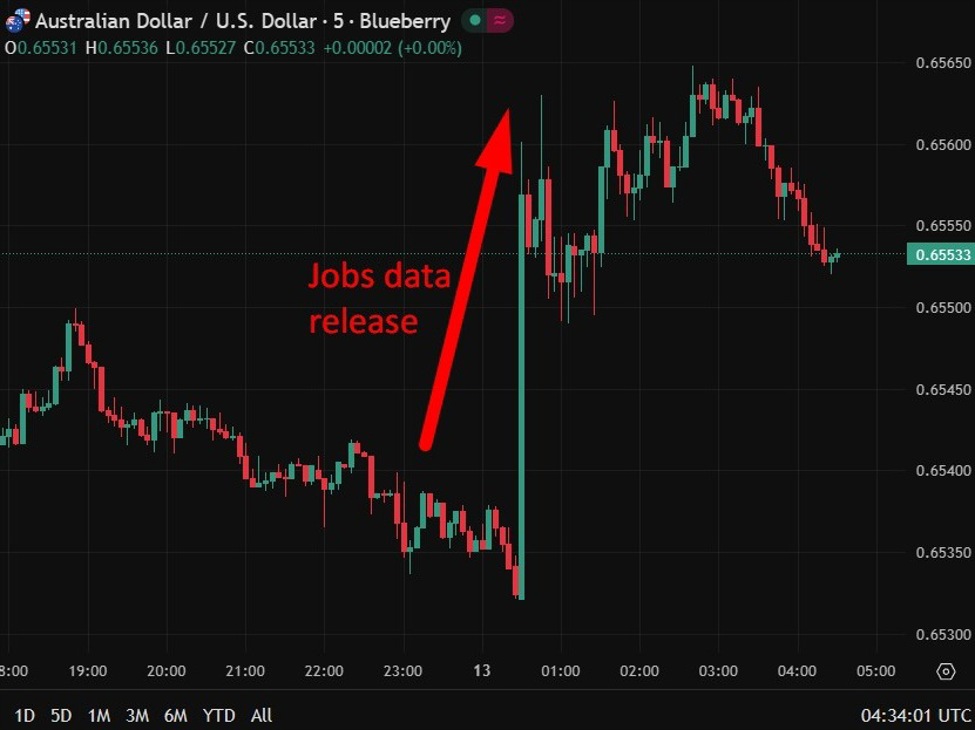
investingLive Asia-Pacific FX news wrap: AUD up, ASX drop after strong Australian job data
Westpac: October job rebound lets RBA look past September weakness, stay inflation-focusedChina set for 5% growth in 2026 on strong exports, Macquarie’s out of consensus call saysTrump has signed the bill to reopen the US governmentAustralian dollar up, shares down. Strong jobs report destroys hope for RBA rate cut.Tokyo Stock Exchange considers curbs on listed firms hoarding crypto assetsJapan wholesale inflation slows to 2.7% as import costs fall, BOJ stays cautious – recapUS House votes to reopen the government. Trump to sign soonPBOC sets USD/ CNY reference rate for today at 7.0865 (vs. estimate at 7.1156)A USD/JPY surge above 155 heightens intervention risk. USD/JPY the Thanksgiving turkey?Australian dollar jumped higher on the very strong jobs report – no RBA rate cuts aheadUeda says BOJ ready to act if long-term yields move out of line with fundamentalsJapan’s finance minster says its hard to forsee Japan defaulting on its debtAustralian October unemployment rate 4.3% (expected 4.4%, prior 4.5%)Takaichi: Will strive to create strong economy so that tax revenues rise without tax hikesBoJ Ueda: BOJ striving to achieve moderate inflation, wage growth, helping improve economyAustralian Inflation Expectations (November 2025) 4.5% (prior 4.8%)White House says September BLS data will be released after the government reopeningJapan October PPI +0.4% m/m (expected +0.3%) & +2.7% y/y (expected +2.5%)US House of Representatives voted to advance legislation to reopen the federal governmentEU drafts plan to advance U.S. trade deal and secure broader tariff relief – 5 key pointsJapan firms upbeat under PM Takaichi but see risks from minority government, China tensionMicrosoft taps OpenAI chip designs to boost in-house AI hardware developmentSwitzerland heads to Washington to seal tariff-cutting dealFT says EU to accelerate limitations on incoming cheap Chinese parcelsFull SNAP benefits to restart within 24 hours once shutdown ends, USDA saysOil – private survey of inventory shows a headline crude oil build less than expectedNZ retail spending inches higher in October as card transactions show modest liftFed’s Collins: Still high inflation means mildly restrictive policy is still warrantedAnother mixed day for US stocks. The rotation out of tech and into Dow stocks continueFed’s Collins says its likely to be appropriate to keep rates on hold for some timeinvestingLive Americas market news wrap: Gold and bitcoin head in opposite directionsBoston Fed President Susan Collins spoke after U.S. markets closed, reinforcing the more cautious tone emerging within the FOMC. Collins, who backed last month’s quarter-point cut, said she sees a “relatively high bar” for any additional easing in the near term, citing stubborn price pressures, the inflationary impact of tariffs, and limited data during the government shutdown. Her comments mean four voting Fed officials (Collins, Musalem, Goolsbee and Schmid — who dissented against the October cut) are now openly signalling they are not looking for another reduction in December.In Japan, wholesale prices rose 2.7% in October, above expectations. BOJ Governor Ueda told parliament that underlying inflation — stripping out temporary factors — is “gradually accelerating” toward the 2% target, suggesting progress toward meeting rate-hike conditions. On JGBs, Ueda reiterated that if long-term yields were to rise sharply in a way inconsistent with normal market moves, the BOJ stands ready to respond flexibly, including through additional bond buying.The Australian dollar rallied while local equities fell to a three-month low after a very strong labour-market report. The unemployment rate dropped from last month’s four-year high, job gains were double expectations, and full-time hiring surged. The data effectively removes any prospect of a December RBA rate cut — and likely pushes out easing expectations further, well into 2026.The U.S. government shutdown has ended, with Congress passing legislation to reopen federal agencies after 43 days — the longest shutdown in U.S. history. The White House said the delayed September BLS data will be released now that the government has reopened.FX was subdued, with most major pairs trading in tight ranges. USD/JPY briefly moved toward 155.00 before easing back, while EUR/JPY hit a record high near 179.50. Gold edged higher, while oil prices recovered some ground. Asia-Pac stocks:Japan (Nikkei 225) +0.23%Hong Kong (Hang Seng) -0.58% Shanghai Composite +0.44%Australia (S&P/ASX 200) -0.87% This article was written by Eamonn Sheridan at investinglive.com. 🔗 Source 💡 DMK Insight The strong jobs report from Australia is a game changer for the RBA’s monetary policy stance. With the Australian dollar rising and shares dipping, traders need to reassess their positions. The labor market’s resilience suggests that the RBA may prioritize inflation control over rate cuts, which could lead to a stronger AUD in the near term. This shift in focus could also impact related markets, particularly commodities and equities tied to Australian economic performance. Watch for the AUD/USD pair; a sustained break above recent highs could signal further bullish momentum. Conversely, if the RBA’s inflation focus leads to tighter monetary conditions, it might pressure equities, especially in sectors sensitive to interest rates. Keep an eye on the upcoming economic indicators that could provide more clarity on the RBA’s next moves. 📮 Takeaway Monitor the AUD/USD for a potential breakout; a strong jobs report could keep the RBA hawkish, impacting rate expectations and market sentiment.

Gold looks poised for a test of the October highs
The rebound is continuing for gold with price up another 0.4% today to $4,214 currently. After a drop under $4,000 and a tug of war there since the end of October, dip buyers are certainly showing much conviction in pushing price back up above $4,200 currently. The question though, is there scope for further gains down the road?As things stand, gold buyers have numerous reasons to stay bullish as they have for quite some time. And even with the end of the US shutdown, it doesn’t mean the end of data uncertainty surrounding the US economy.If the administration doesn’t want the October numbers published, especially for jobs, it makes it difficult for markets to get a good read on the flow of things in the labour market. Even more so since October is supposedly a weak month as underscored by the Challenger layoffs here.Adding to that, the inflation picture also remains tricky. And there might not be all too much clarity on that front before the next Fed meeting in December at least.It also begs the question if we are going to see the September non-farm payrolls come out in the week ahead, as one might expect it to. And what about retail sales data? That’s a major component for US GDP and it remains to be seen if there is data for September, let alone October.If there are no updates on inflation and consumer spending, with there also being minimal updates on the labour market, how does that play into the Fed’s hands before next month’s FOMC meeting?As a reminder, Fed chair Powell said this last month: “What do you do if you’re driving in the fog? You slow down.”And that prolonged uncertainty could be another reason for gold to keep staying underpinned. That as markets need to sort out their feet in figuring out what the Fed might do next.Amid a push above the 50.0 Fib retracement level of the swing lower since the end of last month as well as the $4,200 mark now, gold buyers are definitely looking poised to make a run for the October highs near $4,380. This article was written by Justin Low at investinglive.com. 🔗 Source 💡 DMK Insight Gold’s recent rebound to $4,214 signals strong dip-buying interest, but caution is warranted. After a significant drop below $4,000, the market’s ability to hold above $4,200 suggests a potential bullish trend, yet traders should monitor for resistance levels around $4,250. If gold can break through this threshold, it could attract more momentum buyers. However, a failure to maintain this level might trigger profit-taking and a return to the $4,000 support zone. Keep an eye on broader economic indicators, like inflation rates and interest rate decisions, as they could impact gold’s appeal as a safe haven. Additionally, watch for any shifts in the U.S. dollar’s strength, which often inversely correlates with gold prices. The real story here is whether this rebound is sustainable or just a temporary bounce. If the market sees increased volatility, it could lead to rapid price swings, so having stop-loss orders in place is crucial. 📮 Takeaway Watch for gold’s ability to hold above $4,200; a break above $4,250 could signal further upside potential.