
 Bitcoin
  Ethereum
  Tether
  BNB
BNB  XRP
XRP  USDC
USDC  Solana
  TRON
TRON  Lido Staked Ether
  Figure Heloc
Support quarter-point cut as a precautionary moveMon pol must continue to lean against above-target inflationTariffs are adding to inflation and the impact is yet to be fully feltOver-emphasis on labor market could lead to policy that is too loose and does more harm than goodLoose financial conditions and other factors mean the Fed should move cautiously on further cutsThis isn’t a big surprise coming from him but he’s certainly staking out the hawkish ground at a time when policy is headed in the other direction. This article was written by Adam Button at investinglive.com. Source: investinglive.com (Read Full Article)
Fed's Musalem: Congress has recognized the value of central bank independence
Congress formerly valued many things that I’m not so sure it values anymore, like the ability to set tariffs.More:Expects that the impacts of tariffs on inflation to last 2-3 quartersWhat I think a lot of economists are missing is the start of the renegotiation of USMCA starting in mid-2026 and running through year end. About 28% of US imports come from that region and spiking the tariff rate there would lead to a second round inflation effect that starts to look more like ‘persistent’ inflation than a one off. This article was written by Adam Button at investinglive.com. Source: investinglive.com (Read Full Article)
Auto manufacturers rev up gains while big tech stumbles
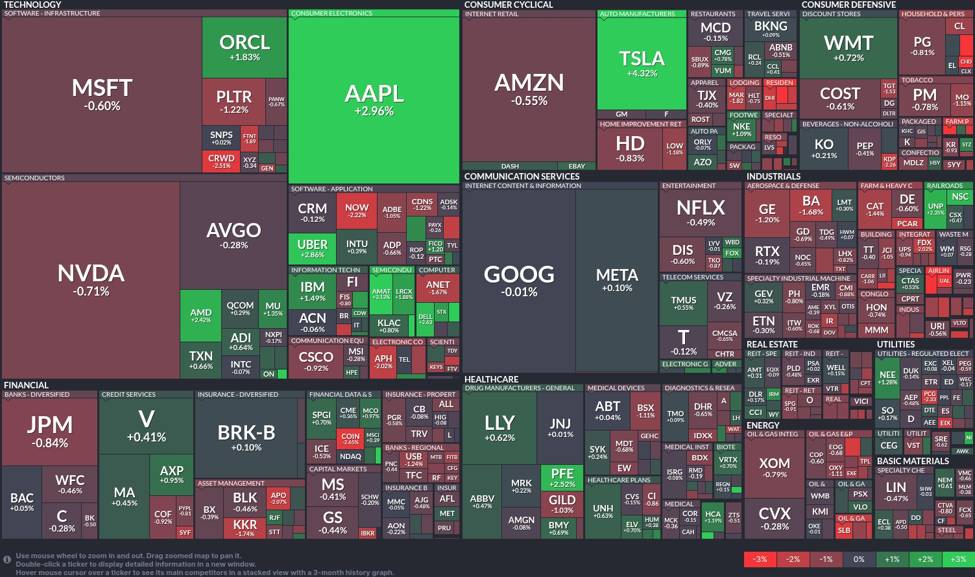
Auto manufacturers rev up gains while big tech stumblesThe US stock market presented a mixed picture today, with auto manufacturers driving significant gains and big tech facing a challenging session. Investors are closely examining the nuanced performance across sectors to adapt their strategies.🔧 Auto Manufacturers Lead the WayTesla (TSLA) surged by 4.32%, leading the auto sector with a strong performance fueled by upbeat quarterly production numbers and optimistic forecasts.This sectoral uptrend suggests renewed investor interest in electric vehicles and the potential for growth in sustainable transportation.💼 Technology Takes a HitMicrosoft (MSFT) saw a dip of 0.60%, reflecting broader cautious sentiment in the technology arena.Oracle (ORCL) emerged as a positive exception within tech infrastructure with a gain of 1.83%, showcasing strength in cloud services and enterprise solutions.The software application segment, represented by ServiceNow (NOW), declined 2.22%, possibly due to profit-taking activities and market recalibration.🏠 Mixed Signals in Consumer SectorsApple (AAPL)’s impressive rise of 2.96% highlights a surge in consumer electronics, driven by robust product demand and expansion strategies.Conversely, Amazon (AMZN) dipped 0.55%, indicating potential concerns around retail performance or logistical challenges.📊 Market Mood and TrendsThe overall market mood today is cautious yet opportunistic, with investors dissecting sector-specific news and broader economic indicators. The rise in auto manufacturers reflects a tilt towards growth-driven sectors, whereas the tech pullback indicates strategic realignments amidst evolving market conditions.📈 Strategic RecommendationsInvestors should consider shifting focus towards the growing auto sector, leveraging the momentum in electric vehicle advancements. Diversification remains crucial; maintaining a balanced portfolio could mitigate risks from tech fluctuations. Keeping an eye on tech innovation and potential rebounds could offer further opportunities for enterprising investors. For continuous updates and insights, visit InvestingLive.com! 💡 This article was written by Itai Levitan at investinglive.com. Source: investinglive.com (Read Full Article)
Fed talk roundup: Hammack says inflation is a bigger problem than jobs
We had some IT issues at investingLive today but we’re back in business and while we were gone a trio of Fed speakers weighed in.I’ll stick to just the highlights and meaningful comments. Hammack has been in a hawk in the past but really doubled down today:We should be very cautious in removing policy restrictionI expected 4.3% unemployment to ‘rise a bit’ but we’re near full employment nowWe are missing inflation by a more-meaningful numberI have one of the highest estimates of neutral, and believe we’re only modestly neutralLayoff notices have not been trending upThere are signs of fragility in the jobs marketIf we remove restrictions too quickly, I am worried about inflationLikely to see inflation continuing to riseLower income households are strugglingThere is a clear position here and it’s that the economy is fine and inflation is still high, so it’s no time to be cutting rates.Miran spoke on Friday but dove a bit deeper into his thinking on rates:Policy is ‘considerably restrictive’ and ‘very restrictive’Short term rates are roughly 200 bps too highExpects H2 and early 2026 growth to improveIt’s tough to even make a read on Miran but he’s a Trump mouthpiece and will do what he’s told. Barkin:Wage pressure is steadily coming downExpect workforce growth this year to be close to flatExpect the current low-hiring, low-firing labor market to continue but could break in either directionBusiness optimism has ticked back upLow unemployment, wage gains and stock prices all supporting consumer spendingBarkin sounds upbeat and he’s often a good gauge for the core of the Fed’s thinking. This article was written by Adam Button at investinglive.com. Source: investinglive.com (Read Full Article)
Why this chart is deceiving
Stock market bulls have been pointing to this chart as a reason to remain bullish but I wouldn’t be so sure. It shows money market funds climbing steadily since 2017 and tripling over that period.The argument is that all the money that’s parked in short-term cash funds will eventually find its way into the stock market, particularly as the Fed cuts rates and money-market returns dwindle from 4.15% currently to around 3%.Looking at the chart, it seems as though people are scared and holding cash but when the animal spirits truly come out, that will all pile into stocks in some kind of 1999-style blowoff. Here is why it might not be so straight forward. While money-market assets have tripled in that time period, so has the S&P 500. In fact, as a percentage of the S&P 500, money market funds are at 15% compared to a normal long-term average of 20%. The size of the fixed income market has also grown dramatically given the rise in US (and other sovereign) debt.In short, the ‘money on the sidelines’ may not be there. This article was written by Adam Button at investinglive.com. Source: investinglive.com (Read Full Article)
Yen and Dollar Under Threat. The Franc is Eyeing the Safe-Haven Throne
Two currencies that shaped global markets for the past 70 years are losing their status. The yen is no longer the world’s free credit line and the dollar is no longer the clean safe haven. That vacuum has to be filled by somebody — and everything now points to the Swiss franc — both the world’s new funding currency and its ultimate refuge.The yen under pressureFor thirty years the yen symbolized cheap money and powered global carry trades. But today, that reality has burned out. The Bank of Japan drowned in policy chaos, inflation is stuck, and the USDJPY exchange rate has broken through 160. What was once seen as the ultimate safe haven has become a liability. The market is already moving on.Carry trade was born in Tokyo. From the late 1990s to December 2024, investors borrowed yen at zero and poured it into everything with yield. But from January 2022 the whole structure started to collapse: the yen crashed to 150 per dollar, credibility evaporated and volatility exploded.In January 2025, the BOJ finally moved — hiking to 0.5%, the highest level in 17 years. Why? Because inflation was no longer an illusion. Tokyo CPI pushed past 2.5%, food and energy costs surged, and domestic demand finally showed up. Add in the pain of higher import costs from a weak yen, and zero rates were no longer an option. And now economists expect another step to 0.75% before year-end.The dollar’s problemThe dollar used to jump whenever markets got scared. Not anymore. Washington keeps using it as a political weapon — tariffs on rivals, sanctions on Russia, trade fights with India and anyone else who refuses to play by its rules. The logic was clear: force the world to use dollars and demand would stay locked in.But politics cuts both ways. Instead of tightening their grip, sanctions and tariffs pushed countries to experiment with alternatives — oil deals settled in yuan, sovereigns raising debt in francs, central banks trimming their dollar share. IMF’s COFER data for Q1 2025 shows the dollar’s share of global reserves edging down to 57.74%, while the pound slipped to 4.7%. The Swiss franc, though small, is finally moving the other way — its share has inched higher for the first time in over a decade. For reserve managers, that shift is symbolic: the franc is no longer a niche, it’s becoming a credible alternative.The data tells the same story. The revisions wiped out 911,000 jobs — nearly a million paychecks that simply vanished. August payrolls added just 22,000 instead of the 75,000 expected. That’s not a slowdown — that’s a halt. Unemployment is stuck at 4.3%. And inflation? It’s not easing. CPI jumped 2.9% year-on-year, while core held at 3.1%. That’s not cooling — that’s re-accelerating.And here’s the danger. Markets still expect the Fed to cut rates this week — even as inflation ticks higher. Apollo, a Wall Street giant, warns the setup looks eerily like the 1970s: inflation dipped, then came roaring back in two brutal waves. If the Fed eases now, it risks the same trap — weaker growth, hotter prices, and an even deeper loss of trust in the dollar. History also shows another danger: market crashes often start not at peak rates, but right after cuts begin. When the Fed blinks, it usually means the economy is already cracking — and that’s when confidence truly unravels.The vacuum and the rise of the francWhile the yen collapsed as funding and the dollar lost its haven shine, the market searched for a replacement. The euro is stuck in recession. The old anchors are gone. That left a vacuum — and the franc stepped straight in.In 2025, CHF surged 11% against the dollar, while EURCHF slid to historic lows. Normally a rally like this would scare off investors. Instead, demand accelerated right after the SNB cut rates to 0% in June. The reason? The central bank sent the opposite message: no return to negative rates, no heavy-handed interventions, no more defending “floors” in EURCHF. SNB Chairman Martin Schlegel even spelled it out: “The barriers to reintroducing negative interest rates are very high.”Meanwhile, Swiss inflation has disappeared. In May, CPI printed –0.1% y/y — first deflation since COVID. For exporters, a stronger franc is painful. For global capital, it’s a green light: stability, no inflation risk, and a central bank willing to let the currency run. That combination makes the franc unique — 0% for funding, and a safe haven when the world cracks. In short, the franc is what the yen once was — without the chaos, without the policy circus, with far more credibility. And it’s not just theory. Capital flows already prove it — sovereigns, funds, and banks are treating the franc as the new anchor.The world is already movingIt’s not just Zurich policy or Swiss inflation anymore — the rest of the world is proving the shift with money on the table. This year, Panama secured nearly $2.4 billion in Swiss franc loans from banks this year, saving more than $200 million compared with dollar borrowing. Colombia, Sri Lanka and Kenya — they’re all running the same math: why pay a premium for USD when the franc is cheaper and cleaner?The crisis tape tells the same story. When Israel struck Iran in June, the USDCHF rate initially rose — a reflex reaction to the dollar. But this movement did not last long. Within a few days, the market reversed, and the franc rose to new multi-year highs. Nobody was running to Treasuries. The yen didn’t even show up. The bid went straight into francs, fast and heavy.Even banks are joining the move. Sight deposits at the SNB spiked CHF 11.2 billion in July, pushing reserves to their highest in over a year. Institutions aren’t waiting for theory — they’re already parking liquidity in francs, getting ready for the next shock. Emerging market borrowers are increasingly turning to Swiss francs in their financing mix. Several EM issuers chose CHF in recent

Gold rising every day isn't normal and it isn't a good sign
Since gold broke out of its recent range, I’ve been highlighting the reasons why it could go higher. It’s done just and at a neck-breaking pace. It’s up $420/oz in four weeks to $3747, including a $63 gain today.If you’re a gold bull (and I certainly am) this is good news but if you take a step back and look at the real world, this is a five-alarm fire. Gold is signalling many things about the real economy/world and none of them are good.You can take your pick as a series of long and short-term factors collide:1) The rally first kicked off with the massive expansion of government budgets/debt in covid, along with ultra-low rates2) A second leg came after Russia invaded Ukraine and their USD-assets were frozen, highlighting that the USD is no longer a safe reserve currency if you’re not friendly with the USA.3) Trump’s reelection set the stage for another leg higher as it came with another deficit-ballooning tax cut and a trade war.But I can make an even shorter and more-concise explanation for why gold is rising every day: The global order is breaking down. The rules of conflict, trade and politics are fracturing and where it lands is anyone’s guess. Even social norms are rapidly changing.I don’t think this is one of those moments whether ‘the futures is always uncertain and scary’ holds true either and gold is telling us that. Gold right now is a hedge against all the change at once leading down a dark path (and I haven’t even mentioned AI). As for targets, the long-term chart says it all: Gold is going parabolic. I’ve been highlighting $4000 as a target since the range break at the start of the month but the shallowness of the drawdowns and aggressive buying on dips makes me hopeful (and fearful) that we’re going much higher. This article was written by Adam Button at investinglive.com. Source: investinglive.com (Read Full Article)
Economic calendar in Asia Tuesday, September 23, 2025 – a middling one – Japan holiday
It’s a very light data agenda ahead for Tuesday, September 23, 2025. Flash PMIs from Australia are about it. Japanese markets are closed today for a holiday, Autumn equinox (hence the bad pun in the post title). This article was written by Eamonn Sheridan at investinglive.com. Source: investinglive.com (Read Full Article)

The party continues in US stock markets: Records across the board
Closing changes:S&P 500 +0.4%Nasdaq Comp +0.7%DJIA +0.1%Russell 2000 +0.6%Toronto TSX Comp +0.6%US stock markets started the day lower but turned around mid-day and then FOMO took it a decent leg higher. Nvidia reversed higher after announcing a $100 billion investment with OpenAI. This article was written by Adam Button at investinglive.com. Source: investinglive.com (Read Full Article)
investingLive Americas market news wrap: Fed officials stake out the hawkish ground
Fed talk roundup: Hammack says inflation is a bigger problem than jobsFed’s Musalem says he sees limited room for further easingCanada August producer price index +0.5% m/m vs +0.2% expectedMarkets: Gold up $62 to $3746WTI crude oil down 4-cents to $62.64S&P 500 up 0.4%EUR leads, CAD lagsUS 10-year yields up 1.3 bps to 4.15%A pair of Fed officials in Hammack and Musalem said they were reluctant to cut much more in light of inflation risks as both highlighted a decent, and perhaps improving economy. Barkin took a more-neutral view but also touched on improving business confidence while Miran continued to call for 200 bps of easing in short order.The Fed talk had limited impact on markets as stock futures pointed to a 0.4% decline early only to turn around and hit new records with a 0.4% gain in the S&P 500 (and 0.6% in the Nasdaq). Nvidia helped by announcing a $100 billion investment in OpenAI. The stock market continues to shove its chips ‘all-in’ on AI and it’s easy to see why if you’re spent time with the latest models. That said, at some point the returns are going to have to justify the unprecedented investments.The gold market is seeing something very different as it rallied forcefully to a new high today on steady bids in North America. The combination of fiscal recklessness and tumultuous politics is certainly a tailwind. Bitcoin wasn’t able to shake off the earlier rout despite the positive risk mood. The correlation between bitcoin and the Nasdaq has broken this month with bitcoin flat over the past two months and the Nasdaq up more than 10%.In FX, the euro steadily gained to 1.1800 as it claws back a part of the three-day decline at the end of last week. The loonie went in the opposite direction as Carney highlighted the rift with the US, though I think it was more flows that commentary behind the move. Canadian PPI numbers ran hot and that could give the BOC a headache. This article was written by Adam Button at investinglive.com. Source: investinglive.com (Read Full Article)